The Silky Terrier and the Australian Terrier look alike at a glance, but the two breeds carry opposite coats. The American Kennel Club (AKC) describes the Silky Terrier coat as a single, straight, glossy layer with no undercoat, while the AKC standard gives the Australian Terrier a harsh topcoat over a short, soft undercoat. That one difference changes brushing, trimming and what a groomer should be asked to do.
What is the real difference between a Silky Terrier and an Australian Terrier?
The real difference between a Silky Terrier and an Australian Terrier is coat structure and purpose, not origin. Both breeds come from Australia, and the AKC recognized the Silky Terrier in 1959 and the Australian Terrier in 1960. The AKC places the Silky Terrier in the Toy group, and FCI Standard No. 236 lists its use as a toy terrier and companion dog. The AKC standard describes the Australian Terrier instead as a sturdy working terrier.
Temperament descriptions also differ in tone. Norma Baugh, a Silky Terrier breeder of 40 years and past president of the Silky Terrier Club of America, told the AKC: “They can be sweet but protective.” The Kennel Club breed standard describes the Australian Terrier as “Friendly, extrovert, obedient and anxious to please.” Individual dogs vary, so these lines are a starting point, not a guarantee.
Why does a Silky Terrier have a single coat while an Australian Terrier has two layers?
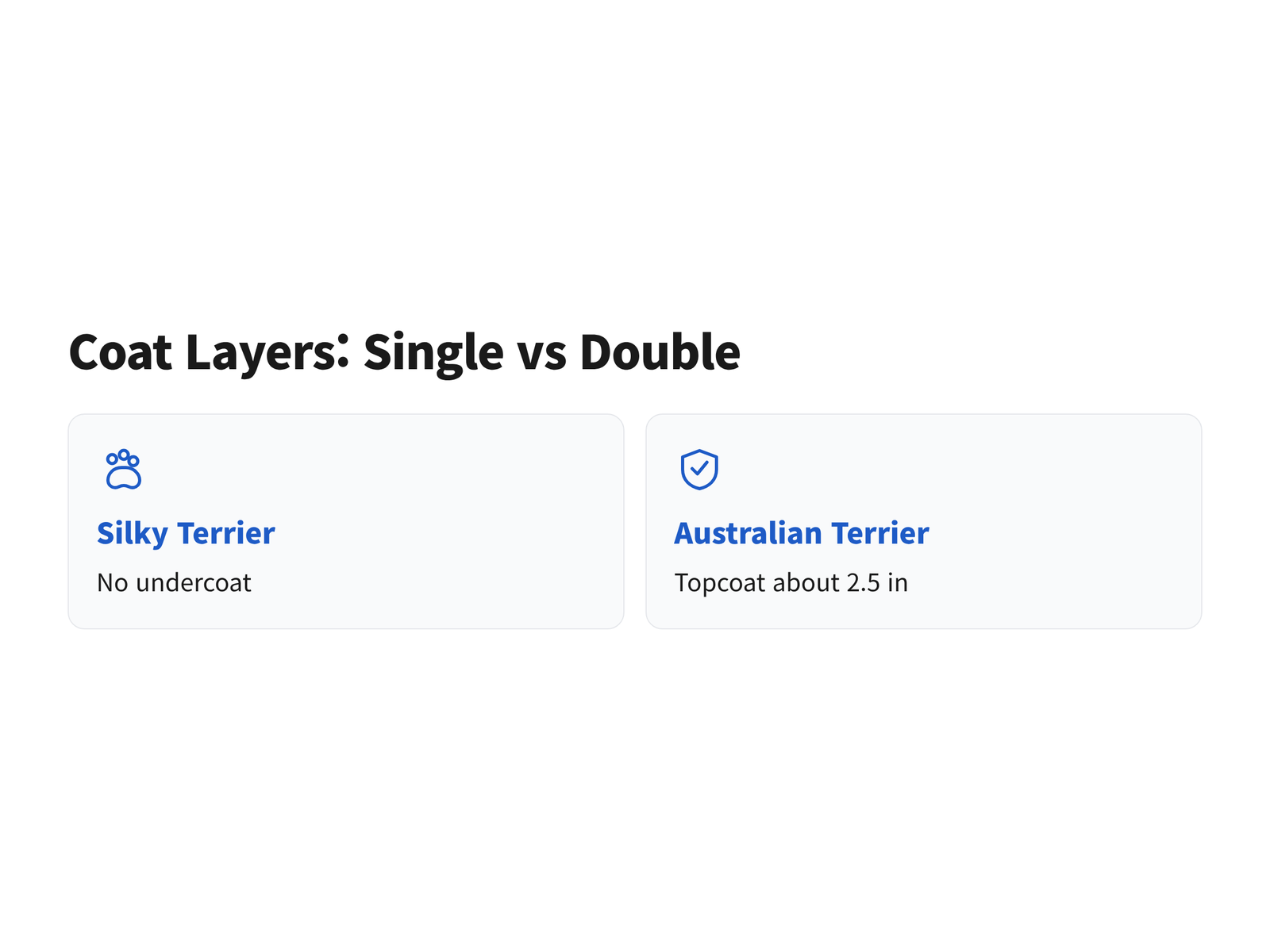
A Silky Terrier has a single coat because the breed standards call for one fine, flat layer, while the Australian Terrier standards call for a protective double coat. Dogs Australia and FCI Standard No. 236 state that the Silky Terrier coat “Must be flat, fine and glossy and of a silky texture.” Breeder Florence Males, quoted in the AKC history of the breed, called the texture “so much like human hair.”
The Australian Terrier coat is built the other way around. The AKC standard calls for a harsh, straight topcoat of about 2.5 in over a short, soft undercoat, and The Kennel Club gives the same length as 6.35 cm. FCI Standard No. 8 puts the Australian Terrier topcoat at approximately 6 cm. The UKC standard describes the breed with an “untrimmed harsh coat,” and Dogs Australia adds a definite ruff around the neck. The harsh outer layer is the part that grooming choices can change over time.
A single coat does not mean low grooming for a Silky Terrier. The Kennel Club lists Silky Terrier grooming as “Every day,” while the AKC suggests brushing at least twice a week with a soft bristle brush or pin brush and a bath every few weeks. The two sources differ, so both figures are shown here. Consult your veterinarian if you notice skin changes under either coat.
Why does clipping an Australian Terrier’s coat backfire?
Clipping can backfire on an Australian Terrier because, according to the AKC, clipping a wire coat can gradually soften it and change its look. The AKC article on hand-stripping, which covers wire coats in general rather than the Australian Terrier by name, warns that clipping by an inexperienced groomer may end up “affecting its color, sheen, and texture,” may “disrupt the hairs’ natural growth cycle,” and over time “will eventually soften the dog’s coat.”
Hand-stripping is the alternative for wire and harsh terrier coats. The AKC defines it plainly: “Pulling the hair out of a wire coat is called stripping or plucking.” The AKC guide to wired coat care describes plucking out bits of dead coat over time, brushing weekly with a pin brush, and notes that clipping is “just fine” around the face and underbelly. That guide is also general advice for wire coats, not a breed-specific schedule for the Australian Terrier.
Clipping is still the normal choice for most pet terriers, so the decision is a trade-off rather than a right-or-wrong rule. Kim Kier, owner of Little Barks Grooming and Boutique, told the AKC that clipper trims with carding are “almost always the grooming process for most pets.” Kier also said, “Hand-stripping is a premium service and will (and should) be more expensive than a traditional groom.” An Australian Terrier owner who values the harsh texture can ask for stripping, and an owner who values convenience can accept a softer coat.
Do-it-yourself stripping carries its own risk for an Australian Terrier. Kier warned in the same AKC article: “An untrained pet strip can be painful for the dog and may not produce the results the owner seeks.” A groomer with real experience on terrier coats is the safer route for an owner who wants to keep the harsh topcoat.
Why is a Silky Terrier’s coat not grown to the floor like a Yorkie’s?
A Silky Terrier’s coat is not grown to the floor because the breed standards require daylight to show under the dog. The UKC standard states that the Silky Terrier coat must not impede action and that “Daylight must show under the dog,” and FCI Standard No. 236 and Dogs Australia also require daylight to be seen under the dog. The AKC also notes that the Silky Terrier body coat should not reach the floor.
This rule is the clearest sign that a Silky Terrier is not a miniature Yorkshire Terrier. A floor-length, Yorkie-style coat sits outside the Silky Terrier standard, so a groomer working from a Yorkie photo may produce the wrong outline. Owners who want the correct Silky Terrier look can ask for a coat that clears the ground with a visible gap of daylight.
How different are they in size and weight?
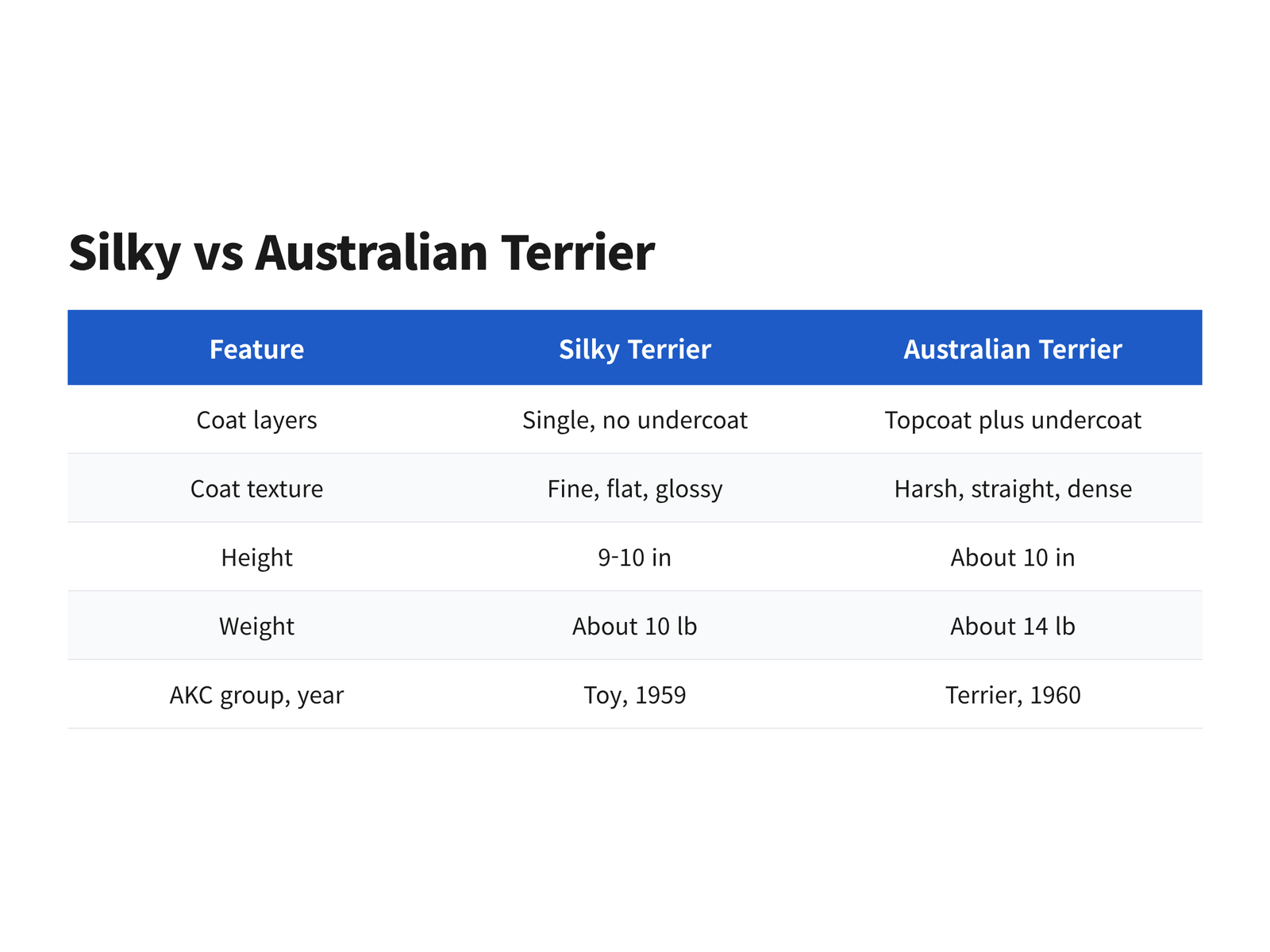
The two breeds are close in height, but the Australian Terrier is the heavier, sturdier dog. The UKC standard lists the Silky Terrier at 9-10 in at the withers, and FCI Standard No. 236 gives 23-26 cm for males. The AKC puts the Silky Terrier at about 10 lb, although the breed standards themselves give no weight figure. The Kennel Club and FCI place the Australian Terrier at approximately 6.5 kg, or about 14 lb, with females slightly less.
| Feature | Silky Terrier | Australian Terrier |
|---|---|---|
| Coat layers | Single, no undercoat | Topcoat plus undercoat |
| Coat texture | Fine, flat, glossy | Harsh, straight, dense |
| Height | 9-10 in | About 10 in |
| Weight | About 10 lb | About 14 lb |
| AKC group, year | Toy, 1959 | Terrier, 1960 |
Height figures for the Australian Terrier vary by registry. The AKC standard gives 10-11 in, while the UKC, FCI, The Kennel Club and Dogs Australia give approximately 10 in, or 25-25.5 cm. For coat length, the AKC, UKC and Dogs Australia agree on about 2.5 in for the Australian Terrier topcoat.
Which breed fits apartment life better?
The Silky Terrier is the breed with a documented apartment rating, but it still needs more activity than its size suggests. The Kennel Club lists the Silky Terrier as suited to a flat or apartment, a small or medium garden, and either town or country, with exercise of “Up to 30 minutes per day.” The AKC adds that the Silky Terrier needs more exercise than most toy breeds, can live in apartments with frequent walks, and may bark at outside noises.
Comparable apartment data for the Australian Terrier was not available from The Kennel Club breed page, so this guide does not rate the Australian Terrier for flat living. What the standards do show is coat upkeep: the AKC standard keeps the Australian Terrier ears very short and keeps the tail, pasterns, rear legs from the hocks down and the feet free of long hair.
Frequently asked questions
Is a Silky Terrier just a small Australian Terrier?
No. The Silky Terrier is a toy breed with a single silky coat, while the Australian Terrier is a working terrier with a harsh double coat. The AKC recognizes the two as separate breeds in separate groups.
Can an Australian Terrier be clipped instead of stripped?
Yes, and clipper trims with carding are common for pet terriers. The AKC notes that clipping a wire coat can soften it and affect its color and sheen over time, so the choice is a trade-off between texture and convenience.
How often should a Silky Terrier be brushed?
The AKC suggests at least twice a week, and The Kennel Club lists daily grooming. A soft bristle brush or pin brush suits the fine single coat.
Does the coat difference between a Silky Terrier and an Australian Terrier matter for a pet, not a show dog?
Yes. The coat type decides which grooming method a groomer should use, even when the dog never enters a show ring.
Sources
- American Kennel Club, “Silky Terrier History: The Sweet & Feisty Australian Ratting Dog”, Rebecca Wallwork, 2026-05-26 – https://www.akc.org/expert-advice/dog-breeds/silky-terrier-history-sweet-feisty-australian-ratting-dog/
- American Kennel Club, “Yorkshire Terrier vs. Silky Terrier: Similarities and Differences”, Stephanie Gibeault, 2026-01-12 – https://www.akc.org/expert-advice/dog-breeds/yorkshire-terrier-vs-silky-terrier/
- American Kennel Club, “Official Standard of the Australian Terrier”, 2021-01-12 – https://images.akc.org/pdf/breeds/standards/AustralianTerrier.pdf
- American Kennel Club, “Hand-Stripping Dog Coats”, Colt Dodd, 2025-11-10 – https://www.akc.org/expert-advice/health/hand-stripping-dog-coats/
- American Kennel Club, “Wired Coat Care: Stripping”, Steve Pessah, 2019-12-06 – https://www.akc.org/expert-advice/grooming/wired-coat-care-stripping/
- American Kennel Club, “Breeds by Year Recognized” – https://www.akc.org/press-center/articles-resources/facts-and-stats/breeds-year-recognized/
- The Kennel Club, “Australian Terrier breed standard”, 2025-04-01 – https://thekennelclub.org.uk/breed-standards/terrier/australian-terrier
- The Kennel Club, “Australian Silky Terrier” breed page, accessed 2026-10-16 – https://thekennelclub.org.uk/search/breeds-a-to-z/breeds/toy/australian-silky-terrier
- FCI, Standard No. 236, Australian Silky Terrier, 2017-01-01 (via KUSA) – https://www.kusa.co.za/images/Breed%20Standards%202024/Australian%20Silky%20Terrier%20-%20FCI%20[01-2017].pdf
- FCI, Standard No. 8, Australian Terrier, 2019-01-01 (via KUSA) – https://kusa.co.za/images/Gallery/TERRIER%20GROUP%202025/Australian%20Terrier%20-%20FCI%20[01-2019].pdf
- Dogs Australia (ANKC), “Australian Silky Terrier breed standard”, 2009-05-22 – https://dogsaustralia.org.au/breed/detail/16
- Dogs Australia (ANKC), “Australian Terrier breed standard”, 2012-10-18 – https://dogsaustralia.org.au/breed/detail/37
- United Kennel Club, “Silky Terrier” standard, 2007-04-15 – https://www.UKCDogs.com/docs/breeds/silky-terrier.pdf
- United Kennel Club, “Australian Terrier” standard, 2007-04-15 – https://www.ukcdogs.com/docs/breeds/australian-terrier.pdf