A “pH balanced” claim on a dog shampoo label tells you the maker aimed the formula at dog skin rather than human skin. It does not tell you which pH number was targeted, and no agency checks the claim before the bottle reaches a shelf. This guide covers what pH balanced on a dog shampoo label does not tell you, why human and baby shampoo are a poor fit for a small dog, and how often bathing starts to stress the skin barrier.

What does “pH balanced” on a dog shampoo label actually promise?
A “pH balanced” label promises only that the shampoo was formulated with dog skin in mind, not that it matches any single verified number. The reason is simple: published figures for dog skin pH range from about 5.5 to 9.0, depending on the source and the dog. The American Kennel Club gives a dog skin range of 6.2 to 7.4. A study in the Journal of the American Animal Hospital Association (JAAHA) measured eight healthy dogs and recorded individual readings from 6.3 to 9.0, with a baseline mean of 7.55.
The same JAAHA authors noted that a range of 5.5 to 7.2 is “often cited,” while the values they actually measured ran more alkaline. Per-dog averages spanned 6.57 to 8.58, and the authors cited earlier work showing that excitement can shift skin pH by up to about one unit within a minute. A “pH balanced” label therefore points at a moving target without saying which part of the range the formula was built for.
Why does human shampoo fail on a small dog’s skin?
Human shampoo is made for skin that sits around pH 5.5 to 5.6, according to the American Kennel Club, while the AKC places dog skin at 6.2 to 7.4. That gap is the core of the AKC position. In the words of AKC writer Jan Reisen, “Using a human shampoo on dogs disrupts the acid mantle, leaving your dog vulnerable to parasites, viruses, and bacteria.” A separate AKC guide puts it more bluntly: “Don’t use human shampoo on your dog: the pH level won’t be right, and it can cause skin irritation.”
The AKC also states that human skin has 10 to 15 cell layers while dog skin has 3 to 5, a figure the AKC gives without citing a primary study. Frequency matters too. The AKC says a “once-in-a-blue-moon” use of human shampoo will likely be fine and that repeated use drives reactions. One bath with the wrong bottle is not an emergency for a small dog.
Is dog shampoo approved by the FDA?
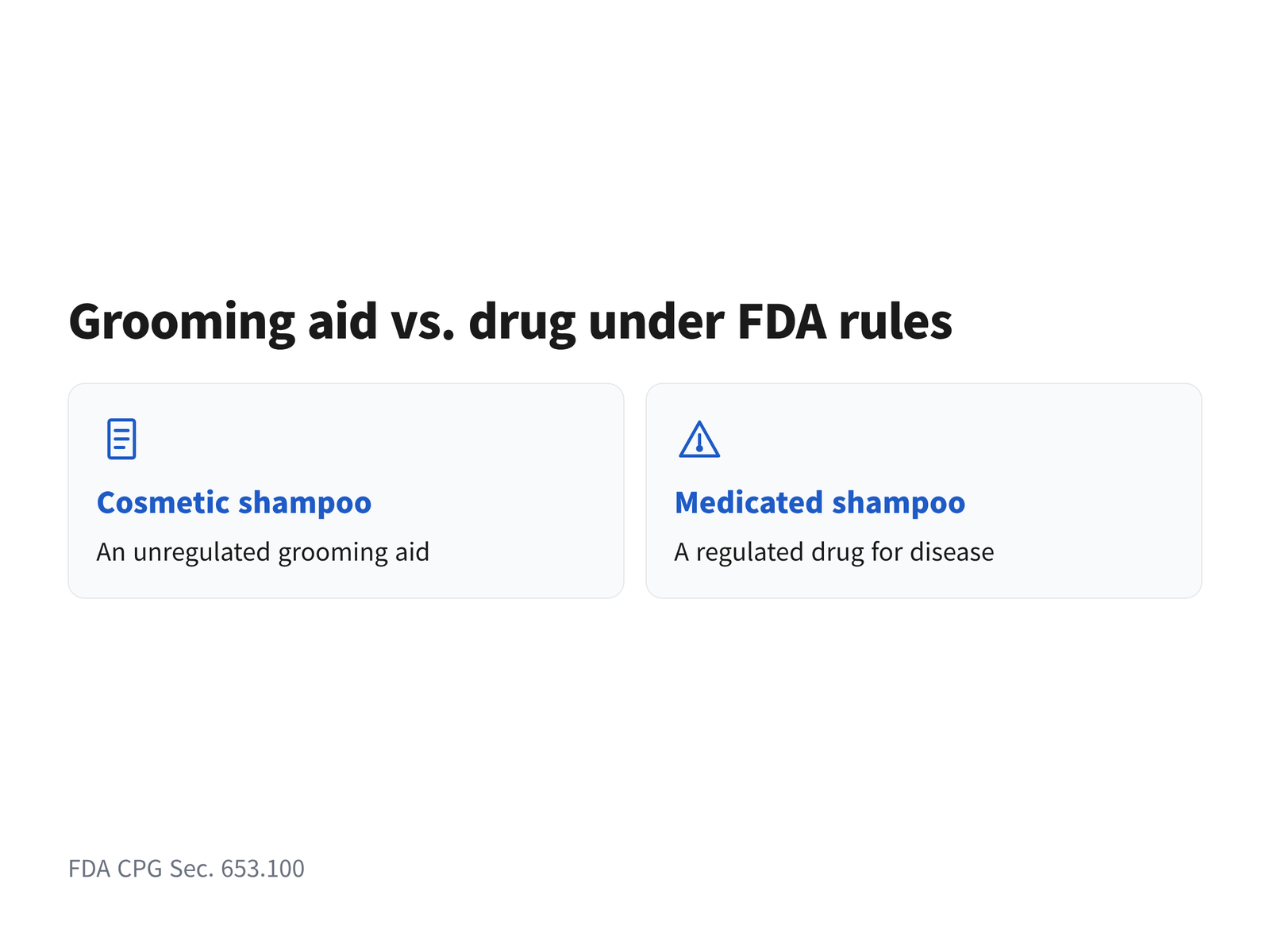
No. A dog shampoo sold only for regular bathing is treated by the U.S. Food and Drug Administration as a “grooming aid,” and grooming aids are not regulated by the FDA. The FDA states it directly: “The animal counterpart of a cosmetic is commonly called a ‘grooming aid’ and is not regulated by the FDA.” The governing policy is FDA Compliance Policy Guide Sec. 653.100, Animal Grooming Aids, first issued in 1980 and reissued in its current form in 2019.
The FDA picture changes when a shampoo claims a medical purpose. Under CPG Sec. 653.100, a grooming aid intended to treat or prevent disease is a drug under the Federal Food, Drug, and Cosmetic Act. The FDA gives medicated shampoos for ringworm or allergy itching as examples of products it does regulate. For a cosmetic dog shampoo, “pH balanced” is a claim the FDA does not review before sale. Whether any separate legal or industry definition of the phrase exists could not be confirmed.
Can you use baby shampoo on a small puppy?
The American Kennel Club advice is to use shampoos and conditioners “made for dogs and pH balanced,” and a very young puppy may not need shampoo at all. Baby shampoo is still a human product, so it does not meet that AKC description. The AKC puppy bathing guide, which draws on advice from master groomer Jennifer Bishop-Jenkins, says: “Until the dog is 3 or 4 months old, all you really need to use is a warm wash rag.”
The same AKC guide introduces shampoo from at least 3 months of age and suggests lukewarm water for puppy baths. For owners of toy breeds, a tiny puppy’s first baths can skip the bottle question entirely. After that age, a dog shampoo labeled pH balanced fits the AKC guidance better than a baby product, even though the label still leaves the exact target number unstated.
How often can a small dog be bathed without drying out the skin?
There is no single verified bathing interval for every small dog, but the available evidence points away from very frequent shampooing. The American Kennel Club puppy guide suggests bathing monthly. A small study by Yu and colleagues in the Journal of Veterinary Clinics compared shampooing every other day, every 5 days and every 8 days in eight dogs.
In the Yu study, every-other-day shampooing significantly changed skin hydration, surface pH and protein loss, while the 5-day and 8-day intervals showed changes that were not statistically significant. Eight dogs is a very small sample, so the result is a signal rather than a rule. How often your own dog needs a bath depends on coat type, activity and skin condition. If you see persistent itching, redness or flaking after baths, consult your veterinarian before switching products or changing the schedule, since a medicated product is a veterinary decision.
Dog shampoo vs human shampoo: what actually differs?
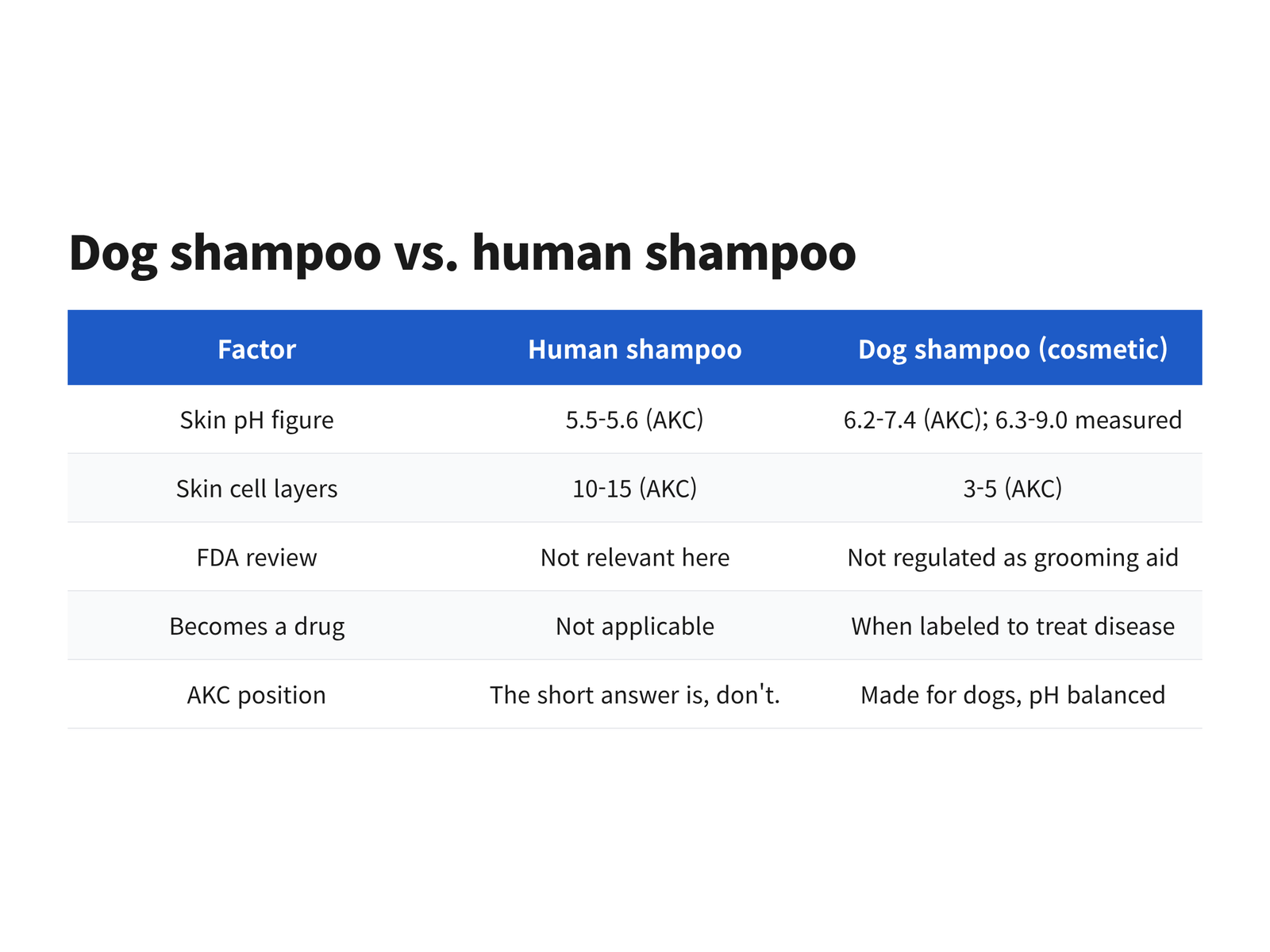
Dog shampoo and human shampoo differ in the skin pH they are designed around, in the skin structure the AKC describes, and in how a medical label changes their legal category. The table below summarizes the published figures and positions from the American Kennel Club, JAAHA and the FDA.
| Factor | Human shampoo | Dog shampoo (cosmetic) |
|---|---|---|
| Skin pH figure | 5.5-5.6 (AKC) | 6.2-7.4 (AKC); 6.3-9.0 measured |
| Skin cell layers | 10-15 (AKC) | 3-5 (AKC) |
| FDA review | Not relevant here | Not regulated as grooming aid |
| Becomes a drug | Not applicable | When labeled to treat disease |
| AKC position | “The short answer is, don’t.” | Made for dogs, pH balanced |
What should you check on the bottle besides “pH balanced”?
Beyond the “pH balanced” claim, check whether the shampoo is made specifically for dogs, whether it suits your dog’s coat type, and whether the label makes any medical claim. The American Kennel Club guide on choosing a dog shampoo advises matching the product to the coat, and notes that double-coated dogs need a shampoo that reaches through the undercoat to the skin. A label that promises to treat itching or infection moves the product into drug territory under FDA policy, and that choice belongs with a veterinarian.
Rinsing is the step the label never mentions. The AKC says, “It should take much longer to rinse your dog than to lather them up,” and its shampoo guide adds, “even when you think you’ve rinsed out all of the suds, rinse again.” Leftover residue sits on the skin regardless of how well the formula’s pH was chosen.
Frequently asked questions
Does “pH balanced” mean the shampoo matches your dog’s exact skin pH?
No. Published dog skin pH figures run from about 5.5 to 9.0, and the JAAHA study found that pH varies between individual dogs and can shift with excitement. The label names no specific target.
Is one bath with human shampoo dangerous for a small dog?
The American Kennel Club says a “once-in-a-blue-moon” use will likely be fine. Repeated use is what the AKC links to skin reactions.
Do medicated dog shampoos follow the same rules as regular ones?
No. Under FDA CPG Sec. 653.100, a shampoo intended to treat or prevent disease is a drug, while a shampoo for regular bathing is an unregulated grooming aid.
When can a puppy start using dog shampoo?
The AKC puppy guide introduces shampoo from at least 3 months of age and suggests a warm wash rag until about 3 to 4 months.
Sources
- U.S. Food and Drug Administration, “Got a Question About Your Pet’s Health?”, content current as of 2022-06-01 — https://www.fda.gov/ForConsumers/ConsumerUpdates/ucm427093.htm
- U.S. Food and Drug Administration, CPG Sec. 653.100 “Animal Grooming Aids”, March 2019 — https://fda.gov/media/121177/download
- Matousek JL et al., “The Effects of Four Acidifying Sprays, Vinegar, and Water on Canine Cutaneous pH Levels,” Journal of the American Animal Hospital Association 39(1):29-33, 2003 — https://jaaha.kglmeridian.com/view/journals/aaha/39/1/article-p29.xml
- Yu JW, Shin HJ, Bae S, Choi S, Oh TH, “Functional assessment of frequency of a commercial shampoo for normal canine skin,” Journal of Veterinary Clinics 30(4):283-287, 2013 — https://research.knu.ac.kr/en/publications/functional-assessment-of-frequency-of-a-commercial-shampoo-for-no/
- American Kennel Club, Jan Reisen, “Can You Use Human Shampoo on Dogs?”, 2021-04-30 — https://www.akc.org/expert-advice/health/human-shampoo-on-dogs/
- American Kennel Club, “Finding the Right Shampoo for Your Dog”, updated 2024-05-17 — https://www.akc.org/expert-advice/health/dog-shampoos-find-right-one-dog
- American Kennel Club, “Bathing Your Puppy: A Step-by-Step Guide”, updated 2026-05-12 — https://www.akc.org/expert-advice/health/bathing-your-puppy-step-by-step-guide/