The usual answer to why a small dog’s nails still click after trimming is the quick. The quick grows longer with the nail, so one trim cannot safely take a long nail back to a short length. Clicking on its own is also not proof that the nails are too long. Blue Cross points out that dogs cannot retract their nails, while The Kennel Club treats loud clicking on hard floors as a warning sign. Here is what the American Kennel Club (AKC), Blue Cross and The Kennel Club say.
Why do a small dog’s nails still click after trimming?
A small dog’s nails often still click after trimming because the quick, not the nail tip, limits how short each trim can go. The Kennel Club describes the quick as “a section of nerves and blood vessels” running through the centre of each claw. According to the AKC, “the quick grows longer with the nail and needs to recede over time with small, frequent nail trims.” A long nail means a long quick, so one session cannot remove much length safely.
The fix is repetition rather than one deep cut. The AKC nail-trimming guide states that “Regular nail trimming will cause the quick to recede from the end,” so small, frequent trims are what shorten the quick over time. The AKC advises clipping only the tip of the nail, straight across, and not clipping past the curve of the nail.
Does clicking always mean a small dog’s nails are too long?
No, clicking alone does not prove a small dog’s nails are too long, and two UK authorities describe the sound differently. Blue Cross explains that dogs cannot retract their nails the way cats can, “so you’ll always hear their nails clicking when they walk on solid surfaces.” Blue Cross adds: “This does not necessarily mean their nails are too long and need to be clipped.”
The Kennel Club takes a firmer line on volume. Its guide to long nails lists, as a sign of overgrowth, that “you can hear their claws clicking loudly as they move around on hard or tiled floors.” The Kennel Club also notes that long claws can be a problem “particularly in older dogs where posture may already be a problem.” Read together, the two sources suggest that loud clicking on hard floors deserves a closer look, while a light tap on tile is not a verdict by itself.
Why do small dogs need nail care more often than large dogs?
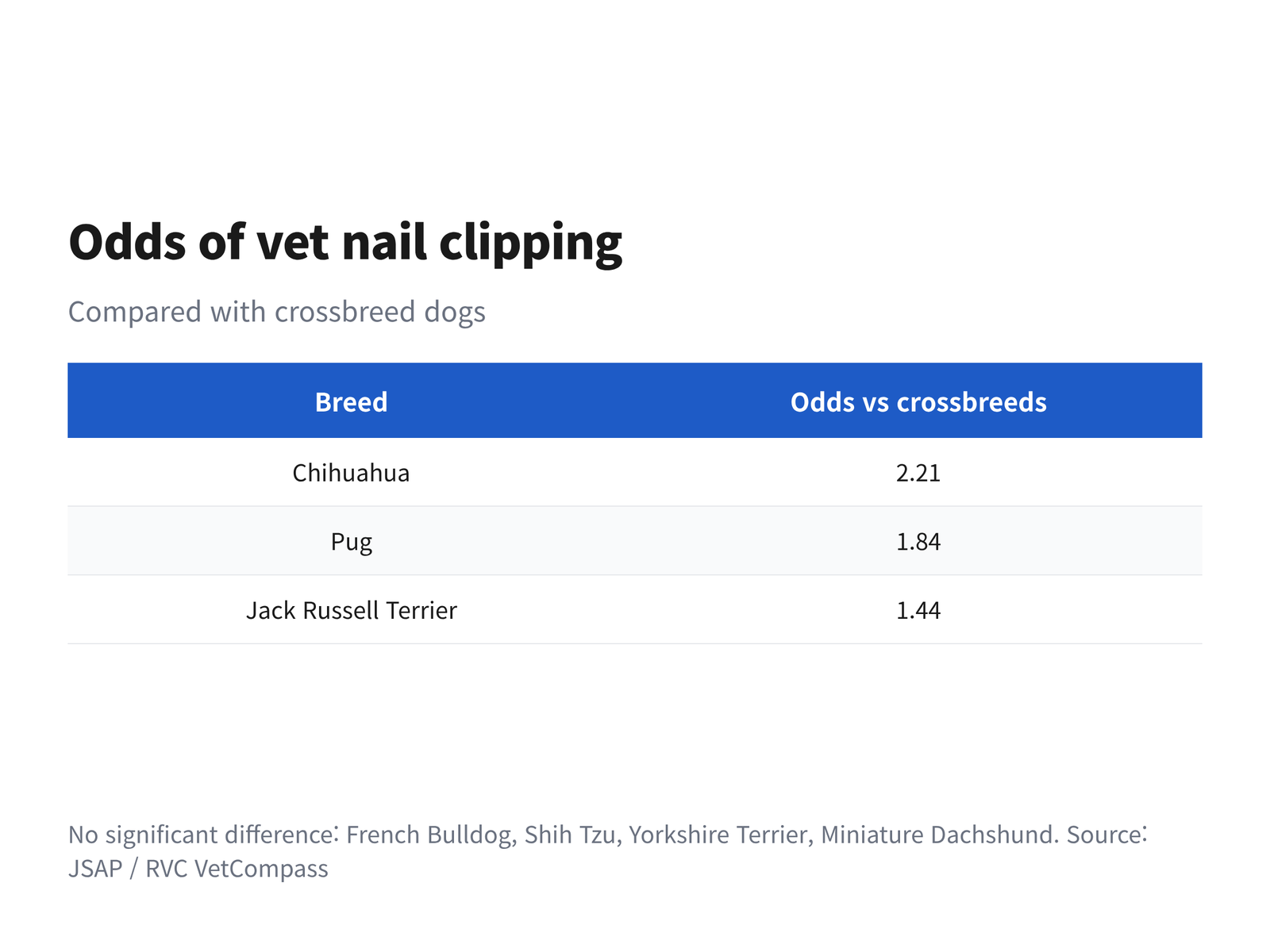
Several small breeds are more likely than crossbreeds to have their nails clipped at the vet, according to UK veterinary records. A study in the Journal of Small Animal Practice by Ahmed and colleagues at the Royal Veterinary College (RVC) reviewed one year of VetCompass records covering more than 2.25 million dogs under UK primary veterinary care. Overall, 5.64% of those dogs had their nails clipped at a vet practice during the year, and nail clipping was the main reason for the visit in 59.4% of clipping events.
Compared with crossbreeds, the Chihuahua had 2.21 times the odds of nail clipping, the Pug 1.84 times and the Jack Russell Terrier 1.44 times. Size alone does not settle it, because the French Bulldog, Shih Tzu, Yorkshire Terrier and Miniature Dachshund showed no significant difference. The RVC also reported that dogs under 10 kg had higher odds of overgrown nails than dogs of 40 kg or more. Dr Dan O’Neill of the RVC put it this way: “some dog breeds have more than twice the need to have their nails clipped compared to other breeds.”
The VetCompass study counted vet-practice clipping only, not trims at home or at a groomer, so it shows how often owners turn to a vet, not how fast nails grow.
How often should an indoor small dog’s nails be trimmed?
There is no single agreed interval, and the three main sources give different answers:
- AKC: “Most dogs need nail trims every three to four weeks.”
- The Kennel Club: owners should “aim to trim your dog’s claws once or twice a month.”
- Blue Cross: trimming is “often not necessary,” because “In most cases, natural wear will be enough to keep your dog’s nails at a good length.”
The difference matters most for an indoor small dog. The Kennel Club notes that pets get little natural wear “because our pets spend much of their time indoors or running on soft surfaces,” and that “regular walks, including on hard surfaces such as pavements, will help to shorten their claws.” A small dog that mostly walks on carpet gets less of the natural wear Blue Cross relies on. Age can shift the schedule too: the RSPCA says “Senior dogs may need their nails trimmed more often if they’re exercising less.”
Grinder vs clipper for a toy breed dog: what actually differs?
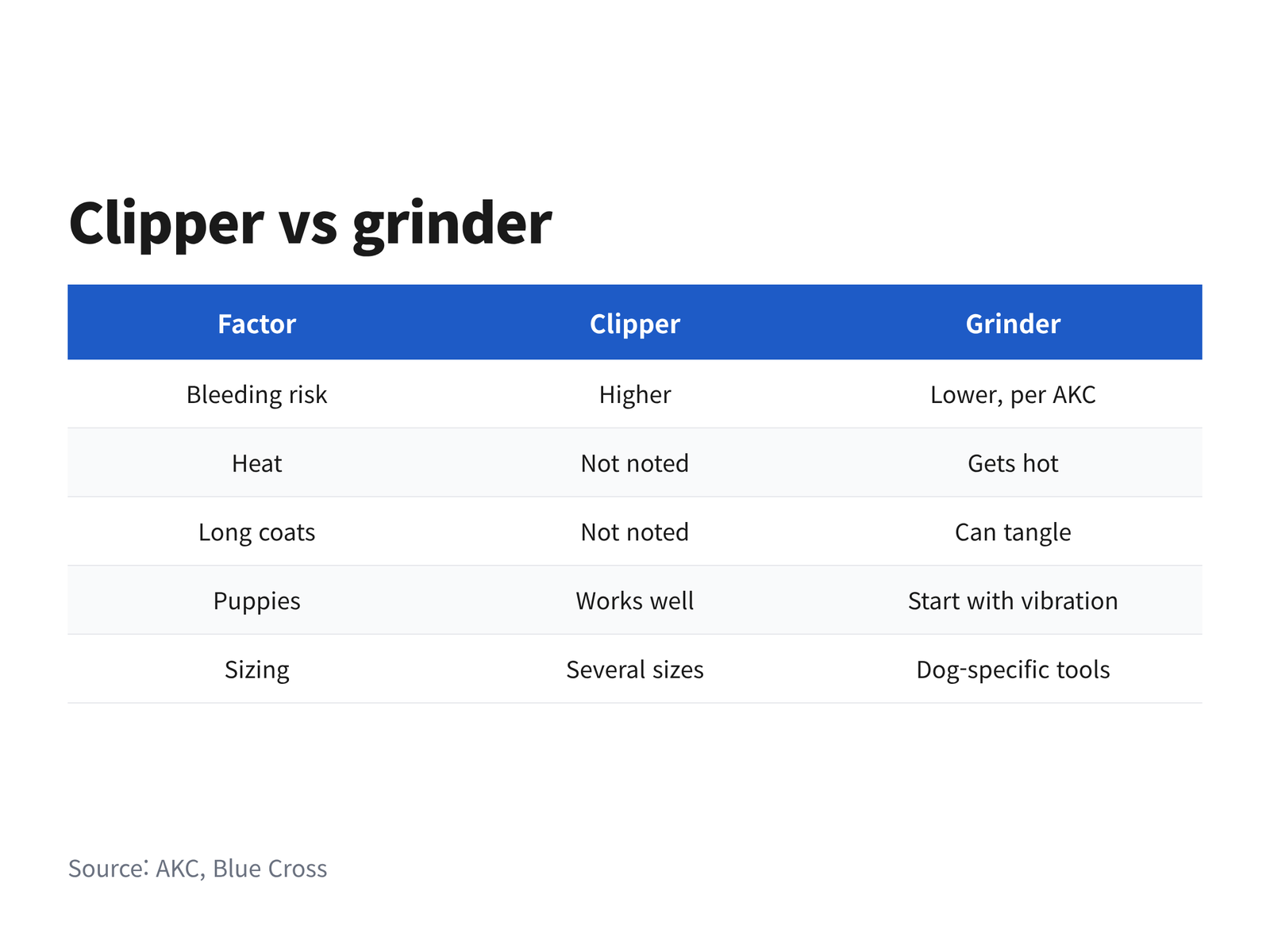
Both tools are accepted options, and the AKC says owners can use “whatever type you’re most comfortable with, or whatever works best for your dog.” The AKC lists nail scissors, guillotine types and dog grinders. For a toy breed, size matters: Blue Cross notes that clippers “come in several sizes depending on the size of your dog.”
| Factor | Clipper | Grinder |
|---|---|---|
| Bleeding risk | Higher | Lower, per AKC |
| Heat | Not noted | Gets hot |
| Long coats | Not noted | Can tangle |
| Puppies | Works well | Start with vibration |
| Sizing | Several sizes | Dog-specific tools |
The AKC sums up the trade-off in one line: “Grinders are less likely to cause bleeding, but they get hot and can tangle in dogs’ coats.” That tangling point matters for long-coated small dogs, where hair around the toes can catch. On the other side, the AKC says clippers “work especially well on young puppies’ nails,” and its puppy routine suggests letting a puppy “feel the vibration” of a grinder before using it on the nails.
For owners unsure of technique, Dr. Jerry Klein, Chief Veterinarian for the AKC, suggests that “you may want to have your veterinarian or vet tech give you a lesson on how to do it.”
Why do dewclaws get missed on small dogs?
Dewclaws get missed because they sit higher on the leg and do not touch the ground, so walking never wears them down. Blue Cross explains that dewclaws “will overgrow as they don’t reach the ground during walking, so don’t wear down naturally.” The Kennel Club says a dewclaw “often requires trimming more often than other claws,” and warns that “In some dogs, these claws are only held on to the leg by loose skin and may be prone to ripping or tearing.”
Dewclaws show up clearly in the VetCompass data. Dewclaws alone were clipped in 11.39% of nail-clipping events, and broken claws or dewclaws were the clinical reason in 8.84% of events. The AKC instruction is simple: “Include the dewclaws, located on the inner side of the paw.”
When should a vet trim a small dog’s nails instead?
A vet or vet nurse is the safer choice when the nails are black and you cannot see the quick, or when a paw is sore or infected. Blue Cross notes that “Black claws are more difficult to trim as you cannot see the sensitive quick,” and that “it’s safer to let a vet or nurse trim their nails” if you are unsure how much to cut. For a sore or infected paw, Blue Cross says to “always visit your vet instead of cutting their claws at home.” If a nail is cracked, bleeding or painful, consult your veterinarian rather than guessing.
For owners who do trim at home, the AKC suggests watching for “a chalky white ring” on dark nails, and The Kennel Club advises trimming “little by little” until a black spot appears in the centre of the claw. The AKC also recommends keeping styptic powder or another clotting product on hand “in case you cut a nail too short.” Lead author Dr Lavin Ahmed of the VetCompass study called nail care “a genuine welfare issue that deserves much more attention.”
Frequently asked questions
Is clicking on tile floors normal for a small dog?
Some clicking is normal. Blue Cross says dogs cannot retract their nails, so clicking on solid surfaces happens even when the nails are not too long. The Kennel Club treats loud clicking on hard or tiled floors as a sign of overgrown claws.
Can a small dog’s long nails be cut short in one session?
No. The AKC explains that the quick grows longer with the nail and recedes only with small, frequent trims, so one deep cut risks reaching the quick.
Are guillotine clippers bad for small dogs?
The AKC lists guillotine types alongside nail scissors and grinders and says to use whatever works best for your dog. Blue Cross adds that clippers come in several sizes, so matching the clipper to a small dog’s paw is the main point.
Sources
- American Kennel Club, “How to Trim Your Dog’s Nails at Home”, Harriet Meyers, updated 2026-06-01 – https://www.akc.org/expert-advice/health/how-to-trim-dogs-nails-safely/
- American Kennel Club, “Good Grooming” (dog nail care routine), Roxanne Hawn, 2024-11-19 – https://www.akc.org/expert-advice/family-dog/dog-nail-care-routine/
- Blue Cross, “How to Cut Your Dog’s Nails”, 2025-02-25 – https://www.bluecross.org.uk/advice/dog/wellbeing-and-care/how-to-cut-your-dogs-nails
- The Kennel Club, “Long nails in dogs” (no date shown) – https://thekennelclub.org.uk/health/for-owners/long-nails
- RSPCA, “Caring for Older Dogs” (no date shown) – https://www.rspca.org.uk/adviceandwelfare/pets/dogs/health/seniordogs
- Ahmed LA, Somarriba M, Brodbelt DC, Church DB, O’Neill DG, “Epidemiology and clinical management of nail clipping in dogs under UK primary veterinary care”, Journal of Small Animal Practice 66(12):925-933, 2025-08-05 – https://pmc.ncbi.nlm.nih.gov/articles/PMC12686259
- Royal Veterinary College, “New RVC study reveals novel insights into nail clipping in dogs in the UK”, 2025-08-08 – https://www.rvc.ac.uk/vetcompass/news/new-rvc-study-reveals-novel-insights-into-nail-clipping-in-dogs-in-the-uk