Dog coat sizing for a deep-chested small dog works from three tape measurements, not from the number on the scale. The American Kennel Club lists back length, chest girth and neck girth as the measurements that decide gear size, and body weight is not one of them. Two small dogs of similar weight can carry very different rib cages, so a weight-matched or S/M/L label can pinch under the front legs on one dog and hang loose on another. The sections below explain why that happens and how to size a winter coat with a tape measure instead.
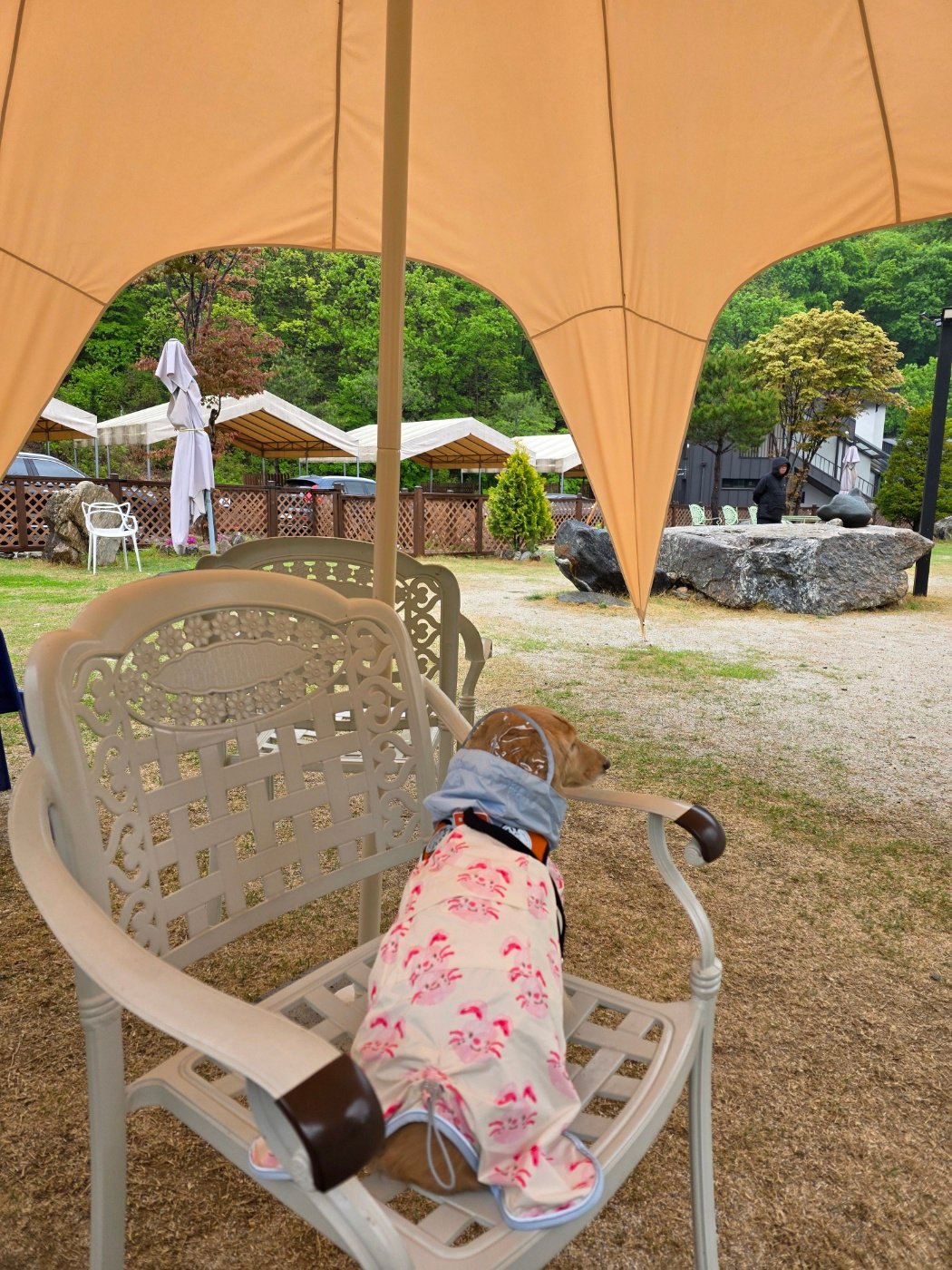
Why doesn’t a dog coat sized by weight fit a deep-chested small dog?
A coat sized by weight misses chest depth, which is the dimension that most often decides whether a coat closes comfortably on a deep-chested small dog. The AKC guide to measuring dogs for gear says owners “still need all three key measurements: back length, chest girth, and neck girth.” Weight does not appear in that list. Not every brand sizes by weight, and the AKC notes that “each brand and design may differ slightly,” but a weight band or a single letter cannot show how deep or wide a dog’s rib cage is. A deep chest therefore needs a tape reading, not an estimate.
The practical problem is that a weight band describes mass, while a coat wraps around a shape. A small dog with short legs and a rib cage carried low and far back can weigh the same as a leggier, narrower dog. The weight-matched coat then has to stretch across a much larger chest girth on the deep-chested dog. Based on the AKC three-measurement rule and published breed standards, the reasonable inference is that weight-only sizing will fail first at the chest.
Which three measurements decide a small dog’s coat size?
Back length, chest girth and neck girth decide a small dog’s coat size, according to the American Kennel Club. Each measurement has a specific starting point, and the dog should be standing square while the tape goes on. A soft tailor’s tape gives a more accurate reading than a rigid ruler because the tape follows the curve of the body.
- Back length: from the base of the neck, where a collar sits, along the spine to the base of the tail.
- Chest girth: around the largest part of the rib cage, usually just behind the front legs. The AKC describes the tape as snug, not tight.
- Neck girth: around the base of the neck, where the collar normally rests.
- Two-finger check: the AKC recommends leaving room for two fingers between the tape and the dog on each reading.
- Record both units: the UK veterinary charity PDSA suggests writing measurements down in both centimetres and inches, since brand charts use either.
Once the three numbers are written down, compare all three against the chart for the specific coat being considered. A coat chart from one brand does not transfer to another brand, so the same small dog might be an “S” in one line and an “M” in the next. Chest girth usually deserves the closest look on a deep-chested small dog, because chest girth is the measurement a weight label hides.
Why can two terriers of similar weight need different coat sizes?
Two terriers of similar weight can need different coat sizes because breed standards describe very different chest shapes for dogs in the same weight range. The Kennel Club standards for the Scottish Terrier and the Lakeland Terrier make a useful pair. Both breeds sit in a similar small-dog weight band, yet the Scottish Terrier standard describes “well-rounded ribs flattening to deep chest and carried well back,” while the Lakeland Terrier standard says “chest reasonably narrow.”
| Trait | Scottish Terrier | Lakeland Terrier |
|---|---|---|
| Weight | 8.5-10.5 kg (19-23 lb) | avg 7-8 kg (15-17 lb) |
| Height | 25-28 cm (10-11 in) | up to 37 cm (14.5 in) |
| Chest | broad, deep | reasonably narrow |
| Legs | short | balanced, compact |
| Likely sizing risk | chest outgrows size | length, leg room differ |
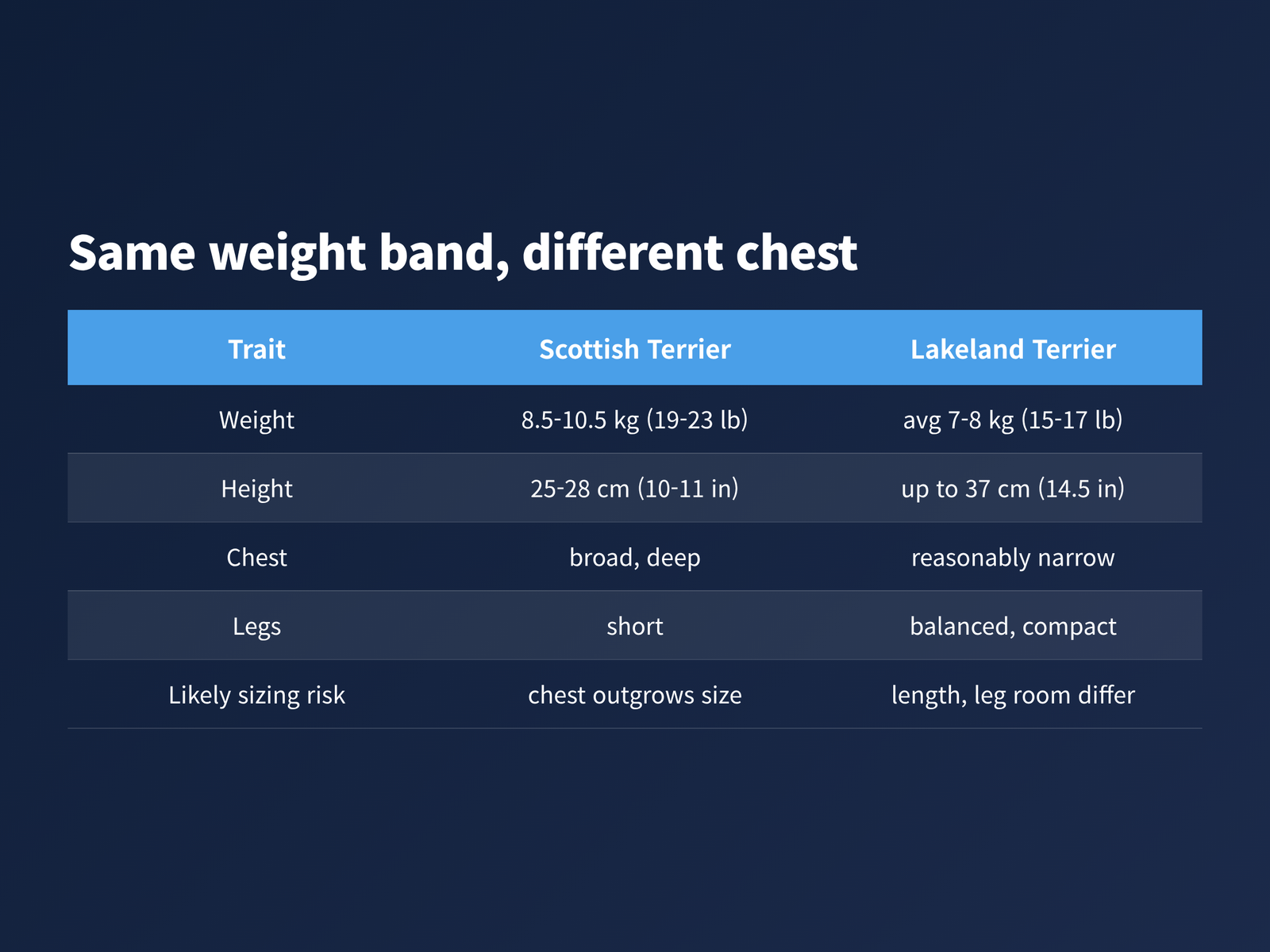
The last row of that table is an editorial inference from the standards, not a measured finding. Neither Kennel Club standard publishes an actual chest girth figure. Still, the standards suggest a weight-matched coat would close easily on a Lakeland Terrier and strain across a Scottish Terrier, a breed the Kennel Club also describes as “short legged.” The Scottish Terrier stands roughly 25-28 cm at the withers, while the Lakeland Terrier can reach 37 cm, so leg room and coat length also differ between the two breeds.
What should you do when your dog falls between two coat sizes?
When a dog falls between two coat sizes, the AKC advice is direct: “When in doubt, always opt for the larger size.” That rule works as a tie-breaker, not as a reason to buy big. The same AKC coverage on winter coats warns that a jacket should not be so loose the dog could become entangled, so sizing up too far creates a new fit problem.
A sensible order for a small dog between sizes is to let chest girth decide first, then check that the larger size does not run far past the base of the tail on back length. Neck girth comes last, taken where the collar sits, as the AKC describes. No published source gives a fixed number of centimetres or inches to add as ease, so the brand’s own chart and the two-finger check remain the reference points.
Why does a coat that fits the chest still fail on a male dog or over a harness?
A coat that fits the chest can still fail on a male dog because a full-belly design may sit in the way when he urinates. The AKC suggests that if a coat has no belly cutout, owners “consider slightly shortening the underside fit to prevent accidents.” Checking the underside cut matters as much as checking the chest girth on a male small dog.
A harness adds a second layer of fit. The AKC notes that a coat with a built-in hole lets a back-clip harness attachment pass through, so the leash connects without the coat bunching over the harness. Harness sizing itself is a separate measurement job and is best handled on its own, before the coat is chosen. For early dark evenings, a reflective trim on the coat is a small extra worth looking for.
How can you tell a dog coat fits badly once it is on?
A dog coat fits badly when the dog cannot move normally in the coat or keeps trying to get the coat off. The Kennel Club advises owners to make sure a coat fits well “so that it doesn’t prevent them moving normally,” and the RSPCA says “the jacket should be snug, but not restrict their movement.” Watching the dog walk, run, jump and toilet in the new coat gives the clearest answer.
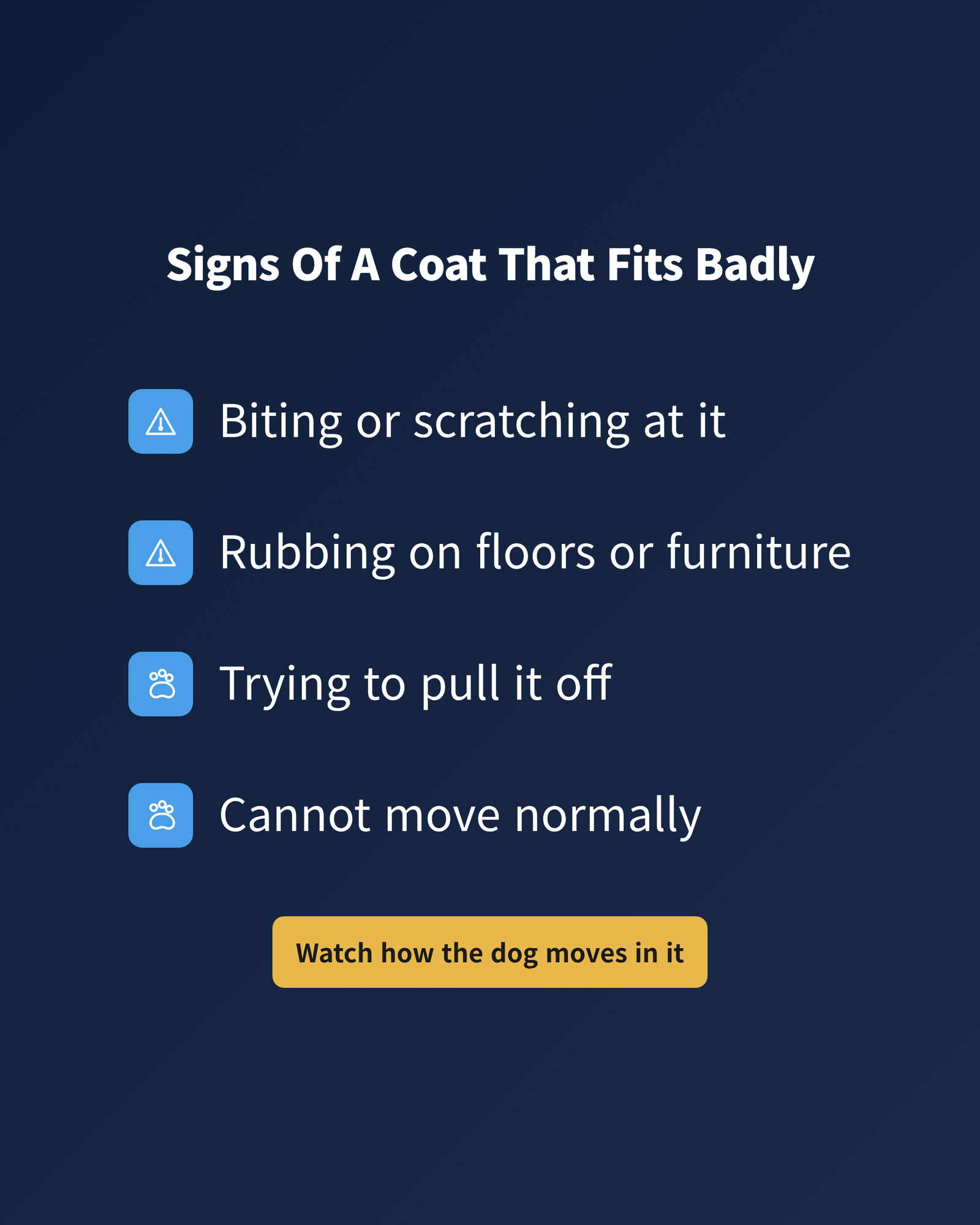
The PDSA lists biting or scratching at the coat and rubbing against floors or furniture as signs of a poor fit. A PDSA vet answer puts the reason plainly: “Our pets can get just as uncomfortable as us if they wear clothes that don’t fit right.” If a dog keeps rubbing or seems uncomfortable in a coat that seems correctly sized, remove the coat and consult your veterinarian, especially for elderly, very young or unwell dogs.
Does every small dog need a winter coat?
Not every small dog needs a winter coat, and UK animal charities draw the line differently by coat type and condition. Blue Cross says thick-coated dogs “are not so bothered by the cold,” while the RSPCA lists elderly dogs, young dogs, dogs with thin or short fur and dogs with medical conditions as more likely to benefit from a coat. For dogs in those groups, consult your veterinarian before deciding on outdoor clothing.
Indoor wear splits the guidance too. The PDSA notes that most dogs can quickly overheat in modern, centrally heated homes, while Blue Cross says some dogs may benefit from a jumper indoors. Both positions come from established charities, so the right answer depends on the individual dog and the home.
Frequently asked questions
Is chest girth or back length more important for a small dog’s coat?
Chest girth usually decides whether a coat closes comfortably, especially on a deep-chested small dog. Back length still matters, because the AKC treats back length, chest girth and neck girth as three required measurements.
Can one brand’s size chart be used for another brand?
No. The AKC notes that each brand and design may differ slightly, so measure the dog once and compare the three readings against every chart separately.
Should a small dog coat be loose for comfort?
A coat should be snug but allow normal movement, as the RSPCA describes. A jacket that is too loose can cause entanglement, according to the AKC.
How often should a small dog be re-measured for a coat? Re-measure before each coat purchase, because a dog’s shape can change and brand charts differ between product lines.
Sources
- American Kennel Club, “How to Measure Your Dog for Gear” (Courtney Campbell), updated 2026-08-10 – https://www.akc.org/expert-advice/lifestyle/measure-dog-gear/
- American Kennel Club, “Dog Winter Coat” (Sassafras Patterdale), updated 2025-11-14 – https://www.akc.org/expert-advice/lifestyle/dog-winter-coat/
- The Kennel Club, “Keep your dog safe during winter” – https://www.thekennelclub.org.uk/health-and-dog-care/health/health-and-care/a-z-of-health-and-care-issues/winter-dangers-to-dogs/
- The Kennel Club, “Scottish Terrier breed standard”, updated 2025-01-01 – https://thekennelclub.org.uk/breed-standards/terrier/scottish-terrier
- The Kennel Club, “Lakeland Terrier breed standard”, updated 2025-01-01 – https://thekennelclub.org.uk/breed-standards/terrier/lakeland-terrier
- RSPCA, “Winter and cold weather care for dogs” – https://www.rspca.org.uk/adviceandwelfare/seasonal/winter/pets/dogs
- Blue Cross, “Advice for dogs and puppies in winter”, reviewed 2023-01-20 – https://www.bluecross.org.uk/pet-advice/looking-after-your-dog-winter-0
- PDSA, “Vet Q&A: Does my dog need to wear a coat on winter walks?”, 2019-10-28 – https://pdsa.org.uk/what-we-do/blog/vet-qa-does-my-dog-need-to-wear-a-coat-on-winter-walks
- Scottish Terrier Club of America, “AKC Breed Standard”, approved 1993-10-12 – https://stca.biz/about-the-breed/breed-standard/