Dental chews fail small dogs for four structural reasons, not because every chew is useless. The VOHC seal covers one product line and one claim, a wrongly sized chew can be swallowed whole, a hard chew can crack a tooth, and no chew closes the brushing gap. Those gaps matter more for little dogs: extra-small breeds were up to five times more likely than giant breeds to be diagnosed with periodontal disease in a large US study.
Why do dental chews fail so many small dogs?
Dental chews fail small dogs when the chew is picked on packaging claims instead of on the seal, the size, the hardness and the brushing routine behind it. The idea that dental chews simply do not work is a false premise. The Veterinary Oral Health Council (VOHC) states: “Regular use of products carrying the VOHC Seal will reduce the severity of periodontal disease in pets.” A dental chew can help, but only as the right product, in the right size, on top of brushing.
The stakes are higher for small breeds. Wallis and colleagues reviewed over 3 million Banfield records across 60 breeds and 5 years, published in The Veterinary Journal in 2021. Periodontal disease was recorded in 18.2% of pure-bred dogs overall, and extra-small breeds were up to 5 times more likely to be diagnosed than giant breeds. Papillon (29.7%), Toy Poodle (28.9%) and Miniature Poodle (28.2%) sat near the top of the list.
What does the VOHC seal actually prove, and what doesn’t it?
The VOHC seal proves that a specific product met a plaque or tartar reduction standard in trials; the VOHC seal does not prove the chew suits every dog. The council awards the seal in two claim categories, “Helps Control Plaque” and “Helps Control Tartar,” after reviewing trial data submitted by the manufacturer. In the council’s own words: “The VOHC does not test products itself.”
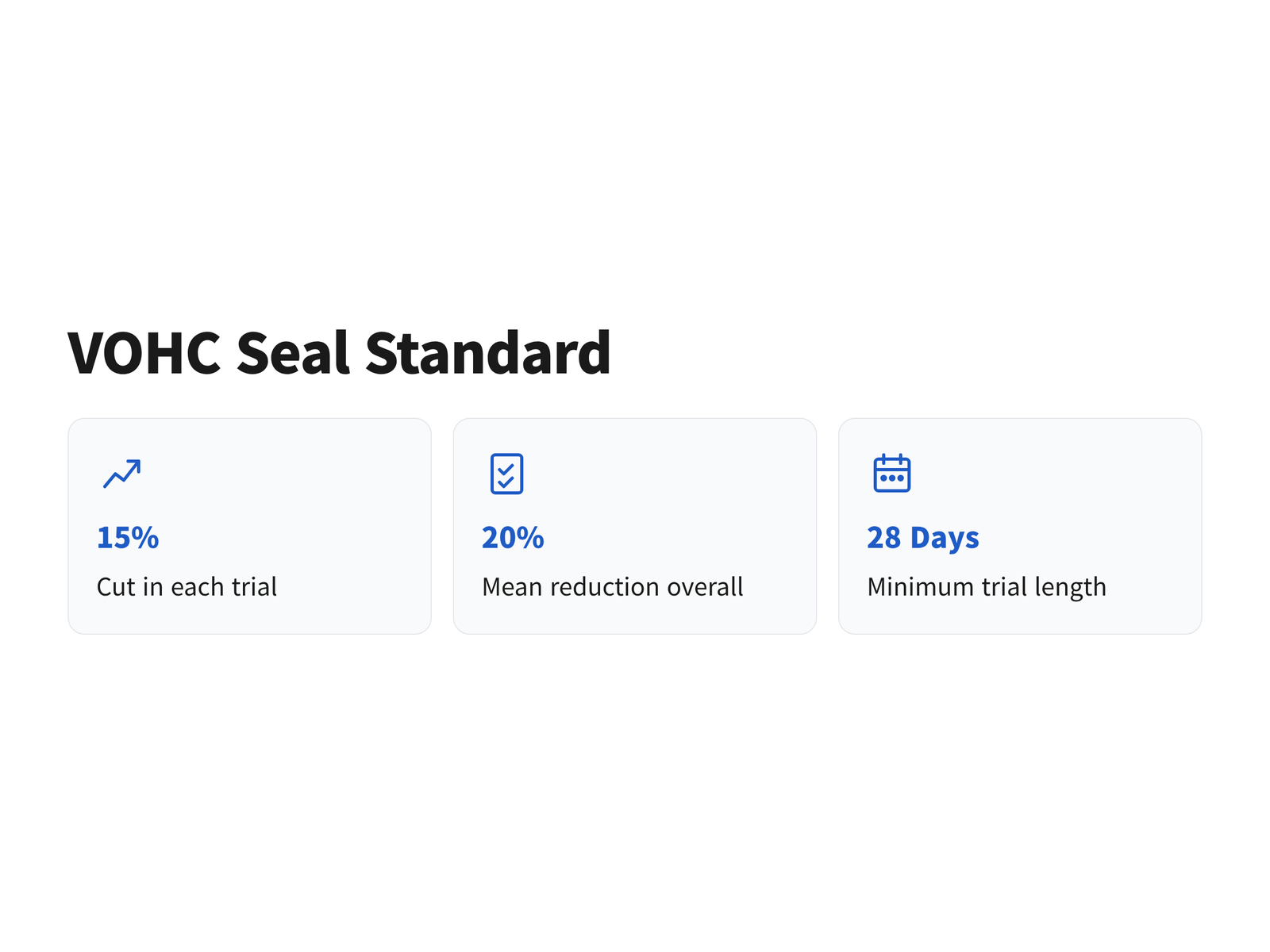
Under the general standard, a product needs at least a 15% reduction in each of two trials and a 20% mean reduction across both, each statistically significant, with every trial lasting at least 28 days. The VOHC observes oral tissue to assess safety, but the VOHC awards no periodontal-disease claim and no gingivitis claim; in the US, a gingivitis claim goes through the FDA Center for Veterinary Medicine instead.
Size is where the VOHC seal is easiest to misread. Trials use dogs of similar body weight and age, and testing extra sizes is encouraged but not required unless the product line is sold in multiple sizes. That is why the VOHC accepted-products list is worth checking for the exact product line and size wording, such as “five sizes,” “all sizes” or “Large Dog Treats.” Fraser Hale, DVM, warned in the Canadian Veterinary Journal: “one must be careful to not place too much faith in any product just because it has the VOHC Seal of Acceptance.”
Why does chew size matter more for a small dog?
Chew size matters because a chew that does not fit the dog can be swallowed whole, and a small dog has little margin for that mistake. The ASPCA advises: “Pet parents should choose a product size consistent with their pet’s size and chewing habits.” The ASPCA also warns: “Inappropriately small chews may also be swallowed whole, resulting in choking or blockage.”
Size matching has two layers for a small dog. The package size should suit the dog’s size and chewing style, whether gentle gnawing or fast gulping, and the VOHC size wording should cover that size. This guide gives no weight-to-size chart, because none of the veterinary sources reviewed here publishes one. Follow the manufacturer’s wording, and ask your veterinarian if your dog falls between sizes. Blue Cross veterinary nurse Tracey Parnell adds: “Always supervise your dog when you give them a chew.”
Which chews are too hard for small teeth?
Chews that cannot be bent or flexed are the ones most likely to be too hard for small teeth. Graham Thatcher of the University of Wisconsin School of Veterinary Medicine gives a simple rule: “if you can bend or flex the object, it is less likely to fracture a tooth.” The bend/flex test takes seconds and works on any new chew.
Some popular chews fail that test by design. Graham Thatcher is direct: “We never recommend giving bones, antlers or bully sticks.” Blue Cross adds a second risk beyond broken teeth: “Large chunks of bone can cause life threatening blockages to a dog’s airway and gut.” The ASPCA notes that hard nylon and rubber toys are not designed for consumption, so a hard chew toy is not a dental chew. A softer chew that passes the bend/flex test is the safer starting point, though individual needs vary.
Can a dental chew replace brushing for a small dog?
No, a dental chew cannot replace brushing; toothbrushing stays the base of home dental care for a small dog. The AVMA states: “Daily brushing is best, but it’s not always possible and brushing several times a week can be effective.” The AVMA also notes that early periodontal disease is very likely by 3 years of age, which leaves little room for a chew-only routine.
Small mouths make the brushing gap harder to close. The American Animal Hospital Association (AAHA) notes that “Brachycephalic breeds also tend to have more dental issues due to the rotation and crowding of teeth,” which applies to flat-faced small breeds such as pugs and French bulldogs. The American Veterinary Dental College adds that removing tartar from visible tooth surfaces alone “has little effect on a pet’s health.” A dental chew works as an add-on to brushing, not a substitute.
When should you talk to a veterinarian about a small dog’s dental care?
Talk to a veterinarian before choosing dental products, and plan the first dental visit around a small dog’s first birthday. The AAHA Dental Care Guidelines recommend a first professional dental cleaning by 1 year of age for small- to medium-breed dogs, compared with 2 years for larger breeds. AAHA also treats an expected adult weight under about 20-25 lb as a signal for more involved dental care.
The AVMA advises asking a veterinarian before choosing dental products, because not all dental products are effective. If a chew routine is in place but its value is unclear, consult your veterinarian rather than switching brands alone. A veterinarian can examine the dog’s mouth directly and advise on brushing, chews and cleaning timing.
How do common home-care tools compare for small dogs?
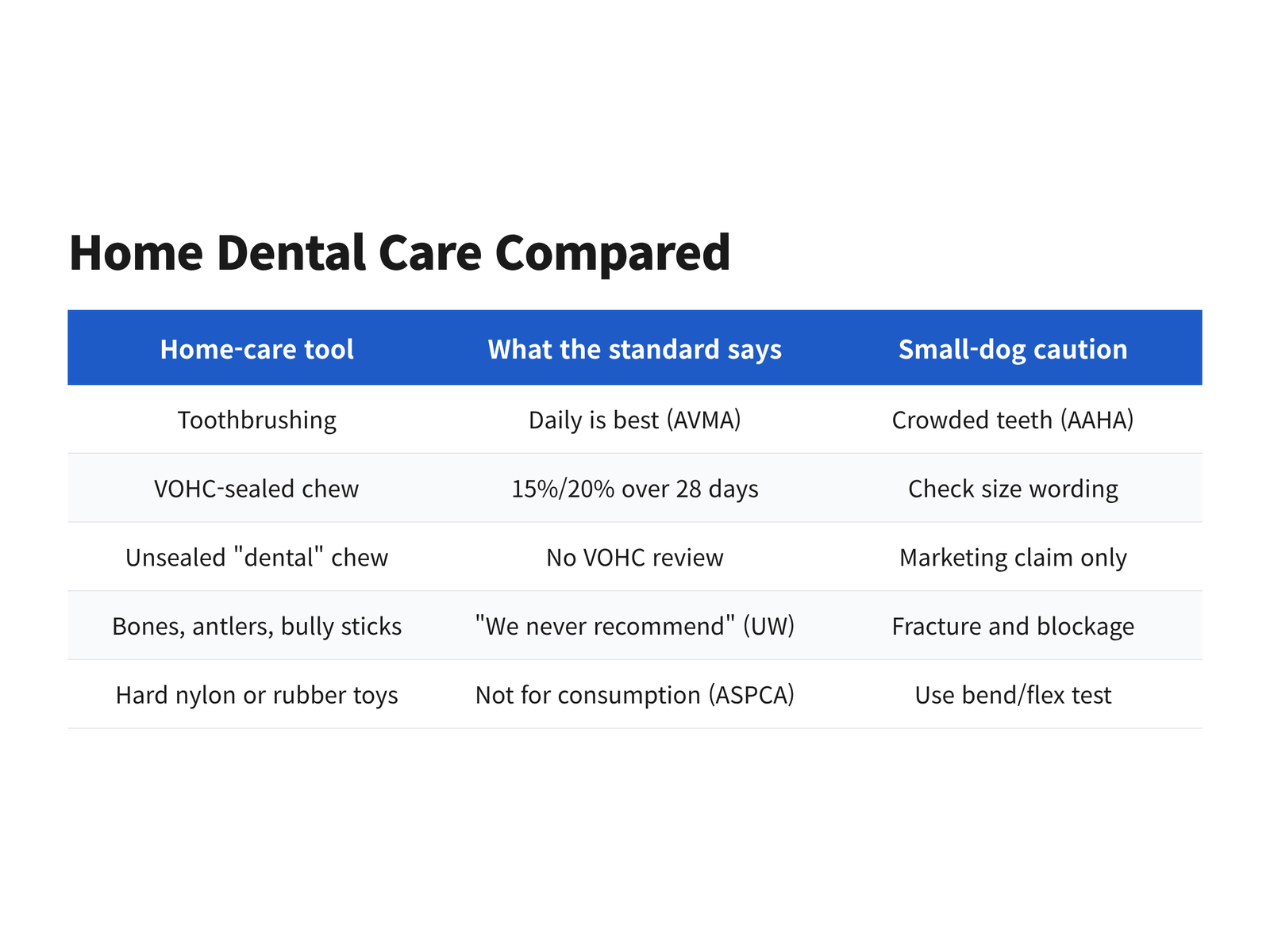
Toothbrushing leads, VOHC-sealed chews follow, and unsealed or very hard chews carry the most caveats for small dogs.
| Home-care tool | What the standard says | Small-dog caution |
|---|---|---|
| Toothbrushing | Daily is best (AVMA) | Crowded teeth (AAHA) |
| VOHC-sealed chew | 15%/20% over 28 days | Check size wording |
| Unsealed “dental” chew | No VOHC review | Marketing claim only |
| Bones, antlers, bully sticks | “We never recommend” (UW) | Fracture and blockage |
| Hard nylon or rubber toys | Not for consumption (ASPCA) | Use bend/flex test |
A quick checklist before any new chew:
- Look for the VOHC seal and its claim: plaque, tartar or both
- Check the VOHC list for the exact product line and size
- Match chew size to the dog’s size and chewing habits
- Try the bend/flex test
- Supervise every chew
- Keep brushing as the base routine
- Ask your veterinarian before choosing dental products
Frequently asked questions
Do dental chews actually work for small dogs?
Yes, when the chew carries the VOHC seal, fits the dog and is used alongside brushing. The VOHC states that regular use of sealed products “will reduce the severity of periodontal disease in pets.” Dental chews fail small dogs mainly when one of those conditions is skipped.
Is a VOHC-sealed chew safe for every small dog?
No. The VOHC seal is a plaque or tartar claim based on manufacturer trials, not a safety certificate for every dog. Size matching (ASPCA) and supervision (Blue Cross) still apply.
How often should a small dog’s teeth be brushed?
The AVMA says daily brushing is best, and several times a week can be effective. A dental chew does not change that baseline.
Sources
- Veterinary Oral Health Council, “About the VOHC” (undated page, (c) 2022) – https://vohc.org/about
- Veterinary Oral Health Council, “Trial Protocol – Detailed Requirements” (undated page, (c) 2022) – https://vohc.org/trial-protocol-requirements/
- Veterinary Oral Health Council, “Protocols and Submissions” (undated page) – https://vohc.org/protocols-and-submissions/
- Veterinary Oral Health Council, “VOHC Accepted Products” (dog list dated 2026-08-25) – https://vohc.org/accepted-products/
- American Animal Hospital Association, “2019 AAHA Dental Care Guidelines – Preventing Periodontal Disease” (2019) – https://www.aaha.org/aaha-guidelines/dental-care/prevention-strategies/preventing-periodontal-disease/
- American Veterinary Medical Association, “Pet dental care” (undated page) – https://www.avma.org/resources-tools/pet-owners/petcare/pet-dental-care
- American Veterinary Dental College, “Companion Animal Dental Scaling Without Anesthesia” (adopted 2004-04-10) – https://avdc.org/wp-content/uploads/2019/AVDC-pos-stmts/Dental_Scaling_Without_Anesthesia.pdf
- Hale F., “The VOHC seal: Why is it important?”, Canadian Veterinary Journal 2011;52(4):437-438 – https://pmc.ncbi.nlm.nih.gov/articles/PMC3058665/
- Wallis C. et al., The Veterinary Journal 2021;275:105717, summarized by Veterinary Practice (2021) – https://www.veterinary-practice.com/2021/smaller-dog-breeds-at-higher-risk-of-developing-dental-problems-than-their-larger-canine-friends
- Wallis C. et al., summarized by dvm360, “Teeth troubles in tiny dogs” – https://www.dvm360.com/view/teeth-troubles-in-tiny-dogs
- ASPCA, “Position Statement on Dog Chews/Treats” (undated page) – https://www.aspca.org/about-us/aspca-policy-and-position-statements/position-statement-on-dog-chews-and-treats
- University of Wisconsin School of Veterinary Medicine, “Protect Your Pet’s Teeth: Top Tips from a Veterinary Dentist” (undated page) – https://www.vetmed.wisc.edu/protect-pets-teeth/
- Blue Cross, “Blue Cross warning to choose chews carefully” (2016-05-10) – https://www.bluecross.org.uk/story/blue-cross-warning-choose-chews-carefully