A dog booster seat lifts a small dog to window height, but it does not hold the dog’s body in place during a collision. That is the short answer to why dog booster seats fail small dogs in a crash. Crash testing by the Center for Pet Safety found failures in all four booster models it examined, and no US federal standard exists for pet seats.

Why do most dog booster seats fail small dogs in a crash?
Most dog booster seats fail because they lift a dog without containing it. The Center for Pet Safety defines a pet travel seat as a product that “does not offer full containment.” In its 2015 pet seat pilot study, the Center for Pet Safety tested four boosters with test dogs of 25 lb and 30 lb, and every model showed a failure of some kind: an anchor strap, a buckle, wire hardware or a seat connection.
Two results from that pilot stand out. For the Snoozer Lookout I, the Center for Pet Safety reported: “Upon impact the anchor strap failed and the test dog was fully unrestrained.” For the Kurgo Skybox, it reported: “Upon impact the seat connections failed and the Kurgo Skybox Booster Seat became a fully unrestrained projectile.” These are 2015 pilot results, and the models may have changed since, so read them as a record of how open boosters can fail, not as current ratings.
Is there a safety standard for dog car seats like the one for child seats?
No. There is no pet equivalent of FMVSS 213, the US federal standard for child safety seats. The Center for Pet Safety borrows FMVSS 213 test conditions as a reference for its own carrier testing, and its crash tests represent a collision of “approximately 30 MPH.” That reference is a testing choice, not a legal requirement.
Consumer Reports noted in 2020 that “there are no standards or industry tests” for pet restraints. A 2015 Subaru of America and Center for Pet Safety release said the same for crates and carriers: no US test protocols or performance standards exist. A “crash-tested” label on a booster seat therefore has no rulebook behind it, so check who ran the test and whether the tester was independent.
Why should a small dog not ride in a booster seat in the front passenger seat?
A small dog should not ride up front because a deploying airbag can seriously injure the dog. The American Veterinary Medical Association states: “If the car is equipped with airbags, keep dogs from riding in the passenger seat.” The Royal Kennel Club goes further: “Your dog must never travel in the front passenger seat,” because airbags “could very seriously injure your dog.”
The Center for Pet Safety also flags “airbag deployment” and “occupant compartment intrusion” as front-seat risks. The American Kennel Club calls the back seat “optimal” so that dogs are “not harmed by air bags.” Many boosters are still marketed for the front seat, which adds airbag exposure to a product that already offers no full containment. If your dog is ever in a crash, consult your veterinarian afterward, even if your dog seems fine.
Why should you never clip a seat belt tether to your dog’s collar?
A collar is not built for crash forces, so it should never be the anchor point. The Center for Pet Safety states that collars and walking harnesses “are not designed for crash protection.” In the 2015 pilot, the PupSaver test dog stayed connected only through the collar and the tether.
The American Kennel Club describes car harnesses as the attachment point to use “instead of clipping to their collar.” RSPCA Australia adds that a vehicle-restraint harness should be crash-tested and “may differ from a walking harness.” Even a harness is not a guarantee. A 2015 case report by Zeleny and Grusova in Veterinarni medicina described a harnessed dog that was severely hurt in a crash while the driver had minor injuries, and the authors concluded the harness did not protect the dog. Consult your veterinarian after any collision, whatever restraint was used.
Booster seat, carrier or crate – which restraint holds up best for a small dog?
A carrier anchored to the seat or a secured crate offers full containment, which an open booster seat does not. The Center for Pet Safety notes that carriers in its testing “typically contain a small dog (30 lbs and under).” Only some carrier models held up in the 2015 Center for Pet Safety crate and carrier study, so containment is a starting point, not a pass.
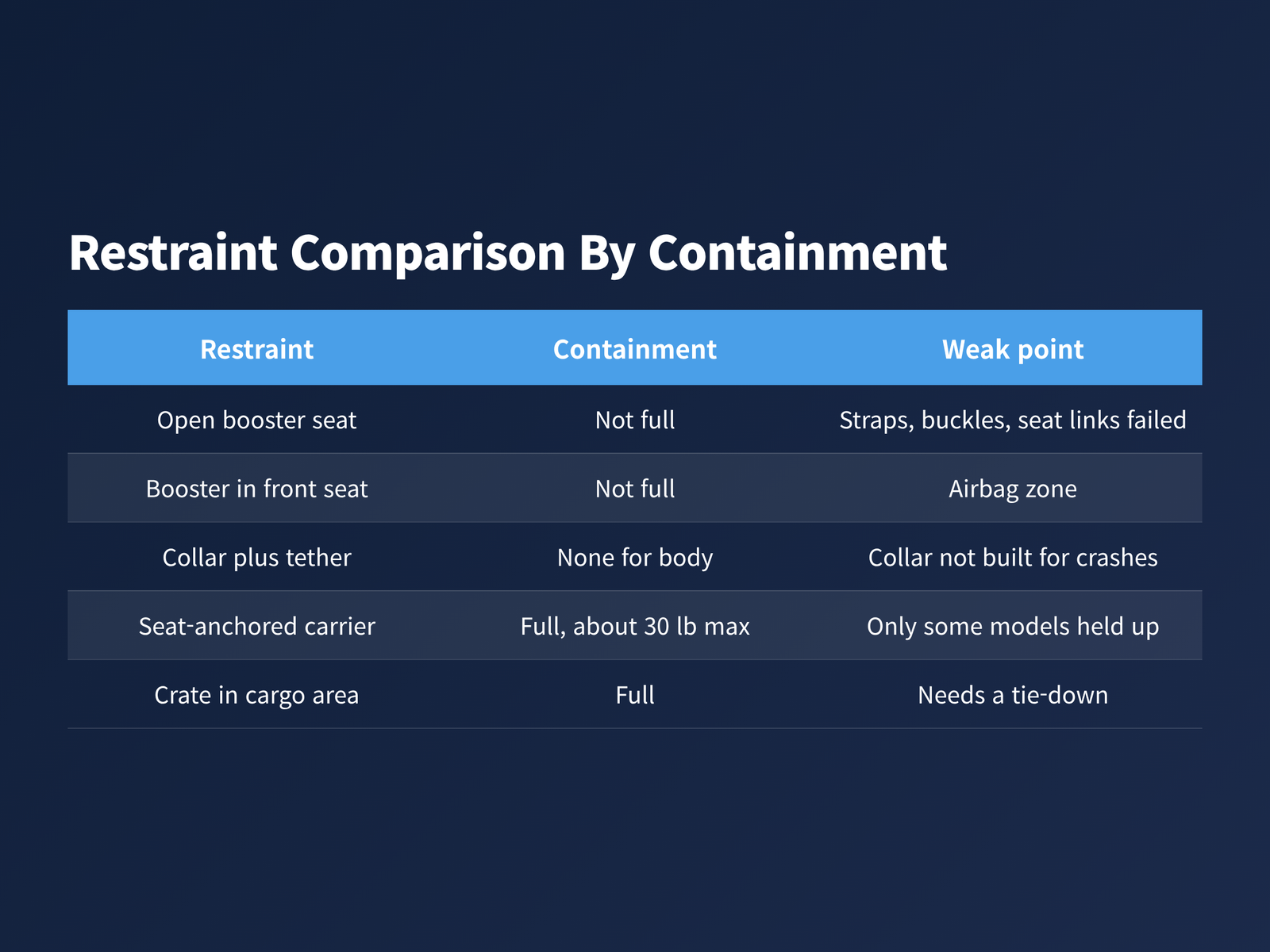
| Restraint | Containment | Documented weak point |
|---|---|---|
| Open booster seat | Not full | Straps, buckles, seat links failed |
| Booster in front seat | Not full | Airbag zone |
| Collar plus tether | None for body | Collar not built for crashes |
| Seat-anchored carrier | Full, about 30 lb max | Only some models held up |
| Crate in cargo area | Full | Needs a tie-down |
Hazel and colleagues reported in Preventive Veterinary Medicine in 2019 that crates were the most common restraint in the US and UK. Michael McHale of Subaru of America said in the 2015 release: “We recommend that owners choose the right sized crate for their dog.”
How many owners actually restrain their dogs in the car?
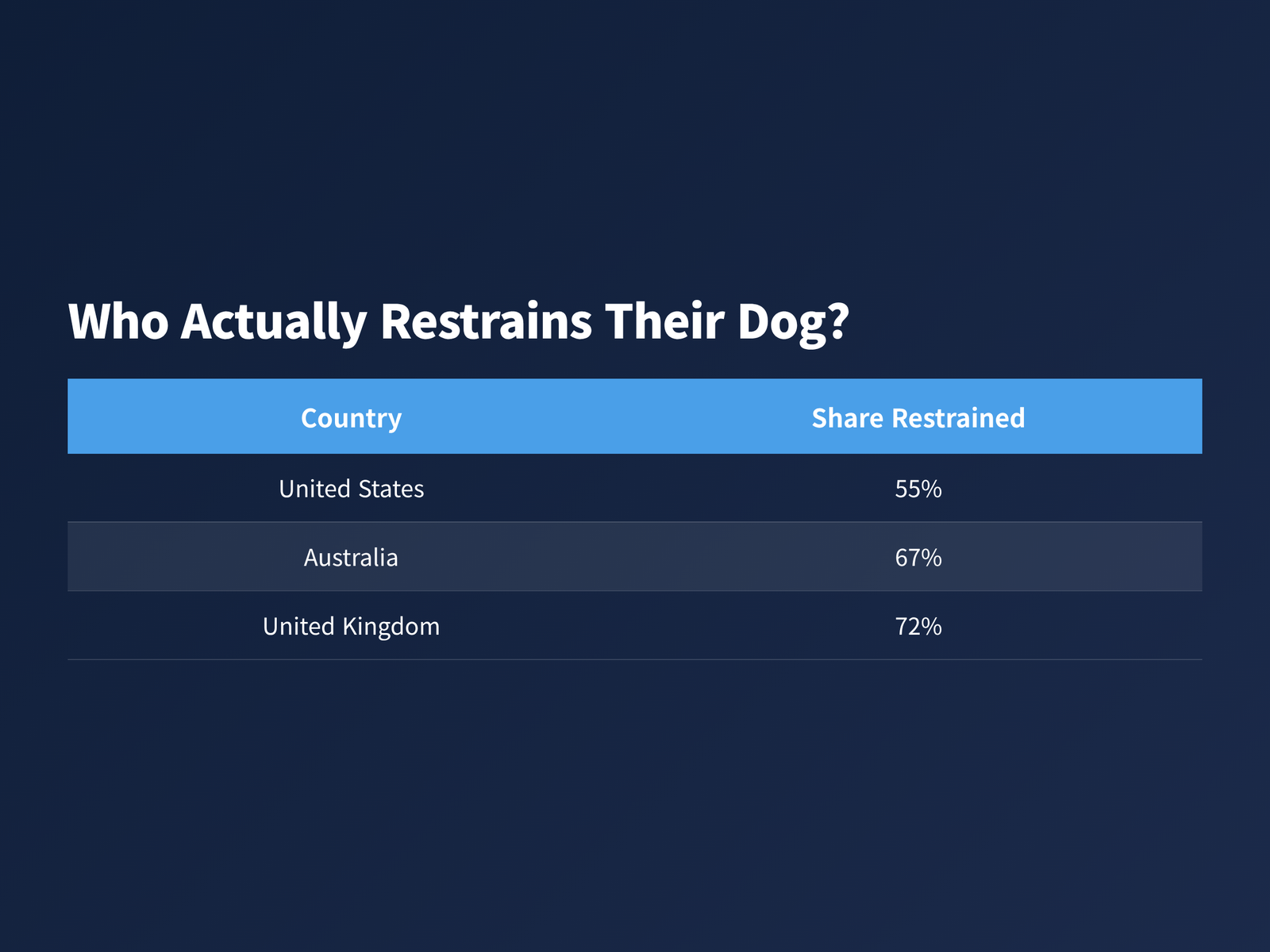
Roughly half to three quarters of owners do, depending on the country. Hazel and colleagues found restraint use of 55% in the US (n = 706), 67% in Australia (n = 637) and 72% in the UK (n = 692). The authors wrote: “A lack of restraint is likely to be associated with an increased risk of serious injury or death.”
Distraction is the second problem. Dr. Flaura Winston of the Center for Injury Research and Prevention at Children’s Hospital of Philadelphia said in 2015: “Unrestrained pets share the same characteristics as another dangerous distraction–texting while driving.” Dr. Winston also noted that peer-reviewed research on pet restraints is thin.
What do UK and US rules actually require for small dogs in cars?
In the UK, Highway Code Rule 57 requires dogs to be restrained; in most US states there is no specific law. Rule 57 on GOV.UK says animals must be “suitably restrained so they cannot distract you while you are driving or injure you, or themselves, if you stop quickly.” Rule 57 lists a seat belt harness, pet carrier, dog cage or dog guard as ways to restrain a dog. An open booster seat is not on that list.
In the US, a 2017 Stateline report found that most states had no rule aimed at dogs in cars, and Hawaii was the one state identified with an explicit lap rule. The American Veterinary Medical Association is clear either way: “Never allow dogs to sit on the driver’s lap.” RSPCA Australia notes that restraint laws vary by state and territory, so check the rules where you drive.
How can you make car travel safer for a small dog?
Start by moving the small dog to the back seat and switching to a restraint built for crash loads. These steps follow guidance from the American Veterinary Medical Association, the Royal Kennel Club, the American Kennel Club, RSPCA Australia and the Center for Pet Safety.
- Move the small dog to the back seat.
- Use a seat-anchored carrier, a secured crate or a crash-tested harness.
- Attach any tether to a harness, never a collar.
- Ask whether a “crash-tested” claim comes from independent testing.
- Check the restraint law where you drive.
Frequently asked questions
Are dog booster seats safe for small dogs in a crash?
The Center for Pet Safety found failures in all four booster seats in its 2015 pilot and says pet seats do not offer full containment. A booster seat helps a small dog see out; it does not replace a crash restraint.
Can you put a dog car seat in the front?
The American Veterinary Medical Association and the Royal Kennel Club both advise against front passenger seat travel when airbags are fitted. The back seat is the safer position.
Does a “crash-tested” booster seat meet a legal standard?
No legal standard exists for pet restraints in the US. Consumer Reports notes there are no standards or industry tests, so a crash-tested label depends entirely on who ran the test.
Should a small dog see a vet after a minor car accident?
Consult your veterinarian after any crash, even if your dog seems fine.
Sources
- Center for Pet Safety, “2015 Pet Seat Pilot Study” (2015) – https://www.centerforpetsafety.org/?p=1152
- Center for Pet Safety, FAQ “What speed crash does your testing represent?” (undated) – https://www.centerforpetsafety.org/?p=264
- Center for Pet Safety, “2015 Crate and Carrier Study” FAQ (2015) – https://www.centerforpetsafety.org/?p=2832
- Subaru of America and Center for Pet Safety, crate and carrier press release, 2015-07-22 – https://media.subaru.com/pressrelease/790/1/subaru-america-center-pet-safety-studies-showcase-promising
- American Veterinary Medical Association, client brochure “Traveling with your pet”, 2023 – https://ebusiness.avma.org/files/ProductDownloads/mcm-client-brochures-travel-with-pet-2023.pdf
- The Royal Kennel Club, “Travelling with your dog” (undated) – https://www.royalkennelclub.com/your-dog/getting-a-dog/caring-for-a-new-pup/travelling-with-your-dog
- American Kennel Club, Stephanie Gibeault, “Dog Seat Belts: What You Need to Know”, updated 2026-03-10 – https://www.akc.org/expert-advice/travel/dog-seat-belts-what-you-need-to-know-to-keep-your-dog-safe/
- RSPCA Australia Knowledgebase, “Do I need to restrain my dog when travelling in my car?”, updated 2025-09-30 – https://kb.rspca.org.au/knowledge-base/do-i-need-to-restrain-my-dog-when-travelling-in-my-car/
- GOV.UK, “The Highway Code – Rules about animals (47 to 58)”, updated 2025-10-22 – https://www.gov.uk/guidance/the-highway-code/rules-about-animals-47-to-58
- Hazel SJ, Kogan LR, Montrose VT, Hebart ML, Oxley JA, “Restraint of dogs in vehicles in the US, UK and Australia”, Preventive Veterinary Medicine 170 (2019) 104714 – https://digital.library.adelaide.edu.au/items/2ea4f1ff-0ba2-4a4f-a136-37e04b18cc90
- Zeleny M, Grusova K, “A car accident involving a restrained dog within the vehicle: a case report”, Veterinarni medicina 60(7):399-402, 2015 – https://vetmed.agriculturejournals.cz/artkey/vet-201507-0009_a-car-accident-involving-a-restrained-dog-within-the-vehicle-a-case-report.php
- Consumer Reports, Jon Linkov, “How to Keep Your Pets Safe in a Car”, 2020-05-22 – https://www.consumerreports.org/car-safety/keep-pets-safe-in-the-car
- Children’s Hospital of Philadelphia, Center for Injury Research and Prevention, Flaura Winston, “Dogs and Driving: Reasons to Restrain Pets in Cars”, 2015-12-28 – https://injury.research.chop.edu/blog/posts/dogs-and-driving-reasons-restrain-pets-cars
- Stateline (Pew), Jenni Bergal, “Distracted Dogging”, 2017-12-20 – https://stateline.org/2017/12/20/distracted-dogging-legal-in-most-states-controversial-in-all/