Why clipping ruins a Wire Fox Terrier coat comes down to how the hair is removed. Clippers cut each hair at a set length and leave the dead hair in the follicle, while hand stripping plucks that dead hair out so new, wiry hair can grow. According to the American Kennel Club, clipping over time can soften the coat and change its color, sheen and texture. Clipping is still how most pet wire coats are kept, so the real question is which trade-offs a household is willing to accept.
What does the breed standard say a Wire Fox Terrier coat should feel like?
The AKC breed standard describes a Wire Fox Terrier coat as broken, dense and wiry, with a texture compared to coconut matting. The Official Standard of the Wire Fox Terrier, approved in 1991, states that “the best coats appear to be broken, the hairs having a tendency to twist.” The same standard gives an average coat length of three quarters of an inch to 1 inch on the shoulders and neck.
The standard also keeps expectations realistic. The AKC standard notes that the coat on the sides is not as harsh as the coat on the back and quarters, and the standard calls a curly coat “very objectionable.” For scale, the standard sets a male Wire Fox Terrier at no more than 15½ in at the shoulder and about 18 lb in show condition, with females slightly smaller and about 2 lb lighter.
Why is a wire coat different from other dog coats?
A wire coat is different at the genetic level, not only in how it is groomed. A 2009 study in Science by Cadieu and colleagues linked wire coats and facial furnishings to a 167-base-pair insertion in the RSPO2 gene. In that study, 297 of 298 dogs with furnishings carried the RSPO2 insertion, and none of the 406 dogs without furnishings did. The authors wrote that “wire-haired breeds, all of which have furnishings, carry the RSPO2 insertion.”
The AKC describes hand stripping as the plucking of dead strands of hair to retain a wire coat’s coarse texture. The AKC also states that the coat itself, rather than the breed label, decides whether hand stripping is needed.
Why does clipping make a Wire Fox Terrier coat soft and dull?
Clipping makes a Wire Fox Terrier coat soft because clippers cut the hair while the dead hair stays in the follicle. The AKC explains that this disrupts the natural growth cycle and that a clipped wire coat softens over time. Stripping, also called plucking, removes the dead hairs so new, wiry hairs can grow in their place.
The UK breed club reaches the same conclusion. The Wire Fox Terrier Association states that “clipping a wires coat as opposed to hand stripping can result in loss of coat quality.” The AKC also connects long-term clipping of wire coats with a higher risk of skin problems and effects on temperature regulation. Dr. Jerry Klein, Chief Veterinary Officer at the AKC, notes in a general article on shaving that “your dog’s coat actually acts as an insulator.” If a Wire Fox Terrier shows skin irritation or seems to struggle with heat or cold after a groom, consult your veterinarian rather than adjusting the coat routine alone.
Does clipping actually change a Wire Fox Terrier’s coat color?
Yes, clipping can change a Wire Fox Terrier’s coat color as well as texture. The AKC states that clipping a wire coat can change its color, sheen and texture, and the Wire Fox Terrier Association says clipping affects the richness of colour.
The published sources describe the result, not the full biological mechanism behind the color shift. What the AKC and the breed club agree on is the practical outcome: a hand-stripped Wire Fox Terrier coat keeps its color and harsh finish better than a coat maintained with clippers alone.
How do clipping and hand stripping compare for a Wire Fox Terrier?
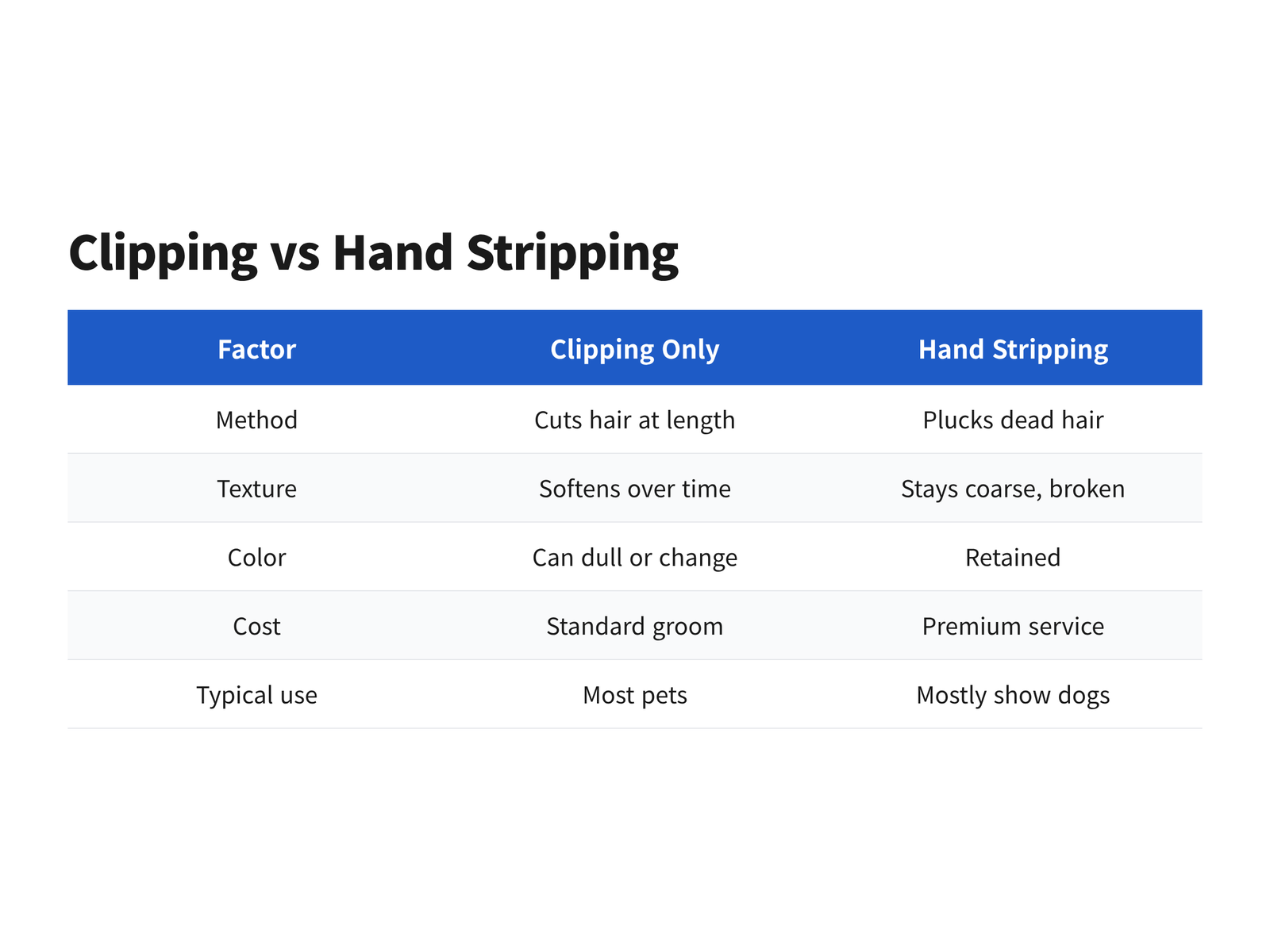
According to the AKC, clipping is initially convenient and less time-consuming, while hand stripping protects the wire texture and color at a higher cost. The comparison below draws on the AKC hand-stripping guide, the AKC wired-coat care guide and the Wire Fox Terrier Association.
| Factor | Clipping only | Hand stripping |
|---|---|---|
| Method | Cuts hair at length | Plucks dead hair |
| Texture | Softens over time | Stays coarse, broken |
| Color | Can dull or change | Retained |
| Cost | Standard groom | Premium service |
| Typical use | Most pets | Mostly show dogs |
Cost is part of the decision. Groomer Kim Kier, owner of Little Barks Grooming & Boutique, told the AKC that “hand-stripping is a premium service and will (and should) be more expensive than a traditional groom.” Prices vary by groomer and region, so a quote from a local stripping groomer is the only reliable figure.
Is a “pet strip” a fair middle ground between clipping and hand stripping?
A pet strip is a common middle ground for a family Wire Fox Terrier. The AKC describes a pet strip as a clipper trim combined with carding, which pulls out the soft undercoat. According to Kim Kier in the AKC hand-stripping guide, clipper work plus carding is “almost always the process for pets,” while full hand stripping is mostly for show dogs.
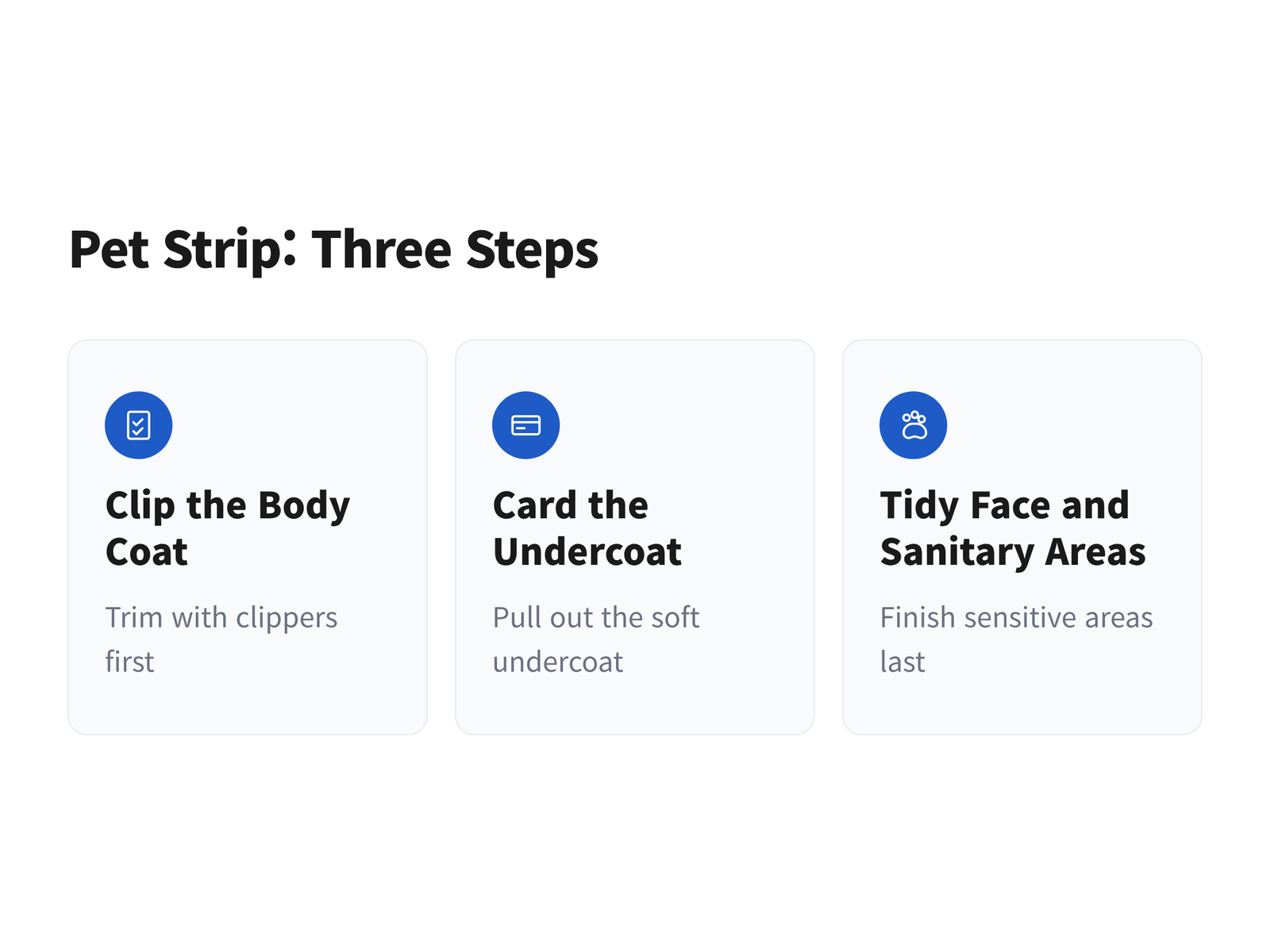
A pet strip usually follows three steps: clip the body coat, card out the soft undercoat, then tidy the face and sanitary areas. Kier adds a warning: “An untrained pet strip can be painful for the dog and may not produce the results the owner seeks.” A groomer experienced with terrier coats is the safer choice for both pet strips and full stripping.
Tools for a pet strip or home rolling include a stripping knife and a carding tool.
Can a clipped Wire Fox Terrier coat ever go back to wire?
No published veterinary or kennel-club source gives a timeline for restoring a clipped Wire Fox Terrier coat to full wire texture. The AKC sources and the Wire Fox Terrier Association material reviewed here do not state how long the process takes or whether every coat recovers.
The research that does exist measures length, not texture. In a 2004 Veterinary Dermatology study of 37 Labrador Retrievers, clipped hair took about 13.6 to 15.4 weeks to grow back to its original length. That study did not involve Wire Fox Terriers or wire coats, so it says nothing about when a harsh texture returns. A groomer who strips terrier coats can assess an individual Wire Fox Terrier and explain what is realistic for that coat.
When does hand stripping not make sense for a pet Wire Fox Terrier?
Hand stripping makes less sense when a Wire Fox Terrier is a pet and the household does not need a show-standard coat. The AKC hand-stripping guide is clear that most pet wire coats are kept with clippers and carding. Choosing a clipper or pet strip routine is a normal grooming decision, not neglect.
Some areas get clipped even on stripped dogs. The AKC notes that the face, throat, sanitary areas and belly are sensitive, and that clippers and thinning shears are used there with restraint. Hand stripping may also be a poor fit if no trained groomer is nearby, since rough or unskilled stripping can hurt.
How often does a Wire Fox Terrier need stripping and brushing?
A Wire Fox Terrier needs stripping several times a year and brushing once a week. The Wire Fox Terrier Association describes stripping “several times a year,” depending on how each coat grows. The AKC wired-coat care guide recommends weekly brushing in this order: pin brush, medium-toothed comb, fine-toothed comb, then slicker brush.
Between full strips, the AKC describes rolling the coat. Rolling removes small amounts of dead coat over time instead of all at once. To roll, grip a few hairs near the root between thumb and forefinger and pull gently in the direction of growth. Rubber fingertips or grooming chalk improve the grip. The breed club adds that the undercoat can be raked out and that furnishings and leg hair need regular brushing to prevent tangles.
Frequently asked questions
Is clipping a Wire Fox Terrier bad for the dog?
Clipping is the usual routine for most pet wire coats, according to the AKC. The trade-off is a softer coat with changed color over time, and the AKC links long-term clipping to a higher risk of skin problems. For any skin or temperature concerns, consult your veterinarian.
Can a Wire Fox Terrier puppy be hand stripped?
The sources reviewed here do not give a starting age for stripping. A groomer experienced with terrier coats can advise on when a Wire Fox Terrier coat is ready.
Why is hand stripping more expensive than clipping?
The AKC notes that hand stripping requires training, practice and an understanding of breed standards. Kim Kier told the AKC that hand stripping “will (and should) be more expensive than a traditional groom.”
Sources
- American Kennel Club, “Everything You Need to Know About Hand-Stripping Dog Coats” (Colt Dodd), updated 2025-11-10 – https://www.akc.org/expert-advice/health/hand-stripping-dog-coats/
- American Kennel Club, “Wired-Coat Care: Stripping” (Steve Pessah), updated 2019-12-06 – https://www.akc.org/expert-advice/grooming/wired-coat-care-stripping/
- American Kennel Club, “Official Standard of the Wire Fox Terrier”, approved 1991-02-09 – https://images.akc.org/pdf/breeds/standards/WireFoxTerrier.pdf
- American Kennel Club, “Is It OK to Shave Your Dog’s Coat in Summer?” (Harriet Meyers), updated 2026-03-27 – https://www.akc.org/expert-advice/health/is-it-ok-to-shave-your-dog/
- Cadieu E. et al., “Coat Variation in the Domestic Dog Is Governed by Variants in Three Genes”, Science 326:150-153, 2009 – https://pmc.ncbi.nlm.nih.gov/articles/PMC2897713/
- Diaz S.F. et al., “An analysis of canine hair re-growth after clipping for a surgical procedure”, Veterinary Dermatology 15(1):25-30, 2004 – https://experts.umn.edu/en/publications/an-analysis-of-canine-hair-re-growth-after-clipping-for-a-surgica/
- Wire Fox Terrier Association, “Discover Dogs Breed Info”, 2024 – https://www.wirefoxterrierassociation.co.uk/s/Discover-Dogs_Breed_Info_2024.pdf