Four Russian Bolonka colors are not allowed under the American Kennel Club standard: solid white, spotted, parti-color and merle. Every other color is permitted. The AKC standard lists those four patterns as disqualifications, which means a dog with one of them cannot be shown in conformation. The same standard also caps height at the withers at 11 inches and bans trimming anywhere except the feet. The details below come straight from the AKC and Russian (RKF) standards.

The Russian Tsvetnaya Bolonka, or “Russian Colored Lapdog,” is a toy breed from Leningrad that entered the AKC Toy Group in January 2026, and its standard permits any coat color except solid white, spotted, parti-color or merle.
Which Russian Bolonka colors are not allowed under the AKC standard?
The AKC standard excludes exactly four Russian Bolonka coat patterns: solid white, spotted, parti-color and merle. The AKC wording is direct: “All colors are permitted except solid white, spotted, parti-color or merle.” The disqualification list repeats the point, naming “any spots, markings (except where mentioned), solid white, parti-color or merle coat color.” The RKF standard from Russia uses a parallel rule, allowing “any color” except white, spotted and marbled.
The phrase “disqualified” belongs to the show ring. The disqualification list sits inside the AKC conformation standard, which describes how judges evaluate a Russian Bolonka in competition. Whether AKC registration itself is affected for a solid white, merle or parti-color dog could not be confirmed for this article. For any registration or judging question, check the official AKC standard and the Russian Tsvetnaya Bolonka Club of America (the parent club) directly rather than relying on a breed-profile summary.
Why is a white Russian Bolonka disqualified when a founding dog was white?
A white Russian Bolonka is disqualified in the show ring because early breeders deliberately selected for color. According to the AKC history of the breed, the first litter was born in 1951 in Leningrad. One parent was “Trifon,” a white dog from Hungary, and the other was “Zhuzhu,” a coffee-colored dog. Candace Mogavero, president of the Russian Tsvetnaya Bolonka Club of America, summarized the goal for the AKC: “They valued any color other than solid white.”
That preference is built into the name, which translates as “Russian Colored Lapdog.” Mogavero described her own first impression of the Russian Bolonka in the same AKC article: “I liked their appearance with their dark-colored coats.” Read the rule as a breeding goal, not as a judgment about a white dog’s value as a pet.
Which white markings are allowed on a Russian Bolonka?
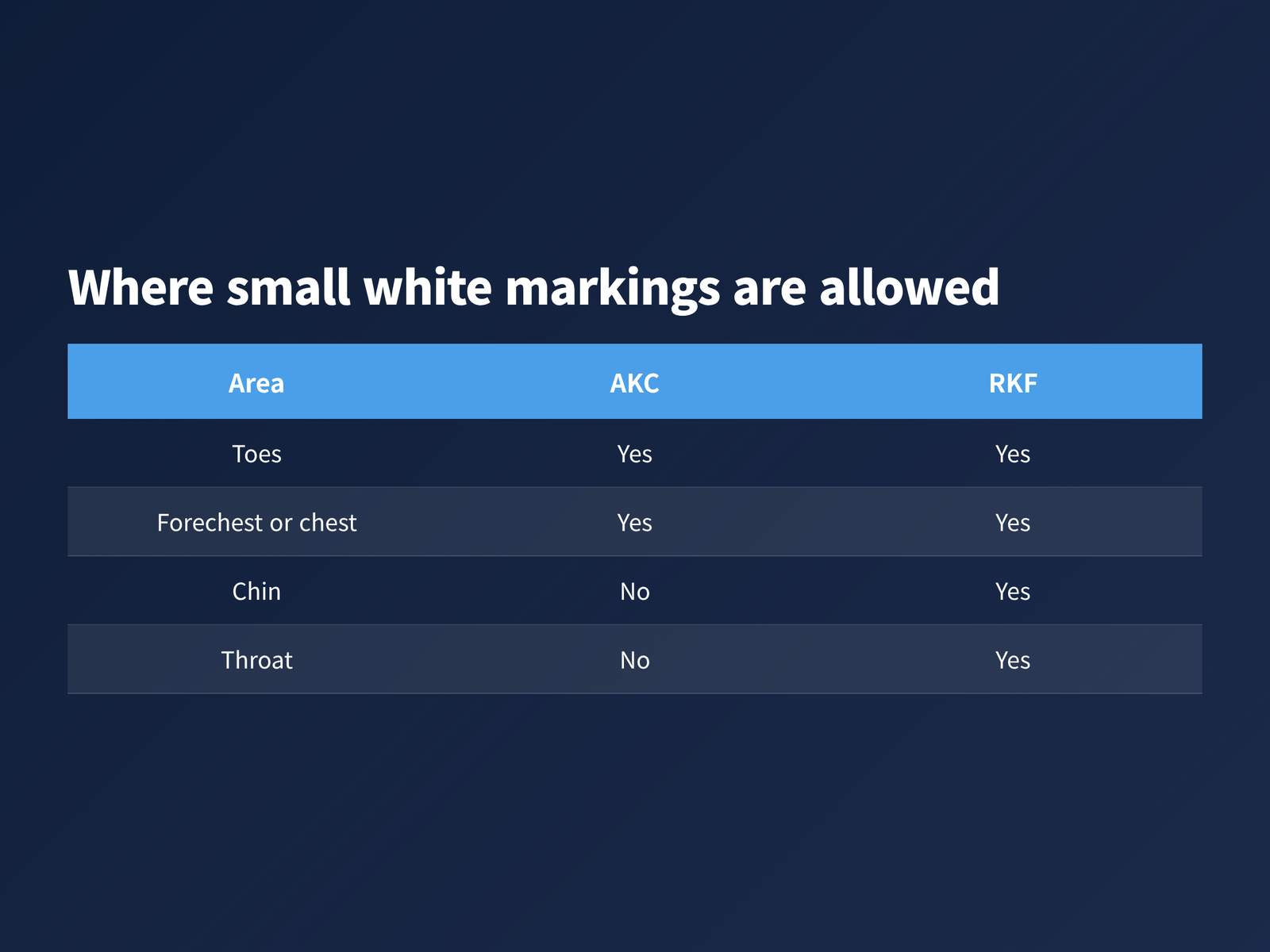
The AKC allows only small white markings on the toes and forechest of a Russian Bolonka. The AKC text reads: “Small white markings on the toes and forechest are permitted.” Anything larger moves toward the “spotted” or “parti-color” categories that the standard disqualifies. The RKF standard is slightly broader on placement. RKF permits small, barely noticeable white spots on the chin, throat, chest and toe tips, and it treats large white patches on the chest or legs as a serious fault rather than an automatic disqualification.
This difference matters for anyone importing a Russian Bolonka or reading a European pedigree. A white chin patch that passes under the RKF standard is not on the AKC list of permitted markings. Ask the breeder which standard the parents were judged under; that question is a practical way to read a pedigree, not a rule from either standard.
Is a Russian Bolonka over 11 inches tall still within the standard?
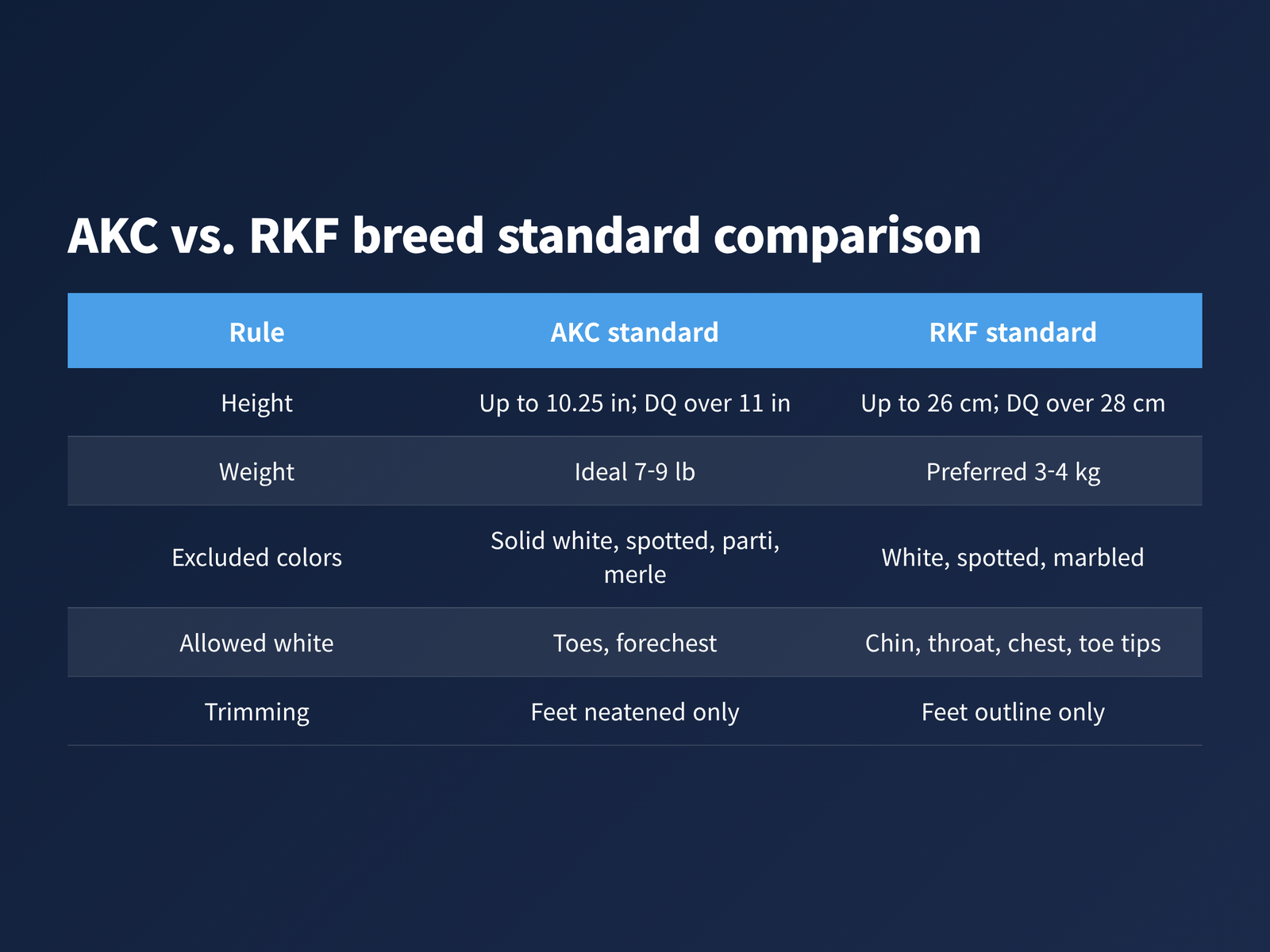
No. A Russian Bolonka over 11 inches at the withers is disqualified under the AKC standard. The AKC standard sets the desired height at “up to 10¼ inches” and states plainly: “Height at withers over 11 inches is a disqualification.” The ideal weight is 7 to 9 pounds for both males and females, and the body should be “not more than 15 percent” longer than the height at the withers. Height is the hard cutoff; the weight figure is described as an ideal.
The popular numbers around the Russian Bolonka do not match the standard. The AKC’s own fun-facts page describes the breed as “about 11 inches” tall and 6 to 9 pounds, and some retail breed pages say “less than 12 inches.” The AKC conformation standard, with its 10¼-inch preference and 11-inch disqualification, is the document that governs the show ring. The RKF standard uses metric limits: a preferred height up to 26 cm, a disqualification over 28 cm and a preferred weight of 3 to 4 kg. For questions about an individual dog’s weight or growth, consult your veterinarian.
Why can’t a Russian Bolonka’s coat be trimmed for the show ring?
The AKC standard allows only the feet to be neatened; the rest of the Russian Bolonka coat must stay untrimmed. The exact line is: “Feet may be neatened. No other trimming of the coat is allowed.” The standard adds that “the coat is never deliberately parted,” and the hair on the head may fall naturally or be held up with a small bow. The RKF standard says the same thing in different words: the coat is not clipped or trimmed except the feet, which are trimmed along their outline.
The rule centers on the coat itself. The AKC describes the Russian Bolonka coat as “long, dense, thick, soft, and supple, with a well-developed undercoat,” falling in “large curls (preferred)” or a very wavy pattern. RKF goes further and lists a straight coat as a serious fault. The trimming ban applies to show presentation only; a pet haircut is an owner’s choice and has no bearing on whether a Russian Bolonka is purebred.
How do the AKC and Russian (RKF) Bolonka standards differ?
The AKC and RKF standards agree on the main exclusions but differ on units, allowed white and some disqualifications. Beyond the table, the AKC disqualification list also includes blue or partially blue eyes, a spotted or flesh-colored nose, an overshot bite or wry mouth, a missing or docked tail and a complete lack of beard and moustache. The RKF list includes blue eyes or heterochromia, a bobtail, absent ornamental head hair, signs of dwarfism and aggressiveness or cowardice. These are show rules, not health statements.
| Rule | AKC standard | RKF standard |
|---|---|---|
| Height | Up to 10¼ in; DQ over 11 in | Up to 26 cm; DQ over 28 cm |
| Weight | Ideal 7–9 lb | Preferred 3–4 kg |
| Excluded colors | Solid white, spotted, parti, merle | White, spotted, marbled |
| Allowed white | Toes, forechest | Chin, throat, chest, toe tips |
| Trimming | Feet neatened only | Feet outline only |
The RKF standard also notes that “the breed is not yet recognized by the FCI,” the international breed federation. The Kennel Club (UK) status of the Russian Bolonka could not be confirmed for this article. In the United States, the AKC path ran from the Foundation Stock Service in 2015 to the Miscellaneous Class in 2023 and full Toy Group recognition in 2026. With that addition, AKC reported 205 recognized breeds. AKC President and CEO Gina M. DiNardo said at the time: “As always, it’s extremely important to do your research to find a breed that matches your lifestyle.”
Frequently asked questions
Can a Russian Bolonka be white?
A Russian Bolonka can be born white, since a founding dog in 1951 was white, but solid white is a disqualification under the AKC standard and is excluded by the RKF standard. Whether a white dog can be registered with AKC was not confirmed here.
Does a Russian Bolonka coat need regular brushing?
Yes. Candace Mogavero told the AKC that “the coat usually doesn’t mat and can be any color other than white,” yet AKC breed material also advises brushing or combing several times a week to prevent mats. The Russian Bolonka coat is not maintenance-free, and AKC describes the breed as shedding minimally rather than not at all.
Are blue eyes allowed on a Russian Bolonka?
No. Blue or partially blue eyes are a disqualification under the AKC standard, and RKF lists blue eyes and heterochromia among its disqualifications. That is a show-ring rule only. For any question about a dog’s eyes or health, consult your veterinarian.
Sources
- American Kennel Club, “Official Standard of the Russian Tsvetnaya Bolonka” (approved 2021-06-17, effective 2023-01-01) — https://s3.amazonaws.com/cdn-origin-etr.akc.org/wp-content/uploads/2024/02/13143313/Russian-Tsvetnaya-Bolonka-Breed-Standard-02132024.pdf
- Russian Cynological Federation (RKF), “Russian Tsvetnaya Bolonka” breed standard (published 2019-05-15) — https://info.rkf.online/article/514a792a-9cfe-5461-8894-7708731a8ee6
- American Kennel Club, “Russian Tsvetnaya Bolonka History,” Elaine Waldorf Gewirtz (2026-01-06) — https://www.akc.org/expert-advice/dog-breeds/russian-tsvetnaya-bolonka-history/
- American Kennel Club, “Meet AKC’s Three Newly-Recognized Dog Breeds,” Elaine Waldorf Gewirtz (2025-12-30) — https://www.akc.org/expert-advice/dog-breeds/newly-recognized-breeds-2026/
- American Kennel Club, “The Pack is Expanding! The American Kennel Club Welcomes Three New Breeds to the Registry,” press release (2025-12-30) — https://www.akc.org/press-releases/the-pack-is-expanding-the-american-kennel-club-welcomes-three-new-breeds-to-the-registry/
- American Kennel Club, “Facts About the Russian Tsvetnaya Bolonka You May Not Know,” Micaela Erickson (updated 2026-01-02) — https://www.akc.org/expert-advice/dog-breeds/russian-tsvetnaya-bolonka-fun-facts/