A dog tag on a harness instead of a collar does not match the wording of UK law. The Control of Dogs Order 1992 says every dog in a public place in Great Britain must wear a collar carrying the owner’s name and address, and the Order never mentions harnesses. So is a dog tag on a harness instead of a collar UK-compliant? Not by the Order’s wording, and that matters for harness-only toy breeds. This is general information, not legal advice.
Is a tag on a harness enough under UK law?
A tag on a harness does not match the wording of the Control of Dogs Order 1992, because the Order names a collar and does not mention harnesses. Article 2(1) states that “every dog while in a highway or in a place of public resort shall wear a collar with the name and address of the owner inscribed on the collar or on a plate or badge attached to it.” The rule covers England, Scotland and Wales. Durham County Council adds that the rule applies “whether your dog is on a lead or not.”
No court ruling on a harness-mounted tag has been confirmed. The published readings all point the same way, though. Dr Brian Faulkner, an RCVS-registered veterinary surgeon writing for Petplan, says: “Even if you’ve attached an ID tag to your dog’s harness, this doesn’t exempt your dog from needing to wear a collar.” Press coverage syndicated by the Yorkshire Post says the law applies even when owners switch from a collar to a harness.
What does a UK dog tag legally have to show?
A UK dog tag legally has to show the owner’s name and address, and nothing else is required by the Control of Dogs Order 1992. The name and address can be engraved on the collar itself or on a plate or badge attached to the collar. Petplan describes the address as the house number or name plus the postcode.
A phone number is not a legal requirement. The Royal Kennel Club lists the phone number as optional, and the Royal Kennel Club also says you do not need to put your dog’s name on the tag. Space is the practical limit: the American Kennel Club notes that tags are “usually limited to two to four lines of text,” so the name and address should take priority over extras.
Which dogs are exempt from the UK collar and tag rule?
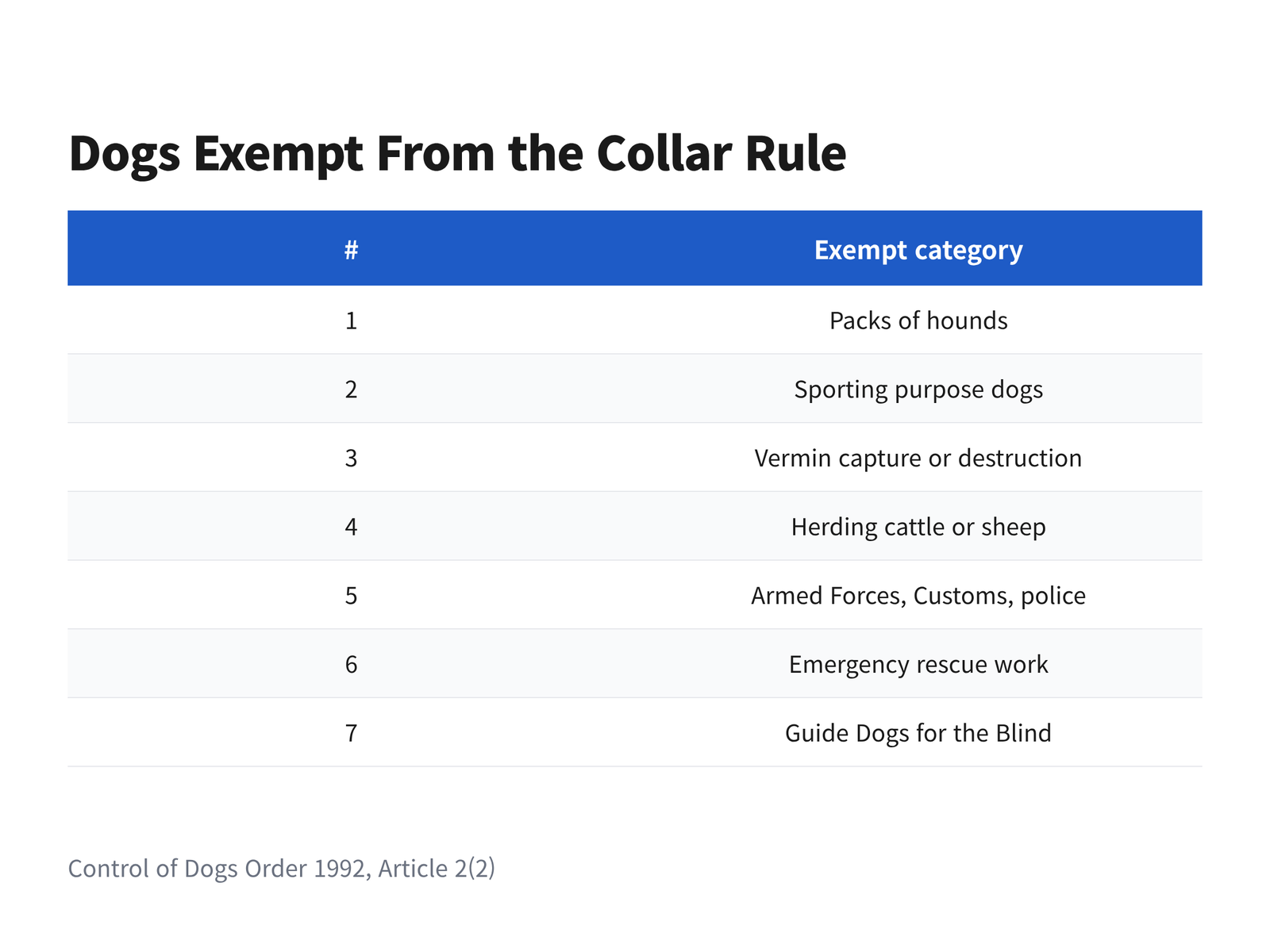
The exemptions in the Control of Dogs Order 1992 cover working, official and guide dogs, not pet small dogs. Article 2(2) lists the following:
- Packs of hounds
- Dogs used for sporting purposes
- Dogs used for the capture or destruction of vermin
- Dogs used for driving or tending cattle or sheep
- Dogs on official duties of the Armed Forces, Customs and Excise or the police
- Dogs used in emergency rescue work
- Dogs registered with the Guide Dogs for the Blind Association
A pet Chihuahua or Pomeranian walked in a harness does not appear anywhere on that Article 2(2) list. Article 3 also says the offence applies “without lawful authority or excuse, proof of which shall lie on him,” which places the burden of showing an excuse on the owner.
How big is the fine for a dog without a collar tag in the UK?
The fine for a dog without a collar tag is not settled in the published sources, because the figures differ. The explanatory note to the 1992 Order refers to a level 5 fine, “currently £2000,” and Durham County Council also gives £2,000. The Royal Kennel Club gives £5,000. Syndicated press coverage attributes “an unlimited fine and/or up to six months” to DEFRA, and Petplan mentions an “unlimited fine, or even jail.”
The original DEFRA statement behind the unlimited-fine wording has not been confirmed, so the current maximum fine is unconfirmed. A single press report from the Yorkshire Post describes one Cocker Spaniel owner fined £50 plus costs and a surcharge, which shows that real penalties can sit far below the headline figures.
Why doesn’t a microchip replace a collar tag?
A microchip does not replace a collar tag because GOV.UK states that a microchipped dog “must still wear a collar and tag with your name and address when in a public place.” All dogs in the UK must be microchipped and registered by 8 weeks old, and GOV.UK sets the fine for an unchipped dog at up to £500. The collar tag rule sits on top of the microchip rule, not in place of it. Dogs Trust gives the same answer.
The data shows why both layers exist. A study of 53 US shelters published in the Journal of the American Veterinary Medical Association found that only 58.1% of microchips (1,129 of 1,943) were registered when the registry was contacted. Among 876 cases where owners could not be found, 35.4% involved a wrong or disconnected phone number. Linda Lord of Ohio State University put it plainly: “The chip is only as good as my ability as a pet owner to keep my information up to date in the registry.”
Microchipped stray dogs were still returned to owners at 52.2%, against 21.9% without a chip. A microchip needs a scanner, though. The American Kennel Club says “the benefit of a dog tag is that it can be read without needing special equipment.” In a US survey of 1,015 households, 14% of recovered dogs were found through an ID tag.
What should you leave off a small dog’s ID tag?
The dog’s name is the main item owners debate leaving off a small dog’s ID tag, and the law does not require it. Petplan notes that some owners worry a visible name helps thieves, while the Royal Kennel Club says you do not need to put your dog’s name on the tag. No data linking names on tags to theft rates has been confirmed, so the choice stays a personal one.
What should not be left off is current contact information. Wrong or disconnected phone numbers were the top reason, at 35.4%, that chipped animals were not reunited in the shelter study, so a phone number on the tag only helps while it stays current.
Can a small dog wear a collar for the tag and a harness for the lead?
Yes, a small dog can wear a light collar for the tag and a harness for the lead, and that setup fits both the Control of Dogs Order 1992 and GOV.UK guidance. The collar exists to carry the tag in public. The collar does not have to take the pull of the lead.
That split suits neck-sensitive small dogs. The American College of Veterinary Surgeons lists Yorkshire Terriers, Pomeranians, Poodles and Chihuahuas as the breeds most affected by tracheal collapse. If your dog coughs or struggles with neck pressure, consult your veterinarian before choosing a collar.
Practical steps from the Royal Kennel Club and GOV.UK:
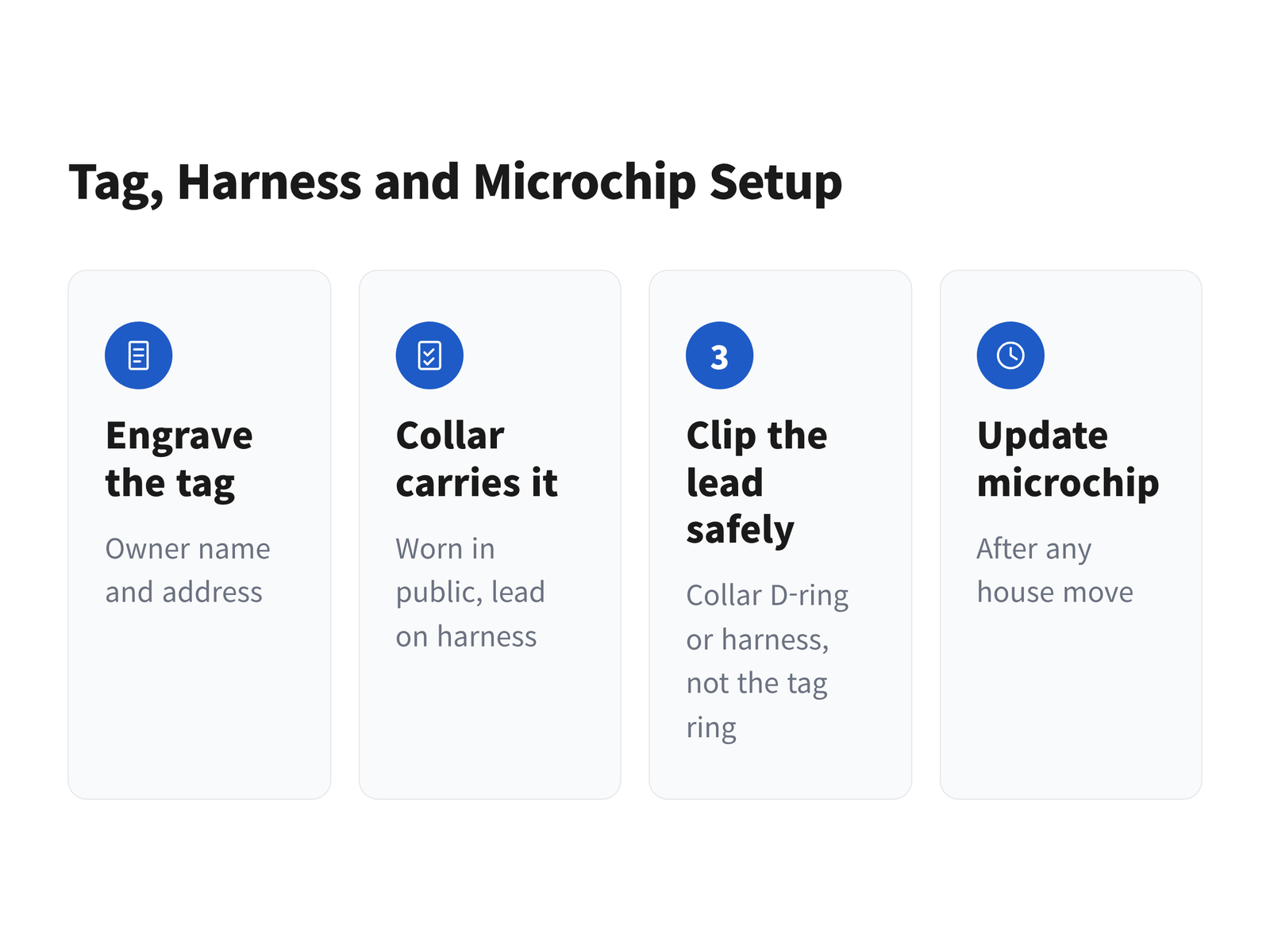
- Engrave the owner’s name and address on the tag or collar.
- Put the tag on a collar worn in public, even if the lead clips to a harness.
- Clip the lead to the collar D ring or harness, never the tag’s split ring, which the Royal Kennel Club says is “not strong enough to take the weight of your dog.”
- Check that two fingers can slip under the collar.
- Update microchip registry details after moving.
Collar tag vs microchip at a glance
The collar tag and the microchip do different jobs, and UK guidance expects a dog in public to have both.
| Collar tag | Microchip | |
|---|---|---|
| Legal basis | Control of Dogs Order | Microchipping regulations |
| Readable without scanner | Yes | No |
| Required content | Owner name and address | Registered keeper details |
| Published fine | £2,000 to £5,000 or unlimited (figures differ) | Up to £500 |
| Main failure point | Collar off or tag lost | Outdated details |
Frequently asked questions
Does the collar and tag rule apply in Northern Ireland?
The Control of Dogs Order 1992 covers Great Britain. Northern Ireland rules were not reviewed for this guide, so the collar and tag rule here applies to England, Scotland and Wales.
Is a phone number required on a UK dog tag?
No. The Control of Dogs Order 1992 requires only the owner’s name and address. The Royal Kennel Club describes a phone number as optional.
Has a court ruled on harness tags?
No court ruling on a harness-mounted tag has been confirmed. The Order’s text names a collar, and published veterinary and press readings say a harness tag does not replace the collar.
Sources
- legislation.gov.uk, “The Control of Dogs Order 1992” (SI 1992/901), made 1992 – https://www.legislation.gov.uk/uksi/1992/901/made
- legislation.gov.uk, “The Microchipping of Dogs (England) Regulations 2015”, regulation 3 – https://www.legislation.gov.uk/uksi/2015/108/regulation/3/made
- GOV.UK, “Get your dog or cat microchipped”, accessed 2026-10-30 – https://www.gov.uk/get-your-dog-cat-microchipped
- Durham County Council, “Dog microchipping, collars and ID tags”, accessed 2026-10-30 – https://durham.gov.uk/article/3893/Dog-microchipping-collars-and-ID-tags
- Royal Kennel Club, “Essential equipment for your puppy or dog”, accessed 2026-10-30 – https://www.royalkennelclub.com/your-dog/getting-a-dog/buying-a-dog/essential-equipment-for-your-puppy-or-dog
- Dogs Trust, “Dog Microchipping Questions & Answers”, accessed 2026-10-30 – https://www.dogstrust.org.uk/dog-advice/health-wellbeing/essentials/microchipping
- American Kennel Club, Stephanie Gibeault, “Are ID Tags Enough? The Importance of Identifying Your Dog”, updated 2026-03-10 – https://www.akc.org/expert-advice/home-living/id-tags-enough-importance-identifying-dog/
- American College of Veterinary Surgeons, “Tracheal Collapse”, modified 2023-06-20 – https://www.acvs.org/small-animal/tracheal-collapse/
- Lord LK, Ingwersen W, Gray JL, Wintz DJ, “Characterization of animals with microchips entering animal shelters”, JAVMA 2009;235:160-167 – https://pubmed.ncbi.nlm.nih.gov/19601734/
- Weiss E, Slater M, Lord L, “Frequency of Lost Dogs and Cats in the United States and the Methods Used to Locate Them”, Animals 2012;2(2):301-315 – https://pmc.ncbi.nlm.nih.gov/articles/PMC4494319/
- AVMA JAVMA News, “Pet owners, shelters, and clinics: Check the chip”, 2017-08-01 – https://www.avma.org/javma-news/2017-08-01/pet-owners-shelters-and-clinics-check-chip
- The Ohio State University News, “Microchips result in higher rate of return of shelter animals to owners”, 2009 – https://news.osu.edu/microchips-result-in-higher-rate-of-return-of-shelter-animals-to-owners/
- Yorkshire Post, “Dog owners risk £5k fine or jail for using harness instead of collar on walks”, undated – https://www.yorkshirepost.co.uk/read-this/dog-owners-risk-ps5k-fine-or-jail-for-using-harness-instead-of-collar-on-walks-3392113
- Petplan UK, Dr Brian Faulkner, “Do dogs need to wear a collar in public?”, undated – https://www.petplan.co.uk/pet-information/dog/advice/does-my-dog-need-to-wear-a-collar/