Dental chews that don’t work for toy breeds usually fail for one of three reasons: the product has no VOHC seal, the seal was earned in a different size of the same product, or the chew is fed outside its label weight range. None of that makes every chew useless. For a Yorkshire Terrier or Toy Poodle, a chew is a supporting tool, and daily brushing with dog toothpaste stays the base routine.
Do dental chews actually work for a toy breed like a Yorkshire Terrier?
Some dental chews do reduce plaque or tartar, but the evidence for a dog under 10 lb is thinner than the packaging suggests. A chew with the Veterinary Oral Health Council (VOHC) Seal of Acceptance has passed controlled trials; a chew without it has no VOHC-reviewed efficacy data, so its dental claim is unverified.
Small-breed trial data does exist. In a 28-day crossover study published in the Journal of Veterinary Dentistry, 26 miniature schnauzers given a daily chew showed a 43.8% reduction in calculus by the Warrick-Gorrel index and 65.8% by quantitative light-induced fluorescence. Whether a different product performs the same way in a Yorkshire Terrier under 10 kg (about 22 lb) has not been confirmed by any public VOHC record.
What does the VOHC seal prove, and what doesn’t it tell you about a dog under 10 lb?
The VOHC seal proves that submitted trial data met a fixed efficacy standard; the VOHC does not test products itself. The Veterinary Oral Health Council requires at least a 15% reduction in plaque or tartar score in each trial, a 20% mean reduction across two required trials, and a minimum trial length of 28 days.
The seal does not tell you which dogs were in those trials. The Veterinary Oral Health Council trial protocol states: “VOHC trials are often conducted using beagle dogs or DSH cats housed in a USDA-approved laboratory animal facility.” The same protocol adds: “Additional trials in dogs of different sizes are encouraged but are not required by VOHC.” A beagle is not a toy breed.
The VOHC accepted list also shows that claims differ: of 38 dog chew and treat entries, 24 claim plaque and tartar control, while 14 claim tartar only. Whether any VOHC trial used Yorkshire Terriers specifically is not confirmed in public VOHC material.
Why is a toy breed at higher risk of dental disease than a larger dog?
Toy breeds face higher odds of periodontal disease, and the risk climbs as adult bodyweight falls. The Veterinary Oral Health Council itself lists body size as a factor, noting that “periodontal disease is more prevalent and severe in toy and small dogs than in medium or larger dogs.”
A UK study in the Journal of Small Animal Practice, drawing on a random sample of 22,333 dogs from 784 clinics, found a one-year periodontal disease prevalence of 12.52%. Dogs with an adult bodyweight under 10 kg (about 22 lb) had an adjusted odds ratio of 3.07 compared with dogs weighing 30 to under 40 kg. The authors concluded: “Increasing adult bodyweight was associated with progressively decreasing odds of periodontal disease.”
Breed results point the same way. Compared with crossbreds, the Toy Poodle showed an adjusted odds ratio of 3.97, the Yorkshire Terrier 2.16 and the Chihuahua 2.09. The Royal Veterinary College summary reports that 22.22% of Yorkshire Terriers in the sample were affected.
Why can the wrong size band make a dental chew useless for a small dog?
A dental chew fed outside its label weight range is being used outside the condition it was tested in. Under the Veterinary Oral Health Council Product Line policy, dogs in each trial must fall within the label weight range of the size being tested. The Veterinary Oral Health Council trial protocol adds that dogs in both trials must be “of similar body weight and age range.”
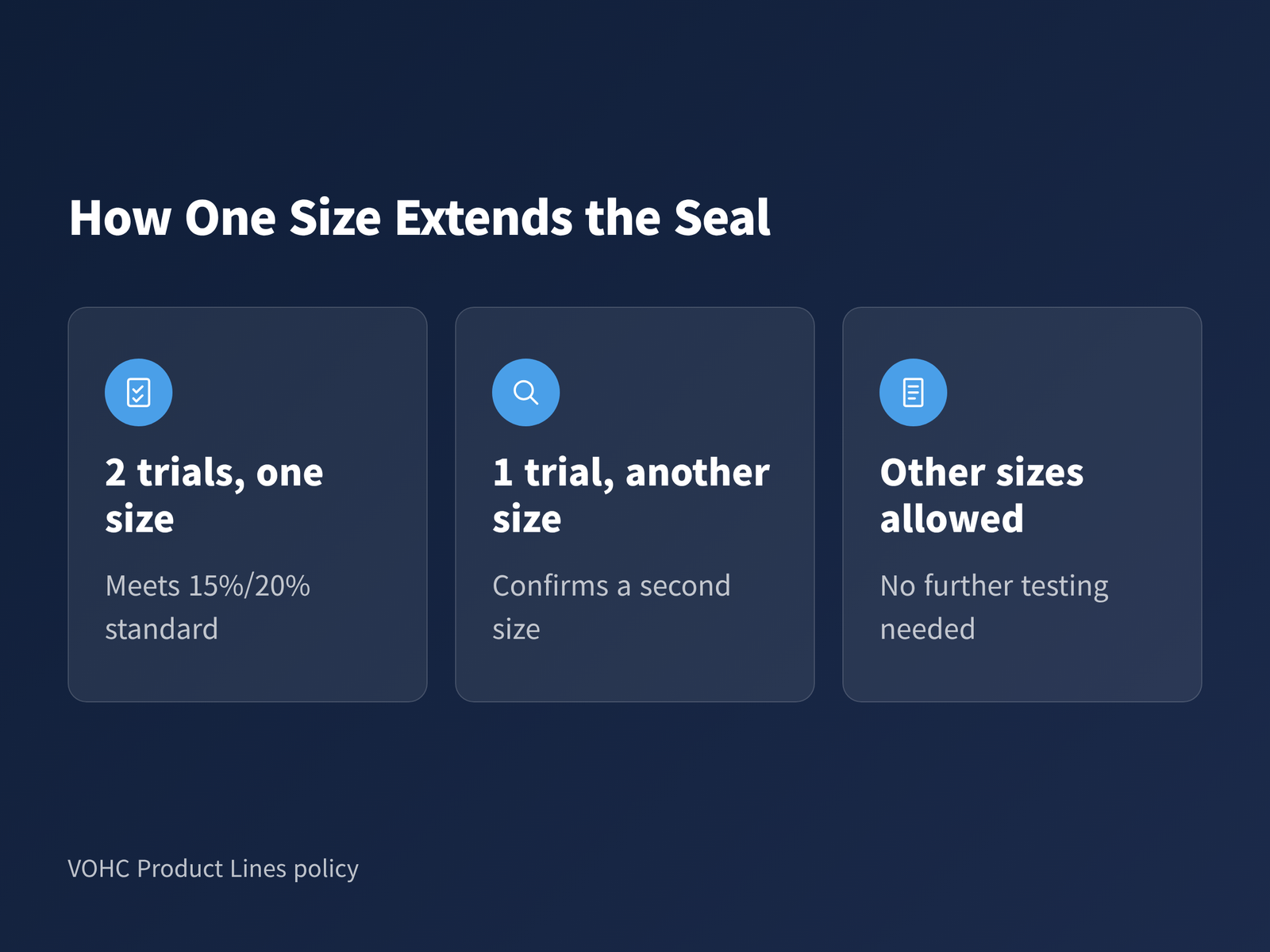
The Product Line policy has a gap for a Yorkshire Terrier owner. A product sold in several sizes needs two trials with one size plus one trial with a different size. After that, “Other sizes of product will be permitted to use the Seal without further testing.” The policy does not say the smallest size must be one of the tested sizes. Which size of each product line was actually tested is not published, so it could not be confirmed.
If a product’s sizes carry no body-weight range, the Veterinary Oral Health Council will not review them as one product line. Blue Cross gives the plain version: “The dental chews should be the correct size for your dog.”
Can a dental chew replace brushing a Yorkie’s teeth?
No, a dental chew does not replace brushing; daily brushing with dog toothpaste remains the foundation of home oral care. The American Animal Hospital Association (AAHA) Dental Care Guidelines state: “Brushing needs to be done daily to be of benefit.” The Kennel Club takes a similar line, noting that dogs ideally have their teeth brushed every day, “but even doing it a few times a week can help.”
Brushing has its own limit, which is why the two tools are layered rather than swapped. The AAHA guidelines note that brushing “only removes plaque, not calculus,” and that brushing inflamed gums causes pain and aversion. The U.S. Food and Drug Administration says: “Only use pet toothpaste for pets, never human toothpaste.” FDA veterinarian Martine Hartogensis adds: “Check the label for xylitol in the ingredients of products, especially ones that advertise as sugar-free or low sugar.”
How do dental chews compare with brushing and other options?
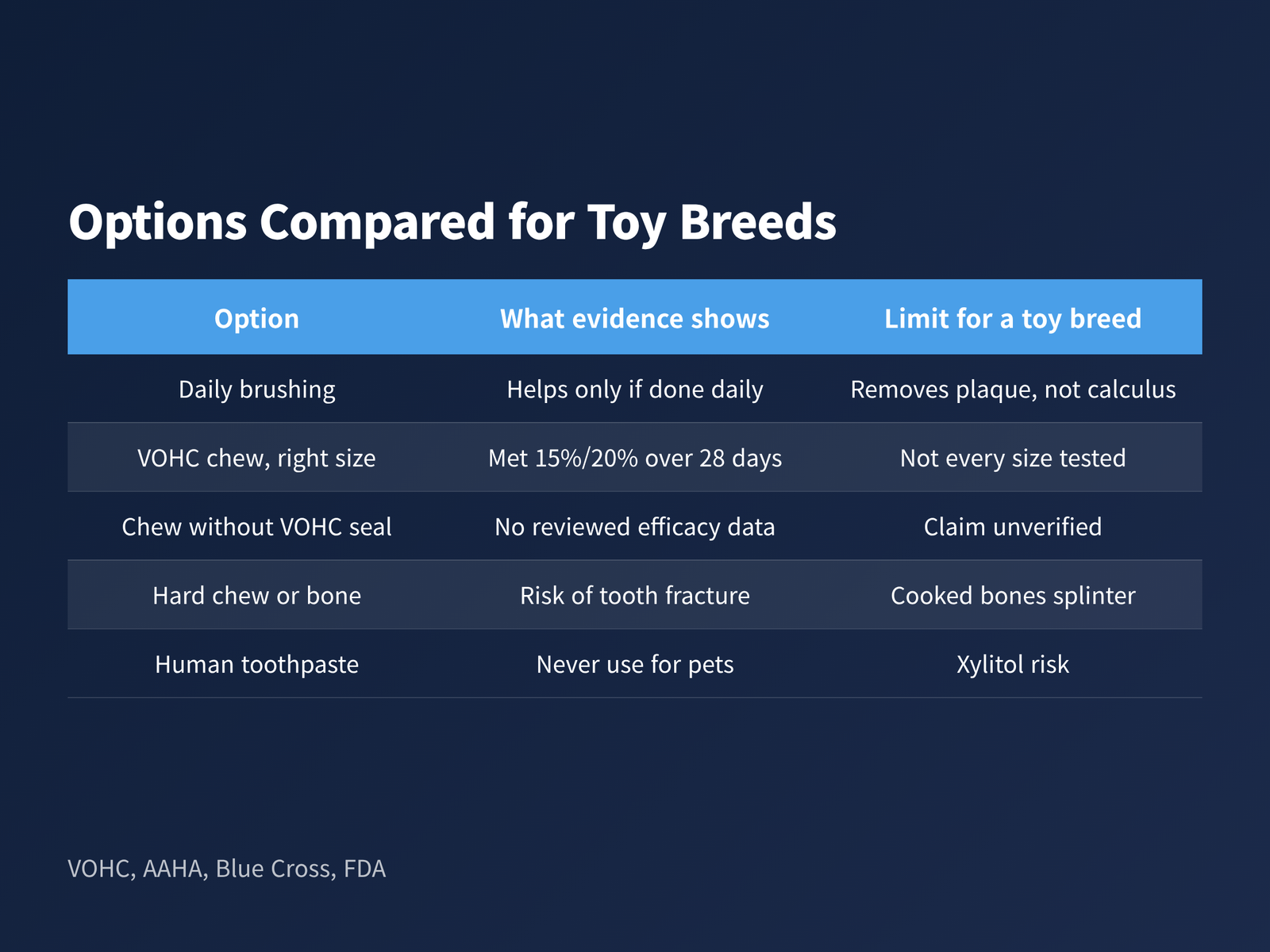
Each option has a different evidence base and a different weak spot for a toy breed, based on guidance from the Veterinary Oral Health Council, AAHA, Blue Cross and the FDA.
| Option | What evidence shows | Limit for a toy breed |
|---|---|---|
| Daily brushing, dog toothpaste | Must be daily to help | Removes plaque, not calculus |
| VOHC chew, correct size | Met 15% / 20% over 28 days | Not every size tested |
| Chew without VOHC seal | No reviewed efficacy data | Claim unverified |
| Hard chew or bone | Risk of tooth fracture | Cooked bones splinter |
| Human toothpaste | Never use for pets | Xylitol risk |
Which chews should a toy breed owner avoid?
Owners of toy breeds are best served by skipping chews with no VOHC seal, chews sized for heavier dogs, and very hard items such as bones. Blue Cross warns that hard chews risk fracturing or wearing teeth and that cooked bones splinter. Blue Cross veterinary nurse Tracey Parnell put the obstruction risk directly: “Large chunks of bone can cause life threatening blockages to a dog’s airway and gut.”
Calories are the quieter problem. Blue Cross notes that many dental chews are calorie-dense, so meals should be reduced to balance them. Choking or obstruction rates for dental chews in toy breeds could not be confirmed from an authoritative source, so supervising every chew remains the sensible default.
A practical checklist for a Yorkshire Terrier, Chihuahua or Toy Poodle owner:
- Find the exact product and size line on the VOHC accepted list
- Check whether the label claims plaque, tartar, or both
- Match the size band to your dog’s label weight range
- Supervise every chew
- Count chew calories and trim meals to match
- Keep daily brushing with dog toothpaste as the base routine
- Ask about oral health at every routine vet visit
Oral health varies between individual dogs. Please consult your veterinarian about your dog’s teeth and gums before relying on any chew.
Frequently asked questions
Is a VOHC-accepted chew safe for any size of dog?
The VOHC seal relates to plaque or tartar efficacy, not suitability for every dog. Match the size band to your dog’s weight and supervise chewing.
Does the VOHC seal mean the chew was tested on small dogs?
Not necessarily. The VOHC protocol says trials in dogs of different sizes are “encouraged but are not required,” and trials are often run in beagles.
How often should a toy breed’s teeth be brushed?
AAHA says brushing needs to be daily to be of benefit. The Kennel Club notes that even a few times a week can help.
Can a dental chew remove existing tartar?
Some VOHC-accepted chews claim tartar reduction based on trial data, but removing existing calculus is a question for your veterinarian.
Sources
- Veterinary Oral Health Council, “Trial Protocol Requirements”, viewed 2026-10-30 — https://vohc.org/trial-protocol-requirements/
- Veterinary Oral Health Council, “Product Lines” policy, viewed 2026-10-30 — https://vohc.org/product-lines/
- Veterinary Oral Health Council, “VOHC Accepted Products”, viewed 2026-10-30 — https://vohc.org/accepted-products/
- Veterinary Oral Health Council, home page, viewed 2026-10-30 — https://vohc.org/
- O’Neill DG et al., “Epidemiology of periodontal disease in dogs in the UK primary-care veterinary setting”, Journal of Small Animal Practice, 2021 — https://rvc-repository.worktribe.com/OutputFile/1551103
- Royal Veterinary College, Clinical Connections, “Epidemiology of canine periodontal disease”, Autumn 2021 — https://rvc-web-app01.live01.azure.rvc.ac.uk/clinical-connections/epidemiology-of-canine-periodontal-disease
- Wallis C et al., “Validation of Quantitative Light-Induced Fluorescence for Quantifying Calculus on Dogs’ Teeth”, Journal of Veterinary Dentistry 35(3), 2018 — https://journals.sagepub.com/doi/10.1177/0898756418786018
- American Animal Hospital Association, “2019 AAHA Dental Care Guidelines for Dogs and Cats – Recommending home oral hygiene and products”, 2019 — https://www.aaha.org/resources/2019-aaha-dental-care-guidelines-for-dogs-and-cats/recommending-products/
- U.S. Food and Drug Administration, “Paws Off Xylitol; It’s Dangerous for Dogs”, 2025-12-17 — https://www.fda.gov/consumers/consumer-updates/paws-xylitol-its-dangerous-dogs
- Blue Cross, “Dog dental care: how to clean your dog’s teeth”, reviewed 2024-10-03 — https://www.bluecross.org.uk/advice/dog/dog-dental-care
- Blue Cross, “Blue Cross warning to choose chews carefully”, 2016-05-10 — https://www.bluecross.org.uk/story/blue-cross-warning-choose-chews-carefully
- The Kennel Club, “Feeding for dental health”, undated — https://www.royalkennelclub.com/health-and-dog-care/health-dog-care/health/health-and-care/a-z-of-health-and-care-issues/feeding-for-dental-health