A breathing test for a small flat-faced puppy does not exist in certified form, because the Respiratory Function Grading Scheme (RFGS) only certifies dogs aged 12 months or older. What a buyer can check instead is the breathing grade of the puppy’s parents. That grade is useful, but it has limits. This guide covers what an RFGS grade measures, which small breeds became eligible in 2026, and what to ask a breeder before paying a deposit.
What does a breathing grade (RFGS) actually measure in a small flat-faced dog?
An RFGS grade records how well a dog breathes before and after light exercise, scored from Grade 0 to Grade 3. The Orthopedic Foundation for Animals (OFA) describes the RFGS as a screening exam for Brachycephalic Obstructive Airway Syndrome (BOAS), in which a specially trained veterinarian listens to the airway before and after a brisk three-minute walk. The University of Cambridge developed the scheme with The Kennel Club, now the Royal Kennel Club, and OFA licensed it for North America.
The RFGS exam follows four steps, according to OFA:
- A breathing health questionnaire completed by the owner
- Calm listening to the airway before exercise
- A brisk three-minute walk or trot at about 4-5 mph, stopped early if the dog shows distress, and the dog is not pulled along
- Listening again after exercise, followed by the grade
The University of Cambridge Veterinary School grading notes add one exception: if the owner reports fainting episodes or blue gums, the dog is classed as Grade III without the exercise test. Eddie Dziuk, chief operating officer of OFA, told AVMA News that “the same dog under similar conditions on the same day should achieve the same grade.”
Why can’t a puppy itself get a certified breathing grade?
A puppy cannot receive a certified RFGS grade because OFA sets the minimum age for a certifiable exam at 12 months. An exam on a younger dog counts only as a preliminary result. A buyer of an 8- to 12-week-old Shih Tzu or Pomeranian is therefore judging the parents’ RFGS grades, not the puppy’s own airway.
OFA also recommends an annual re-check for dogs under 24 months, which means a young parent dog may have a newer grade than the one first shown on a certificate. For that reason, the useful question for a breeder is not “has this puppy been tested?” but “what are the dam’s and sire’s current RFGS grades, and when were they examined?”
What do Grades 0, 1, 2 and 3 mean for a buyer?
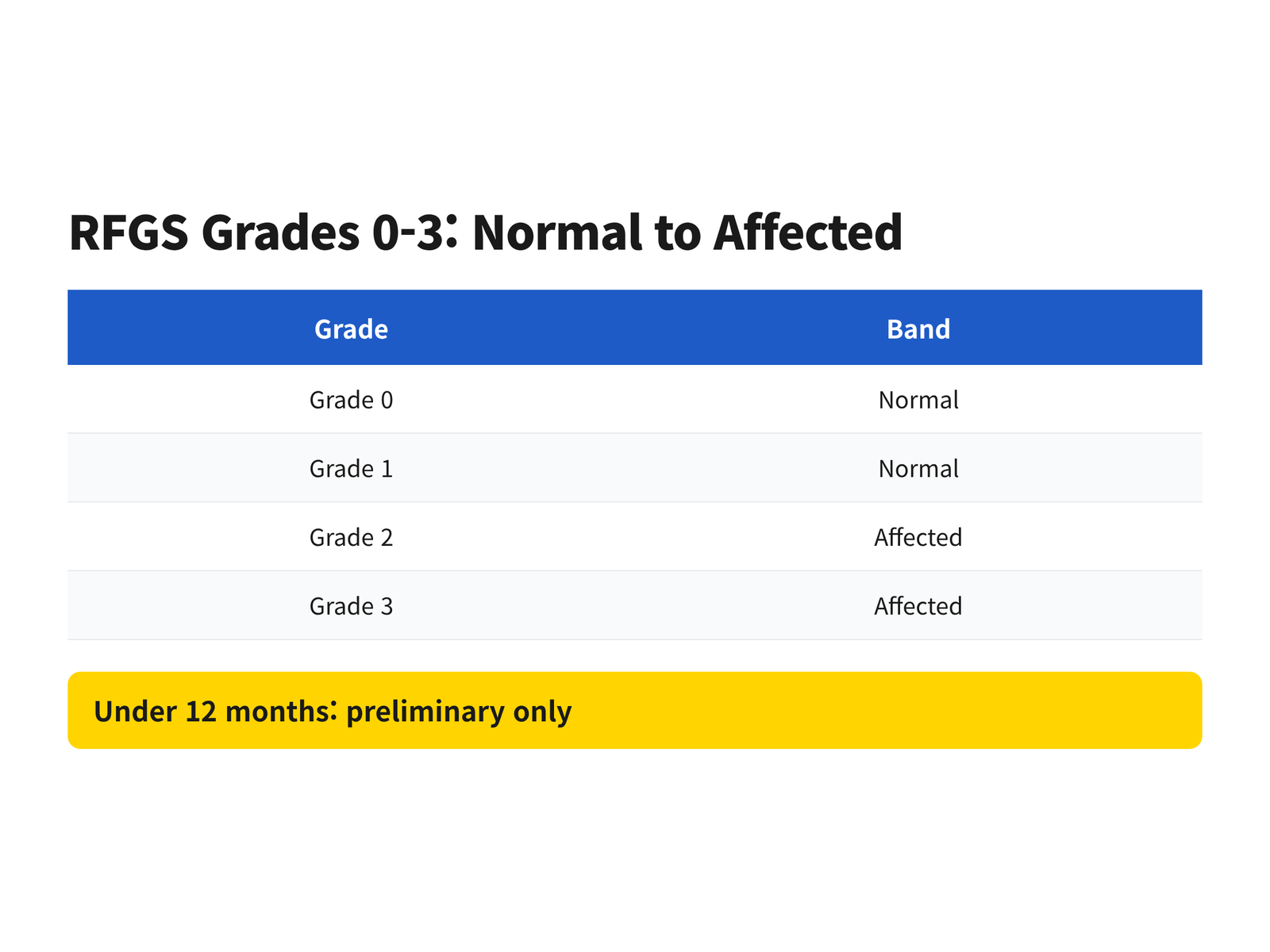
Grades 0 and 1 fall in the normal band, while Grades 2 and 3 are classed as abnormal and indicate BOAS, according to AVMA News. The table below translates each RFGS grade into buyer terms.
| Grade | What the examiner hears | Buyer meaning |
|---|---|---|
| Grade 0 | No airway noise, even by stethoscope | Clinically unaffected |
| Grade 1 | Mild noise, stethoscope only | Unaffected, mild signs |
| Grade 2 | Noise audible without stethoscope | Affected, moderate |
| Grade 3 | Severe noise and effort | Affected, severe |
| Under 12 months | Preliminary exam only | Not certifiable |
The Grade 1 versus Grade 2 line matters most for a puppy buyer. A Grade 1 parent still sits in the normal band, while a Grade 2 parent has breathing noise loud enough to hear without a stethoscope. The University of Cambridge stated in 2019 that dogs graded 3 should not be bred from, and AVMA News reported that Grade 2 or Grade 3 dogs should be bred with caution or excluded. Dr Jane Ladlow, Chief Assessor of the RFGS, put the core point plainly in VetClick: “Noisy breathing is never normal. If you can hear a dog struggling to breathe, they are affected.”
Which small breeds can now get an RFGS grade, and how risky is each one?
Since April 2026, 14 more breeds can be graded, and the list includes the Shih Tzu, Pekingese, Japanese Chin, Chihuahua, Pomeranian, Brussels Griffon and Affenpinscher. The Canadian Kennel Club and OFA list the newly eligible breeds, and Dogs Australia published a matching Royal Kennel Club list. The Maltese appears on the Royal Kennel Club and Canadian Kennel Club lists, but the OFA page is not consistent on the Maltese, so confirm eligibility on the registry’s own website.
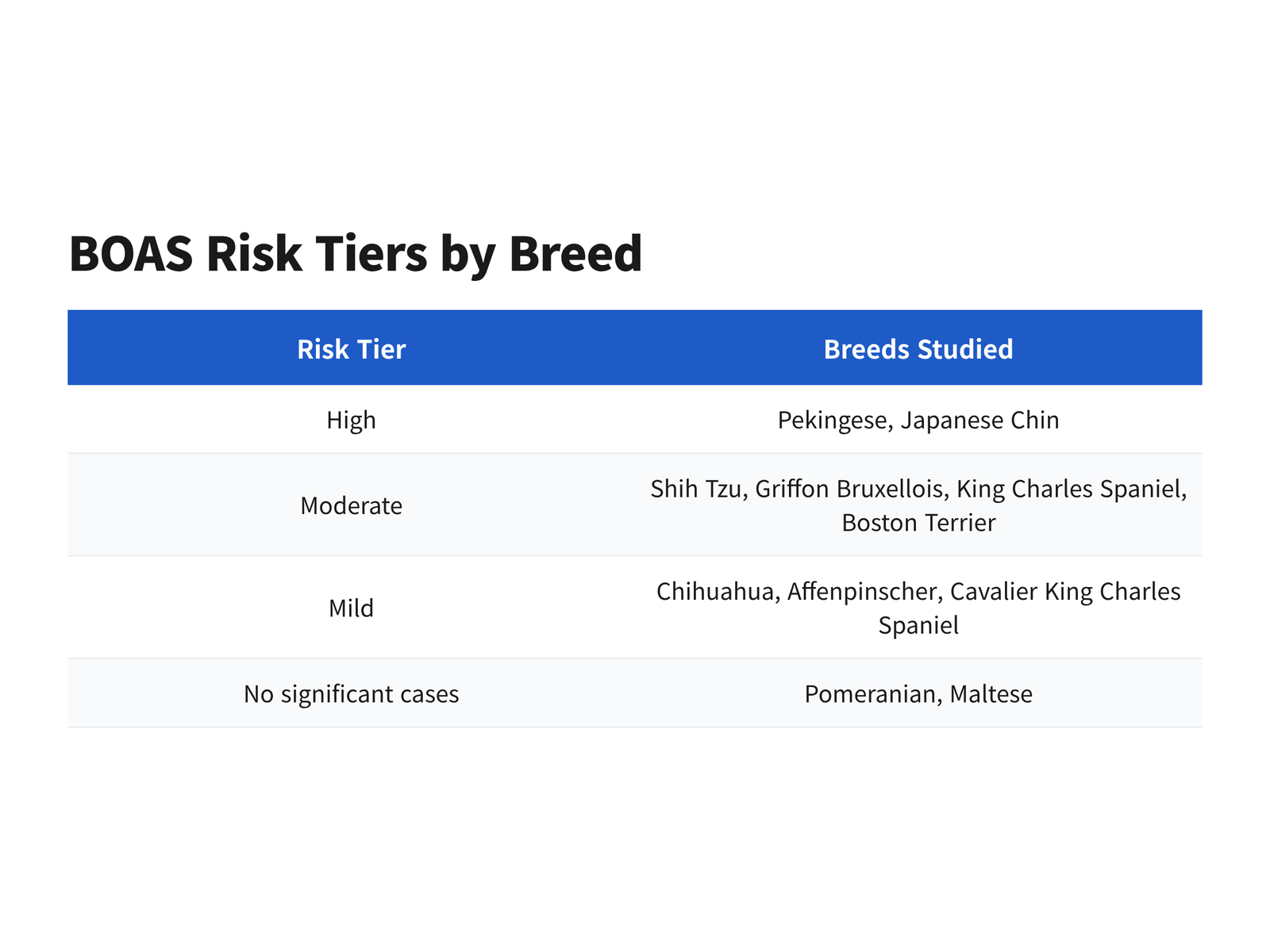
A PLOS ONE study by Tomlinson and colleagues examined 898 dogs from 14 breeds and found some detectable abnormality in 12 of them, according to the University of Cambridge. The study groups small breeds into rough risk tiers:
- High risk: Pekingese and Japanese Chin. Only 10.9% of 46 Pekingese and 17.4% of 46 Japanese Chin were Grade 0.
- Moderate risk: Shih Tzu, Griffon Bruxellois, King Charles Spaniel and Boston Terrier.
- Mild risk: Chihuahua, Affenpinscher and Cavalier King Charles Spaniel.
- No clinically significant cases in the sample: Pomeranian (51 dogs) and Maltese (32 dogs).
The PLOS ONE authors wrote that “only the Maltese and Pomeranian had no dogs with clinically significant disease.” Dr Fran Tomlinson of the Cambridge Veterinary School added that “BOAS exists on a spectrum,” so a mild-risk breed label is a description of a sample, not a promise about any one Chihuahua.
Why doesn’t a parent’s Grade 0 guarantee a healthy puppy?
A parent’s Grade 0 lowers the odds but does not guarantee a BOAS-free puppy, because OFA states that BOAS inheritance is not fully understood and is not entirely predictable. Dr Jane Ladlow said at the 2019 launch that “the way that BOAS is inherited is very complex and so not always entirely predictable.” The RFGS cannot promise that puppies from unaffected parents will be free of BOAS.
Appearance is also a weak shortcut. In the PLOS ONE study, nostril narrowing, body condition and craniofacial ratio together explained only about 20% of the variation in BOAS status. The University of Cambridge reported that only about 6% of Pekingese and 18% of Japanese Chin had open nostrils. That is why a breathing assessment remains the most accurate way to identify BOAS status, rather than judging a Pekingese by its face.
Body condition has a role for some breeds. The University of Cambridge found that being overweight was significant for the Cavalier King Charles Spaniel, Shih Tzu and Affenpinscher. Keeping a Shih Tzu lean is a sensible management habit, not a cure. If a dog of any breed already breathes noisily, consult your veterinarian rather than relying on a grade or a breed label.
Why is a missing grade on a public database not the same as a pass?
A missing RFGS result on the OFA database can mean the dog was never tested, or that it scored Grade II or III and the owner chose not to publish it. OFA releases Grade 0 and Grade I results by default with a certification number, but releases Grade II and Grade III results only with the owner’s authorization. A breeder can therefore hold results that never appear publicly.
Testing is also uncommon. VetClick reported that most UK-bred Pugs, French Bulldogs and Bulldogs are not tested, and that pet-bred dogs are tested far less often than show dogs. For a buyer, the practical step is to ask for the certificate itself, with the certification number, instead of relying on a database search.
What should you ask a breeder for before paying a deposit?
Ask for both parents’ RFGS certificates, the grade on each, and the exam date, before any money changes hands. Dr Jane Ladlow noted that “being aware of risk factors can be useful for both breeders and prospective owners,” and a parent’s certificate is the clearest risk factor a buyer can see. A short checklist for a small flat-faced puppy:
- The dam’s and sire’s RFGS grades, shown on the certificate, not described verbally
- The certification number, so the result can be checked with the registry
- The exam date, since OFA recommends yearly re-checks for dogs under 24 months
- Whether either parent has ever been graded 2 or 3
- Which registry issued the grade, since breed lists differ by registry
Clear answers on each point give a buyer far more to go on than a promise of a “healthy line.”
Frequently asked questions
Can a Shih Tzu puppy get an RFGS breathing test before going home?
A Shih Tzu puppy can have a preliminary exam, but OFA certifies RFGS grades only from 12 months of age. A buyer should look at the parents’ certified grades instead.
Is Grade 1 a bad result for a parent dog?
Grade 1 sits in the normal band, according to AVMA News and OFA. It means mild airway noise heard only with a stethoscope, and OFA classes it as clinically unaffected.
Is a Pomeranian or Maltese free of breathing problems?
In the 2026 PLOS ONE sample, no Pomeranian or Maltese had clinically significant disease. That finding describes 51 Pomeranians and 32 Maltese, not every dog of either breed.
Does a snoring dog have BOAS?
A breed article cannot answer that for an individual dog. Dr Jane Ladlow has said noisy breathing is never normal, so consult your veterinarian about any dog with noisy breathing.
Sources
- Orthopedic Foundation for Animals, “Respiratory Function Grading Scheme (RFGS)”, modified 2026-10-26 — https://ofa.org/diseases/rfgs/
- Tomlinson F, Liu NC, Sargan D, Ladlow JF, “A cross-sectional study into the prevalence and conformational risk factors of BOAS across fourteen brachycephalic dog breeds”, PLOS ONE 21(2): e0340604, 2026-02-18 — https://journals.plos.org/plosone/article?id=10.1371%2Fjournal.pone.0340604
- University of Cambridge, “Pekingese, Shih Tzu and Staffordshire Bull Terrier among twelve dog breeds at risk of serious breathing condition”, 2026-02 — https://www.cam.ac.uk/research/news/pekingese-shih-tzu-and-staffordshire-bull-terrier-among-twelve-dog-breeds-at-risk-of-serious
- University of Cambridge, “Scheme launched to improve health of French bulldogs, pugs and bulldogs”, 2019-02-04 — https://www.cam.ac.uk/research/news/scheme-launched-to-improve-health-of-french-bulldogs-pugs-and-bulldogs
- University of Cambridge Veterinary School, “Functional grading” (undated PDF) — https://www.vet.cam.ac.uk/system/files/documents/Functionalgrading.pdf
- AVMA News, “Health screening test rolled out for brachycephalic dog breeds”, 2023-01-30 — https://www.avma.org/news/health-screening-test-rolled-out-brachycephalic-dog-breeds
- Canadian Kennel Club, “Advancing Breed Health Update”, May 2026 — https://www.ckc.ca/en/News/2026/May-2026/Advancing-Breed-Health-Update
- Dogs NSW, “From Dogs Australia: Updated list of breeds that can be assessed under the RFG scheme”, April 2026 — https://www.dogsnsw.org.au/about-us/news-updates/2026/april/from-dogs-australia-updated-list-of-breeds-that-can-be-assessed-under-the-rfg-scheme/
- VetClick, “Noisy breathing in flat-faced dogs is never normal…”, 2026-05-20 — https://www.vetclick.com/news/noisy-breathing-in-flat-faced-dogs-is-never-normal-new-research-proves-selective-breeding-can-change-that-p11977.php