Most front-of-bag words describe how a dog food was made or named, not how well it feeds your dog. Knowing what dog food label claims don’t mean starts with one fact from AAFCO itself: “There is no AAFCO-approved pet food.” Terms like “human grade,” “natural,” “premium” and “with chicken” each follow a narrow rule, or no rule at all. Below: each claim, the newer label format reaching shelves, and why a measuring cup is a weak tool for small-dog portions.

Does “human grade” on a dog food label mean the food is better for a small dog?
No. “Human grade” is a handling and processing standard, not a nutrition grade. Under the AAFCO Human Grade Claim FAQ, the claim is acceptable only for the product as a whole: every ingredient and the finished product must be stored, handled, processed and transported under 21 CFR part 117, the US human food rules. A single “human grade ingredient” claim is not allowed, and human-grade ingredients cannot be mixed with other food before final packaging.
The AAFCO human grade FAQ addresses how the food moves through the supply chain. The AAFCO human grade FAQ does not address nutritional adequacy or overall quality. A human-grade dog food still needs its own nutritional adequacy statement before it can serve as a complete diet. Whether a human-grade product suits your small dog depends on that adequacy statement and on your dog’s own needs, which your veterinarian can assess.
What does “natural” on a dog food bag actually allow?
“Natural” allows ingredients from plant, animal or mined sources that were not produced by a chemically synthetic process. AAFCO defines a natural feed as one “derived solely from plant, animal or mined sources,” with only trace synthetic amounts consistent with good manufacturing practice.
A “natural” dog food can still contain synthetic vitamins, minerals and trace nutrients. The label must then carry a disclaimer such as “Natural with added vitamins, minerals and trace nutrients,” which AAFCO calls “a disclaimer – not a boast.” The natural claim also says nothing about safety. In the AAFCO wording: “There is no requirement or statement that natural feeds or ingredients are safer.” A small-dog owner reading “natural” learns something about sourcing and processing, and nothing about whether the food is safer or more nutritious.
Is there such a thing as an “AAFCO approved” dog food?
No. AAFCO states plainly: “AAFCO does not approve, certify or otherwise endorse pet foods. There is no AAFCO-approved pet food.” A bag that implies AAFCO approval is describing something AAFCO says does not exist. “Premium” is weaker still. AAFCO says: “Unlike natural and organic, ‘premium’ is a totally unregulated term in feed law.”
AAFCO writes model rules, and the FDA notes that “AAFCO itself has no regulatory authority”; individual states adopt the AAFCO model language. The FDA Center for Veterinary Medicine adds that animal food “doesn’t need FDA’s pre-market review to be legally marketed” unless the food contains a food additive. The wording that does carry meaning is the nutritional adequacy statement. “Complete and balanced” means, per the FDA, “the product is intended to be fed as a pet’s sole diet,” and the food must meet an AAFCO Dog Food Nutrient Profile or pass an AAFCO feeding trial.
What is the difference between “beef dog food”, “beef dinner”, “with beef” and “beef flavor”?
The wording around the protein name sets a minimum amount, and the minimum drops sharply as the wording changes. Under the AAFCO Reading Labels rules, a product named only “Beef Dog Food” must contain at least 95% beef by weight, not counting added water, or 70% counting water.
A “dinner,” “entree” or “platter” name requires at least 25% of the named ingredient, not counting added water. A “with beef” name requires only 3% of each named ingredient. A “beef flavor” name has no percentage at all; the flavor only has to be detectable. Virginia Tech’s extension guide to pet food labels lists the same rules. Two bags that both show a large picture of beef can therefore differ from 95% beef down to no set minimum.
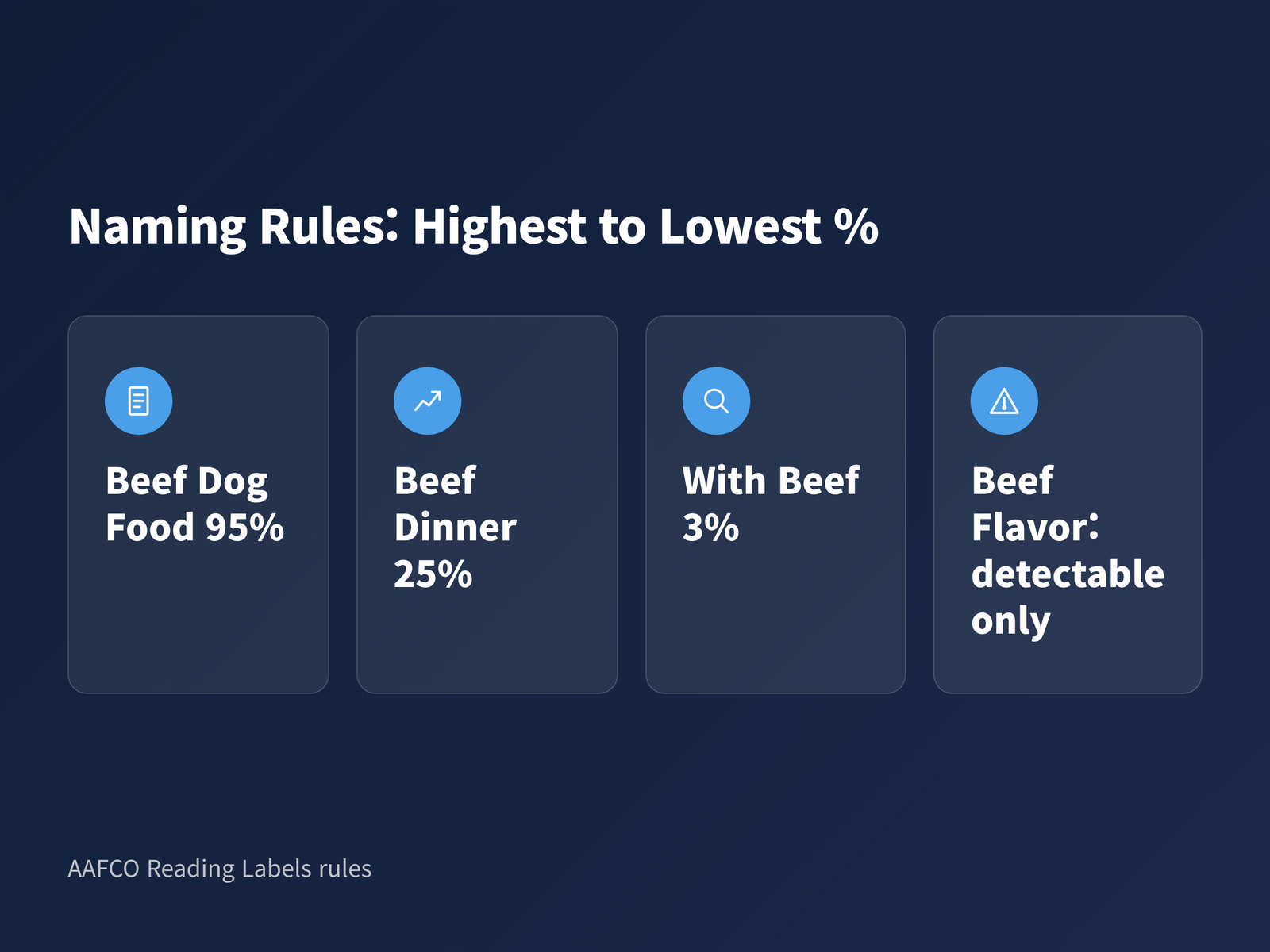
Label claim vs. what the rule actually requires
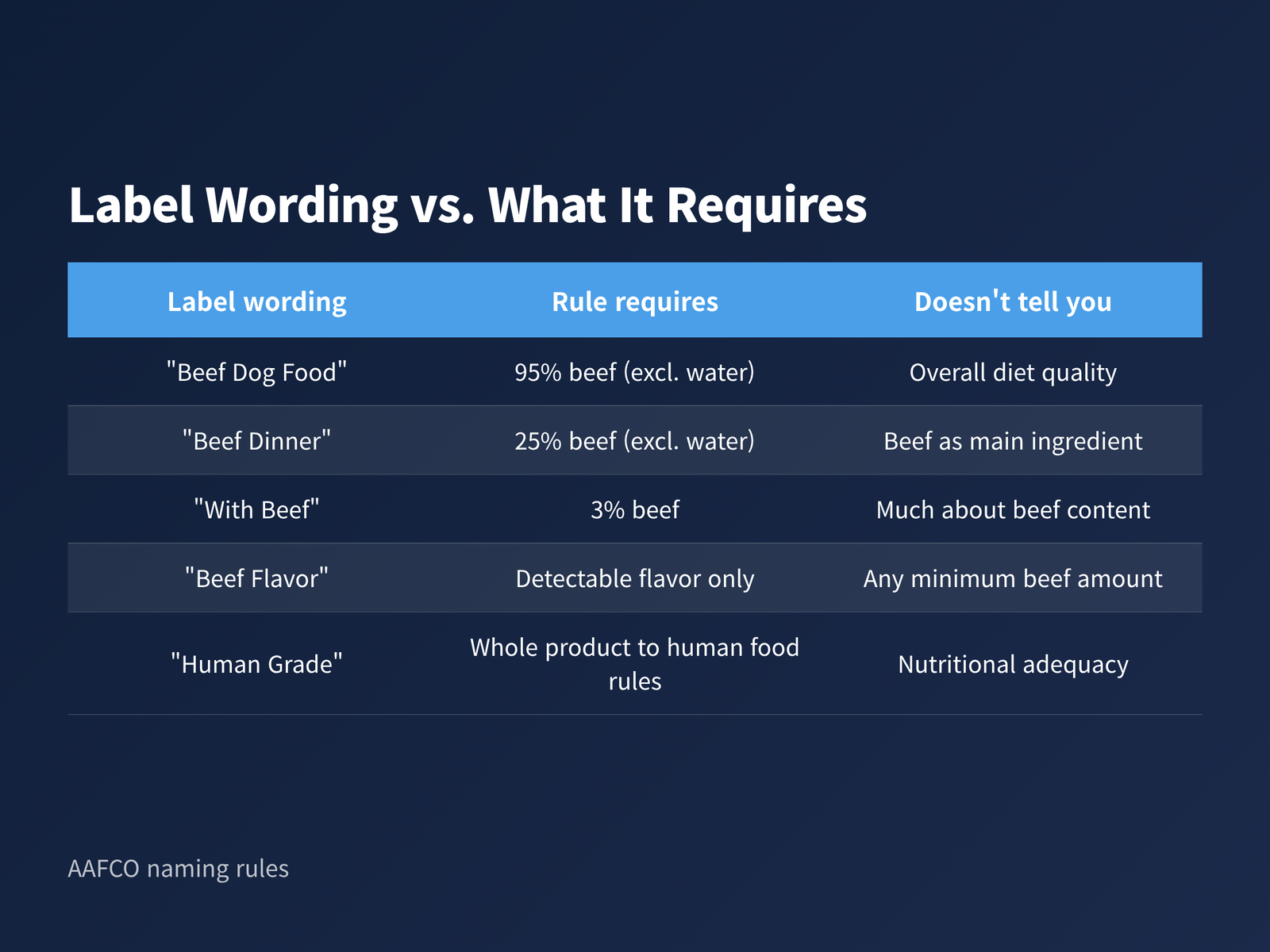
Each AAFCO naming rule sets a floor, not a quality grade. The table below sets each common dog food label wording beside the rule that wording must meet and the gap that rule leaves for a small-dog owner comparing two bags.
| Label wording | What the rule requires | What it does not tell you |
|---|---|---|
| “Beef Dog Food” | 95% beef (excl. water) | Overall diet quality |
| “Beef Dinner” | 25% beef (excl. water) | Beef as main ingredient |
| “With Beef” | 3% beef | Much about beef content |
| “Beef Flavor” | Detectable flavor only | Any minimum beef amount |
| “Human Grade” | Whole product to human food rules | Nutritional adequacy |
What will the new AAFCO intended use statement tell small-dog owners?
The new intended use statement will tell owners, on the front of the bag, whether a product is a complete food, a treat, a supplement or a mixer. AAFCO members approved the Pet Food Label Modernization (PFLM) model regulations in 2023, and AAFCO recommended six years of enforcement discretion starting from the printed 2024 Official Publication.
On new labels, the intended use statement sits on the lower third of the front panel. Options include “Complete Dog Food” for all life stages and sizes, puppy and adult options that reference a 70 lb adult size, “Dog Treat,” “Dog Food Supplement” and “Dog Food Mixer.” A mixer tops, accompanies or adds to a complete diet and is not one itself. Toppers and products marked “intermittent or supplementary feeding only” are not meals, which matters for a small dog fed mostly toppers.
The new Pet Nutrition Facts box will list calories, calories from protein, fat and carbohydrate, a calculated maximum total carbohydrate, and dietary fiber in place of crude fiber. AAFCO executive director Austin Therrell said: “New packaging and labels will be well-defined and easy to understand.” Because states decide adoption, old and new label formats will share shelves for years.
Why do measuring cups fail most with small-dog portions?
Measuring cups fail most with small portions because cup error grows as the portion shrinks. In a study by German and colleagues in the Journal of Animal Physiology and Animal Nutrition, kibble measured with cups ranged from an 18% under-estimate to an 80% over-estimate, and inaccuracy was negatively correlated with portion size (R = -0.67).
A later study by Coe and colleagues at the Ontario Veterinary College, University of Guelph, found individual owners’ cup measurements ranging from -47.83% to +152.17%. The University of Guelph Pet Trust summary concludes that “a gram scale is the most accurate measurement system.” Dr. Jason Coe said: “Our study results have an extremely practical application for both pet owners and veterinarians.” Small dogs eat small portions, so a scoop habit hits them hardest. The right number of grams for your dog is a question to bring to your veterinarian.
How should a small-dog owner read a dog food bag?
A small-dog owner should read the bag from the regulated statements outward, not from the front-panel claims inward. The regulated statements carry defined meanings; the marketing words often do not. The steps below follow the AAFCO label guidance for current and new labels.
- Find the nutritional adequacy statement; on new labels it moves to the bottom of the Pet Nutrition Facts box.
- On new labels, check the intended use statement on the lower third of the front panel.
- Read the product name against the 95%, 25%, 3% and flavor rules.
- Read the “Calorie Content” line, given per kilogram and per a familiar unit such as a cup.
- On new labels, read the household measure and its gram weight; the AAFCO example shows “1 cup (8 oz standard measuring cup) = 32 g.”
- Weigh portions in grams with a kitchen scale.
Food choice and portion size both depend on your individual dog, so consult your veterinarian before changing diets or feeding amounts. The guaranteed analysis on current labels gives minimum crude protein, minimum crude fat, maximum crude fiber and maximum moisture, which helps when comparing products side by side.
Frequently asked questions
Is “premium” dog food held to a higher standard?
No. AAFCO describes “premium” as “a totally unregulated term in feed law,” so the word premium on a dog food bag does not signal any legal standard. The nutritional adequacy statement is the better guide.
Does “natural” mean a dog food has no synthetic ingredients?
Not always. A natural dog food can include synthetic vitamins, minerals and trace nutrients if the label carries a disclaimer such as “Natural with added vitamins, minerals and trace nutrients.”
Are all dog food bags already using the new label format?
No. The PFLM rules were approved in 2023 with a six-year enforcement discretion period, and states decide adoption, so old and new formats will coexist on shelves. Check both the front panel and the back panel on any bag.
Can a topper be a small dog’s main meal?
A product labeled “intermittent or supplementary feeding only,” or a new “Dog Food Mixer” label, is not a complete diet. Ask your veterinarian how to build a complete diet around toppers.
Sources
- AAFCO, “Reading Labels” (modified 2024-06-11) – https://www.aafco.org/consumers/understanding-pet-food/reading-labels/
- AAFCO, “Natural” (modified 2024-06-11) – https://www.aafco.org/consumers/understanding-pet-food/natural/
- AAFCO, “Frequently Asked Questions” (modified 2025-01-09) – https://www.aafco.org/consumers/understanding-pet-food/frequently-asked-questions/
- AAFCO, “Human Grade Pet & Specialty Pet Food Claim Frequently Asked Questions” (2024-09-06) – https://www.aafco.org/wp-content/uploads/2024/12/hg_DOC.pdf
- AAFCO, “AAFCO Membership Approves New Model Pet Food and Specialty Pet Food Regulations” (2023-07-31) – https://www.aafco.org/news/aafco-membership-approves-new-model-pet-food-and-specialty-pet-food-regulations/
- AAFCO, “Position on Enforcement Discretion Related to Pet Food Label” (2023-07-31) – https://www.aafco.org/wp-content/uploads/2023/07/AAFCO-PFLM-Enforcement-Recommendation-Letter-FINAL.pdf
- AAFCO, “Intended Use Statement and Nutritional Adequacy Claims – Major Label Changes” (July 2023) – https://www.aafco.org/wp-content/uploads/2023/10/AAFCO-PFLM-Intended-Use-One-Page-Final-July-2023.pdf
- AAFCO, “Pet and Specialty Pet Nutrition Facts – Major Label Changes” (July 2023) – https://www.aafco.org/wp-content/uploads/2023/10/AAFCO-PFLM-Nutrition-Facts-Final-July-2023.pdf
- FDA Center for Veterinary Medicine, “‘Complete and Balanced’ Pet Food” (2020-02-28) – https://www.fda.gov/animal-veterinary/animal-health-literacy/complete-and-balanced-pet-food
- FDA Center for Veterinary Medicine, “FDA’s Regulation of Pet Food” (2022-02-17) – https://www.fda.gov/animal-veterinary/animal-health-literacy/fdas-regulation-pet-food
- German AJ, Holden SL, Mason SL, et al., “Imprecision when using measuring cups to weigh out extruded dry kibbled food,” Journal of Animal Physiology and Animal Nutrition 95(3):368-373 (2011) – https://agris.fao.org/search/en/providers/122535/records/65df2829b766d82b18006a62
- Virginia Cooperative Extension, “A Consumer’s Guide: Overview of Pet Food Labels” FST-434P (2022-10-05) – https://pubs.ext.vt.edu/FST/fst-434/fst-434.html
- University of Guelph OVC Pet Nutrition, “My cup runneth over” (2019-11-27, updated 2025-08-13) – https://ovcpetnutrition.uoguelph.ca/2019/11/27/my-cup-runneth-over
- University of Guelph Pet Trust, “How Measuring That Kibble Can Help Your Dog Live a Longer, Healthier Life” – https://pettrust.uoguelph.ca/node/240