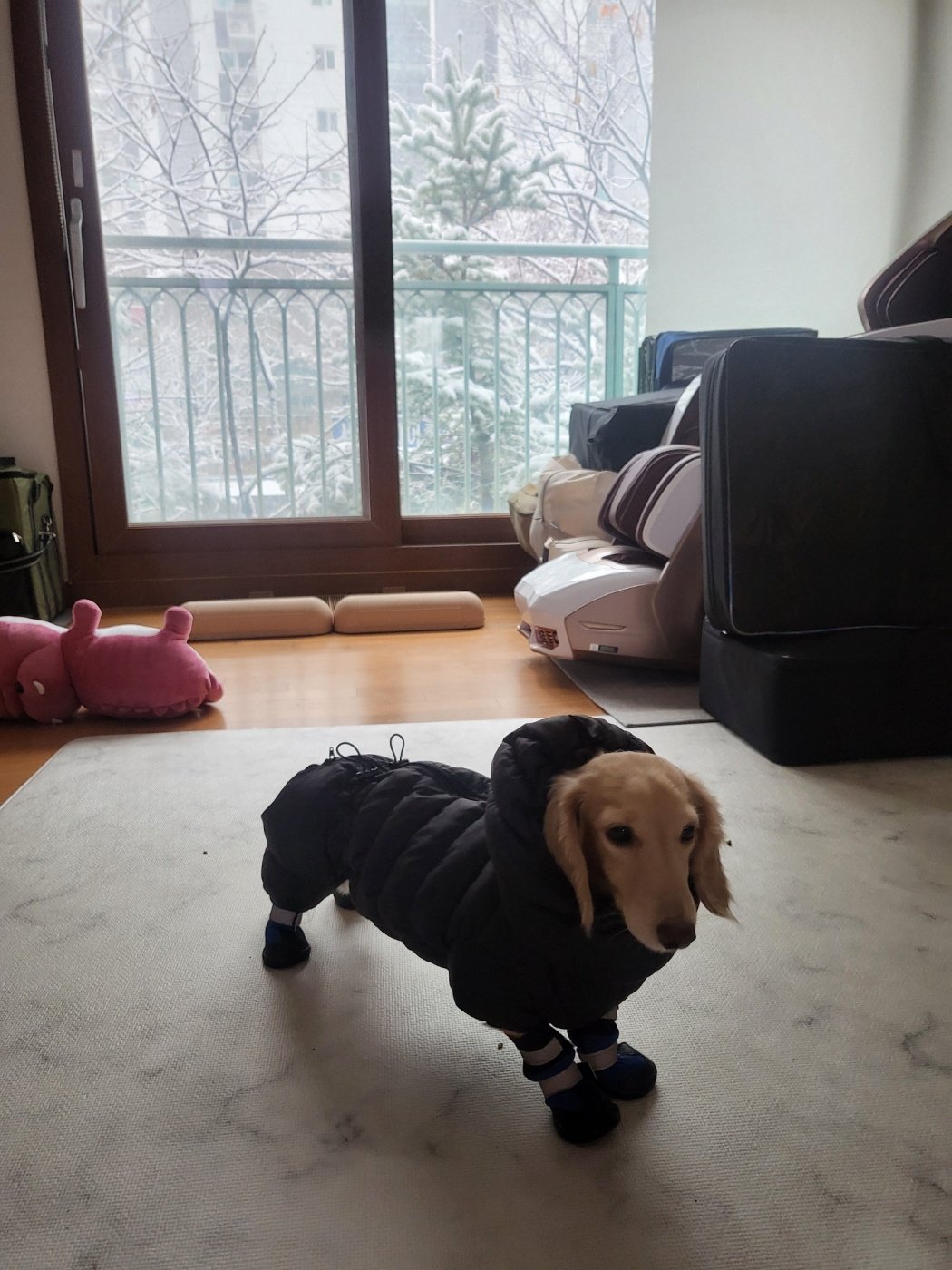
A sweater keeps a Dachshund’s back and chest warmer, but a sweater does not stop a low-slung belly from getting wet when it touches snow, and a sweater does nothing about the grit, rock salt and antifreeze that collect on paws and tummy. Smaller dogs struggle to hold body heat in cold weather, and low-to-ground breeds such as Dachshunds get wet bellies from contact with snow and ice. The fix is a routine, not a single garment: short walks on very cold days, a wipe-down at the door, and full drying before sleep.
Why isn’t a sweater enough for a dachshund in snow?
A sweater is not enough for a Dachshund in snow because the Dachshund’s belly sits close to the ground and the sweater does not cover the belly. The American Kennel Club (AKC) names Basset Hounds and Dachshunds as low-to-ground dogs and notes that “their bellies easily become wet when touching snow and ice.” A sweater wraps the back and chest, which are the parts furthest from the snow. On a long, short-legged body, the most exposed surface is underneath, and that surface stays bare.
The AKC adds a second reason small dogs feel winter more: “Because of their small size, these dogs can’t maintain their body heat in cold weather.” A sweater helps with the top half of the problem. The bottom half, the wet belly and the paws, needs a different answer, and that answer happens mostly after the walk.
Why do low-to-ground dogs get wet and cold faster on snowy walks?
Low-to-ground dogs such as Dachshunds and Basset Hounds get wet faster because their bellies sit close to the ground and come into contact with snow and ice. The AKC names those two breeds specifically and notes that “their bellies easily become wet when touching snow and ice.” For other short-legged small dogs, how much snow reaches the belly depends on the individual dog’s build and the depth of the snow.
Fur on the legs and paws adds a second problem. The Royal Kennel Club advises owners to “try your best to dust them off as they collect on your walk,” referring to snowballs that build up in fur. The RSPCA notes that trimming paw and ear fur “prevents ice balls from forming, which are heavy and painful.” On a longhaired Dachshund, leg and paw fur sits below the sweater line.
Why is a small dog still cold while wearing a coat?
A small dog can still be cold in a coat because size, age, coat type and health all affect how well a dog holds heat, and a garment changes none of those factors. The RSPCA lists the dogs most affected by cold as “Elderly dogs, young dogs, dogs with thin or short fur and dogs with pre-existing medical conditions.” The Royal Kennel Club says “some smaller or short coated dogs feel cold in the winter nip,” and the PDSA notes that breeds “like Chihuahuas and small Terriers, can feel the cold quickly.”
The American Veterinary Medical Association (AVMA) puts the garment in its proper place: “If your dog has a short coat or seems bothered by cold, consider a sweater or dog coat.” A coat is one tool among several. The AKC also states that “there isn’t an exact temperature that’s too cold for all dogs,” so no single garment or thermometer reading can confirm that a particular small dog is warm enough. If a Chihuahua, Dachshund or other small dog still seems unusually cold, shivering or unwell after coming inside, consult your veterinarian rather than adding more layers.
What should you wipe off a small dog’s paws and belly after a winter walk?
After a winter walk, wipe grit, rock salt and antifreeze off both the paws and the tummy, because a sweater does not catch any of them. The RSPCA advises owners to “thoroughly wipe down their paws and tummy to remove grit, antifreeze and rock salt, which are poisonous to dogs.” Blue Cross adds that salt and grit “can irritate paw pads and may be harmful if your dog licks it off.” For a Dachshund, the tummy matters as much as the feet, since the belly brushes the same treated pavement.
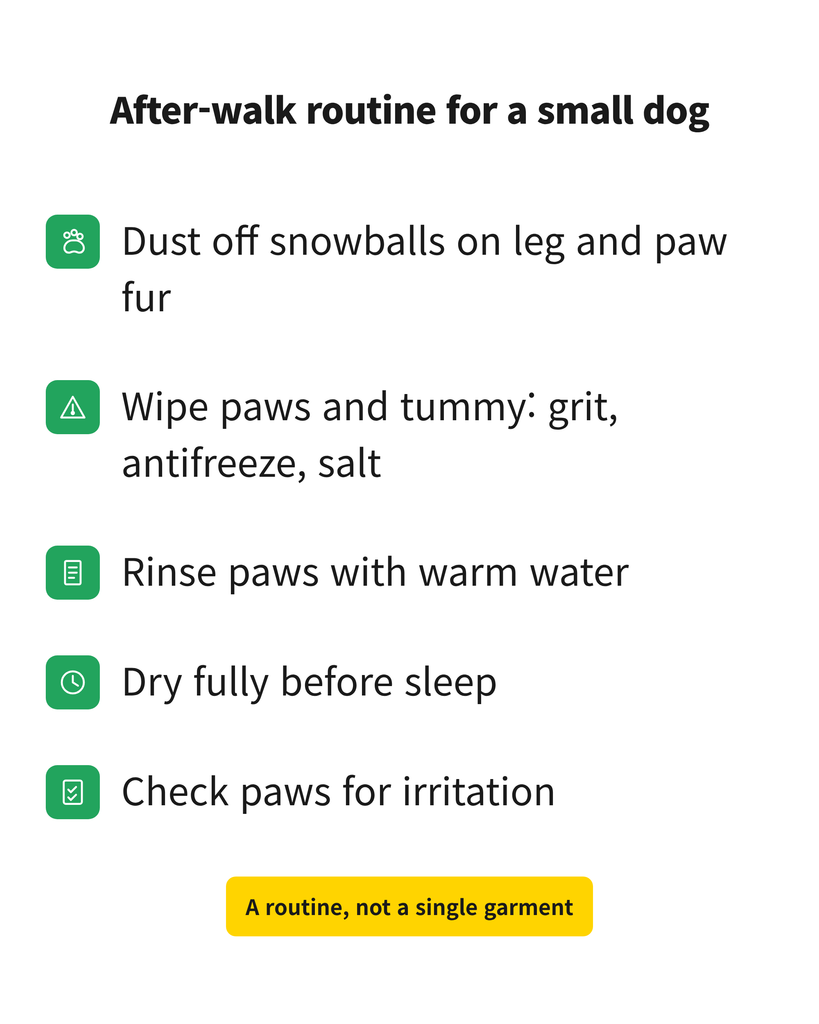
A simple after-walk routine, built from RSPCA, Royal Kennel Club, Blue Cross and AVMA guidance, looks like this:
- Dust off snowballs from leg and paw fur during the walk (Royal Kennel Club).
- Wipe down paws and tummy at the door to remove grit, antifreeze and rock salt (RSPCA).
- Rinse paws with warm water, “as the salt can cause skin irritation” (Royal Kennel Club).
- Dry the dog fully with a towel, a drying coat or a blow dryer before sleep (RSPCA).
- Check paws frequently “for signs of irritation or injury” (AVMA).
Antifreeze needs extra caution. The Royal Kennel Club warns that antifreeze “can damage their kidneys and cause death, even after only a small amount has been licked,” and advises owners to contact a vet immediately if contact is suspected. Drying also deserves attention: the Royal Kennel Club suggests “A warm towel to lay on or a specialist moisture wicking drying coat,” and the AKC warns that coats can harbor bacteria, especially if put away damp after being in the snow.
How long should a small dog stay outside on very cold, icy days?
On very cold, icy days, a small dog should spend as little time outside as possible, and the sources cited here do not set a universal number of minutes. The Royal Kennel Club advises owners to “try to keep the time they spend outside to a minimum,” and the AVMA says simply: “Shorten walks in very cold weather.” The AKC confirms there is no exact temperature that is too cold for all dogs, and the guidance from these organisations points to shorter outings rather than a fixed cut-off.
The RSPCA gives one specific figure, but only for dogs with a known heart condition: no more than 20 minutes outside at a time in winter. That 20-minute figure is not a general limit for healthy small dogs. Ice brings its own risk. The RSPCA warns that “thin ice may break under their weight,” and Blue Cross advises: “Avoid frozen ponds and lakes, and keep your dog on a lead near frozen water.” If a dog does go onto the ice, Blue Cross says “do not follow them.”
Can a small dog overheat if it keeps the sweater on indoors?
Yes, a small dog can overheat if the sweater stays on indoors, so the sweater should come off once the dog is home and dry. The PDSA states that “Most dogs won’t need to wear a coat indoors as they can quickly overheat in modern, centrally heated homes.” A Dachshund that was cold outside can become too warm within a heated room, and a sweater that was helpful on the pavement becomes an extra layer the dog cannot remove.
The RSPCA gives a useful indoor benchmark: try to keep inside temperatures between 10°C and 25°C, with the sleeping area kept above 10°C. Fit matters while the sweater is on, too. The PDSA says clothing must let a dog move freely, and the AKC warns that a jacket “shouldn’t be so loose as to present a hazard where a dog could become entangled.”
How does a sweater compare with a full-coverage suit or drying coat?
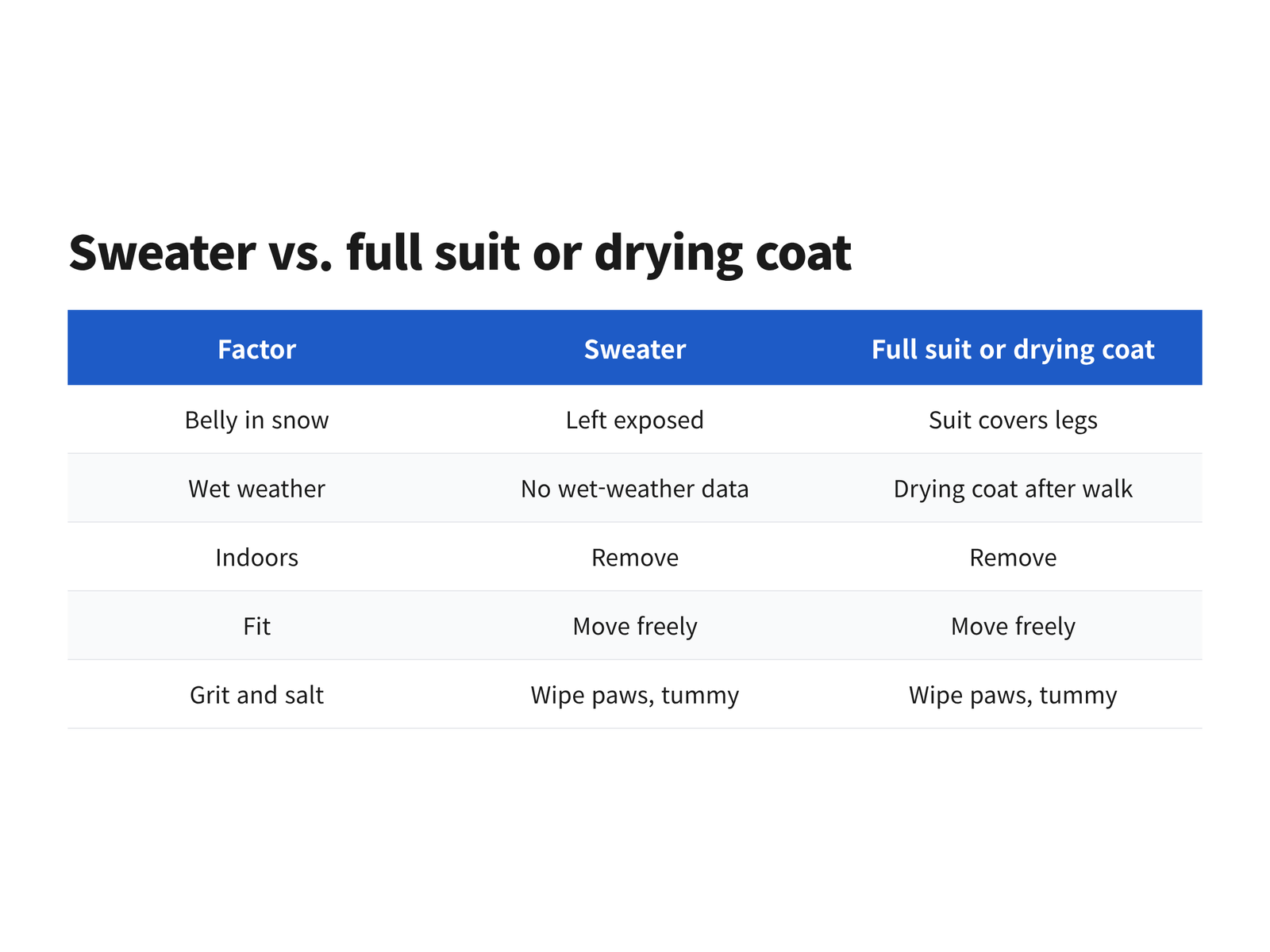
A sweater covers the back and chest, while a full-coverage snowsuit or bodysuit also covers the legs, and a drying coat serves a different job after the walk. The AKC describes snowsuits and bodysuits as garments that “cover your dog’s entire body, including their legs.” The RSPCA and the Royal Kennel Club both name a drying coat as an after-walk tool. No garment removes grit, salt or antifreeze, so the wipe-down step stays the same whichever option a Dachshund owner chooses.
| Factor | Sweater | Full suit or drying coat |
|---|---|---|
| Belly in snow | Left exposed | Suit covers legs |
| Wet weather | No wet-weather data | Drying coat after walk |
| Indoors | Remove | Remove |
| Fit | Move freely | Move freely |
| Grit and salt | Wipe paws, tummy | Wipe paws, tummy |
Frequently asked questions
Does a Dachshund need a sweater in winter at all?
A sweater can help, especially for a short-coated or cold-sensitive Dachshund. The AVMA suggests considering a sweater or coat if a dog has a short coat or seems bothered by cold.
Is there a safe temperature for walking a small dog in snow?
No universal number exists. The AKC states that there isn’t an exact temperature that’s too cold for all dogs, so keep walks short on very cold days and watch how your dog responds.
What if a dog licks antifreeze off its paws?
Contact a vet immediately. The Royal Kennel Club warns that antifreeze can damage a dog’s kidneys and cause death even after a small amount has been licked.
Should a wet sweater be put away after a walk?
No. The AKC notes that coats can harbor bacteria if put away damp after snow, so dry the sweater fully before storing it.
Sources
- American Kennel Club, “Does My Dog Need a Winter Coat?”, updated 2025-11-14 — https://www.akc.org/expert-advice/lifestyle/dog-winter-coat/
- American Kennel Club, “Do Dogs Need Sweaters or Jackets in Winter?”, updated 2025-11-14 — https://www.akc.org/expert-advice/vets-corner/dogs-need-sweaters-jackets-winter/
- American Veterinary Medical Association, “Cold Weather Safety” (PDF, undated) — https://www.avma.org/sites/default/files/resources/ColdWeatherSafety.pdf
- RSPCA, “Winter & Cold Weather Care for Dogs” (undated, accessed 2026-10-27) — https://www.rspca.org.uk/adviceandwelfare/seasonal/winter/pets/dogs
- Blue Cross, “Advice for Dogs and Puppies in Winter”, reviewed 2023-01-20 — https://www.bluecross.org.uk/advice/dog/dogs-in-winter
- The Royal Kennel Club, “Keep your dog safe during winter” (undated, accessed 2026-10-27) — https://www.royalkennelclub.com/health-and-dog-care/health-dog-care/health/health-and-care/a-z-of-health-and-care-issues/winter-dangers-to-dogs
- PDSA, “Vet Q&A: Does my dog need to wear a coat on winter walks?”, 2019-10-28 — https://www.pdsa.org.uk/what-we-do/blog/vet-qa-does-my-dog-need-to-wear-a-coat-on-winter-walks