The Amtrak pet limit is 20 pounds for the dog and the carrier combined, inside a carrier no larger than 19 x 14 x 10.5 inches, on trips of 7 hours or less on most routes. Some popular small breeds still miss it. A top-class Boston Terrier can hit 20 pounds before the carrier goes on the scale, and a Cavalier King Charles Spaniel stands taller at the shoulder than the carrier is high. Below, official breed standards are checked against each Amtrak rule.

Does Amtrak’s 20-pound pet limit include the carrier?
Yes, the Amtrak pet limit counts the pet and the carrier together, so 20 pounds is the combined total. Amtrak’s “Pets on Amtrak Trains” page sets the limit as the weight of pet and carrier, not the dog alone. Weigh the dog, weigh the empty carrier, and add the two; above 20 pounds, the booking fails even when the dog alone is under the line. The carrier may be hard or soft sided, but Amtrak says it “must be leak proof and well ventilated.”
Amtrak also sets conditions on the dog itself. The policy states: “Your pet must be at least eight weeks old and be odorless, harmless, not disruptive and require no attention during travel.” Amtrak allows one pet per reservation and one pet per carrier. The carrier rides under your own seat, not under the seat in front of you, and the pet should stay entirely inside the closed carrier in stations and onboard.
Which small dog breeds can go over Amtrak’s 20-pound limit?
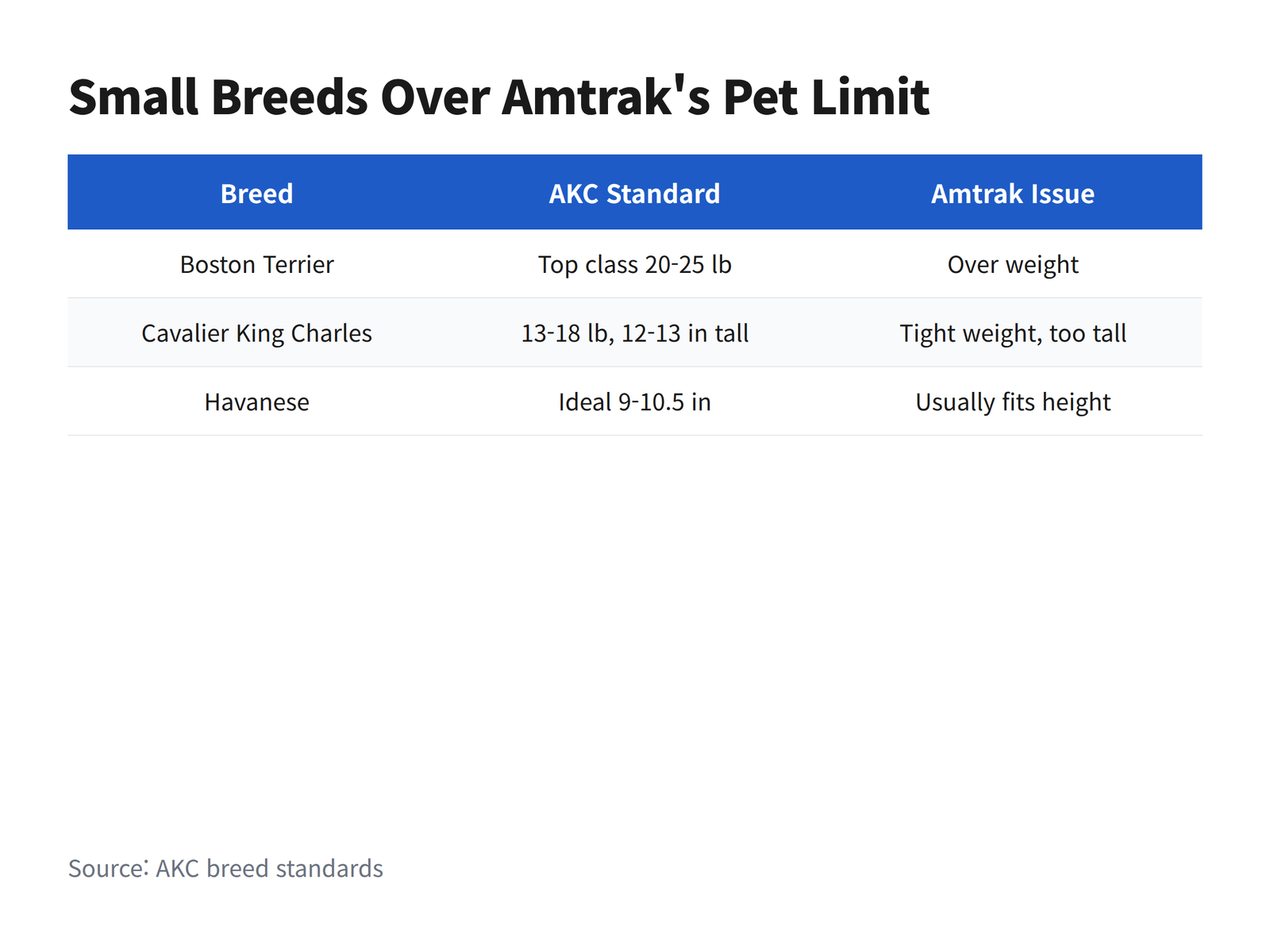
The Boston Terrier is the clearest example, because the American Kennel Club breed standard includes a weight class that starts at 20 pounds. The AKC standard reads: “Weight is divided by classes as follows: Under 15 pounds; 15 pounds and under 20 pounds; 20 pounds and not to exceed 25 pounds.” A Boston Terrier in the top class is at or over the Amtrak pet limit before any carrier is added. A Boston Terrier in the middle class leaves at most 5 pounds for the carrier, so the empty carrier weight decides whether that dog can ride.
The Cavalier King Charles Spaniel standard lists a weight “between 13 and 18 pounds,” which leaves only 2 to 7 pounds for the carrier under the 20-pound rule. Other small breeds cannot be judged from the standard at all. The AKC standard for the Havanese lists height but gives no weight. For that breed, a scale reading of the dog plus the empty carrier is the only reliable check.
| Breed | AKC standard | Amtrak issue |
|---|---|---|
| Boston Terrier | Top class 20-25 lb | Over weight |
| Cavalier King Charles | 13-18 lb, 12-13 in tall | Tight weight, too tall |
| Havanese | Ideal 9-10.5 in | Usually fits height |
Why can a dog under 20 pounds still not fit Amtrak’s pet carrier size?
A dog under 20 pounds can still fail because the Amtrak carrier cannot be taller than 10.5 inches, and some small breeds stand taller than that at the shoulder. The Cavalier King Charles Spaniel standard gives a height of “12 to 13 inches at the withers,” which is above the 10.5-inch maximum carrier height, even when the dog passes the weight limit.
The American Veterinary Medical Association adds a comfort standard that Amtrak does not state. AVMA guidance says a carrier should be “Large enough to allow the pet to stand (without touching the top of the cage), sit up, turn around, and lie down comfortably.” A Cavalier King Charles Spaniel that stands 12 inches at the shoulder cannot stand upright in a 10.5-inch carrier, so the carrier meets the Amtrak size rule while failing the AVMA comfort test.
The Havanese is the borderline case. The AKC Havanese standard says: “The ideal height is between 9 and 10½ inches, with an acceptable height range from 8½ to 11½ inches.” A Havanese at the ideal height sits at or under the 10.5-inch carrier height, while a Havanese at the top of the acceptable range goes over it.
Which Amtrak trains, cars and routes don’t allow pets?
Pets are allowed only in Coach Class and Acela Business Class, and several routes and services exclude pets completely. Amtrak lists “Acela First Class seating, First Class private rooms, non-Acela Business Class, food service cars or other accommodations” as off limits. On Keystone and Pennsylvanian trains, Amtrak states that “pets are not allowed in the Quiet Car.”
The Amtrak pet program is also not available on these services:
- Canada travel on the Adirondack, Maple Leaf and Amtrak Cascades
- Auto Train
- Gold Runner
- Amtrak Connection services
The 7-hour cap applies to total travel time, so many long-distance trips fall outside the Amtrak pet limit even when the dog and carrier pass the scale test. Amtrak also says pets “cannot be booked with multi-ride tickets, Amtrak Connection services or with unaccompanied minors.”
How do Amtrak’s pet rules compare with Brightline and Greyhound?
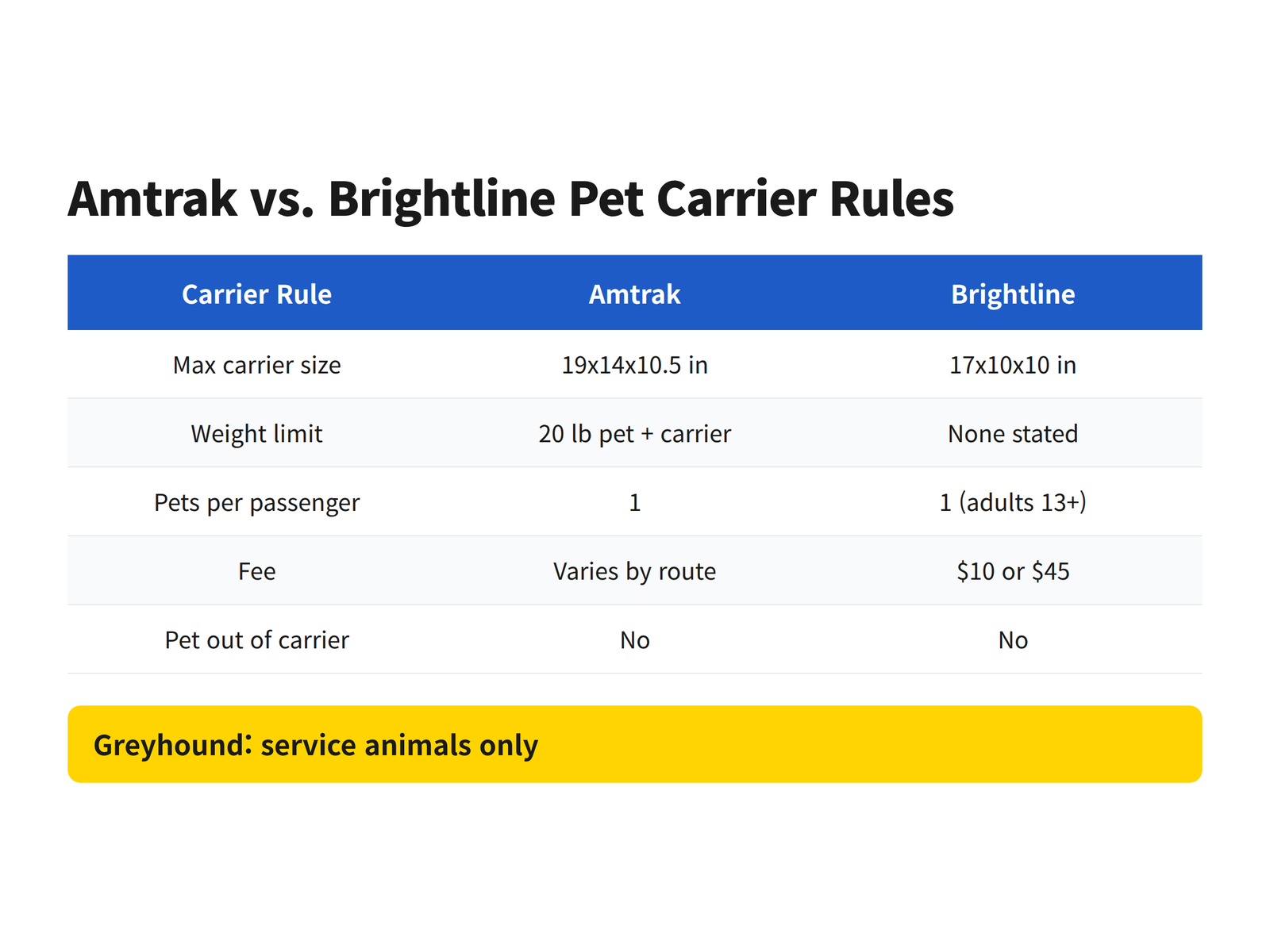
Brightline allows a smaller carrier than Amtrak and states no weight limit, while Greyhound does not allow pets at all. Brightline’s Help Center and Terms of Service set a maximum carrier size of 17 x 10 x 10 inches. A carrier sized for Amtrak can therefore be too big for Brightline.
| Carrier rule | Amtrak | Brightline |
|---|---|---|
| Max carrier size | 19 x 14 x 10.5 in | 17 x 10 x 10 in |
| Weight limit | 20 lb pet + carrier | None stated |
| Pets per passenger | 1 | 1 (adults 13+) |
| Fee | Varies by route | $10 or $45 |
| Pet out of carrier | No | No |
Fees differ as well. Amtrak says, “Pet fees vary by route and will be shown in the price summary at time of reservation,” and Amtrak Cascades lists $29 per reservation, or $58 round trip. Brightline charges $10 within and between Miami, Aventura, Fort Lauderdale, Boca Raton and West Palm Beach, and $45 between Orlando and all other destinations.
Buses are a different story. Greyhound’s baggage policy states: “Pets are not allowed on buses with the exception of service animals.” The American Veterinary Medical Association describes the wider picture: “While many trains allow cats or small dogs under certain conditions, most states prohibit animals from riding on buses. Exceptions are made for service animals accompanying their person in need.”
What should you check before booking a small dog on Amtrak?
Check weight, carrier size, route and paperwork before you book, because each one can stop the trip on its own. These steps follow Amtrak’s rules plus one AVMA recommendation:
- Weigh the dog and the empty carrier; the total must be 20 pounds or less.
- Measure the carrier: no more than 19 x 14 x 10.5 inches.
- Confirm Coach or Acela Business Class, a trip of 7 hours or less, and a route not on the excluded list.
- Book the pet with the ticket, one pet per customer, and not on a multi-ride ticket.
- Arrive 45 minutes early to check in at the ticket office.
- Schedule a veterinary exam before the trip, as the AVMA advises.
At check-in, Amtrak asks owners to sign a “Pet Release and Indemnification Agreement for each travel segment prior to travel” and to certify that vaccinations are up to date. The AVMA also warns: “Consult your veterinarian before giving your pet any tranquilizers or sedatives. These can increase the risk of heart or respiratory problems and generally are not allowed by airlines.”
Frequently asked questions
Can a small dog sit on your lap on an Amtrak train?
No, a small dog should not sit on your lap on an Amtrak train. Amtrak says pets “should remain entirely inside a closed carrier while in stations and onboard trains,” and the carrier goes under your own seat.
How long can a dog ride Amtrak in one reservation?
A dog can ride Amtrak for up to 7 hours of total travel time on most routes.
Is there a limit on how many pets can ride one Amtrak train?
The main Amtrak pets page does not state a single national cap, so the answer depends on the route. Amtrak Cascades reserves no more than five pets per train. When Amtrak expanded the program to weekday Acela trains in 2021, it announced 8 pet spaces per departure.
Sources
- Amtrak, “Pets on Amtrak Trains” (accessed 2026-09-28) — https://www.amtrak.com/pets
- Amtrak Cascades, “Pets” rider guide (accessed 2026-09-28) — https://amtrakcascades.com/riders-guide/pets/
- Amtrak Media, “Amtrak Expands Carry-On Pet Program to Weekday Acela Trains” (2021-03-03) — https://media.amtrak.com/2021/03/amtrak-expands-carry-on-pet-program-to-weekday-acela-trains/
- Brightline Help Center, “Is Brightline pet-friendly?” (accessed 2026-09-28) — https://brightlinesupport.zendesk.com/hc/en-us/articles/16746322363163-Is-Brightline-pet-friendly
- Brightline, “Terms of Service” (accessed 2026-09-28) — https://www.gobrightline.com/terms-of-service
- Greyhound, “Baggage Policies” (accessed 2026-09-28) — https://www.greyhound.com/travel-info/baggage
- American Veterinary Medical Association, “Traveling with your animal” FAQ (accessed 2026-09-28) — https://www.avma.org/resources/pet-owners/petcare/traveling-your-pet-faq
- American Kennel Club, “Official Standard of the Boston Terrier” (2011-02-11) — https://images.akc.org/pdf/breeds/standards/BostonTerrier.pdf
- American Kennel Club, “Official Standard of the Cavalier King Charles Spaniel” (2023-01-10) — https://images.akc.org/pdf/breeds/standards/CavalierKingCharlesSpaniel.pdf
- American Kennel Club, “Official Standard of the Havanese” (2011-08-09) — https://images.akc.org/pdf/breeds/standards/Havanese.pdf