
A breed weight chart tells you what dogs of a breed often weigh, not whether your dog carries the right amount of fat and muscle. That gap explains why breed weight charts are misleading for small dogs: a study of 140 purebred dogs found that published breed weight ranges are not a good predictor of an ideal body condition score. Veterinary guidelines from AAHA and WSAVA judge condition by look and feel on a 9-point scale instead, and this guide shows how that check works at home.

Why can’t a breed weight chart tell you if your small dog is a healthy weight?
A breed weight chart cannot tell you whether a small dog is a healthy weight because the chart measures pounds, not body fat or muscle. A chart gives one range for a whole breed, yet two dogs of that breed can differ in frame. The Kennel Club puts the point directly: “putting them on the scales isn’t always the best way to see if they are overweight.” Blue Cross adds that “Dogs come in all shapes and sizes, so it’s hard to know the right way by looking at a chart.”
None of this makes a breed weight chart useless as a rough reference. The Kennel Club notes that “A dog’s ideal weight will differ between breed types, but a healthy shape will be similar for most kinds of dog.” Shape and condition are the real questions, and a chart answers neither.
What did researchers find when they compared breed weight ranges with body condition?
Researchers found that a weight inside the breed range does not reliably mean a dog is at an ideal body condition. Smith and colleagues recorded nine-point body condition scores alongside weight, neuter status and age for 140 purebred dogs. Their conclusion, published in the Journal of Animal Physiology and Animal Nutrition, was that “published recommended, breed-specific body weight ranges are not a good predictor for an ideal BCS.”
The Smith finding works in one direction only. A small dog inside its breed weight range may still carry too much or too little fat, so the range alone cannot confirm good condition. The study does not show that a weight outside the range is fine, and the abstract does not list which breeds were included.
How do veterinary guidelines judge a dog’s body condition instead?
Veterinary guidelines judge condition with a body condition score (BCS), a look-and-feel check of body fat rather than a weight reading. The WSAVA Nutritional Assessment Guidelines state that “The BCS evaluates body fat,” and the AAHA Nutrition and Weight Management Guidelines suggest “universal use of the 9-point (1–9) BCS scale with whole integers.” WSAVA notes that “The goal for most pets is a BCS of 4 to 5 of 9,” and the American Kennel Club describes the same “about four to five” target.
An owner-level version of the body condition check uses three points:
- Ribs: Tufts Petfoodology advises that you “should always be able to easily feel your pet’s ribs by gently running the flat of your palms across the sides of the chest.”
- Waist from above: the RSPCA says the waist “should be clearly visible when viewed from above.”
- Belly from the side: the RSPCA says “Your dog’s belly should be tucked up when viewed from the side.”
Hands matter more than eyes in a body condition check. WSAVA states that “Palpation is required for accurately assessing BCS and MCS, especially in animals with medium to long hair coats.” Blue Cross says ribs should be felt but not seen, while the RSPCA mentions seeing and feeling the outline. The AKC adds that “a healthy weight will look different for every breed” and that “most sighthounds should have visible ribs,” so one rib rule does not fit every small breed.
Why does one pound mean more on a small dog than on a large dog?
One pound means more on a small dog because the same gain is a far bigger share of total body weight. A 1 lb gain is 10% of a 10 lb dog’s weight, but about 1.4% of a 70 lb dog’s weight. On a breed weight chart, that single pound can look like a minor wobble inside the range.
The body condition score adds the context that pounds leave out. The AAHA guidelines state that “Every incremental increase in BCS is equivalent to a 5% increase in BF%,” meaning body fat percentage. Tracking both weight and body condition gives a small dog owner a clearer picture than either number alone.
Can a small dog be the “right” weight and still be losing muscle?
Yes, a small dog can sit at an expected weight and still lose muscle, because fat and muscle are scored separately. The WSAVA guidelines explain that “The MCS differs from the BCS in that it evaluates muscle mass,” and warn that “An animal can be overweight but still have significant muscle loss.” The AAHA guidelines agree that “BCS and MCS are not causally related and should be assessed separately.”
A muscle condition score (MCS) matters because muscle loss is easy to miss on a scale or a chart. WSAVA notes that a loss of muscle can “look relatively normal if not carefully evaluated.” A breed weight chart has no column for muscle at all.
Does using a body condition chart at home fix the problem?
No, a body condition chart at home did not make owners more accurate in the study that tested one. Eastland-Jones and colleagues, writing in the Journal of Nutritional Science, compared owner judgments of 110 dogs with and without a chart. Owners misjudged body condition 65% of the time without any chart and 64% of the time with a five-point BCS chart. The authors concluded that “use of a five-point BCS chart does not improve accuracy of owners’ perception of their dog’s body shape.”
Only 17 of 110 owners changed their score after seeing the five-point chart, 12 toward the correct answer and 5 away from it. Among overweight dogs, 81% were misperceived without the chart and 85% with it. Most errors were underestimates, at 92% without the chart and 89% with it. Yet 77% of owners believed the chart had helped.
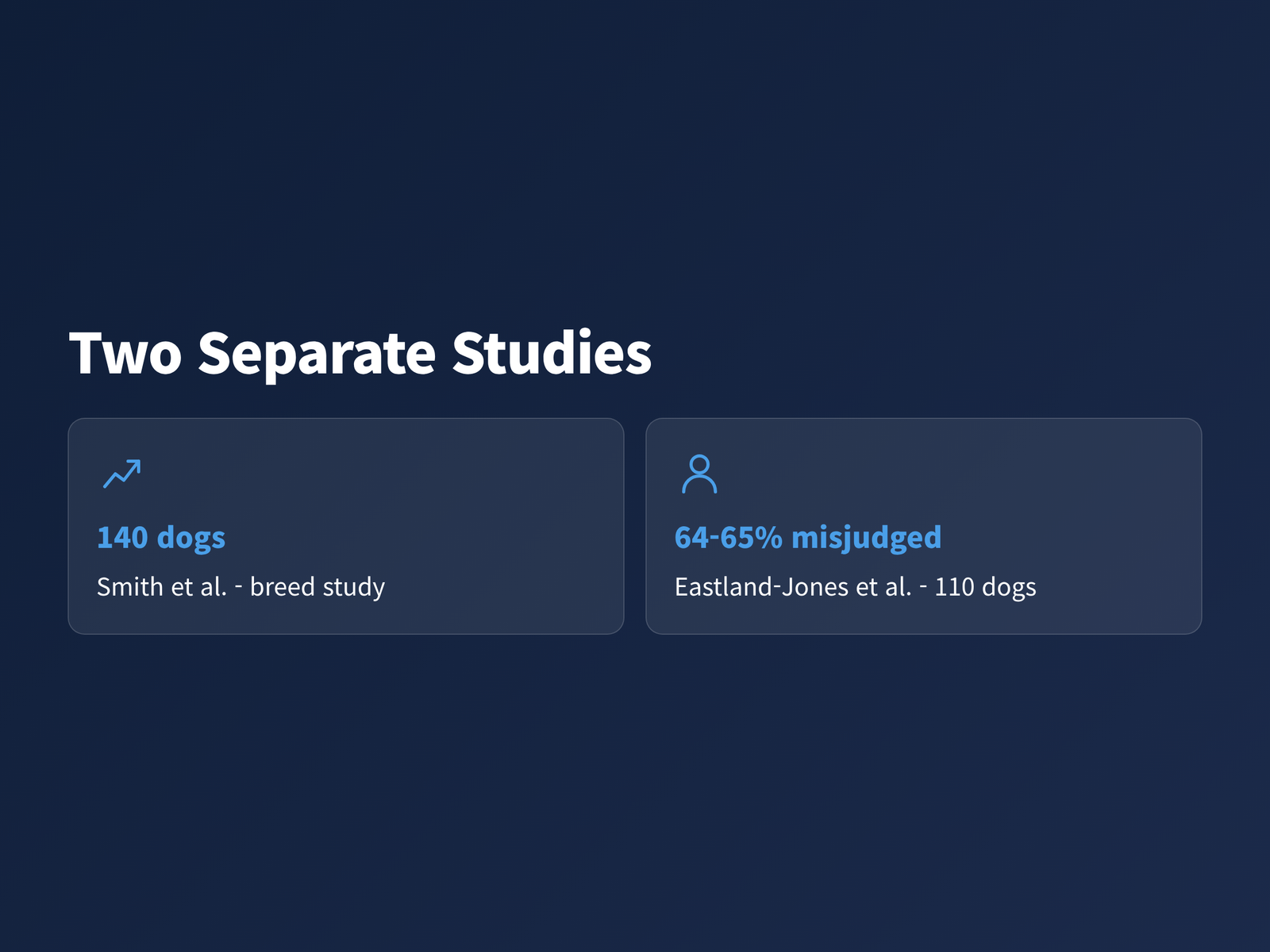
The two studies measured different things. The Smith study of 140 purebred dogs tested breed weight ranges, while the separate Eastland-Jones study of 110 dogs tested owner judgment with and without a five-point chart. These results do not make a body condition chart worthless, because the Eastland-Jones study used a five-point chart rather than the 9-point scale that AAHA recommends. A home chart works best as a starting point for a conversation with a veterinarian, not as a final verdict.
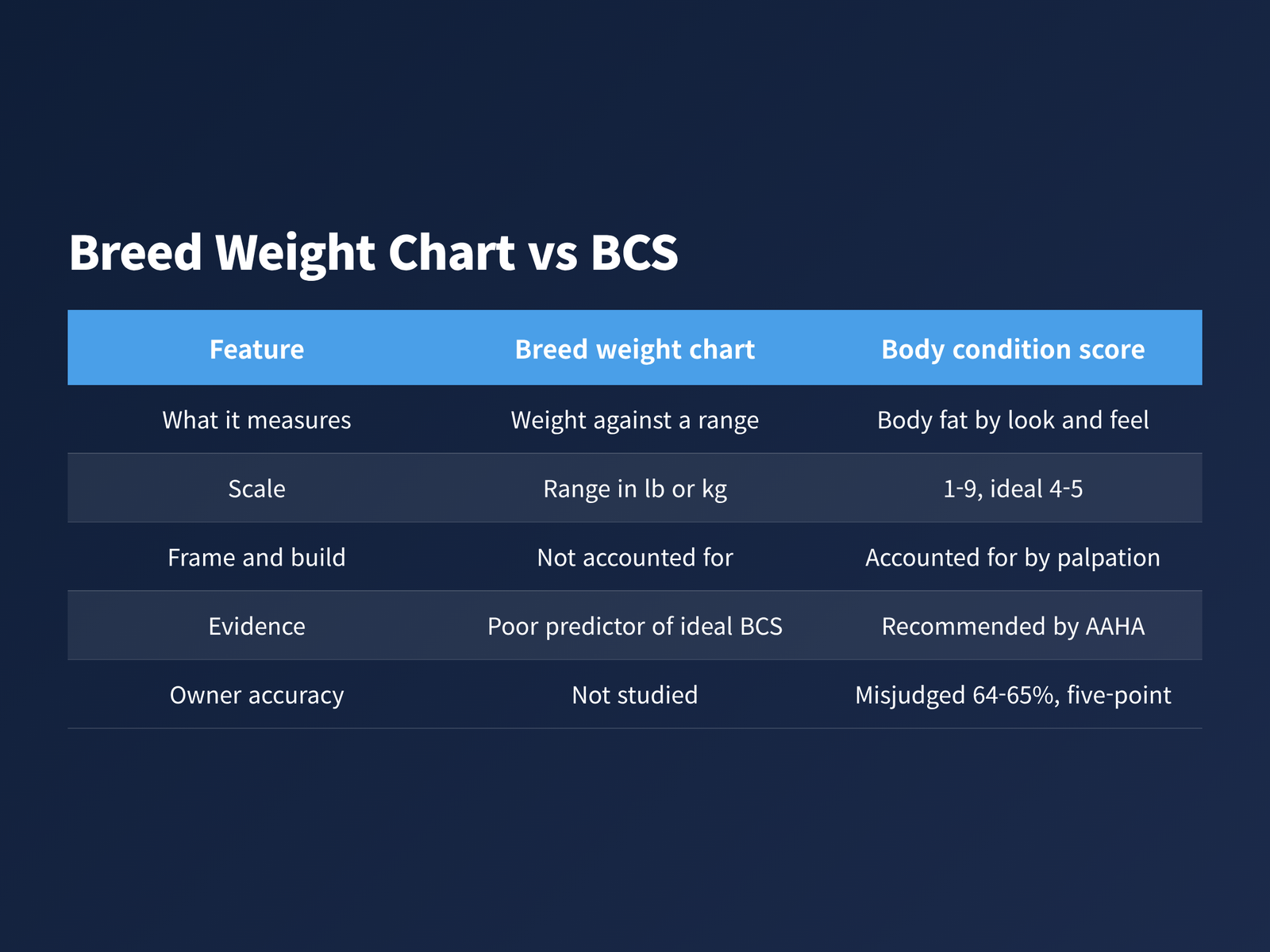
Breed weight chart vs body condition score – what each one tells you
A breed weight chart and a body condition score answer different questions. The breed weight chart compares a number with a published range, while the body condition score judges fat by look and feel on the AAHA and WSAVA scale.
| Feature | Breed weight chart | Body condition score |
|---|---|---|
| What it measures | Weight against a range | Body fat by look and feel |
| Scale | Range in lb or kg | 1-9, ideal 4-5 |
| Frame and build | Not accounted for | Accounted for by palpation |
| Evidence | Poor predictor of ideal BCS | Recommended by AAHA |
| Owner accuracy | Not studied | Misjudged 64-65%, five-point |
A third tool, the muscle condition score, sits beside both and measures muscle mass. The AAHA guidelines say the muscle condition score should be assessed separately from the body condition score, and together the BCS and MCS cover what a breed weight chart cannot.
What should a small dog owner track at home, and when should you call the vet?
Track weight on one scale with one method, check body condition by hand, and consult your veterinarian about any unexplained weight change. The WSAVA guidelines advise using “a consistent method and scale to measure body weight (BW),” and list unexplained weight change as a screening risk factor.
A simple routine for a small dog covers four steps:
- Run the three hands-on checks: ribs, waist and belly.
- Rely on hands rather than eyes.
- Weigh on the same scale, the same way, and note the trend.
- Ask the veterinarian for a BCS and MCS at each exam.
The AAHA guidelines recommend scoring “ideally at each exam visit.” Consult your veterinarian before changing food amounts, because a small dog’s needs depend on factors no breed weight chart can show. During a vet-led weight plan, AAHA suggests check-ins 4 to 8 weeks apart.
Frequently asked questions
What is an ideal body condition score for a small dog?
On the 9-point scale used by AAHA and WSAVA, the goal for most pets is 4 to 5 of 9. A veterinarian can confirm the right target for a specific dog.
Can a dog be inside its breed weight range and still be overweight?
Yes. The Smith study found breed weight ranges are not a good predictor of an ideal BCS, so a weight inside the range does not confirm ideal condition.
Is a body condition score always accurate?
No. The AAHA guidelines note that a BCS is limited in patients with a high body fat percentage, which is one reason a veterinarian may also score muscle condition.
Sources
- Smith EG, Davis K, Sulsh L, Harvey SC, Fowler KE, “Canine recommended breed weight ranges are not a good predictor of an ideal body condition score”, Journal of Animal Physiology and Animal Nutrition 102(4), 2018 – https://oro.open.ac.uk/90488
- Eastland-Jones RC, German AJ, Holden SL, Biourge V, Pickavance LC, “Owner misperception of canine body condition persists despite use of a body condition score chart”, Journal of Nutritional Science 3:e45, 2014 – https://www.cambridge.org/core/journals/journal-of-nutritional-science/article/owner-misperception-of-canine-body-condition-persists-despite-use-of-a-body-condition-score-chart/A9D145895A72EE3D30E5A00B3DB7365B
- American Animal Hospital Association, “AAHA Nutrition and Weight Management Guidelines for Dogs and Cats”, 2021 – http://www.aaha.org/wp-content/uploads/globalassets/02-guidelines/2021-nutrition-and-weight-management/resourcepdfs/new-2021-aaha-nutrition-and-weight-management-guidelines-with-ref.pdf
- AVMA JAVMA News, “New AAHA nutrition, weight management guidelines published”, 2021-09-01 – https://www.avma.org/javma-news/2021-09-01/new-aaha-nutrition-weight-management-guidelines-published
- WSAVA Nutritional Assessment Guidelines Task Force, “WSAVA Nutritional Assessment Guidelines”, Journal of Small Animal Practice, 2011 – https://wsava.org/wp-content/uploads/2020/01/WSAVA-Nutrition-Assessment-Guidelines-2011-JSAP.pdf
- WSAVA Global Nutrition Committee, “Body Condition Score – Dog”, 2013 – https://wsava.org/wp-content/uploads/2020/01/Body-Condition-Score-Dog.pdf
- The Kennel Club, “Weight management – is my dog overweight?” – https://thekennelclub.org.uk/health-and-dog-care/health/health-and-care/a-z-of-health-and-care-issues/weight-management-is-my-dog-overweight
- Blue Cross, “Obesity in dogs”, reviewed 2025-11-18 – https://www.bluecross.org.uk/advice/dog/food-and-weight/obesity-in-dogs
- RSPCA, “Pet obesity” – https://www.rspca.org.uk/adviceandwelfare/pets/general/obesity
- American Kennel Club, Susan Paretts, “How to Tell if Your Dog is Fat”, updated 2024-11-15 – https://www.akc.org/expert-advice/health/how-to-tell-if-your-dog-is-fat/
- Tufts Cummings School Petfoodology, Deborah E. Linder, “How Do I Know If My Pet Is Overweight?”, 2016-12-06 – https://sites.tufts.edu/petfoodology/?p=8890