Detangling spray on a matted small dog helps with small, loose tangles, but it stops being enough once a mat is tight or has progressed close to the skin. At that point, veterinary and grooming guidance points toward slow work with a mat pick over several days, or toward professional clipping. Household scissors may look like the obvious next step, but the ASPCA and the American Kennel Club both warn against them.
When does detangling spray stop working on a matted small dog?
Detangling spray stops being the right tool when a small dog’s tangle has become a larger or tighter mat. The Purdue University Center for Animal Welfare Science notes that small mats can often be detangled by hand, while larger or tighter mats call for a veterinarian or a professional groomer. The ASPCA draws the same line: early, mild mats can be brushed out, but progressed mats require clipping. The American Kennel Club’s Dr. Jerry Klein still lists fingers, conditioner, combs and patience as valid mat-removal aids, so a spray or conditioner has a real role on loose tangles.
Detangling spray on a matted small dog is a helper for the early stage, not a fix for every stage. If a tangle does not loosen after gentle finger work and a comb, that is the signal to change approach rather than add more product or more force.
Why does a bath make a small dog’s mats worse?
A bath makes a small dog’s mats worse because wet hair tangles further and tightens existing knots. The American Kennel Club advises owners to brush thoroughly before bathing “to remove dead hair and mats that will tangle when wet.” Washing a matted coat first can make a manageable tangle much harder to remove.
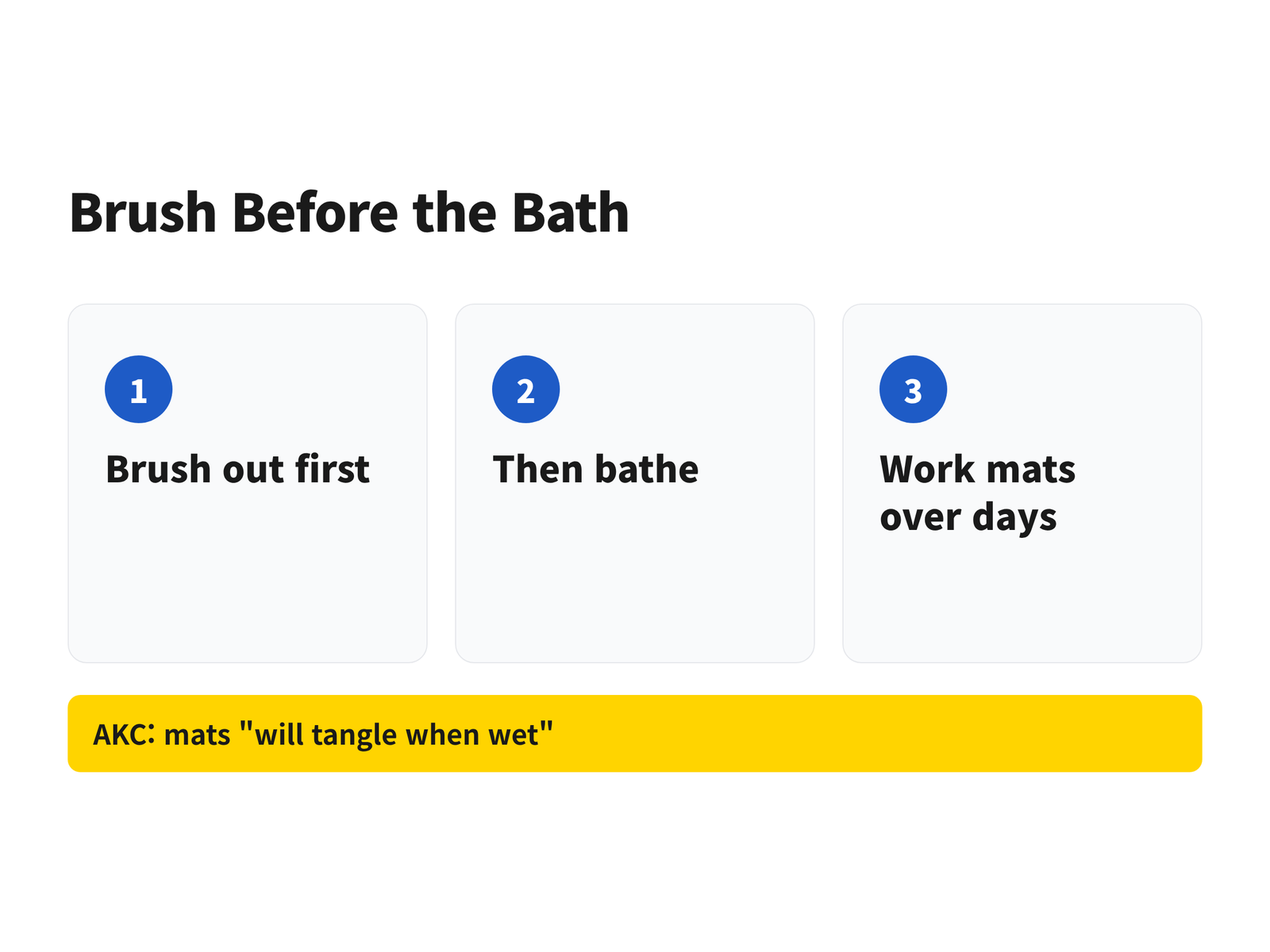
The AKC method for a single mat is also slow by design. Work from the outer edge of the mat toward the body with a mat pick, and hold the mat with the other hand so the pull stays off the dog’s skin. The AKC adds that owners should “keep working at it for a few minutes a couple times a day over several days.” For prevention, the AKC recommends a slicker brush with a light touch, and notes that wide-toothed combs “can also help remove mats and tangles.”
Why shouldn’t you cut mats out of a small dog’s coat with scissors?
You should not cut mats out with household scissors because a dog can move suddenly and the blade can cause a laceration or puncture close to the skin. Dr. Julie Horton, an ASPCA veterinarian, puts the warning plainly: “NEVER cut mats out with scissors.” Dr. Horton explains that “your pet can unexpectedly move or jerk resulting in a severe laceration or puncture.” Dr. Jerry Klein, the AKC Chief Veterinary Officer, agrees: “Do not attempt to cut mats out of your dog’s coat yourself,” adding that “one wrong movement from a nervous pup could result in serious injury.”
Not every organization frames the scissors rule identically. RSPCA Australia allows clippers or blunt-nosed safety scissors used “gently and slowly” to break up and trim a tangle, while still noting that a professional may be the safest choice. The practical reading for owners of a small dog is that ordinary sharp scissors close to the skin carry a laceration risk that both the ASPCA and the AKC consider not worth taking.
Where do mats usually form on a small dog?
Mats usually form on a small dog in friction zones, such as where the front legs meet the chest. The American Kennel Club names those places of friction and adds that dampness and debris also start mats. The ASPCA describes severe matting on the hind end and around the limbs, where hair can wrap all the way around a leg.
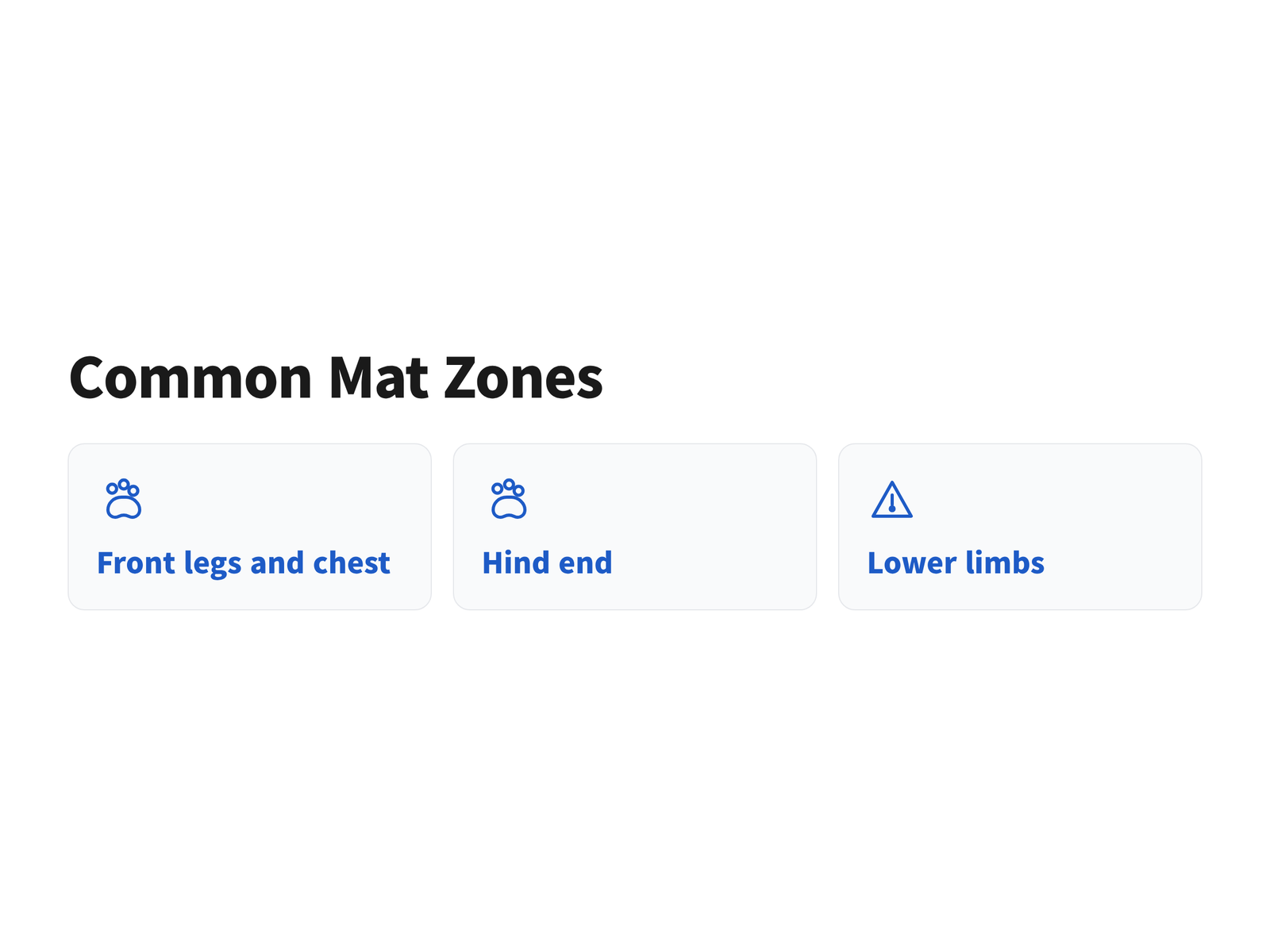
Check those friction zones every grooming session, since the AKC and the ASPCA both name them as places where mats start or become severe. RSPCA Australia states that double-coated dogs “should normally be groomed every day,” and the AKC suggests home brushing every other day, even for short-haired breeds.
Why can matting become a health problem for a small dog?
Matting can become a health problem because tight mats pull on the skin and can hide irritation and fleas underneath. Dr. Horton of the ASPCA warns that “matted hair can lead to severe medical problems for pets,” and notes that irritation under a mat can progress to infected lesions and that fleas can live inside a mat. In a 2023 RSPCA WA case, more than 700 g of matted fur was removed from one Maltese cross; Inspector Manager Kylie Green said, “It’s not just about looks.”
The most serious data come from cruelty and neglect cases, not typical pet homes. In an ASPCA case series published by Watson and Niestat in 2021, 27 dogs had 43 strangulating hair-mat lesions, and “all dogs in this study were classified as small breeds.” The lesions sat on the lower limbs only, the mean age was 5.7 years, and the series recorded 2 self-amputations and 11 clinical amputations. A 2022 Frontiers in Veterinary Science paper by McDonald and colleagues found that 13% of ASPCA-NYPD cruelty cases involved matting or strangulating wounds, and 93% of the dogs in those matting cases were long-haired breeds.
If you find redness, sores, swelling or a mat wrapped around a leg, consult your veterinarian before trying to remove the mat at home. Severe cases may need sedation and full body clipping, according to the ASPCA, and that decision belongs with a veterinary professional.
Dematting or shave-down: which is right for a matted small dog?
Dematting suits a small dog with occasional or loose mats, while a shave-down suits a coat with progressed or severe matting. The table below draws on AKC, ASPCA and Purdue University guidance.
| Approach | Works when | Main limit |
|---|---|---|
| Spray and fingers | Small, loose tangles | Tight mats need a pro |
| Mat pick, edge-in | Occasional mat | May take several days |
| Slicker or wide comb | Prevention, loose hair | Light touch only |
| Household scissors | Not advised | Laceration risk |
| Clipping or shave-down | Progressed mats | Written consent at groomer |
Whether dematting is realistic depends on how tight the mats are and how well your dog tolerates handling. A small dog that panics during handling raises the same injury risk the scissors warnings describe.
Why can a groomer ask for written permission before shaving out mats?
A groomer can ask for written permission because professional standards require it when shaving is deemed necessary. The AKC National Core Professional Dog Grooming Educational Standards tell groomers to “inform clients of shaving negatives, and if shaving is deemed necessary, obtain written permission.”
If a groomer brings a consent form after examining a matted coat, the AKC standard explains why. The conversation is also a good moment to ask how to keep the regrown coat brushed out between appointments, and how a shave-down may reveal skin problems the mat was hiding.
Frequently asked questions
Does detangling spray work on a matted small dog at all?
Yes, detangling spray can help on small, loose tangles alongside fingers and a comb, as AKC guidance on conditioner suggests. Detangling spray is not enough once mats are tight or progressed, according to the ASPCA and Purdue University.
Should a matted small dog be bathed before brushing?
No. The American Kennel Club advises brushing out before the bath, because mats tangle further when wet.
Is it safe to cut a mat out with blunt scissors?
Guidance differs. RSPCA Australia allows blunt-nosed safety scissors used gently and slowly, while the ASPCA and the AKC advise against cutting mats out yourself. A professional groomer or veterinarian is the safer route for tight mats.
Sources
- American Kennel Club, Roxanne Hawn, “How to Overcome the 4 Biggest Dog Grooming Challenges”, updated 2026-08-05 – https://www.akc.org/expert-advice/health/how-to-overcome-the-4-biggest-dog-grooming-challenges/
- American Kennel Club, Dr. Jerry Klein, “The Dos and Don’ts of Home Dog Grooming and Hygiene”, updated 2021-06-25 – https://www.akc.org/expert-advice/health/dog-grooming-at-home/
- American Kennel Club, AKC Staff, “The Soap and Water of Dog Ownership”, updated 2018-01-22 – https://www.akc.org/expert-advice/health/the-soap-and-water-of-dog-ownership/
- American Kennel Club, AKC Staff, “How to Choose the Right Dog Brushes”, updated 2026-03-03 – https://www.akc.org/expert-advice/health/types-dog-brushes-shedding/
- American Kennel Club, “National Core Professional Dog Grooming Educational Standards”, updated 2024-01-26 – https://www.akc.org/wp-content/uploads/2024/06/AKC-National-Core-Professional-Dog-Grooming-Educational-Standards.pdf
- ASPCA, Dr. Julie Horton, “A Haircut Could Save a Life: Preventing Your Pet’s Coat from Matting”, 2015-03-11 – https://aspca.org/news/haircut-could-save-life-preventing-your-pets-coat-matting
- Purdue University Center for Animal Welfare Science, Candace C. Croney PhD, “Brushing your dog”, 2026 – https://caninewelfare.centers.purdue.edu/wp-content/uploads/2026/04/brushing-your-dog.pdf
- RSPCA Australia Knowledge Base, “Why and how should I groom my dog?”, updated 2022-01-19 – https://kb.rspca.org.au/knowledge-base/why-and-how-should-i-groom-my-dog/
- RSPCA WA, “Shocking pictures of matted dog prompt pet care warning”, 2023 – https://www.rspcawa.org.au/news/shocking-pictures-of-matted-dog-prompt-pet-care-warning
- McDonald SE, Sweeney J, Niestat L, Doherty C, “Grooming-Related Concerns Among Companion Animals”, Frontiers in Veterinary Science 9:827348, 2022 – https://www.frontiersin.org/journals/veterinary-science/articles/10.3389/fvets.2022.827348/pdf
- Watson E, Niestat L, “Osseous lesions in the distal extremities of dogs with strangulating hair mats”, Veterinary Radiology & Ultrasound 62:37-43, 2021, via ASPCApro summary, 2021-10-28 – https://www.aspcapro.org/resource/clinical-features-and-outcomes-strangulating-hair-mats-dogs