Most dogs that fail Hawaii’s 5 Day or Less program fail on paperwork and timing, not on health. If you want to know why dogs fail Hawaii 5 Day or Less, the short answer is a missing rabies certificate, a lab wait that is not finished, documents that arrive late, the wrong tick product, or a microchip that cannot be scanned. The official checklists from the Hawaii Department of Agriculture and Biosecurity name each of those requirements, and several of the mistakes carry a set fee.

The 5 Day or Less program is Hawaii’s rabies quarantine track that lets a qualifying dog or cat be released at Honolulu airport or within five days, instead of serving the 120-day quarantine. The Hawaii Department of Agriculture and Biosecurity gives the reason in one line: “Hawaiʻi is the only state that is rabies-free.” Every disqualifier below protects that status.
Why do small dogs miss Direct Airport Release in Honolulu?
Small dogs miss Direct Airport Release in Honolulu because one item on Checklist 1 is incomplete, late or unverifiable. Checklist 1 requires a microchip implanted and scanned before the blood draw, two rabies vaccinations given more than 30 days apart, a FAVN blood test result of 0.5 IU/ml or higher, a health certificate issued within 14 days of arrival, and documents that reach the station more than 10 days before landing. Size does not earn any exemption. A toy breed in an under-seat carrier goes through the same checklist as any other dog.
The order of Checklist 1 matters. The microchip must be in place before the FAVN blood draw, and Checklist 1 warns: “Be sure ‘HAWAII’ is listed as the destination on the lab submission form!” Checklist 1 also says not to order an RFFIT test. The Animal Quarantine Information Page notes that lab processing alone takes 1 to 2 months.
What happens if your dog lands before the 30-day wait is over?
A dog that lands before the 30-day wait is over cannot be released on arrival and is held in quarantine until the dog becomes eligible. Checklist 1 counts the wait from the day after the approved lab receives the blood sample, and the lab-receipt date must be not more than 36 months and not less than 30 days before arrival. Under Checklist 1, an early arrival on the 5 Day or Less track costs $14.30 per day plus the $244 program fee.
The 30-day clock catches owners who book flights before the vet visit. Checklist 1 approves only four FAVN labs: Auburn University, Kansas State University, the University of Missouri, and the DOD Food Analysis and Diagnostic Laboratory in Texas. Add 1 to 2 months of processing, and a trip next month may already be too close.
Why does a single missing rabies certificate disqualify a dog?
A single missing rabies certificate disqualifies a dog because the 5 Day or Less program requires proof of two rabies vaccinations, not one. The FAQ for the 5 Day or Less Program states that documentation for only the most recent vaccination does not qualify. Checklist 1 asks for two original rabies certificates, with the two shots given more than 30 days apart and the most recent shot given more than 30 days before arrival.
For a dog adopted as an adult, the first rabies certificate may still be with a previous owner. Checklist 1 also rejects photocopies and faxes, so a dog with a complete vaccine history can still fail on a copied page. Ask your veterinarian to confirm vaccine timing and the tick product against the current checklist before you book.
Which tick treatment does Hawaii reject?
Hawaii rejects Revolution as the required tick treatment. The FAQ for the 5 Day or Less Program says directly: “Revolution® IS NOT an acceptable treatment.” Checklist 1 requires a long-acting tick product applied by a veterinarian within 14 days of arrival, and the same FAQ lists K-9 Advantix as acceptable for dogs only.
Checklist 1 adds a second airport disqualifier: ticks or parasites found on arrival end Direct Airport Release, even with complete paperwork. The Animal Quarantine Information Page also requires health certificates to state: “All animals were inspected and found free of evidence of New World Screwworm infestation.” The tick product choice belongs to your veterinarian.
Can a small dog fly in the cabin to Hawaii and still be released at the airport?
A small dog that flies in the cabin to Hawaii still goes through the same airport inspection as a dog in the hold. The FAQ for the 5 Day or Less Program states: “Pets allowed to fly in the passenger cabin will be taken by airline personnel upon landing.” Checklist 1 notes that the airline transfer to the Airport Animal Quarantine Holding Facility can take up to one hour.
The state adds: “The Department of Agriculture and Biosecurity does not have any regulation regarding where pets fly within the aircraft.” Cabin rules come from the airline. The Alaska Airlines Newsroom lists a soft-sided carrier no larger than 17 x 11 x 9.5 in, at $100 per carrier each way, or $35 wholly within Hawaii. Check with your airline whether your route accepts cabin pets.
Arrival time is the other trap. The Animal Quarantine Information Page says animals not at the facility by 4:30 p.m. are not released that day. An overnight hold must be picked up by 10:00 a.m., and a late pickup adds $59. The station also notes: “Owners are solely responsible for lifting the crates into vehicles or onto luggage carts.”
Why can’t a dog fly straight to Maui, Kona or Kauai without a permit?
A dog cannot fly straight to Kona, Kahului or Lihue without a Neighbor Island Inspection Permit because Checklist 2 makes the permit a condition of landing there. Honolulu needs no permit. The Neighbor Island Inspection Permit costs $165, the printed permit must be shown to board, and documents for Kona, Kahului or Lihue must arrive 30 days or more before arrival, compared with more than 10 days for Honolulu.
Checklist 2 warns: “Some airlines may not be participating. Check with your airline well in advance.” A pet that misses the neighbor island requirements is denied entry at Kona, Kahului or Lihue and moved to Honolulu or out of state at the owner’s expense.
What does each mistake cost?
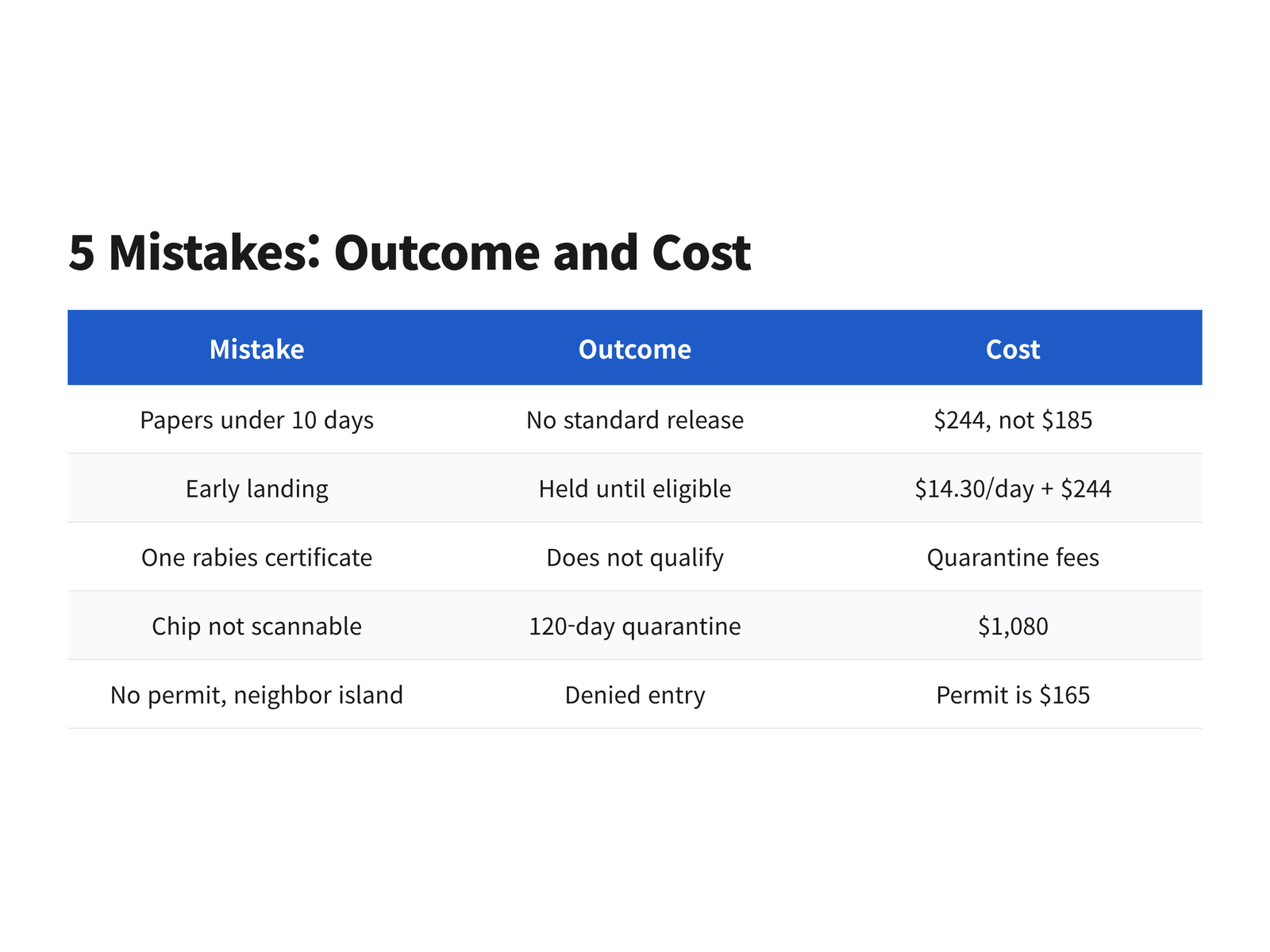
Several mistakes on the Hawaii checklists carry a set official fee, and the most expensive one is an unscannable microchip. Under Checklist 1, the standard Direct Airport Release fee in Honolulu is $185 and the 5 Day or Less fee is $244. The 120-day quarantine program costs $1,080 per pet, according to the FAQ for Animal Quarantine.
| Mistake | Outcome | Official cost |
|---|---|---|
| Papers under 10 days | No standard release | $244, not $185 |
| Early landing | Held until eligible | $14.30/day + $244 |
| One rabies certificate | Does not qualify | Quarantine fees |
| Chip not scannable | 120-day quarantine | $1,080 |
| No permit, neighbor island | Denied entry | Permit is $165 |
Payment can also stall a release. Checklist 1 requires a cashier’s check or money order for the exact amount, with the microchip number included; personal checks are not accepted. Fees follow the checklists in the Sources section, so re-open Checklist 1 and Checklist 2 before you pay.
Frequently asked questions
Can I bring my dog’s documents to the airport instead of mailing them?
Hand-carried or late documents raise the Honolulu Direct Airport Release fee from $185 to $244, according to the FAQ for the 5 Day or Less Program.
Does a small dog in the cabin skip the quarantine check?
No. Airline staff take cabin pets to the Airport Animal Quarantine Holding Facility on landing, and the transfer can take up to one hour under Checklist 1.
What happens if my dog’s microchip cannot be read?
Checklist 1 states that a pet whose microchip cannot be scanned is assigned to 120 days of quarantine. The FAQ for Animal Quarantine lists that program at $1,080 per pet.
Is Revolution accepted for the tick treatment?
No. The FAQ for the 5 Day or Less Program states that Revolution is not acceptable. Consult your veterinarian about a vet-applied, long-acting tick product given within 14 days of arrival.
Sources
- Hawaii Department of Agriculture and Biosecurity, Animal Industry Division, “Animal Quarantine Information Page (Updated)” (undated page; references checklists of 2023-06 and 2024-01) — https://dab.hawaii.gov/ai/aqs/aqs-info/
- Hawaii Department of Agriculture and Biosecurity, “Checklist 1 — Direct Airport Release and 5 Day Or Less Program, Honolulu”, 2023-06-13 — https://dab.hawaii.gov/ai/files/2023/06/Checklist-1-06.13.2023.pdf
- Hawaii Department of Agriculture and Biosecurity, “Checklist 2 — Kona, Kahului, Lihue”, 2024-01-17 — https://dab.hawaii.gov/ai/files/2024/01/Checklist-2_01.17.2024.pdf
- Hawaii Department of Agriculture and Biosecurity, “FAQ — 5 Day Or Less Program”, updated 2018-10 — https://dab.hawaii.gov/ai/?p=2001
- Hawaii Department of Agriculture and Biosecurity, “FAQ for Animal Quarantine”, updated 2026-10-02 — https://dab.hawaii.gov/ai/?p=59
- Alaska Airlines Newsroom, “Paws before takeoff … International Dog Day and beyond”, 2026-08-26 — https://news.alaskaair.com/company/international-dog-day-2026/