Hand stripping vs clipping a Westie comes down to one trade-off. Hand stripping keeps the hard, straight coat that the American Kennel Club (AKC) breed standard describes, while clipping is quicker at first but, according to the AKC, will eventually soften the coat. Neither method suits every household. The right plan for your West Highland White Terrier depends on how much coat texture matters to you and how much grooming time a pet Westie can realistically get.

Is hand stripping or clipping better for a pet Westie?
Hand stripping is the better match if you want a pet Westie to keep the hard coat the breed standard calls for, and clipping is the better match if convenience comes first. The AKC defines hand-stripping as a grooming method for wiry-coated dogs that plucks dead strands of hair to keep the coat’s coarse texture. An older AKC grooming article puts it more plainly: “Pulling the hair out of a wire coat is called stripping or plucking.” Clipping, by contrast, cuts the hair with clippers rather than removing the dead strands.
The AKC’s article on hand-stripping describes clipping as “initially convenient and less time-consuming,” and that is a real advantage for a family pet. The same AKC article also warns that clipping “will eventually soften the dog’s coat.” So the Westie owner is choosing between two costs: more time and specialised skill now with hand stripping, or a softer coat later with clipping. Which cost is easier to carry depends on your schedule, your groomer, and your Westie.
What does the AKC breed standard say about a Westie coat?
The AKC breed standard calls for a hard, weather-resistant double coat and states a clear preference for a hard coat over a soft one. The Official Standard of the West Highland White Terrier reads: “The white double coat is hard and weather-resistant, consisting of straight, hard hair and a short, soft undercoat.” The same standard describes a small terrier, with an ideal height of 11 inches at the withers for dogs and 10 inches for bitches.
The most telling line in the Westie standard is about color and texture together: “A hard straight coat which has some wheaten tipping is preferable to a soft white coat.” In other words, the AKC standard ranks a hard texture above a perfectly white color. The Royal Kennel Club breed page lists the West Highland White Terrier as a small breed with a medium-length coat, and it answers “Yes” to whether the breed sheds. For an owner weighing hand stripping vs clipping a Westie, the standard is the clearest statement of which coat texture the breed is meant to have.
Why does a Westie coat turn soft after clipping?
A clipped Westie coat turns soft because clipping cuts the hair instead of plucking out the dead strands, and the AKC says this can interfere with how the coat grows. The AKC’s hand-stripping article explains: “Clippers or scissors may also disrupt the hairs’ natural growth cycle, which can damage the coat and affect regrowth.” The same AKC article states that clipping “will eventually soften the dog’s coat,” which runs against the hard coat the Westie standard prefers.
The AKC treats coat texture as more than a matter of looks. According to the AKC, a softened coat carries “the risk of skin conditions and negatively affecting temperature regulation.” That wording describes a risk, not a certain outcome, and clipping does not guarantee a problem for any individual Westie. If you notice changes in your Westie’s skin or coat after switching grooming methods, consult your veterinarian rather than changing the grooming plan on your own.
Does hand stripping hurt a Westie?
According to a groomer quoted by the AKC, most pets tolerate hand stripping on the body without complaint. Groomer Kim Kier told the AKC: “Most pets do not mind hand-stripping on the body.” The phrase “on the body” matters, because the same AKC article notes that groomers may treat more sensitive areas differently, which is covered in a section below.
The AKC also advises getting a Westie used to the process early: “If you want your dog to be hand-stripped, start them at a young age with grooming.” That advice is about habit and handling. The AKC article does not set an age, and owners of an adult Westie should talk the plan through with a groomer who strips terrier coats. For coat removal itself, the AKC favours a gradual method, explained in the next section.
What does rolling a Westie coat mean?
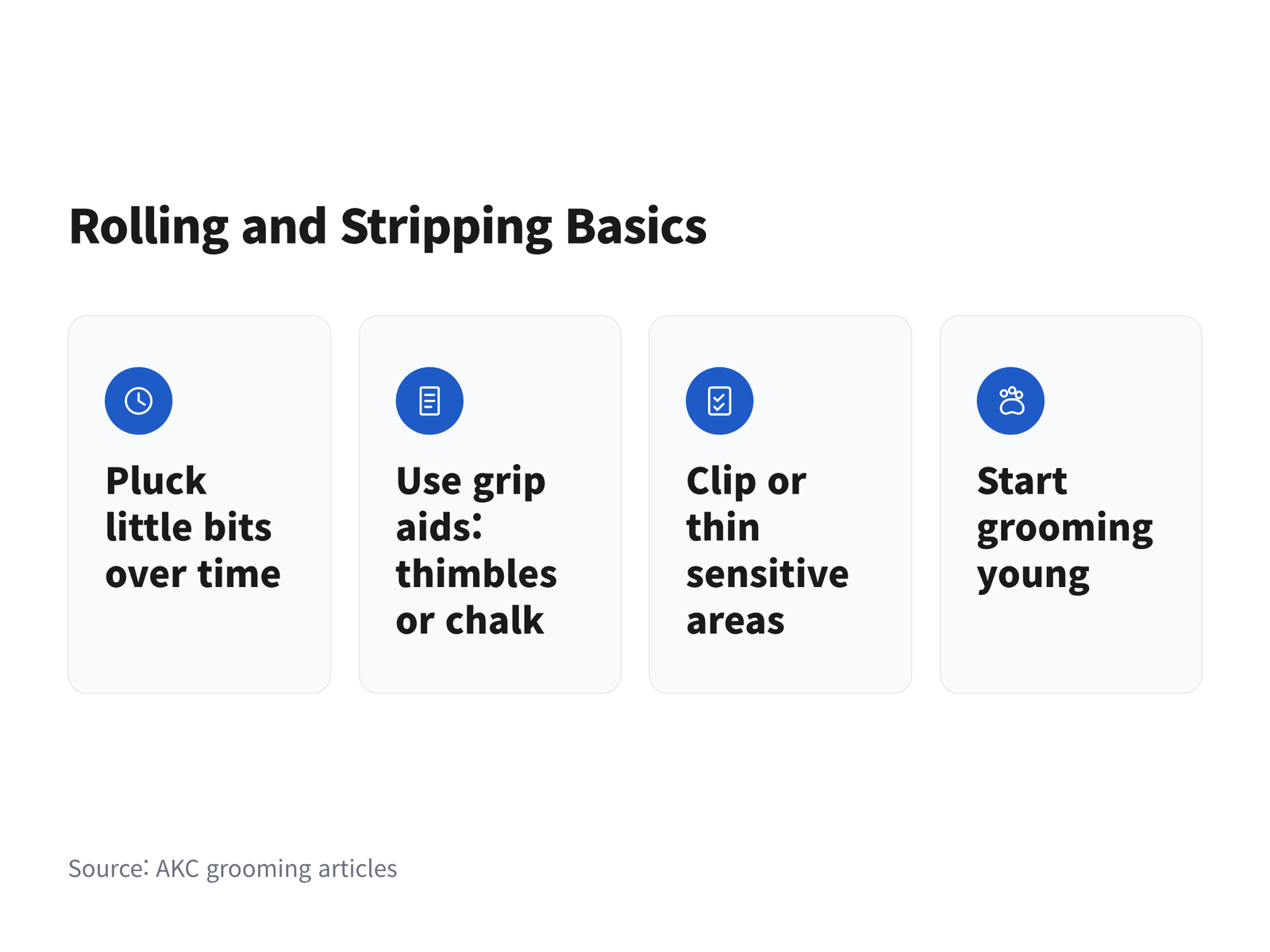
Rolling a Westie coat means plucking out small amounts of dead hair over time instead of stripping the whole coat in one session. The AKC’s wire coat care article describes it this way: “Instead of pulling out an entire coat of dead hair at once (leaving your dog patchy and peach-fuzzy), pluck out little bits of dead coat over time.” For a pet Westie, rolling keeps the coat looking even between groomer visits.
The AKC names several grip aids that make plucking easier. The AKC wire coat care article mentions rubber finger-tip covers or chalk, and the AKC hand-stripping article lists rubber thimbles, pumice stones and carding knives. The same wire coat care article recommends brushing and combing a wire coat once a week. That weekly figure comes from AKC guidance on wire coats in general, not from a Westie-specific schedule, so treat it as a baseline for the brush rather than a stripping timetable.
Can you clip some areas and strip the rest?
Yes, a mixed approach is normal, because groomers may use clippers and thinners on the face, throat and sanitary areas even on a hand-stripped dog. Groomer Kim Kier described this practice in the AKC hand-stripping article. For a Westie owner, that means hand stripping vs clipping is not a strict either-or decision across the whole dog.
The practical split usually follows the AKC description: the body coat is where hand stripping keeps the hard texture, and the sensitive areas are where clippers or thinners do the work. If you ask a groomer for a hand-stripped Westie, it is reasonable to ask which areas will be clipped and which will be stripped.
How often does a pet Westie need grooming?
There is no single grooming interval for a pet Westie, and the main breed sources give different figures for different tasks. The AKC’s Westie fun-facts article says, “To keep a Westie’s coat in its ideal form, regular grooming is key.” Each figure below belongs to one source only:
- Royal Kennel Club breed page: grooming “more than once a week”
- AKC Westie fun-facts article: a groomer visit every 4–6 weeks for the style that article describes
- AKC Westie fun-facts article: show handlers groom every 1–3 weeks
- AKC wire coat care article: brushing and combing a wire coat once a week
These numbers measure different things, from home grooming to salon visits to show preparation, so they should not be blended into one rule. A groomer who knows your dog’s coat is the best person to set a schedule that fits.
Hand stripping vs clipping at a glance
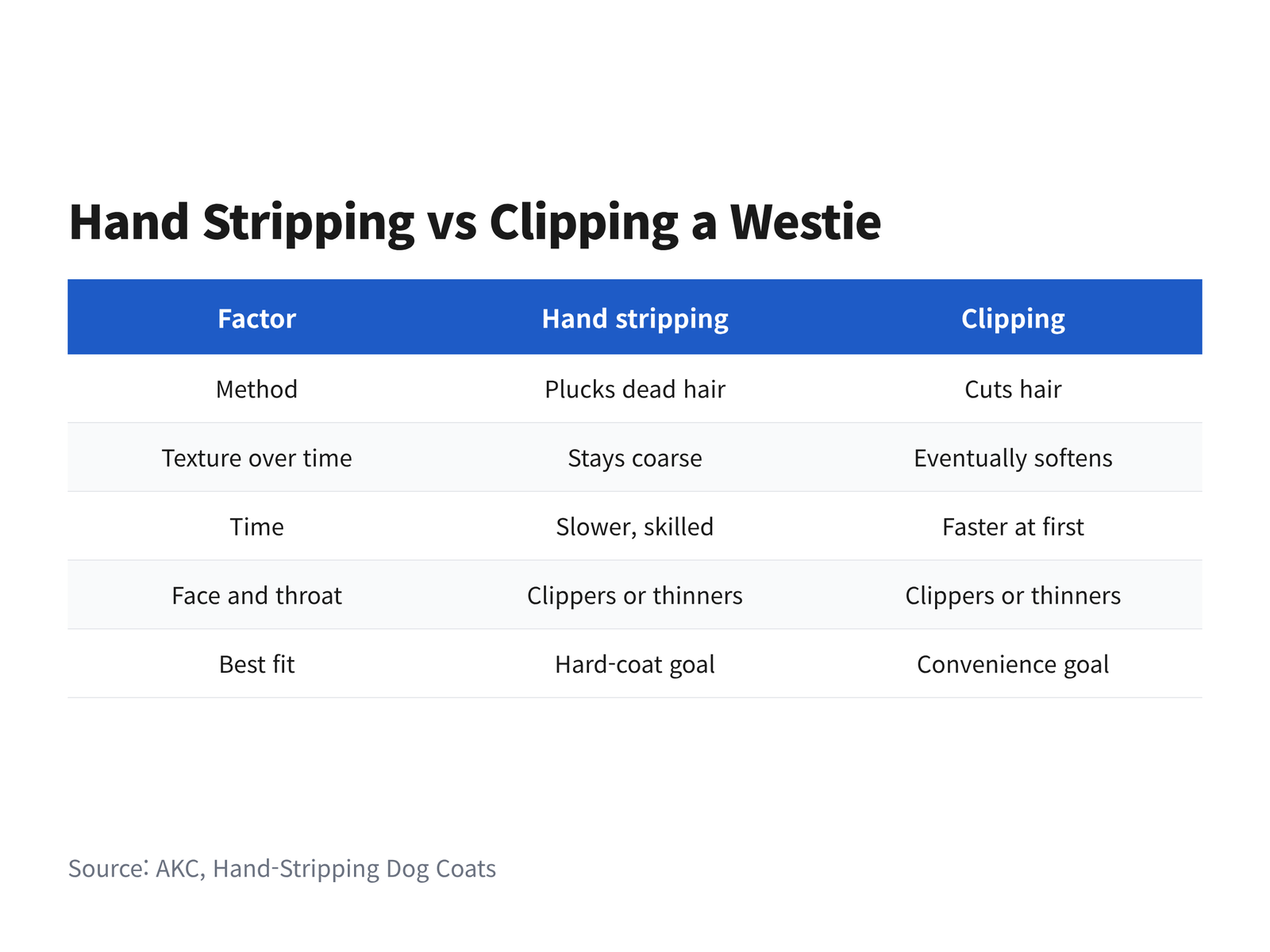
The table below summarises the hand stripping vs clipping comparison using AKC wording.
| Factor | Hand stripping | Clipping |
|---|---|---|
| Method | Plucks dead hair | Cuts hair |
| Texture over time | Stays coarse | Eventually softens |
| Time | Slower, skilled | Faster at first |
| Face and throat | Clippers or thinners | Clippers or thinners |
| Best fit | Hard-coat goal | Convenience goal |
The table makes the Westie trade-off easy to read: hand stripping protects texture at the cost of time, while clipping saves time at the cost of texture. Both methods share the same handling of the face, throat and sanitary areas. Whether the softer coat is acceptable for your Westie is a personal call, and a groomer can show you what each plan involves before you commit.
Frequently asked questions
Will clipping a Westie keep the coat the breed standard describes?
Clipping is unlikely to keep the hard coat the AKC standard describes over the long term. The AKC states that clipping “will eventually soften the dog’s coat,” and the Westie standard prefers a hard straight coat over a soft white coat.
Can an adult Westie start hand stripping?
The AKC advises starting hand stripping at a young age. The sources reviewed here do not say how an adult Westie that has only been clipped will respond, so a groomer who strips terrier coats is the right person to assess an older dog.
Is it fine to strip the whole Westie coat at once?
The AKC recommends rolling the coat instead. According to the AKC wire coat care article, pulling out an entire coat of dead hair at once leaves a dog “patchy and peach-fuzzy.”
Does a Westie shed?
The Royal Kennel Club breed page answers “Yes” to whether the West Highland White Terrier sheds, and lists the coat length as medium.
Sources
- American Kennel Club, “Official Standard of the West Highland White Terrier”, approved 2024-02-13, effective 2024-05-01 — https://images.akc.org/pdf/breeds/standards/WestHighlandWhiteTerrier.pdf
- American Kennel Club, Colt Dodd, “Hand-Stripping Dog Coats”, updated 2025-11-10 — https://www.akc.org/expert-advice/health/hand-stripping-dog-coats/
- American Kennel Club, Steve Pessah, “Wire Coat Care: Stripping”, updated 2019-12-06 — https://www.akc.org/expert-advice/grooming/wired-coat-care-stripping/
- American Kennel Club, Colt Dodd, “Fun Facts About the West Highland White Terrier”, updated 2026-08-10 — https://www.akc.org/expert-advice/dog-breeds/fun-facts-west-highland-white-terrier/
- The Royal Kennel Club, “West Highland White Terrier” breed page, accessed 2026-10-07 — https://www.royalkennelclub.com/search/breeds-a-to-z/breeds/terrier/west-highland-white-terrier