Collars tend to slip off an Italian Greyhound because the breed’s long, narrow head can pass through a loose neck loop, much as the AKC describes for Greyhounds and Whippets. Harnesses can fail for a related reason: a deep, narrow chest and a sharp tuck-up may leave little for the straps to hold. This guide explains why collars slip off an Italian Greyhound, what the breed standards say about that body shape, and how a martingale collar compares with common harness styles.
Why do collars slip off an Italian Greyhound?
A flat collar slips off an Italian Greyhound when the dog pulls backward, because the narrow head can pass through a neck loop that sits comfortably on the wider neck. The American Kennel Club describes the same problem in larger sighthounds, naming “dogs like Greyhounds and Whippets, whose heads are often smaller than their necks.” That wording covers Greyhounds and Whippets, but the Italian Greyhound breed standards describe a long, narrow skull on a long neck, which is the same head-to-neck relationship. The AKC also warns that “if the fit is too loose, your dog may be able to wiggle out and escape.”
What does the Italian Greyhound breed standard say about head, neck and chest?
The Italian Greyhound breed standard describes a narrow head, a long arched neck and a deep, narrow chest, which together help explain why standard gear can fit poorly. The Royal Kennel Club standard calls the skull “long, flat and narrow” and the neck “long, gracefully arched.” The Canadian Kennel Club standard describes the neck as “long, slender, gracefully arched,” with the distance from skull to withers roughly equal to the length of the head. For the chest, the Royal Kennel Club writes: “Chest deep and narrow. Good length of rib and brisket.” The Canadian Kennel Club adds that the Italian Greyhound “should show a very definite tuck up at the flanks,” with a short-coupled loin.
Size adds to the challenge. The Royal Kennel Club gives an ideal height of 32 to 38 cm (12.5 to 15 in) at the withers and an ideal weight of 3.6 to 4.5 kg (8 to 10 lb). The Canadian Kennel Club sets height at 33 to 38 cm (13 to 15 in). The AKC calls the Italian Greyhound, at 13 to 15 inches, the “smallest of sighthounds.” That small, fine frame leaves little margin between a collar that holds and one that slides.
Why don’t standard harnesses fit an Italian Greyhound?
Standard step-in and vest harnesses often fit an Italian Greyhound poorly because the chest is much deeper than the waist, so straps sized for the chest sit loose behind the ribs. The Canadian Kennel Club’s “very definite tuck up” means the body narrows sharply behind the rib cage. A harness built for a barrel-shaped small breed can therefore shift backward when the Italian Greyhound reverses. This link between body shape and harness slip is an editorial reading of the breed standard wording; no published study has measured harness escapes in Italian Greyhounds.
RSPCA South Australia describes the core failure plainly: “If the harness is too loose, the dog can slip an elbow through the straps and back out of it.” On an Italian Greyhound, a harness that looks snug at the chest can still be loose enough at the elbow for that to happen.
Martingale collar or harness: which suits an Italian Greyhound better?
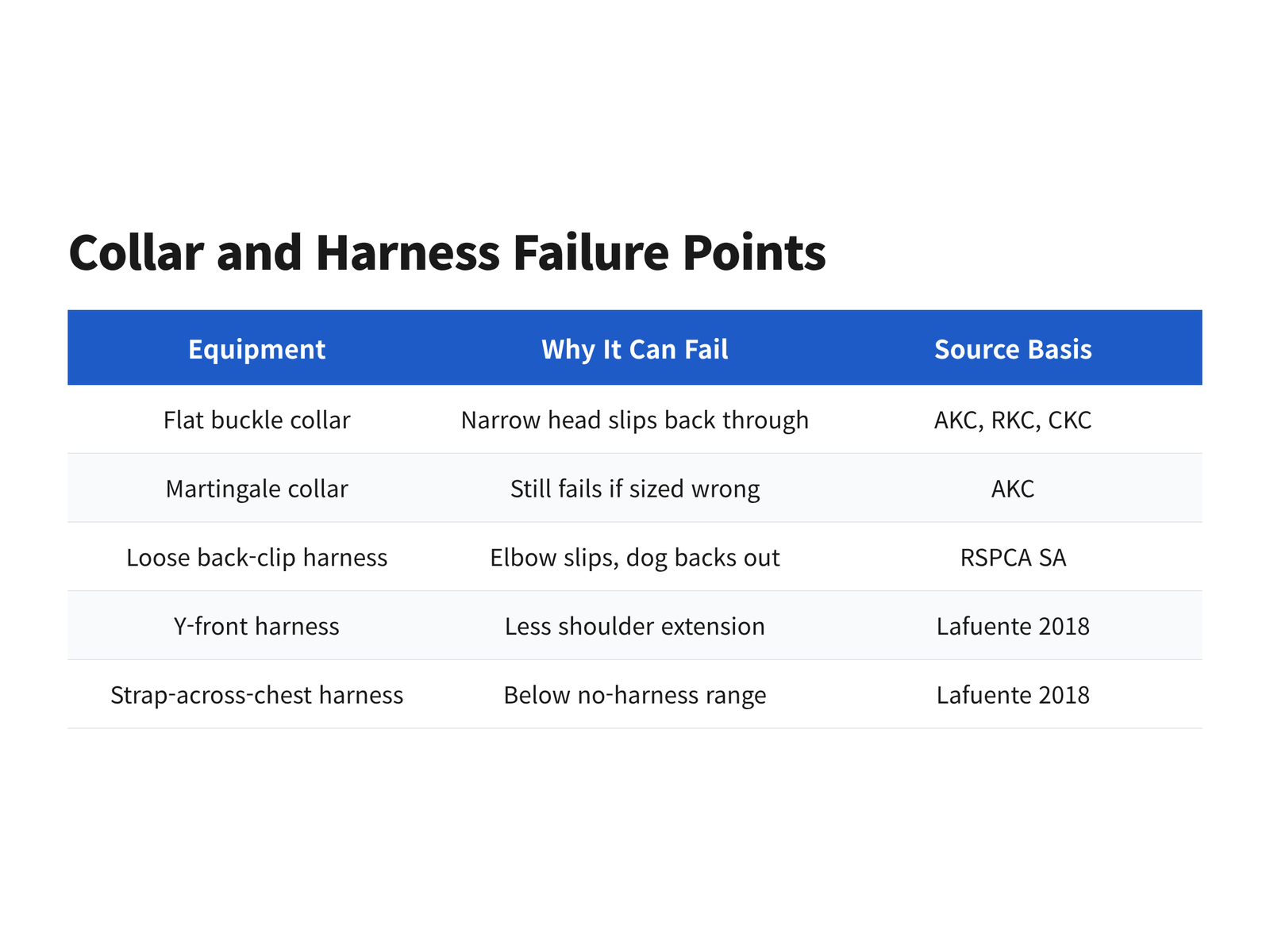
A correctly sized martingale collar often suits an Italian Greyhound well for walks, while a harness suits the dog only when the straps fit both the chest and the elbow area. The AKC states that “martingale collars (limited slip collars) are great for dogs whose necks are about the same size as their heads.” A martingale tightens to a set limit when the dog pulls back, which is meant to keep the loop from sliding over the head, but a wrongly sized martingale has the same weakness as a flat collar. The table below compares five common options for an Italian Greyhound.
| Equipment | Why it can fail | Source basis |
|---|---|---|
| Flat buckle collar | Narrow head slips back through | AKC, RKC, CKC |
| Martingale collar | Still fails if sized wrong | AKC |
| Loose back-clip harness | Elbow slips, dog backs out | RSPCA SA |
| Y-front harness | Less shoulder extension | Lafuente 2018 |
| Strap-across-chest harness | Below no-harness range | Lafuente 2018 |
Pulling behaviour is another factor. In a study of 52 dogs, Shih and colleagues found that “dogs tend to pull stronger and more steadily when wearing a back-connection harness.” With food as the lure, peak tension at the harness reached 16.87 N, against 6.97 N on a neck collar. With a toy as the lure, the study found no significant difference.
Why does an Italian Greyhound back out of a harness on walks?
An Italian Greyhound can back out of a harness by reversing hard while the straps are loose enough for an elbow to come through. RSPCA South Australia names the elbow gap as the escape route, and the narrow chest and tuck-up of the Italian Greyhound may make that gap easier to create. No published study has measured how often this happens, but a loose dog near traffic is a serious risk. If an Italian Greyhound shows pain, limping or a change in gait after a walk, consult your veterinarian rather than adjusting gear alone.
Does harness shape change how a dog moves its shoulders?
Harness shape can change shoulder movement, and in one small study the Y-front design reduced shoulder extension more than a strap-across-chest design. Lafuente, Provis and Schmalz measured nine dogs on a treadmill. At a walk, average shoulder extension was 135 degrees with no harness, 130 degrees in the Y-front (“non-restrictive”) harness and 133 degrees in the strap-across (“restrictive”) harness. At a trot, the figures were 144, 134 and 139 degrees. The authors wrote that “harnesses do limit shoulder extension, but perhaps not in the way originally anticipated.”
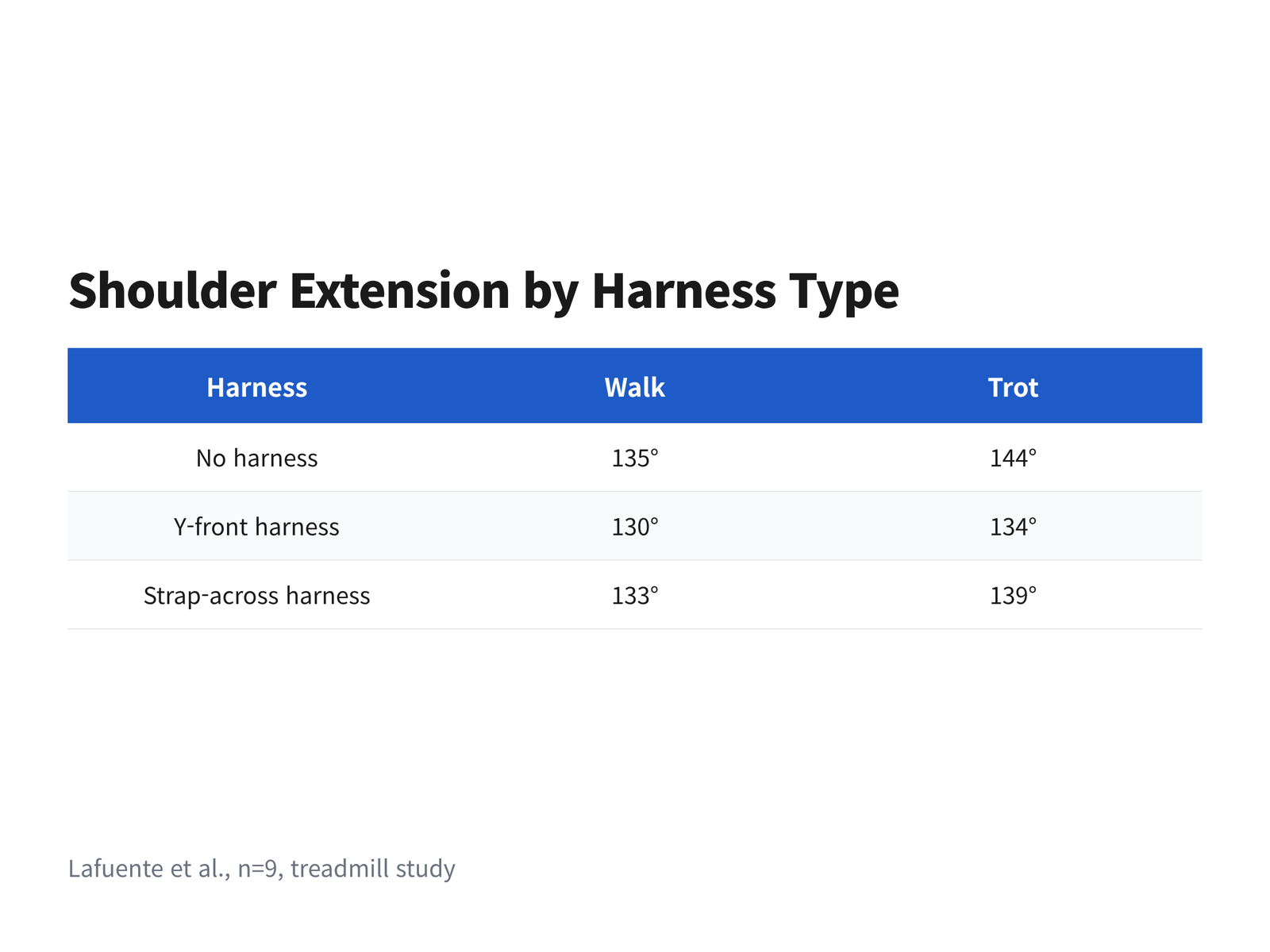
The study did not include Italian Greyhounds, and nine dogs is a small sample, so the findings point to a trend rather than a rule. A separate study of 12 guide dogs (Weissenbacher and colleagues) found shorter steps only in a Y-shaped harness with the handle under light tension, a setting unlike a pet walk. For questions about shoulder or joint comfort, consult your veterinarian.
How snug should a collar or harness be on an Italian Greyhound?
RSPCA South Australia’s general guide is that two fingers should fit under the harness straps, and that guide applies to an Italian Greyhound too. The AKC gives the same two-finger guide for larger dogs. RSPCA South Australia suggests three checks, listed below.
- Slide two fingers under the harness straps to confirm the fit.
- Watch the dog walk with and without the harness on.
- Check that the dog cannot reverse out of the harness.
On the second check, RSPCA South Australia advises: “If they walk differently with the harness on, then it isn’t comfortable and you may need to readjust the straps.” The AKC adds that a martingale collar still needs correct sizing, so check the fit of a martingale collar on an Italian Greyhound as carefully as a harness.
Frequently asked questions
Is a martingale collar safe for an Italian Greyhound?
The AKC says a martingale suits dogs whose necks are about the same size as their heads. Correct sizing still matters, because an oversized martingale can slip off an Italian Greyhound.
Why does a harness that fits the chest still slip?
A deep chest and sharp tuck-up can leave straps loose behind the ribs, and RSPCA South Australia notes that a loose harness lets the dog slip an elbow out.
Does a harness stop an Italian Greyhound from pulling?
Not reliably. Shih and colleagues found stronger, steadier pulling in a back-connection harness when food was the lure, but no clear difference with a toy.
Should an Italian Greyhound wear a Y-front harness?
In one nine-dog study, a Y-front harness reduced shoulder extension more than a strap-across design. The sample excluded Italian Greyhounds, so consult your veterinarian if gait is a concern.
Sources
- Royal Kennel Club, “Italian Greyhound breed standard,” updated 2025-04 — https://www.royalkennelclub.com/breed-standards/toy/italian-greyhound
- Canadian Kennel Club, “Italian Greyhound” breed standard (PDF) — https://www.ckc.ca/CanadianKennelClub/media/Breed-Standards/Group%205/Italian-Greyhound.pdf
- American Kennel Club, “Dog Harnesses and Dog Collars: Which Is Right For Your Dog?,” updated 2026-03-04 — https://www.akc.org/expert-advice/training/dog-harness-vs-collar/
- American Kennel Club, Jan Reisen, “Italian Greyhound Facts You May Not Know,” updated 2026-02-25 — https://www.akc.org/expert-advice/lifestyle/facts-italian-greyhound/
- RSPCA South Australia, “How to fit your dog’s walking harness like a pro,” 2019-04-29 — https://www.rspcasa.org.au/?p=34260
- Lafuente MP, Provis L, Schmalz EA, “Effects of restrictive and non-restrictive harnesses on shoulder extension in dogs at walk and trot,” Veterinary Record 184(2), 2018 — https://doi.org/10.1136/vr.104946
- Shih H-Y et al., “Dog Pulling on the Leash: Effects of Restraint by a Neck Collar vs. a Chest Harness,” Frontiers in Veterinary Science 8:735680, 2021 — https://pmc.ncbi.nlm.nih.gov/articles/PMC8450523/
- Weissenbacher A et al., “Influence of Two Types of Guide Harnesses on Ground Reaction Forces and Step Length of Guide Dogs for the Blind,” Animals 12(18):2453, 2022 — https://www.mdpi.com/2076-2615/12/18/2453