Dog boots fall off small dogs mainly when the boot is too big for the paw, and a boot that is too big will not stay on. The American Kennel Club puts the rule plainly: clothing that is too big “won’t stay on your dog properly.” The fix starts with measuring the paw instead of guessing from the dog’s size, then building up boot time slowly.
Why do dog boots fall off small dogs?
Dog boots fall off small dogs mainly because the boot is larger than the paw it is meant to hold. The AKC’s guidance on dog clothing says a garment that “isn’t too big” matters as much as one that is not too tight, because an oversized item “won’t stay on your dog properly.” On a small paw, that means the size has to be checked against the paw itself rather than estimated from how small the dog looks.
Small dogs also have a stronger reason to wear boots in the first place. The RSPCA states that “smaller dogs lose body heat faster than larger dogs,” and the Royal Kennel Club lists “small, slim, very young or older dogs, or those with short hair” as more at risk in cold weather. That combination is the core problem: the dogs that may benefit most from paw protection are also the dogs whose paws are hardest to fit.
Should you size a small dog’s boots by paw length or by body weight?
Size a small dog’s boots by paw measurements, not by body weight. In a 2022 study published in Frontiers in Veterinary Science, Bieber and colleagues sized each boot by following the manufacturer’s guideline: the distance from the most caudal point of the metacarpal or metatarsal pad (the large pad at the back of the paw) to the tip of the longest claw. Body weight was not the sizing input in that study.
That does not mean every boot maker sizes by length. The practical takeaway is narrower: measure paw length the way the researchers did, and check paw width as well, then compare both numbers against the chart for the specific boot you are considering. A weight-only guess skips the paw measurement entirely, and that gap is one explanation for why dog boots fall off small dogs.
Claw length affects that measurement. The Royal Kennel Club says that on a flat surface a dog’s claws “should not touch the ground,” and suggests trimming “once or twice a month.” Trimming claws before you measure keeps an overgrown claw from adding length to the reading. The Royal Kennel Club guidance is about claw care in general, so treat this as order of steps rather than a promise that trimming changes the boot size you need.
Why is a narrow “hare foot” like the Chinese Crested’s harder to fit?
A narrow hare foot is not proven to be harder to fit, but the Chinese Crested’s long, narrow paw is a clear case for measuring length and width separately. The AKC’s official breed standard describes the Chinese Crested foot as a “hare foot, narrow with elongated toes,” on a dog with an ideal height of 11 to 13 inches. A long, narrow paw on a small frame means length and width need to be checked separately.
Whether dog boots are generally cut for rounder paws is not something any published source confirms, so that question remains unverified. What the breed standard does support is a measurement point: a Chinese Crested owner should not assume the narrowest size will match a narrow paw without measuring both length and width first.
The hairless Chinese Crested adds one more detail. The AKC standard says the hairless variety still has hair on the feet “from the toes to the front pasterns and rear hock joints,” often called socks. Furred feet change the baseline for measuring, so the measurement should account for that hair. The AKC and the Royal Kennel Club both note that snow can ball up in foot fur, which is one reason winter paw care matters even for a mostly hairless dog.
What happens when a dog boot is too tight or too loose?
A dog boot that is too loose falls off or causes tripping, and a boot that is too tight restricts movement. The AKC states that “too tight clothes can restrict your dog’s movement,” potentially leading to injuries. On the other side, the AKC warns that oversized clothing will not stay on and that baggy items can catch or trip a dog.
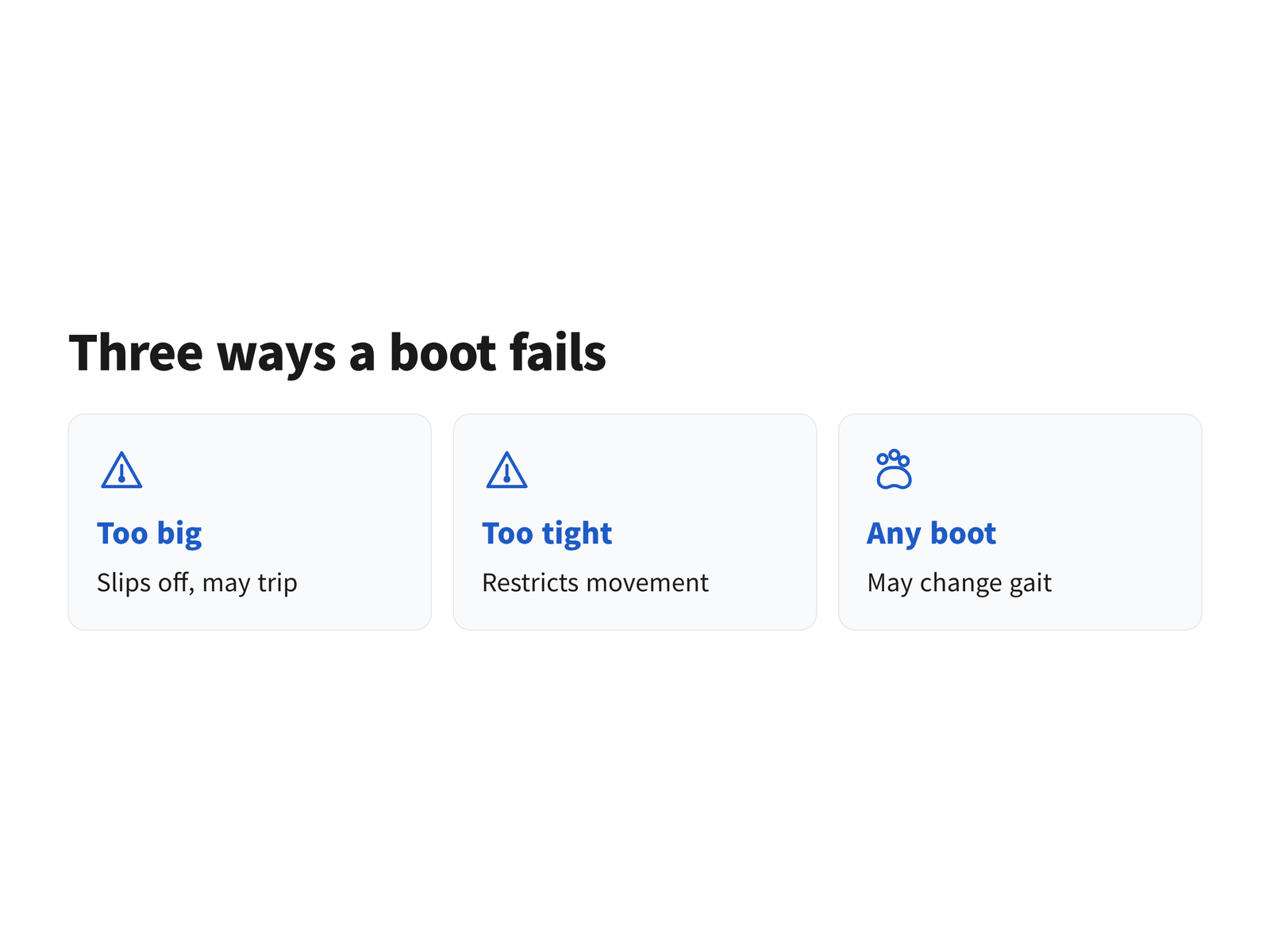
A snug but comfortable fit, based on measured paw length and width, is what the AKC guidance points toward. If a small dog still pulls at a boot or moves awkwardly after a fitting, the boot size or style may need another look before longer walks.
Do dog boots change the way a dog walks?
Dog boots may change the way a dog walks, according to two published gait studies, although neither study tested small or toy breeds. The 2022 Frontiers in Veterinary Science study by Bieber and colleagues used five female Labrador Retrievers with a mean weight of 26.27 kg. With a single front boot, peak vertical force at the trot dropped by 31% in the booted limb, and the center-of-pressure area increased. The authors wrote that “the wearing of boots leads to a certain increased instability, even though the dogs have been previously habituated.”
A 2019 study in Biologia Futura by Shorter and Brown tested six clinically sound Beagles on an AMTI force plate recording at 1,000 Hz. The peak vertical instantaneous loading rate was significantly greater with boots than barefoot, while stance time, peak vertical force and vertical impulse showed no significant difference. The authors noted the higher loading rate “may result in” overloading, and concluded that “caution must be taken when introducing footwear to ensure an adequate adjustment period.”
These results come from medium and larger dogs, so how closely they apply to a Chinese Crested or other small breed is unknown. The studies suggest boots seem to have an effect on gait, not that boots cause injury. If you notice a change in how your dog walks in boots, or see damage to the paw pads after winter walks, consult your veterinarian.
How do you get a small dog used to wearing boots?
Introduce boots one at a time and keep the first sessions short. The AKC’s dog clothing article, written by a certified professional dog trainer, advises that you “put one boot on and praise your dog, and then slowly build up to your dog wearing all four.” The same article is honest about limits: “Not every dog likes it, but patience and time can help.”
For timing, the 2022 Frontiers study offers a reference point rather than a rule. The researchers habituated the dogs over one week with sessions “no longer than 15 min at a time.” That was a study protocol, not an official recommendation, but the idea of short, repeated sessions matches the AKC’s build-up approach. When you arrive home, the AKC’s ice-melt guidance suggests taking the boots off so de-icing chemicals are not carried inside.
Boots, paw wiping or trimming: what do the AKC, RSPCA and Royal Kennel Club recommend for winter paws?
The AKC, RSPCA and Royal Kennel Club all treat boots as one option among several, and the RSPCA and Royal Kennel Club both recommend cleaning paws after winter walks. The RSPCA says “dog boots protect their paws against the cold ground, and prevent contact with poisons,” and the AKC notes that sodium chloride and calcium chloride de-icers “can damage paw pads.” The Royal Kennel Club advises owners on icy or snowy days to “consider using a coat or paw protectors” and to rinse paws with warm water.
| Option | What it does | Limitation |
|---|---|---|
| Dog boots | Blocks cold, ice, de-icers | Must fit; may alter gait |
| Paw wiping or rinsing | Removes grit and salt | Exposure still happens |
| Trimming fur between pads | Reduces ice balls | Does not block chemicals |
| Pet-safe ice melt at home | Limits exposure at home | No control on sidewalks |
| Shorter time out on icy days | Reduces cold exposure | No pad protection on walks |
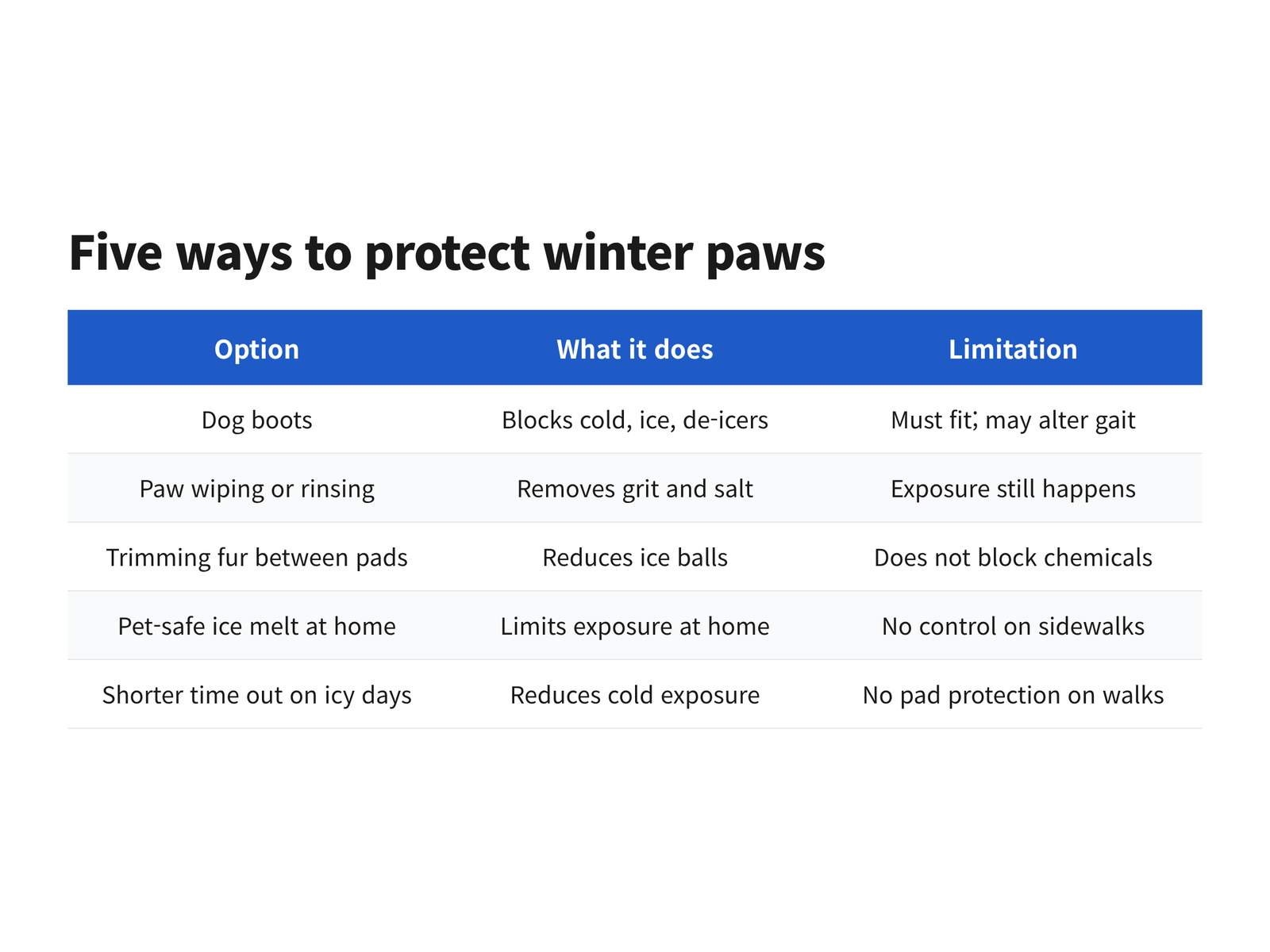
Whether or not your small dog wears boots, wiping or rinsing paws after a walk is the step both the RSPCA and the Royal Kennel Club recommend. Paw wax is sometimes discussed as an alternative to boots, but no veterinary or kennel club source reviewed for this guide evaluates paw wax, so its effectiveness is left unverified here.
Frequently asked questions
Why do dog boots fall off a small dog’s back paws?
No authoritative source reviewed for this guide addresses back paws specifically. The general AKC rule applies to every paw: a boot that is too big will not stay on, so measure each paw rather than assuming front and back paws take the same size.
Can a small dog wear boots all winter without a break?
The available guidance favors gradual build-up rather than long wear from the start. The AKC recommends starting with one boot, and the 2022 study used sessions of no longer than 15 minutes during habituation.
Does a hairless Chinese Crested need different boot sizing?
The AKC breed standard notes hair on the feet of the hairless variety, so measure with that hair in mind. No source gives a separate sizing method for hairless dogs.
Sources
- American Kennel Club, “How To Get Your Dog Comfortable Wearing Dog Clothes” (Sassafras Patterdale, CPDT-KA), updated 2026-03-04 – https://www.akc.org/expert-advice/health/dog-clothes-weather-safety/
- American Kennel Club, “How to Keep Your Dog Warm and Safe This Winter,” updated 2026-01-14 – https://www.akc.org/expert-advice/health/keep-dog-warm-winter-safety-tips/
- American Kennel Club, “How to Care for and Clean Dog Paws and Paw Pads” (Anna Burke), updated 2026-03-18 – https://www.akc.org/expert-advice/health/clean-dog-paws/
- American Kennel Club, “Dog Safe Ice Melts” (Jan Reisen), updated 2026-02-18 – https://www.akc.org/expert-advice/health/dog-safe-ice-snow-melt/
- American Kennel Club, “Official Standard of the Chinese Crested,” approved 1990-06-12 – https://a.storyblok.com/f/92981/x/a99576265a/akc-chinese-crested.pdf
- RSPCA, “Winter & Cold Weather Care for Dogs,” no date shown – https://www.rspca.org.uk/adviceandwelfare/seasonal/winter/pets/dogs
- Royal Kennel Club, “Keep your dog safe during winter,” no date shown – https://www.royalkennelclub.com/health-and-dog-care/health-dog-care/health/health-and-care/a-z-of-health-and-care-issues/winter-dangers-to-dogs
- Royal Kennel Club, “Long claws,” no date shown – https://www.royalkennelclub.com/health-and-dog-care/health-dog-care/health/health-and-care/a-z-of-health-and-care-issues/long-claws
- Bieber, Reicher, Tichy, Bockstahler, “Changes in Ground Reaction Forces and Center of Pressure Parameters of Paws When Wearing Dog Boots in Dogs,” Frontiers in Veterinary Science, 2022-07-12 – https://www.frontiersin.org/journals/veterinary-science/articles/10.3389/fvets.2022.906277/full
- Shorter and Brown, “Ground force kinetic adaptations associated with canine boots,” Biologia Futura, 2019 – https://rune.une.edu.au/web/handle/1959.11/27622