Neither shape wins on its label alone. The usual retail rule says a Y-front harness never restricts a dog’s shoulders and a straight-front harness always does, but the gait studies behind that claim do not back it up. In the best-known study, the Y-shaped harness cut shoulder extension more than the chest strap. Another study found the answer flipped with leg length. When choosing a Y-front vs straight-front harness for small dogs, fit and the distance from elbow to floor appear to matter more than the strap shape printed on the box.
Does a Y-front harness really leave a small dog’s shoulders free?
Not always: in the most cited study, a Y-shaped harness reduced shoulder extension more than a straight chest strap did. A straight-front harness, also sold as a Norwegian or chest-strap harness, has a single strap running horizontally across the chest. A Y-front harness runs a Y-shaped strap from the breastbone up between the front legs to the neck, leaving the front of the shoulders more open. A shelter guide from the Edmonton Humane Society repeats the common claim that an across-the-chest style restricts shoulder movement while Y-shaped designs do not.
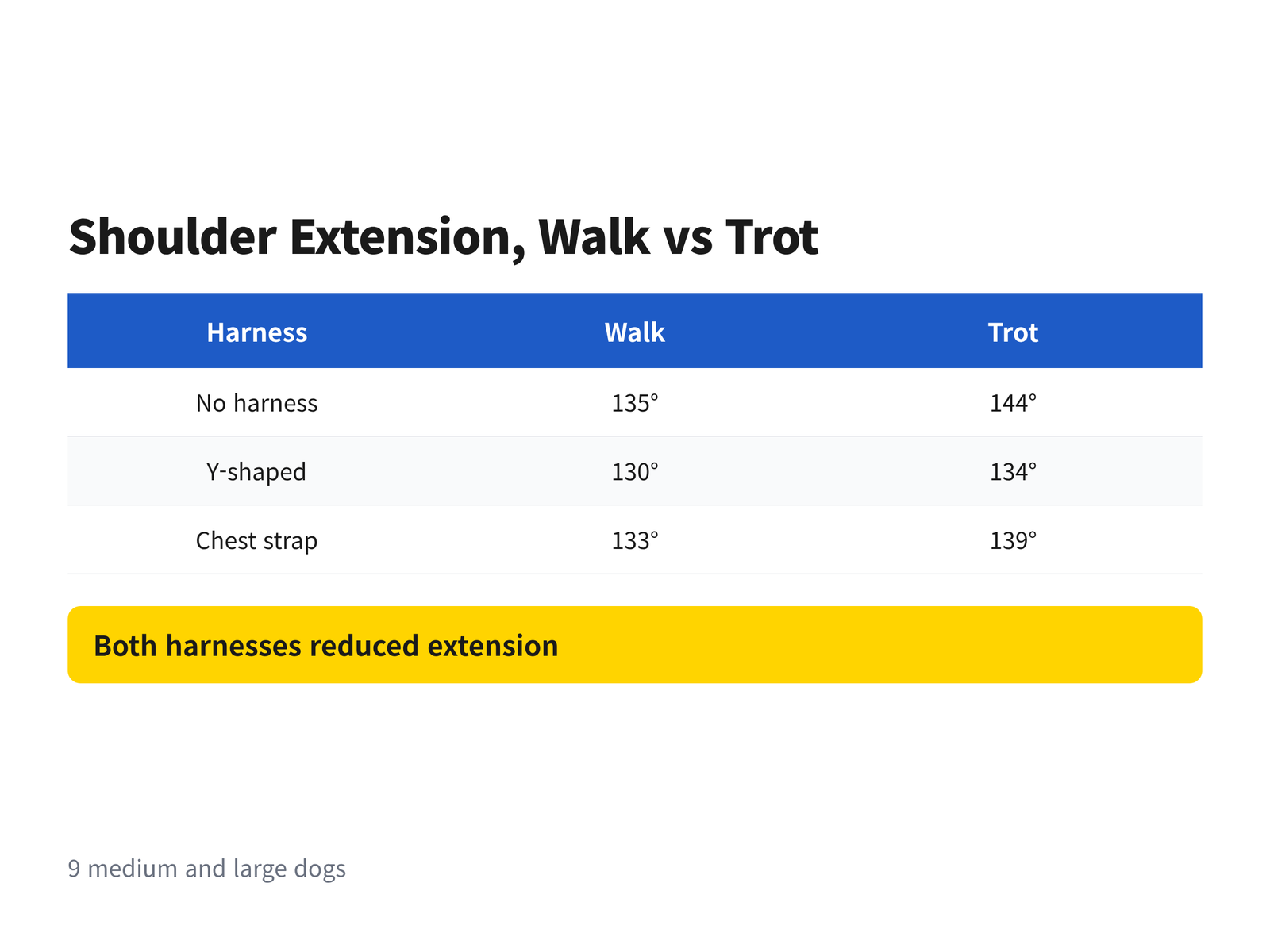
Lafuente, Provis and Schmalz tested both designs in a study published in Veterinary Record. At a walk, shoulder extension measured 135 degrees with no harness, 130 degrees in the Y-shaped harness and 133 degrees in the chest-strap harness. At a trot, the figures were 144, 134 and 139 degrees. The authors reported that a “Significant decrease in shoulder extension was found with both types of harnesses.” A 2025 review in Animals put it plainly: “the Y-shaped harness (which was considered non-restrictive) limited shoulder extension more than the chest-strap.”
The Lafuente result does not make the Y-front a bad harness. The authors listed the main limit: “First, the population size was small.” The study used nine medium and large dogs. The fair reading is that a Y-front label is no guarantee of free shoulders, not that a straight-front harness is the better choice.
What did the harness gait studies actually measure?
The main harness studies measured joint angles or stride length in mostly medium and large dogs, so no study has tested toy breeds. Lafuente used nine medium and large breeds. Weissenbacher and colleagues used 12 guide dogs weighing 23 to 39.3 kg and found that “Stride length was shortened if the Y-harness with handles was used.” Williams and colleagues analysed 66 dogs with a mean weight of 18.99 kg, and their smallest breed was the French Bulldog. Dowdeswell and Churchill did not report the sizes of their 30 dogs.
Dowdeswell and Churchill compared six harnesses with a collar. Median shoulder extension was 97.4 degrees in the collar, 93.5 in a Halti Y-front and 93.8 in a Julius K9 straight front, which is close to a tie. The chest plate (88.5), no-pull (88.2), step-in (86.3) and front-clip (84.7) designs sat lower, and all six harnesses were significantly lower than the collar. For a small dog, these harness results are an extrapolation from larger or unreported sizes.
Two more limits apply to the gait studies. Williams and colleagues note that a dog pulling on the lead may be restricted more than in their test conditions, and the 2025 review found no clinical or epidemiological data on harness-related injury. The studies show short-term changes in movement, not long-term harm.
Why does leg length matter more than the harness label?
Leg length matters because, in the largest harness study, the design that shortened stride changed with how short a dog’s legs were. Williams and colleagues measured elbow-to-floor distance in every dog: 119.29 mm on average in French Bulldogs, 182.50 mm in Cocker Spaniels and 267.35 mm in Labradors. The authors concluded that “these differences suggest that the distance from the dog’s elbow to the floor is a key consideration.”
The Williams results split by build. Cocker Spaniels, with short elbow-to-floor distances, took shorter strides in the Julius K9 chest-strap harness than in their collar. Labradors and Springer Spaniels showed the opposite pattern: the Y-shaped harnesses shortened their stride, while the chest strap had no significant effect. French Bulldogs, the shortest-legged group, took longer strides in the thin, flexible Perfect Fit Y-shape, with 20 mm straps, than in the Julius K9, the Ruffwear Y-shape, their collar or their own harness.
For a short-legged small dog, the Williams study suggests that strap width and where the chest strap crosses relative to the elbow deserve a closer look than the Y or straight label. The authors wrote that “it is possible that there is no “correct” harness for all dogs” and advised that “owners and harness fitters treat dogs on an individual basis.” Whether the French Bulldog result applies to a particular small dog depends on its build, and that group had only four dogs.
Is a front-clip no-pull harness a poor fit for a small dog?
A front-clip no-pull harness is a trade-off rather than a poor fit: it offers more control but showed the largest effect on movement in one study. Dowdeswell and Churchill found the front-clip model had the lowest shoulder extension, at 84.7 degrees, and the largest impact on joint flexion and extension overall. The 2025 review in Animals, by contrast, says non-tightening front-clip harnesses “offer better control without being as restrictive as tightening harnesses” and lists them first for dogs that pull.
Pulling is the deciding question, and small dogs may pull harder than their size suggests. The 2025 review reports that one study found “small dogs exhibited higher mean pulling forces than medium or large dogs,” with peak force at 122.2% of body weight in small dogs against 85.8% in medium and 82.7% in large dogs. For a dog that does not pull, or a brachycephalic breed, the review notes that back-clip harnesses suit the job, and the AKC calls a standard back-attachment harness “a popular choice for use with small dogs.”
A harness of any shape is still a common alternative to a collar for small breeds. The American College of Veterinary Surgeons lists Yorkshire terriers, Pomeranians, Poodles and Chihuahuas among the breeds most affected by tracheal collapse and names coughing when someone pulls on the collar as a sign. If your dog’s gait changes, or your dog seems sore after walks, consult your veterinarian before switching harnesses.
Y-front vs straight-front harness – what the studies found
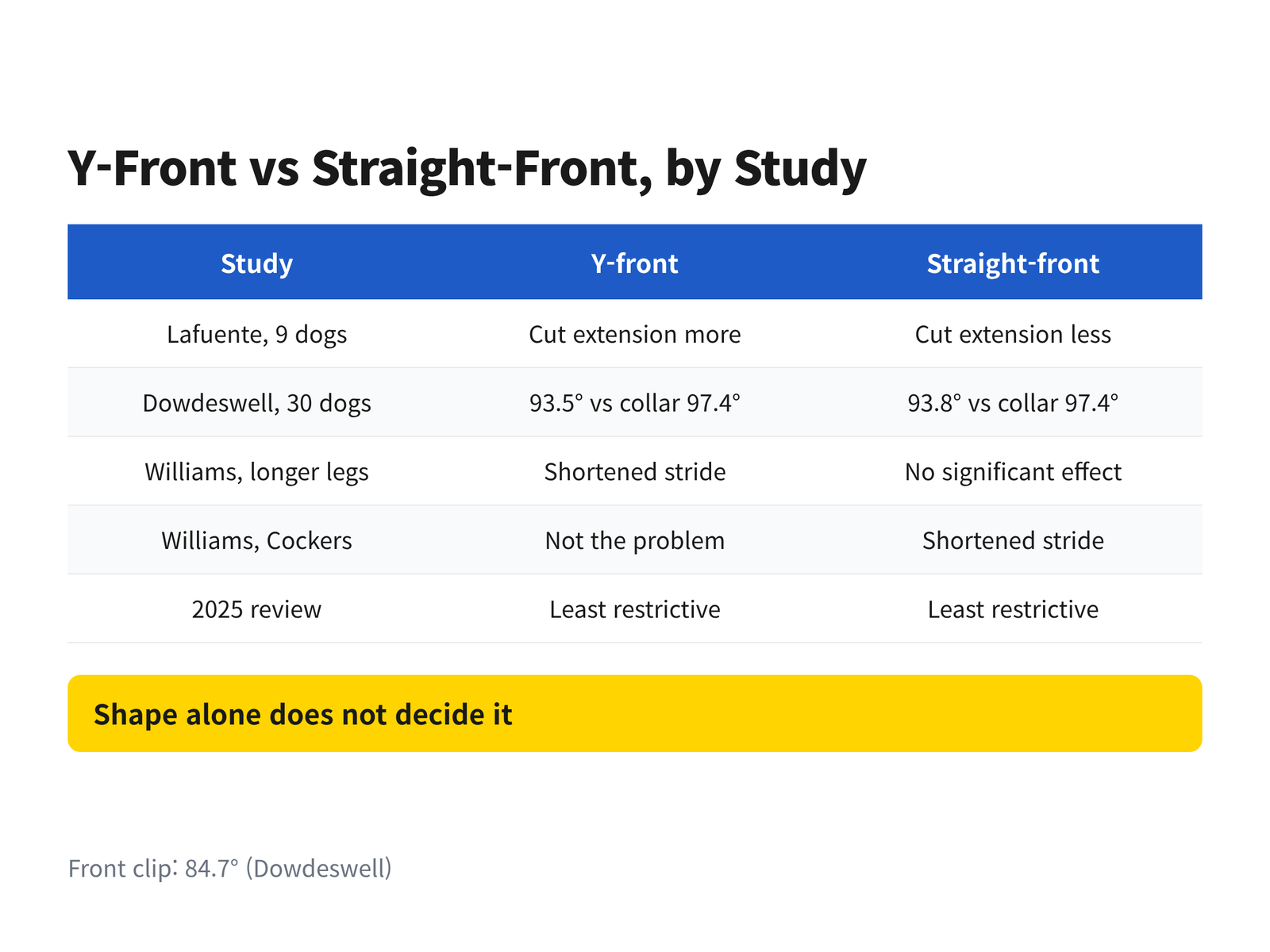
Across four gait studies and one review, neither the Y-front nor the straight-front harness comes out clearly ahead. Each study used different dogs and different harness models, so the rows below compare directions of effect rather than one shared score.
| Study | Y-front | Straight-front |
|---|---|---|
| Lafuente, 9 dogs | Cut extension more | Cut extension less |
| Dowdeswell, 30 dogs | 93.5 vs collar 97.4 | 93.8 vs collar 97.4 |
| Williams, longer legs | Shortened stride | No significant effect |
| Williams, Cockers | Not the problem | Shortened stride |
| 2025 review | Least restrictive | Least restrictive |
The 2025 review covered 21 full-text articles and 2 abstracts and concluded that chest-strap and Y-shaped harnesses are “likely to be the least restrictive” designs. That moves the real choice between a Y-front and a straight-front harness for a small dog onto fit, not shape. A front-clip harness, at 84.7 degrees in the Dowdeswell study, sat below both.
How should a Y-front or straight-front harness fit a small dog?
A Y-front or straight-front harness should fit by chest girth and neck girth, with a small finger gap and no rubbing at the armpits or elbows. The AKC measuring guide says to measure chest girth at the widest part of the ribcage, “usually just behind the front legs.” A simple fit check covers five steps:
- Measure chest girth at the widest part of the ribcage, with the dog standing.
- Measure neck girth at the base of the neck.
- Check the gap: one finger for small dogs on the AKC harness page, two fingers under the tape on the AKC measuring guide.
- Watch the dog walk and check that belly straps do not rub at the armpits or elbows, as the Edmonton Humane Society guide advises.
- On a short-legged dog, note where the chest strap sits relative to the point of the shoulder and the elbow.
The two AKC pages give different figures, so treat the harness gap as a range to check rather than a single number. If the stride looks short in one harness, comparing a second design on the same dog follows the individual approach Williams and colleagues recommend.
Frequently asked questions
Is a Y-front harness better than a straight-front harness for a small dog? Not by shape alone. Lafuente found the Y-shaped harness reduced shoulder extension more, Dowdeswell found a near tie at 93.5 and 93.8 degrees, and the 2025 review rates both among the least restrictive designs.
How much room should a small dog’s harness have? The AKC gives one finger for small dogs on its harness vs collar page and two fingers under the tape on its measuring guide, so check both against your dog.
Do the gait studies show long-term harm from harnesses? No. The studies measured short-term changes in movement, and the 2025 review found no clinical or epidemiological injury data. Consult your veterinarian about any change in how your dog walks.
Sources
- Lafuente MP, Provis L, Schmalz EA, “Effects of restrictive and non-restrictive harnesses on shoulder extension in dogs at walk and trot”, Veterinary Record 184(2):64, epub 2018-11-19 – https://pubmed.ncbi.nlm.nih.gov/30455191/
- Williams E, Hunton V, Boyd J, Carter A, “Effect of harness design on the biomechanics of domestic dogs (Canis lupus familiaris)”, Journal of Applied Animal Welfare Science 28(2):301-317, online 2023 – https://hau.repository.guildhe.ac.uk/id/eprint/18026/
- Weissenbacher A, Tichy A, Weissenbacher K, Bockstahler B, “Influence of Two Types of Guide Harnesses on Ground Reaction Forces and Step Length of Guide Dogs for the Blind”, Animals 12, 2453, 2022 – https://mdpi-res.com/d_attachment/animals/animals-12-02453/article_deploy/animals-12-02453.pdf
- Dowdeswell L, Churchill L, “The Influence of Harness Design on Forelimb Biomechanics in Pet Dogs”, Reinvention: an International Journal of Undergraduate Research 17(S1), 2024 – https://reinventionjournal.org/index.php/reinvention/article/view/1372/1330
- Cavalli C, Protopopova A, “Review of Collars, Harnesses, and Head Collars for Walking Dogs”, Animals 15(15), 2162, 2025-07-22 – https://www.mdpi.com/2076-2615/15/15/2162
- American Kennel Club, AKC Staff, “Dog Harness vs Collar”, updated 2026-03-04 – https://www.akc.org/expert-advice/lifestyle/dog-harness-vs-collar/
- American Kennel Club, Courtney Campbell, “How to Measure Your Dog for Gear”, updated 2026-08-10 – https://www.akc.org/expert-advice/lifestyle/measure-dog-gear/
- American College of Veterinary Surgeons, “Tracheal Collapse”, modified 2023-06-20 – https://www.acvs.org/small-animal/tracheal-collapse/
- Edmonton Humane Society, “Canine harness selection”, undated – https://edmontonhumanesociety.com/wp-content/uploads/2024/05/2023-canine-harness-selection-EHS-Resources.pdf