Set crate size for a small dog by measurement, not weight. Every published sizing rule in English measures the dog first and then adds a fixed allowance. The United States Department of Agriculture adds 6 inches to the dog’s length and squares the result. The American Kennel Club adds 3 to 4 inches to each measurement instead. Weight charts skip that step, which is why two small dogs on the same chart row can need different crates.

What size crate does a small dog actually need?
A small dog needs a crate it can stand up in, turn around in and lie down in, with the exact numbers taken from its own body length and standing height. Four welfare bodies agree on that baseline and each adds one more word to it. The American Kennel Club states a crate “should be big enough for your dog to stand up, turn around, and lie down, but not much larger than that.” The RSPCA adds “and stretch in.” The Kennel Club asks for room to “comfortably lie flat in.” Blue Cross wants the crate “high enough to sit up without touching the top.”
Those four phrasings are not interchangeable. A crate that clears the stand-turn-lie test can still be too low for a small dog that sits upright, or too short for one that sleeps stretched flat.
Should you size a crate by weight or by body measurement?
Body measurement, because weight does not describe shape. The official American Kennel Club standard for the Pomeranian gives a body length to withers-height ratio of 1 to 1, while the Chihuahua standard describes an off-square dog that is slightly longer than tall. Both breeds can sit inside the same weight band, and both need a different crate footprint.
Weight fails outright on some breeds. The Italian Greyhound standard, approved 1976-12-14, sets height at withers at ideally 13 to 15 inches and states no weight at all, so a weight-keyed chart has nothing to work with. The Shih Tzu standard spans 9 to 16 pounds, wide enough to straddle two rows of a retailer chart while the dog itself stays one size.
How do you measure a small dog for a crate?
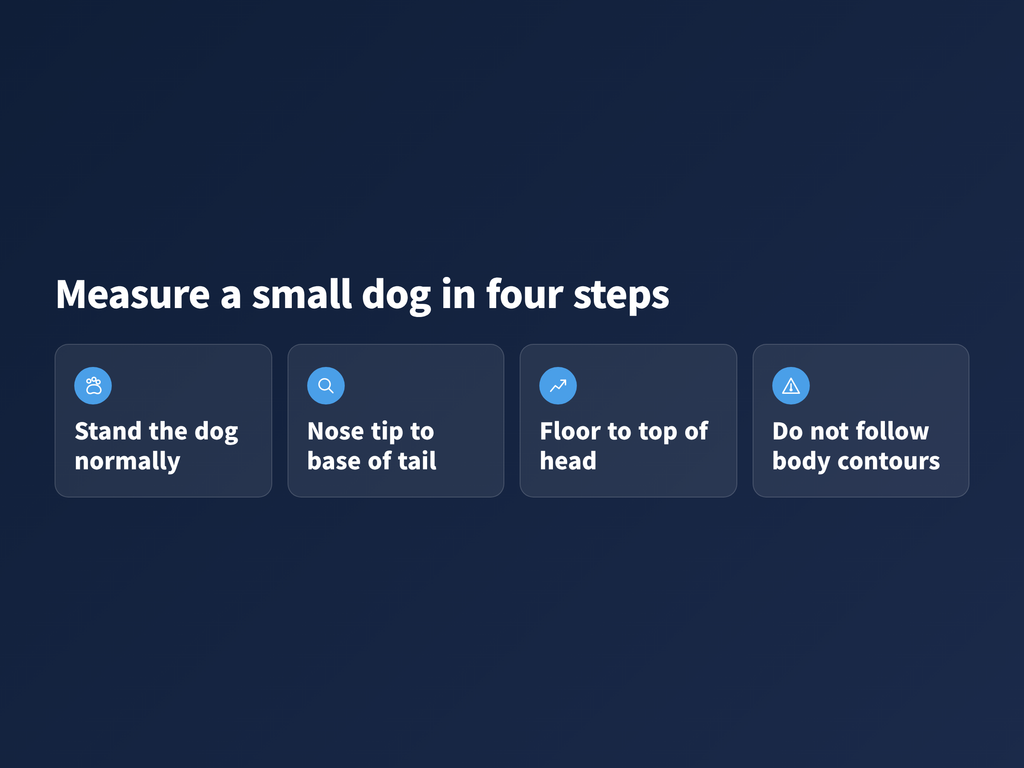
Stand the dog in a normal standing position, or lay it flat on its side, and run the tape in a straight line. The USDA Animal and Plant Health Inspection Service Tech Note APHIS-22-030, reviewed February 2026, is explicit about the tape path: “Do not follow the contours of the dog’s body.”
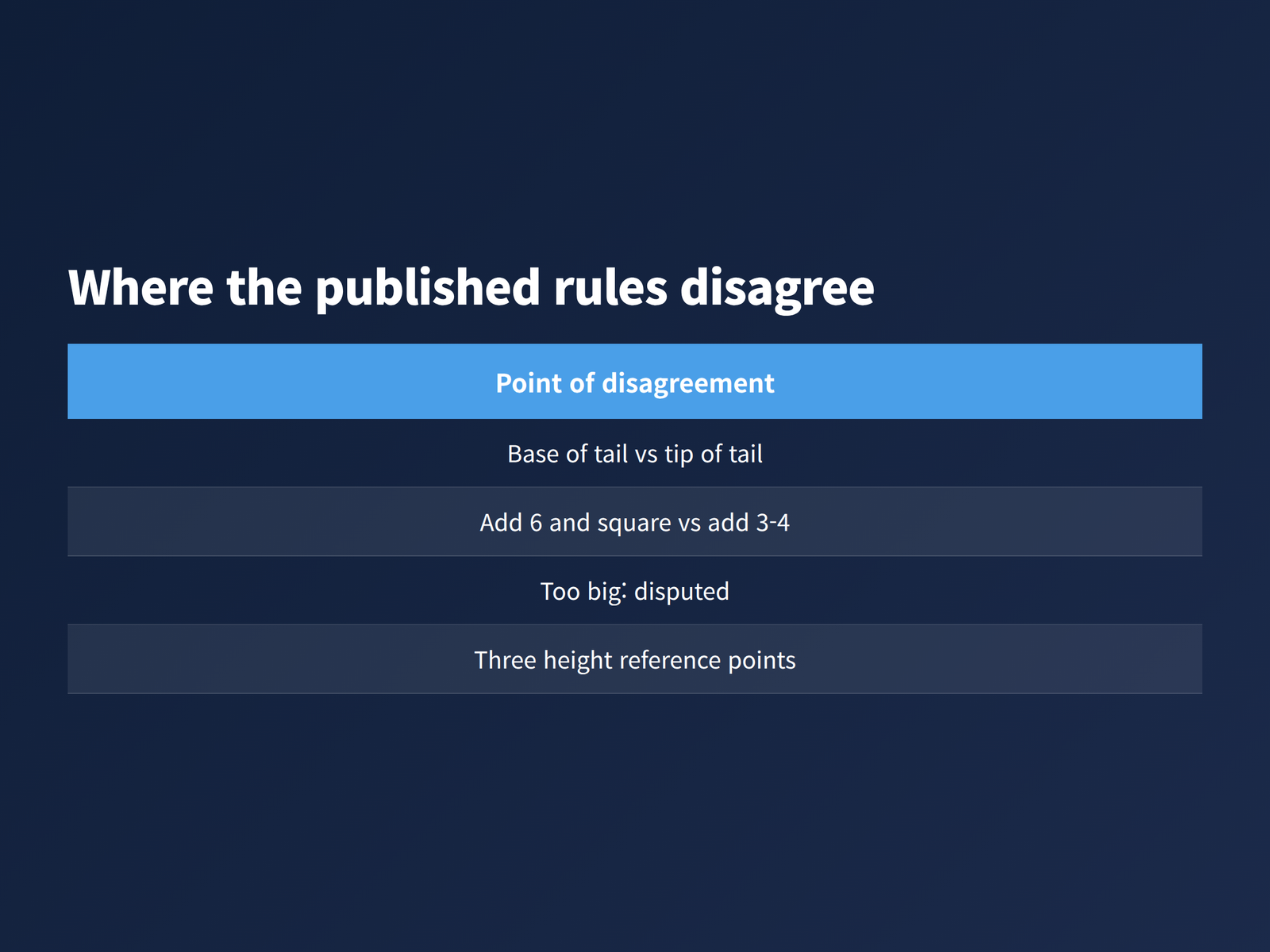
Then take two numbers. For length, APHIS instructs readers to “measure the length of the dog (in inches) from the tip of its nose to the base of its tail.” For height, measure from the floor to the top of the head while the dog stands. Record the American Kennel Club version of length as well, nose tip to tail tip, because the two rules stop at different points.
One extra check applies to small dogs specifically. 9 CFR 3.6(a)(2) requires that mesh or slatted floors must not allow the dogs’ feet to pass through any openings. The smaller the paw, the more that clause matters on a wire pan.
Why do breed-based crate size charts not fit small dogs?
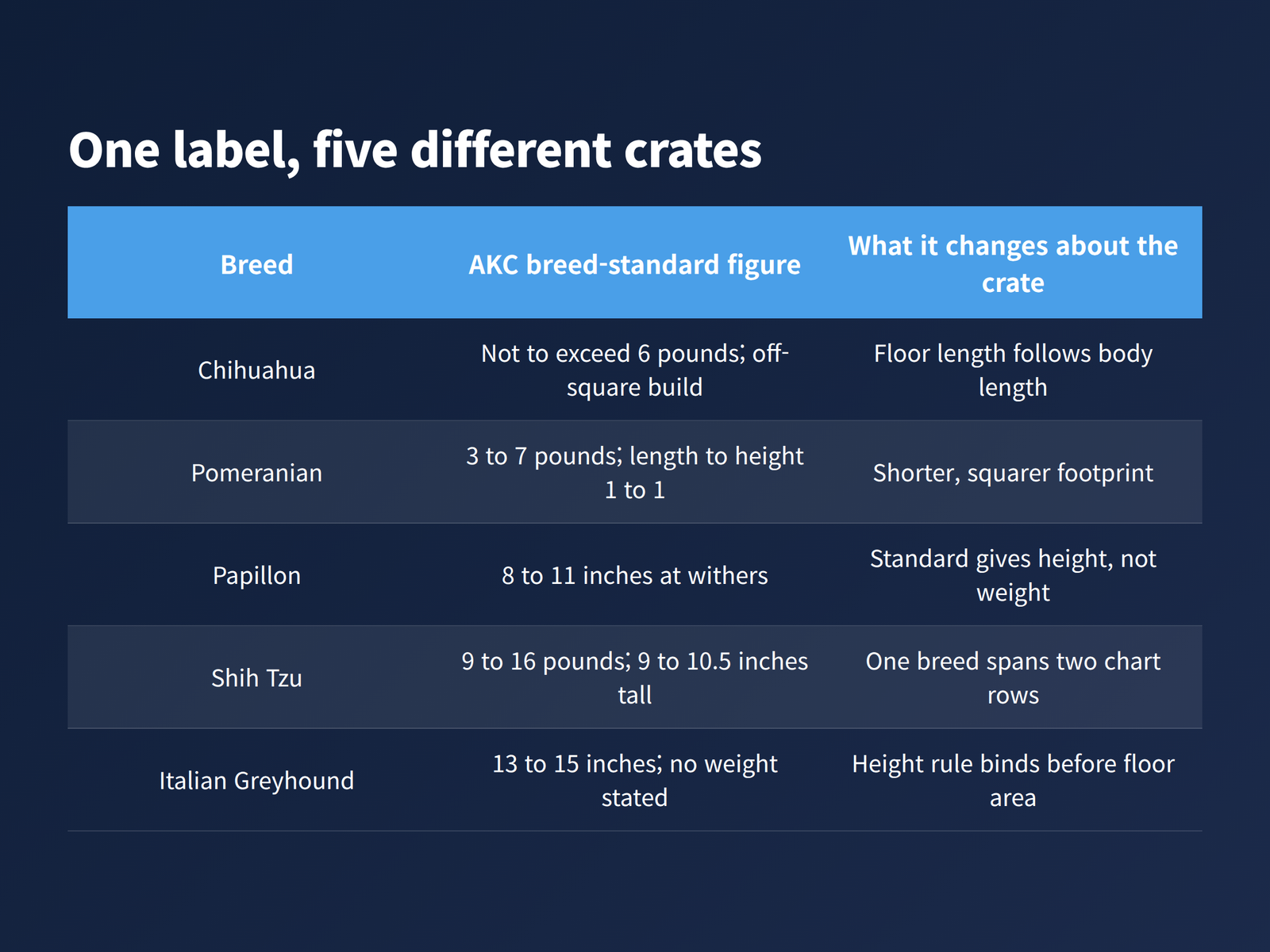
Breed charts collapse geometry into a label, and small-breed standards describe proportion rather than a single size. The five official American Kennel Club standards below all sit under the “small” heading on a retailer chart, yet each pushes the crate in a different direction.
| Breed | AKC breed-standard figure | What it changes about the crate |
|---|---|---|
| Chihuahua | Not to exceed 6 pounds; off-square build | Floor length follows body length |
| Pomeranian | 3 to 7 pounds; length to height 1 to 1 | Shorter, squarer footprint |
| Papillon | 8 to 11 inches at withers | Standard gives height, not weight |
| Shih Tzu | 9 to 16 pounds; 9 to 10.5 inches tall | One breed spans two chart rows |
| Italian Greyhound | 13 to 15 inches; no weight stated | Height rule binds before floor area |
How much floor space does a small dog crate need in square feet?
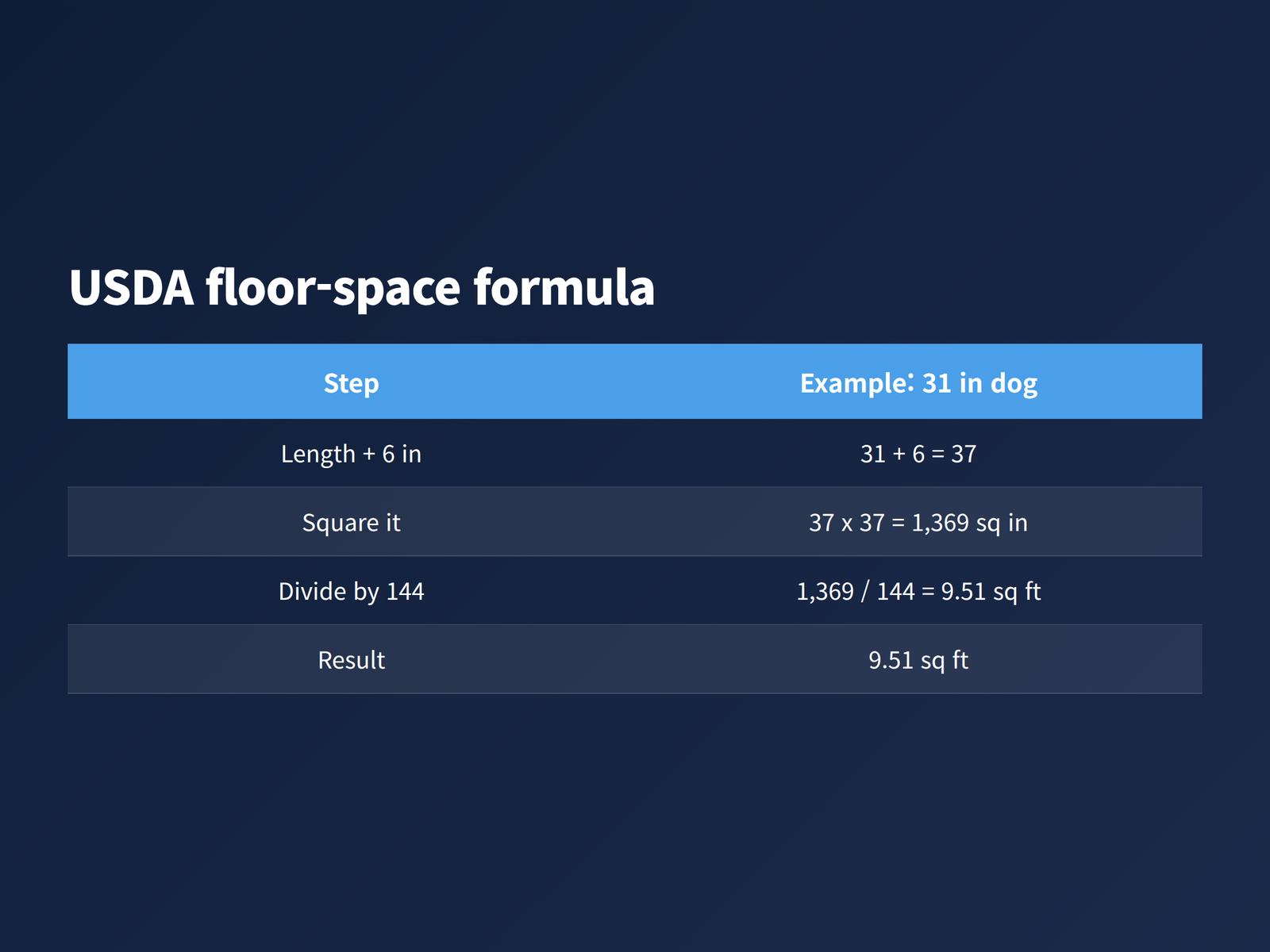
The only published arithmetic answer comes from 9 CFR 3.6(c)(1)(i): add 6 inches to the dog’s length in inches, square that number to get required floor space in square inches, then divide by 144 for square feet. The APHIS Tech Note works it through on a 31-inch dog: 31 plus 6 is 37, 37 times 37 is 1,369 square inches, and 1,369 divided by 144 is 9.51 square feet.
The scope of that rule has to be stated plainly. 9 CFR Part 3 Subpart A sets Animal Welfare Act standards for USDA-licensed dealers, exhibitors and research facilities. It is not a legal requirement for a crate in a private home. Treat the formula as the only published, checkable sizing method, and its output as a regulatory floor rather than a comfortable target.
How high does a small dog’s crate need to be?
Three published rules answer that with three different reference points. USDA requires that “the interior height of a primary enclosure must be at least 6 inches higher than the head of the tallest dog in the enclosure when it is in a normal standing position.” Blue Cross only asks that the dog can sit up without touching the top. The American Kennel Club measures from the top of the head to the bottom of the feet, then adds 3 to 4 inches.
Height is the rule that binds first on tall, light small breeds. An Italian Greyhound standing 13 to 15 inches at the withers needs a taller crate than a heavier, lower-standing small breed.

Can a dog crate be too big for a small dog?
The published bodies disagree, and the disagreement is the honest answer. The American Kennel Club warns against oversizing: “You don’t want one that’s too large. This could encourage your dog to eliminate within the crate because they can sit away from the mess.” Blue Cross takes the opposite position and prefers a larger crate to an undersized one.
No peer-reviewed study settles it, so neither position is established fact. Crate makers offer removable dividers as a middle path, and the American Kennel Club notes that a removable partition lets a crate grow with the dog. No published source specifies where the divider should sit.
How long can a small dog stay in a correctly sized crate?
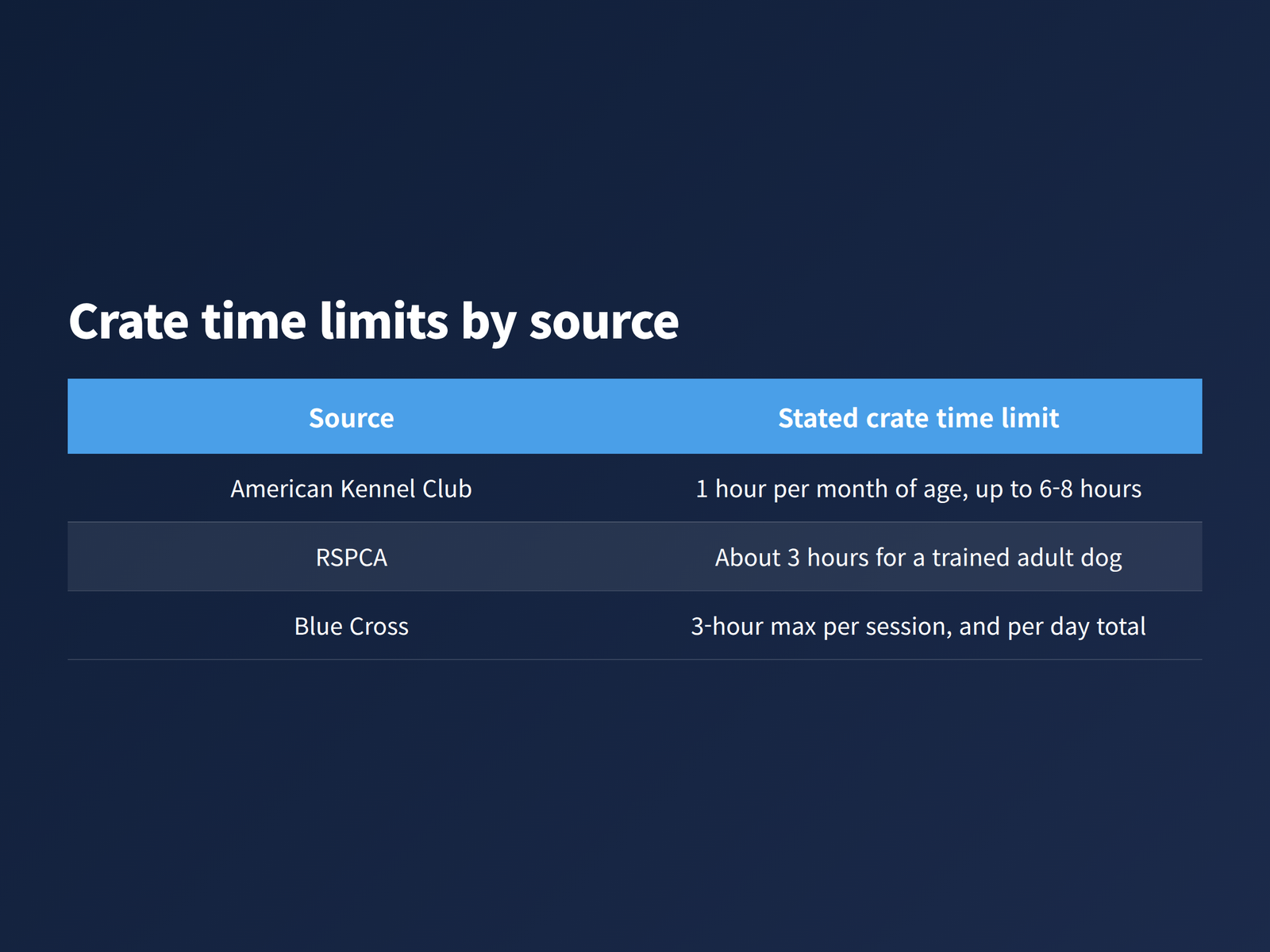
Correct sizing does not extend the time a dog should spend inside. The American Kennel Club crate training manual sets a ceiling of one hour per month of the dog’s age, up to a maximum of 6 to 8 hours, so a four-month-old puppy tops out at four hours. The RSPCA describes a trained adult dog as normally quite happy to be left for about three hours. Blue Cross sets a three-hour maximum per session and across the day in total.
If a small dog shows distress in a crate sized by these measurements, consult your veterinarian or a qualified behaviourist rather than resizing the crate again.
Frequently asked questions
Does the USDA formula apply to a crate at home? No. 9 CFR 3.6 binds USDA-licensed dealers, exhibitors and research facilities, not private owners. It is used here only as published arithmetic.
Which length measurement should be used, base of tail or tip of tail? Record both. USDA stops at the base of the tail and the American Kennel Club goes to the tip, so on a long-tailed small dog the two rules can point to different crate lengths.
Is a 9.51 square foot crate needed for a small dog? No. That figure comes from the APHIS worked example for a 31-inch dog. Run the same arithmetic on a measured small dog and the number drops sharply.
Sources
- United States Department of Agriculture, Animal and Plant Health Inspection Service, “9 CFR 3.6 – Primary enclosures”, amended 2020-05-13 (85 FR 28798) – https://www.ecfr.gov/current/title-9/chapter-I/subchapter-A/part-3/subpart-A/subject-group-ECFRf5fe31f49d4f511/section-3.6
- USDA APHIS Animal Care, “Tech Note: Minimum Space Requirements for Dogs”, APHIS-22-030, reviewed February 2026 – https://www.aphis.usda.gov/sites/default/files/ac-tech-note-minimum-space-dogs.pdf
- American Kennel Club, “Crates for Dogs: How to Choose the Best Dog Crate”, Susan Paretts, updated 2026-02-25 – https://www.akc.org/expert-advice/lifestyle/choose-best-crate-dog/
- American Kennel Club, “An Owner’s Manual for Crate Training” (PDF) – https://images.akc.org/pdf/ebook/Crate_Training.pdf
- American Kennel Club, Official Breed Standards: Chihuahua (2008-08-12), Pomeranian (2011-07-12), Papillon (1991-06-10), Shih Tzu (1989-05-09), Italian Greyhound (1976-12-14) – https://www.akc.org/
- RSPCA, “How to crate train a puppy”, accessed 2026-09-12 – https://www.rspca.org.uk/adviceandwelfare/pets/dogs/environment/crates
- Blue Cross, “Crates – indoor dog kennels”, accessed 2026-09-12 – https://www.bluecross.org.uk/advice/dog/behaviour-and-training/dog-crates
- The Kennel Club, “How to crate train your dog”, accessed 2026-09-12 – https://www.royalkennelclub.com/your-dog/dog-training/get-started/dog-training-and-games/how-to-crate-train-your-dog