A collar size on a product label is usually a weight class. A collar that actually fits is a neck measurement. For a Chihuahua, a breed the American Kennel Club describes as “a well balanced little dog not to exceed 6 pounds,” those two numbers rarely line up. The American Kennel Club tells owners to rely “on a dog’s exact measurements rather than estimations on product labels.” This guide covers how to measure, how tight the collar should sit, what published pressure research says about collar type, and what identification the law requires.
Why don’t standard collar sizes fit a Chihuahua?
Standard collar sizes fail a Chihuahua because they convert body weight into a neck size, and no authority defines a Chihuahua by its neck. The AKC Official Standard of the Chihuahua, approved on 2008-08-12 and effective 2008-10-01, sets a weight ceiling of 6 pounds and makes any dog over 6 pounds a disqualification. The same standard describes the body as “off-square” and the head as “a well rounded ‘apple dome’ skull,” but it states nothing at all about neck circumference. Two Chihuahuas can sit at the same weight and still need different collars, which is exactly what a weight-to-size chart cannot express.
How do you measure a Chihuahua’s neck for a collar?
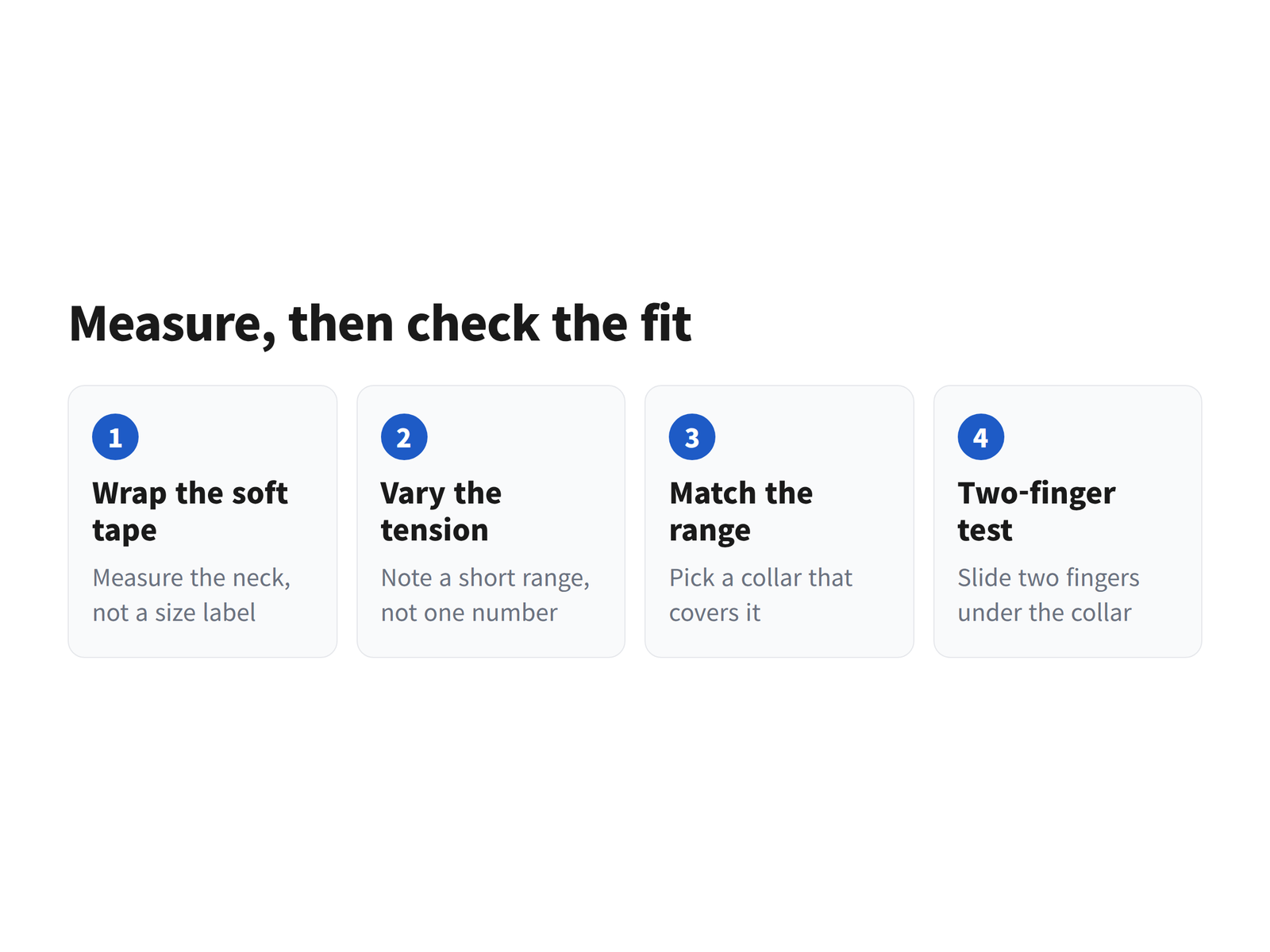
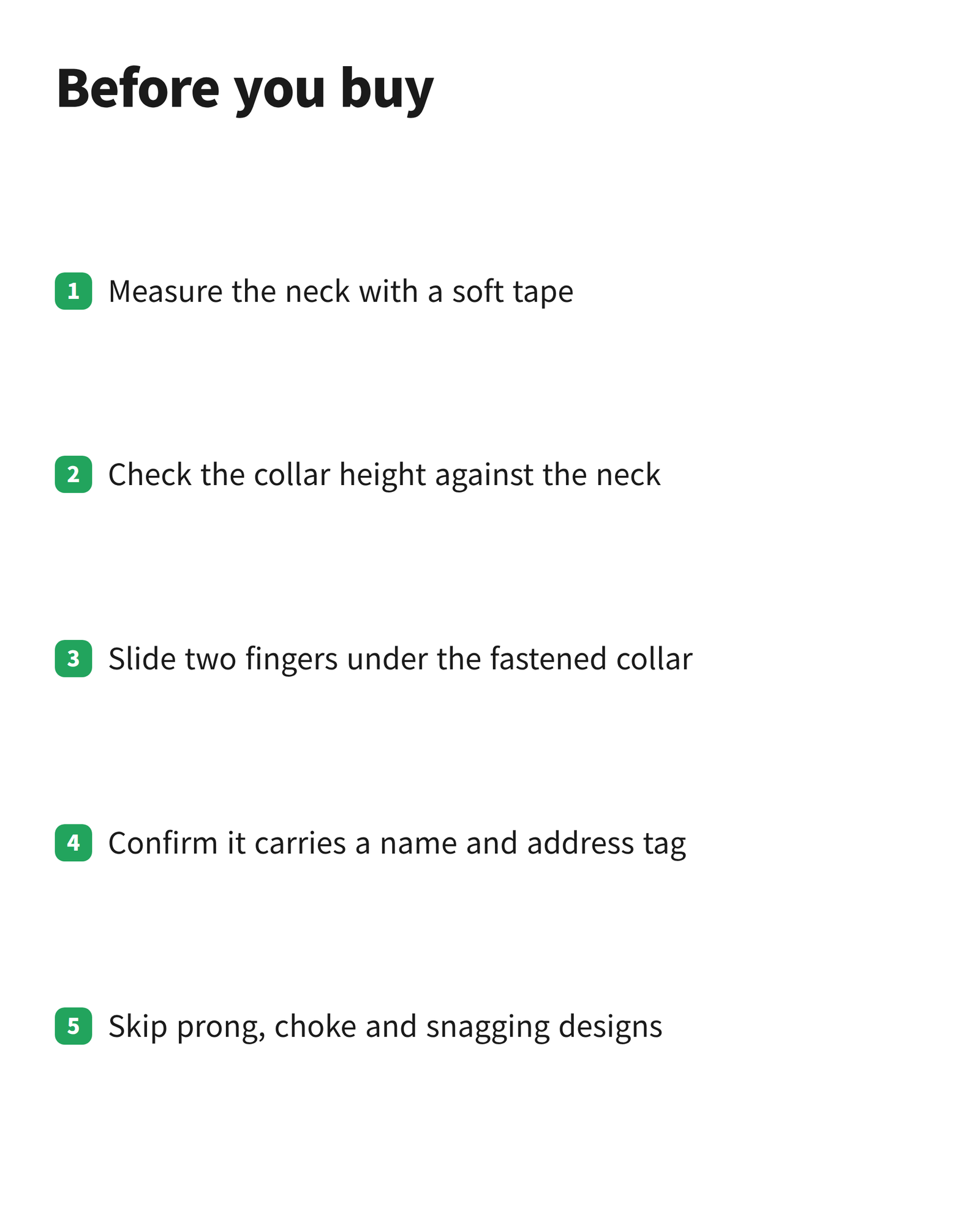
Measure with a soft tape around the neck and buy to that figure, not to a size label. The American Kennel Club, in guidance updated 2026-06-01, instructs owners to “wrap a soft measuring tape around your dog’s neck.” Vary the tape tension slightly as you measure so you end up with a short range rather than one number, then choose a collar whose adjustment range covers it. No Grade A source publishes a neck-circumference range for the Chihuahua breed, so there is no published figure to check your dog against. That absence is the reason the measuring step cannot be skipped.
How tight should a Chihuahua’s collar be?
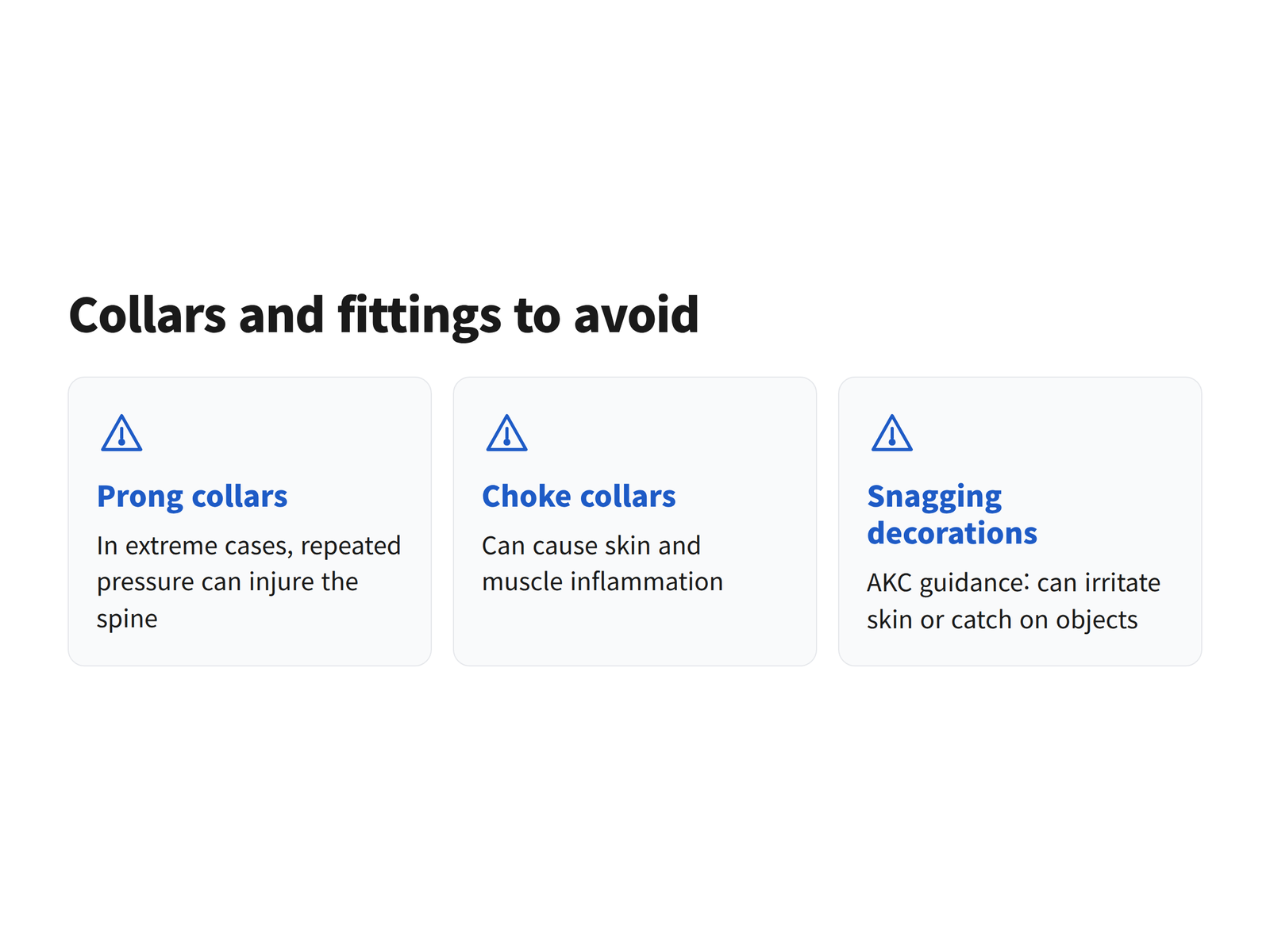
Two fingers should slide under the fastened collar. The AKC guidance updated 2026-06-01 puts the test plainly: “attempt to slide two fingers underneath the collar. If you can’t, the collar is too tight – but if you can slide more fingers, it’s too loose.” On a dog at the top of the breed’s 6 pound ceiling, the margin between those two states is small, so the check is worth repeating after the collar has been worn a few times and the strap has settled. The AKC also advises avoiding decorative attachments that can irritate skin or snag. Any coughing, rubbing or skin change under a collar is a reason to consult your veterinarian rather than to loosen the strap and carry on.
Which collar type puts the most pressure on a dog’s neck?
Collar type changes the pressure applied to a neck by a wide margin. Carter, McNally and Roshier, publishing in Veterinary Record on 2020-04-17, pulled eight collar designs against a simulated neck model at three forces: a 40 N firm pull, a 70 N strong pull and a 141 N jerk. Across the full set, recorded pressures ran from 83 kPa to 832 kPa, and collar type was a significant factor at F(7) = 25.69, P < 0.001. At the 141 N jerk, the rope slip lead recorded 182 kPa while the rolled collar recorded 814 kPa.
| Collar type | Pressure at 40 N | Contact area recorded |
|---|---|---|
| Lurcher collar (widest) | 83 kPa | 67.1 – 90.3 cm² |
| Padded webbing collar | 105 kPa | not captured |
| Padded sports collar | 125 kPa | not captured |
| Rope slip lead | 160 kPa | 23.6 – 31.7 cm² |
| Rolled collar | 509 kPa | not captured |
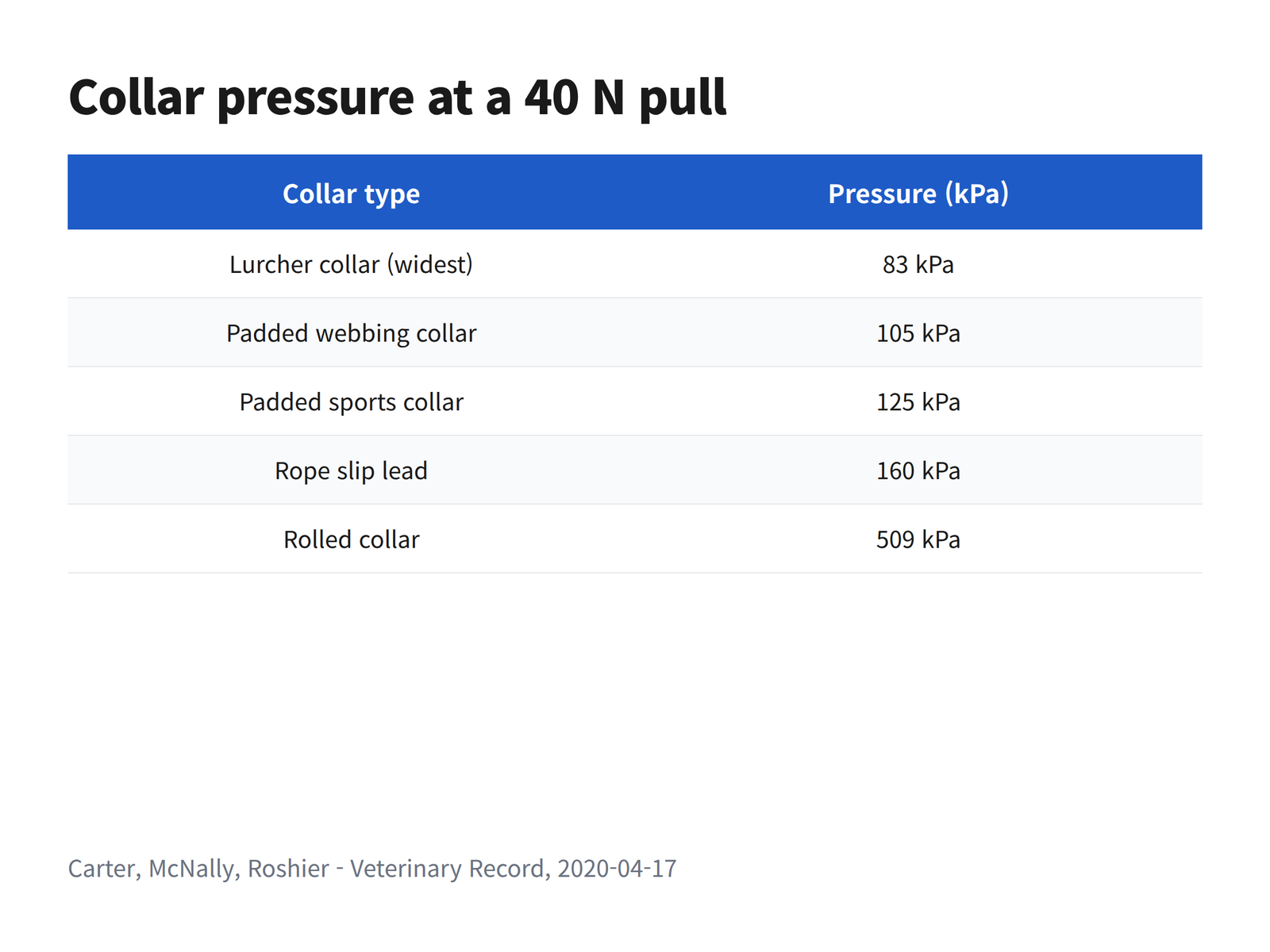
Carter, McNally and Roshier drew a blunt conclusion from those results: “No single collar tested provided a pressure considered low enough to mitigate the risk of injury when pulling on the lead.” The model was a rigid cylinder, not a live toy breed, so treat the figures as a ranking of designs rather than as readings taken from a Chihuahua.
Does a wider collar always work on a toy breed neck?
A wider collar spreads load, but width is only useful if the dog’s neck can carry it. In the Veterinary Record study the tested collars stood 1.5 to 3.8 cm tall against the neck, the rolled designs and the slip lead measured 1.0 to 1.1 cm in diameter, and the widest option recorded both the lowest pressure and the largest contact area, at up to 90.3 cm². Contact area, not strap length, is what drives the pressure a collar applies. Whether the tallest option fits a Chihuahua is a check the owner performs with the stated collar height in hand, because no source gathered here publishes a neck length for a toy breed.
Which collars should you not put on a toy breed?
Prong and choke collars are ruled out. The RSPCA states that “the repeated pressure of collars like choke and prong collars can cause severe inflammation of the skin and muscle, and in extreme cases can cause cervical spine injuries,” and recommends a well-fitting harness with reward-based loose-lead training instead. Restraint choice has measurable effects elsewhere in the body too. Bailey, Packer and Wills, publishing in Veterinary Medicine and Science in 2025 across 20 dogs, recorded intraocular pressure of 15.50 +/- 2.82 mmHg in dolichocephalic dogs exercising in a collar against a 12.10 +/- 2.79 baseline (p = 0.0024), with no significant rise in a harness. Their dogs were grouped by skull shape, not by size.
What happens to the tag when the collar does not fit?
It leaves with the collar. A tag only does its job while the strap it hangs from is still around the dog’s neck, which makes identification a sizing problem before it is a paperwork problem. A Chihuahua that backs away from a startling noise pulls its head straight through a strap sitting even slightly loose, because the apple dome skull the collar has to clear is barely wider than the neck behind it. On a larger dog that difference is a safety margin. On a 6 pound dog it is a fraction of an inch, and a size label picked from a weight chart is not precise enough to land inside it.
The two finger test from the AKC guidance is what marks the boundary in both directions. More than two fingers of slack and the collar can travel forward over the skull, taking the name and address with it. Fewer than two and the collar is too tight to leave on the dog at all. Either error ends with an unidentified dog, which is why the measuring step and the identification step are the same step.
Hardware deserves the same hands-on check as the strap. A tag hangs from a ring, and a ring on an oversized collar rotates under the chin instead of sitting still, so the tag swings, wears and works its fastening loose. A heavy engraved disc on one of the 1.0 cm rolled or rope designs is carrying its weight on a very narrow band of material. Lift the fastened collar, turn it, and confirm the tag is still attached and still legible before the dog goes out.
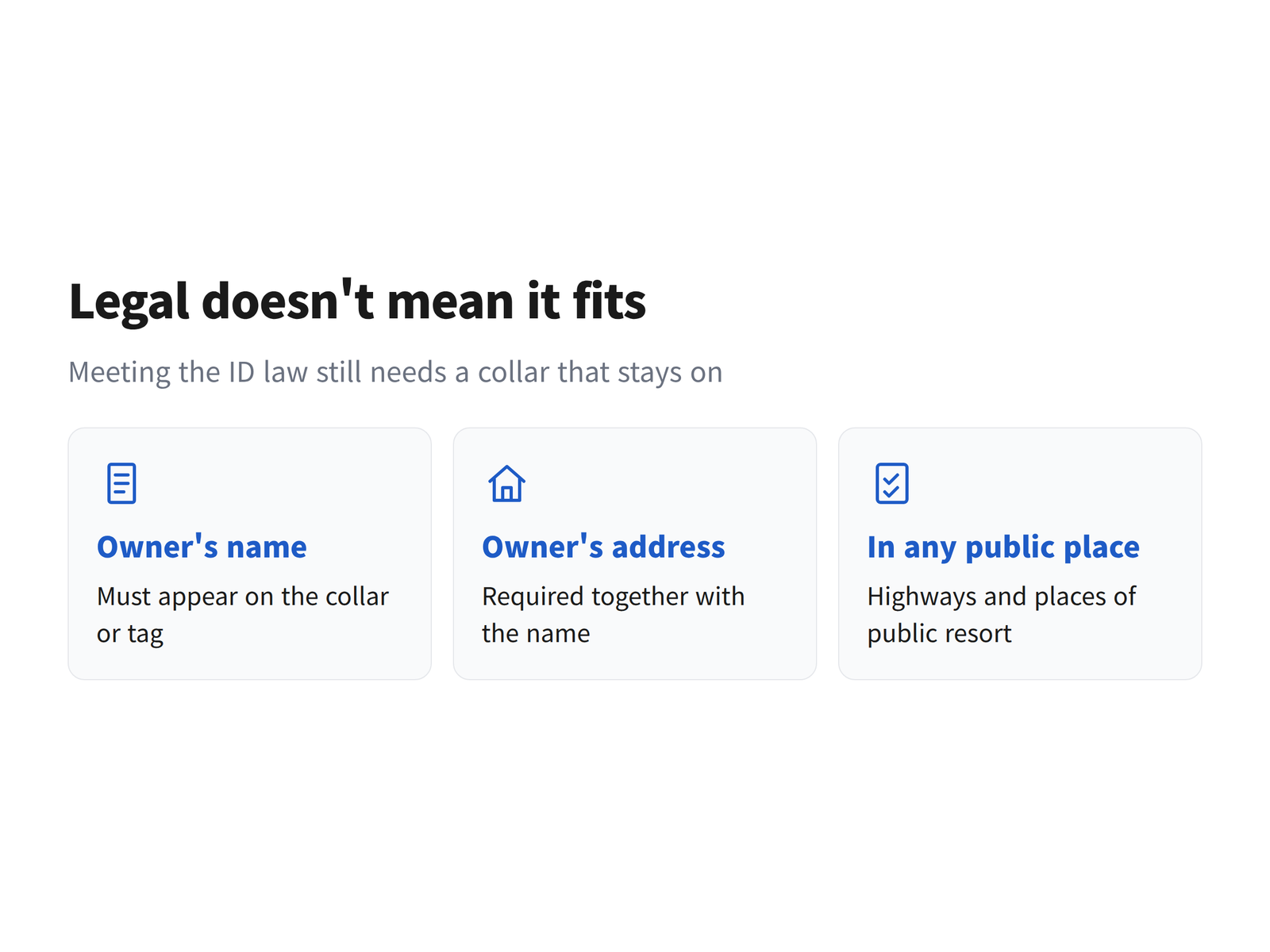
The legal requirement itself is short: in Great Britain a dog in a public place must wear a collar showing the owner’s name and address, and GOV.UK confirms that microchipping does not remove that duty. The requirement fixes on the collar itself, with the name and address carried either on the strap or on a tag or plate attached to it, so a strap the dog can back out of fails the legal test and the fit test in the same movement. In the United States identification requirements are set locally, at state, county or municipal level. Either way, an owner walking their dog with no readable ID is relying on a stranger owning a scanner, and a correctly sized collar is what keeps the readable version on the dog.
Frequently asked questions
Is a weight-based size chart ever good enough?
It is a starting point, not an answer. The American Kennel Club advises relying on exact measurements rather than on label estimations, and the Chihuahua breed standard caps weight without describing the neck.
Do the published pressure figures apply directly to a Chihuahua?
No. Carter, McNally and Roshier tested a simulated rigid neck model, not live toy-breed dogs, so the numbers rank collar designs rather than describe one dog.
What should I check before hanging a tag on the collar?
That the collar passes the two finger test first, and that the ring holding the tag does not rotate freely on an oversized strap. Identification only works while the collar is still on the dog.
Should I buy to the collar’s adjustment range or to its stated height?
Both, in that order. The adjustment range has to cover the neck figure you measured, and the stated height is what sets the contact area the strap presents to the neck. The collars in the Veterinary Record study stood 1.5 to 3.8 cm tall, so check that number against your own dog before assuming the widest design is available to a toy breed.
Sources
- American Kennel Club, “Official Standard of the Chihuahua,” approved 2008-08-12, effective 2008-10-01 – https://images.akc.org/pdf/breeds/standards/Chihuahua.pdf
- American Kennel Club, “Finding and Choosing the Right Dog Collar for Your Dog,” Colt Dodd, updated 2026-06-01 – https://www.akc.org/expert-advice/lifestyle/choosing-right-dog-collar/
- Carter A, McNally D, Roshier A, “Canine collars: an investigation of collar type and the forces applied to a simulated neck model,” Veterinary Record, 2020-04-17, DOI 10.1136/vr.105681 – https://irep.ntu.ac.uk/id/eprint/39713/
- Bailey, Packer and Wills, “Effect of a Collar and Harness on Intraocular Pressure and Respiration Rate of Brachycephalic and Dolichocephalic Dogs,” Veterinary Medicine and Science, 2025, DOI 10.1002/vms3.70384 – https://pmc.ncbi.nlm.nih.gov/articles/PMC12036695/
- The Control of Dogs Order 1992 (SI 1992/901), Article 2 – https://www.legislation.gov.uk/uksi/1992/901/article/2/made
- GOV.UK, “Get your dog or cat microchipped,” page current 2026-09-21 – https://www.gov.uk/get-your-dog-microchipped
- RSPCA, “Prong Collars,” no publication date shown – https://www.rspca.org.uk/adviceandwelfare/pets/dogs/training/prongcollars