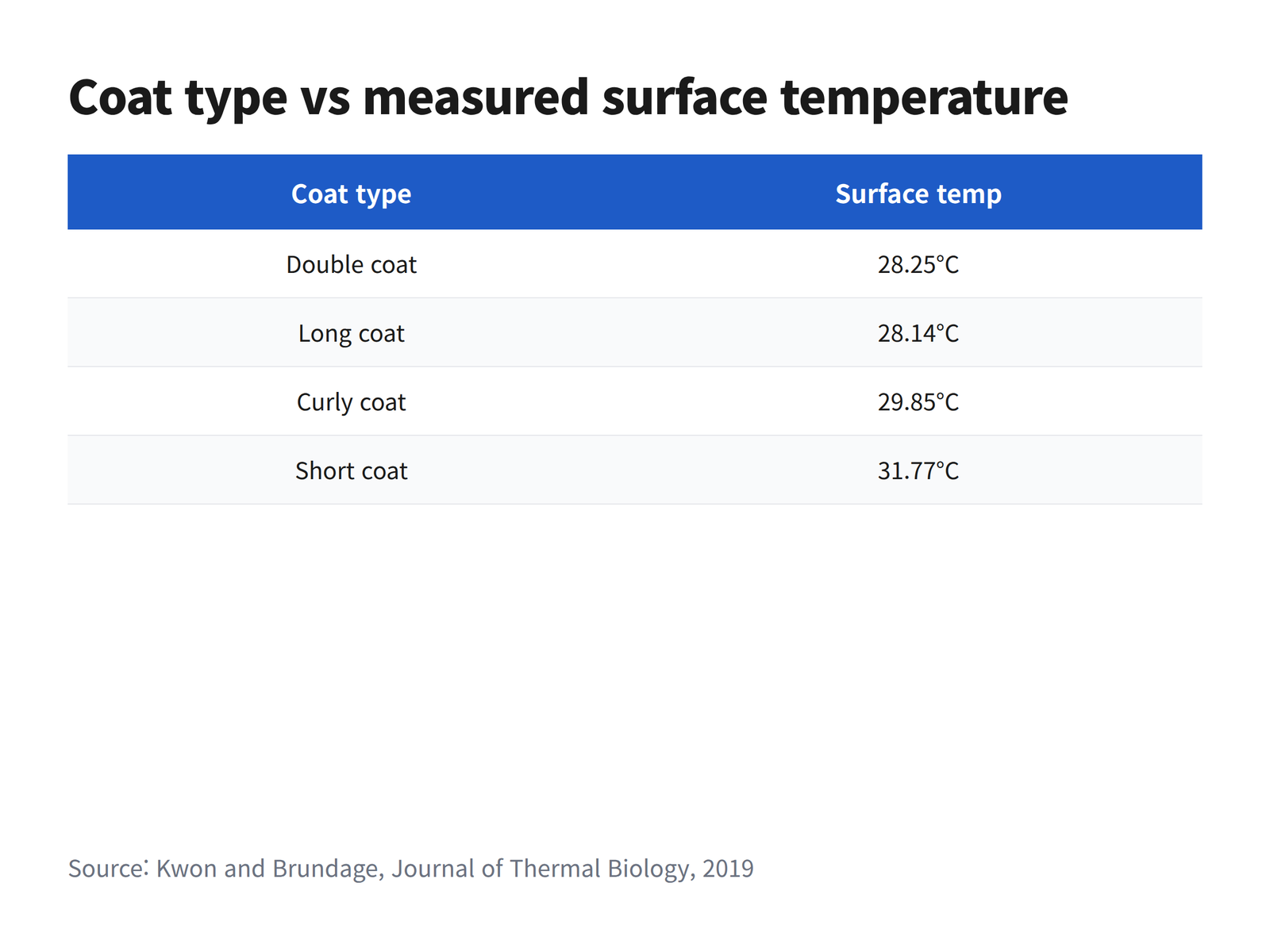
Shaving a double-coated small dog does not lower the temperature at its skin. In a 2019 infrared thermography study of 50 dogs, double-coated dogs measured 28.25 °C at the body surface while short, smooth-coated dogs measured 31.77 °C. The short coats ran hotter. That gap matters for a Pomeranian or any small Arctic-coated breed facing a hot month, so this guide covers what each coat layer does, how long a clipped coat takes to return, and which grooming tools actually reach the undercoat.
Does shaving a double-coated small dog actually keep it cooler?
No. Removing the coat strips out the insulating layer, and measured surface temperatures point the other way. Kwon and Brundage, publishing in the Journal of Thermal Biology (Vol. 82, 2019), recorded 28.25 ± 0.23 °C for double coats, 28.14 ± 0.31 °C for long coats, 29.85 ± 0.33 °C for curly coats and 31.77 ± 0.19 °C for short, smooth coats, a difference of roughly 2 °C between the short and double groups at P < 0.001. Dr. Jerry Klein, Chief Veterinary Officer at the American Kennel Club, says clipping the body down “makes the dog susceptible to heat stroke.”
One caveat belongs with those numbers. The 50 dogs were measured indoors at 23 ± 2.0 °C after a 15-minute acclimation period, from 0.67 ± 0.24 m, using a FLIR B400 camera. Those figures describe surface temperature in a controlled room, not core body temperature outdoors in a heat wave.
What does the undercoat on a Pomeranian actually do?
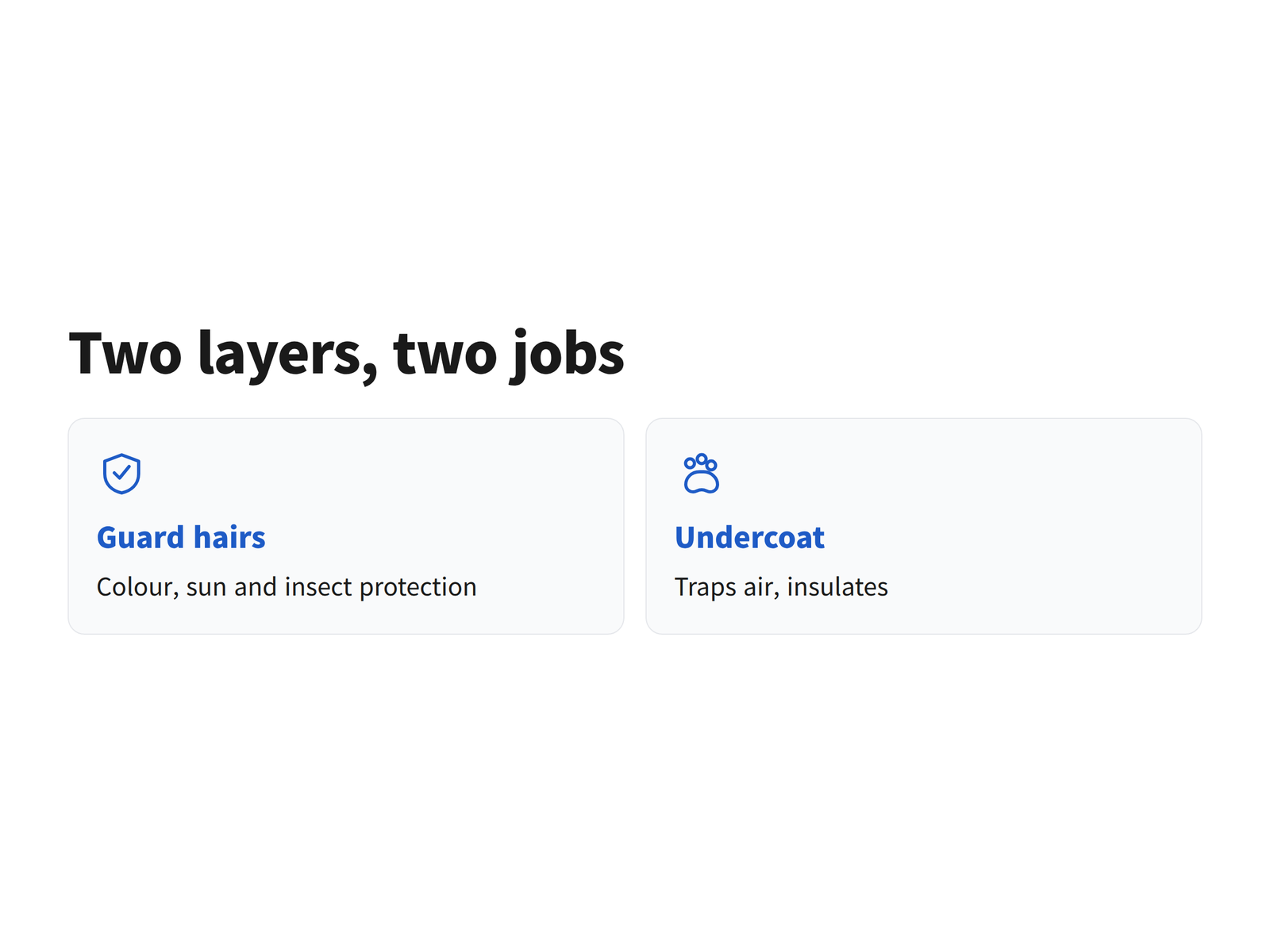
The undercoat traps air between the layers and works as insulation in both cold and heat. The American Kennel Club describes a double coat as two separate layers: a soft, dense undercoat that holds air for insulation, and a coarser outer layer of guard hairs that repels moisture, shields the skin and carries the coat’s color. The American Kennel Club classifies the Pomeranian as an Arctic double coat, the same category as the Samoyed.
The Royal Kennel Club breed standard, last updated in April 2025, puts it in its own words: “Two coats, an undercoat and an outer coat. Former soft, fluffy; the latter long, perfectly straight, harsh in texture.” That same standard lists Pomeranian weight at 1.8–2 kg (4–4½ lbs) for dogs and 2–2.5 kg (4½–5½ lbs) for bitches. Guard hairs also do protective work. Dr. Jerry Klein notes that “a dog’s fur coat protects him from sunburn and decreases his risk of developing skin cancer.”
How long does a shaved double coat take to grow back?
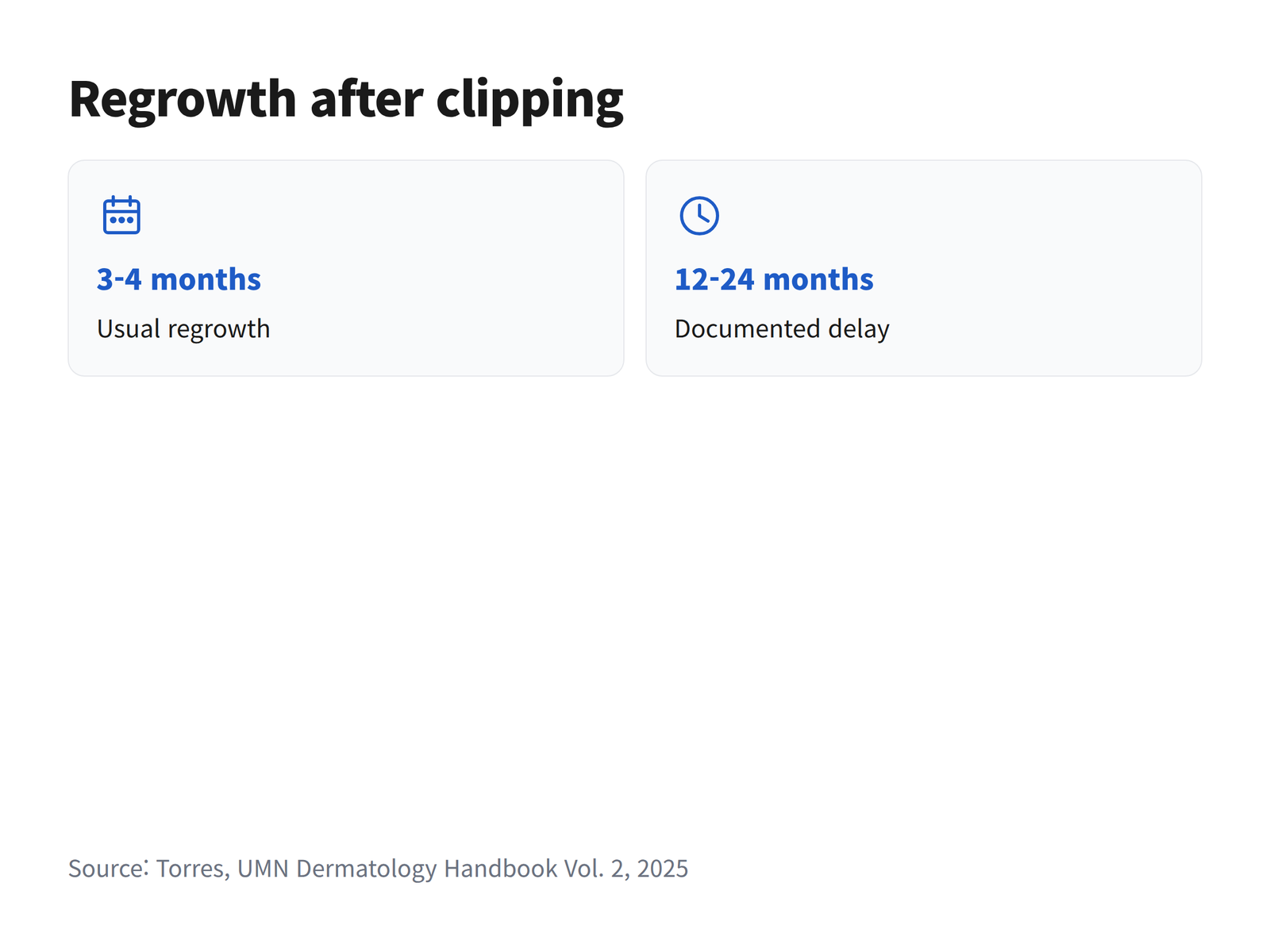
Most clipped coats return in three to four months, though delays of 12 to 24 months are documented. Sheila M.F. Torres, writing in the Small and Large Animal Dermatology Handbook, Vol. 2 (University of Minnesota Libraries Publishing, 2025), reports that regrowth typically takes three to four months but has been delayed as long as 12 to 24 months, with the lumbar-sacral region often slowest. Torres defines the condition plainly: “Post-clipping alopecia occurs after the hair is clipped typically close to the skin for any reason.”
A slow coat is not automatically a clipping problem. The same handbook notes that hypothyroidism, hyperadrenocorticism and sex-hormone-related hair loss have to be ruled out, particularly in middle-aged and older dogs. That sorting is a veterinary job, so consult your veterinarian rather than assuming the clippers are the whole story.
Why does a shaved double coat grow back patchy or a different texture?
The two layers regrow at different speeds, and the faster one wins. The American Kennel Club explains that when a double-coated dog is clipped to the skin, the undercoat grows in first and crowds out the slower guard hairs, which can permanently change both texture and color and leave the coat looking patchy. Torres offers a proposed mechanism: “Skin temperature changes after clipping may induce most hair at the shaved area to enter telogen,” the resting phase of the hair cycle, while noting that the exact pathogenesis is unknown.
Coat color sits in the outer layer, not the undercoat. A Pomeranian that loses guard hair density can come back duller or woollier even once the density looks normal again.
Which brush works on a double-coated small dog, and which one fails?
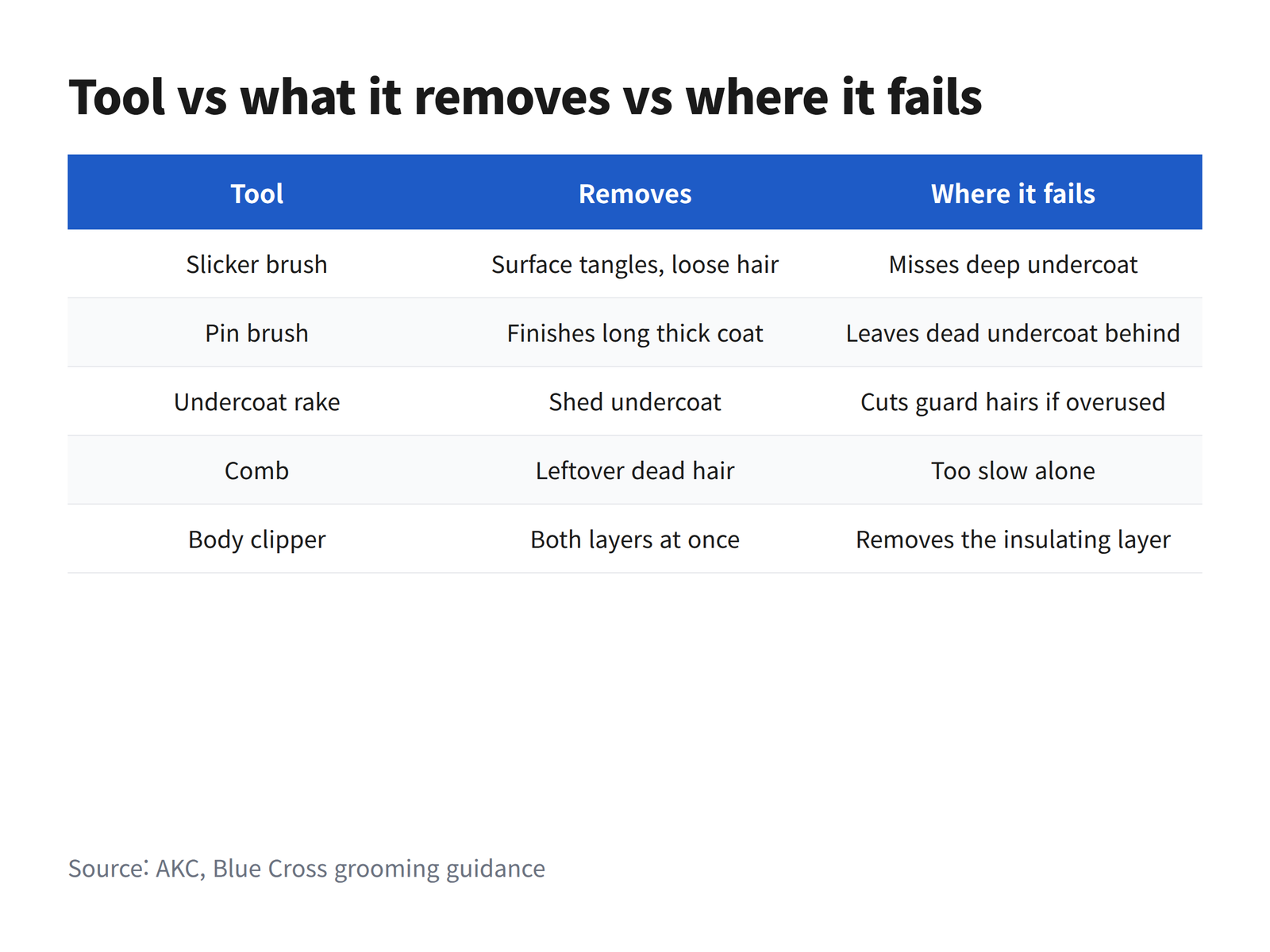
A slicker brush plus a comb handles weekly maintenance, while an undercoat rake is the tool that reaches shed undercoat. The American Kennel Club recommends brushing a double coat about once a week with a slicker brush and following up with a comb. Blue Cross frames tool choice by coat type, describing slicker brushes as suited to short to medium coats or curly fur, and noting that “the longer the pins on the brush, the better it is for dogs with longer, thicker coats.”
| Tool | Removes | Where it fails |
|---|---|---|
| Slicker brush | Surface tangles, loose hair | Misses deep undercoat |
| Pin brush | Finishes long thick coat | Leaves dead undercoat behind |
| Undercoat rake | Shed undercoat | Cuts guard hairs if overused |
| Comb | Leftover dead hair | Too slow alone |
| Body clipper | Both layers at once | Removes the insulating layer |
During a heavy shed, the mistake is reaching for a body clipper instead of a rake. The RSPCA advises that “regular grooming in warmer weather can help brush away any dead or excess hair, and matts and knots, leaving your dog with a less dense coat.”
What should you do instead of shaving before a heat wave?
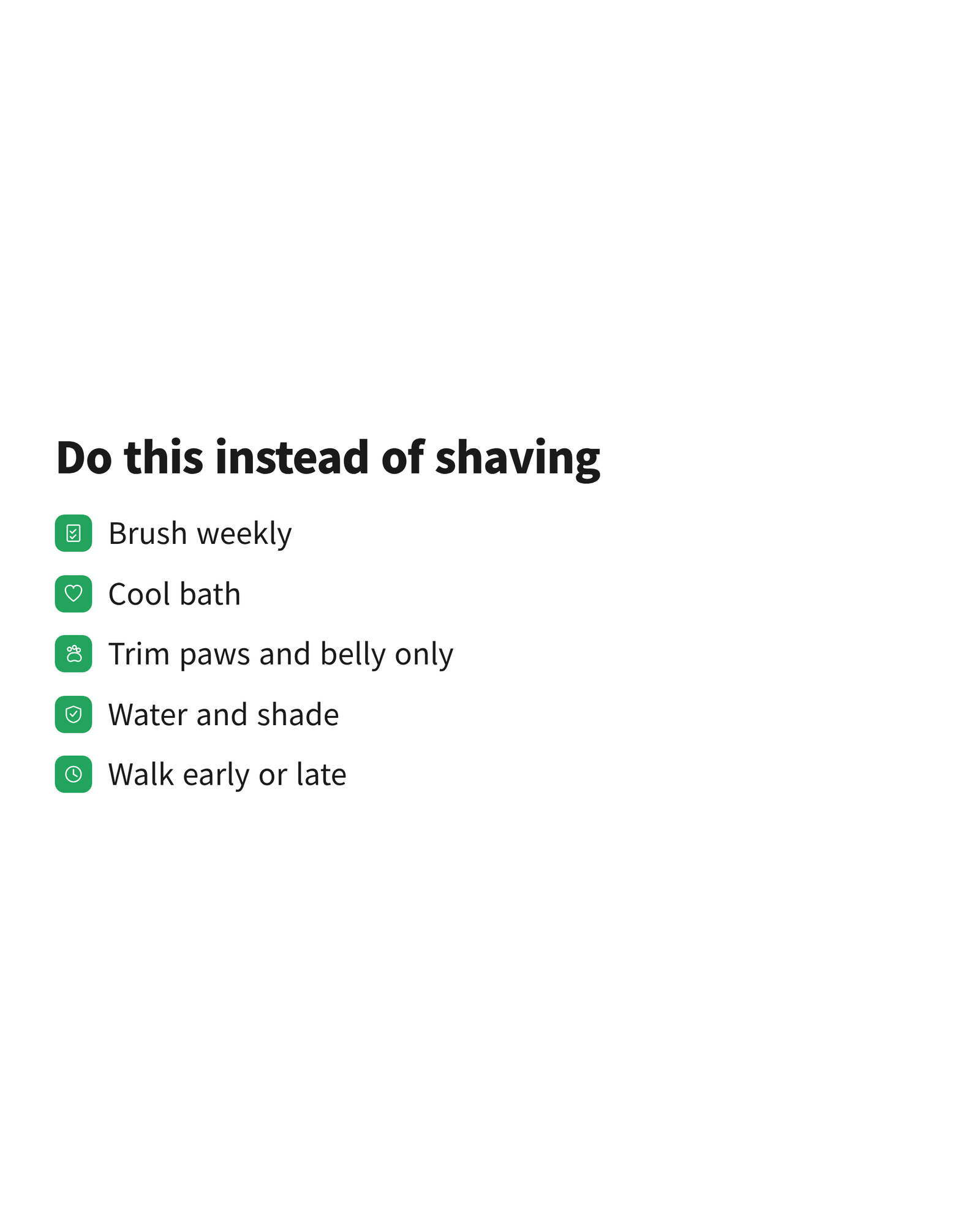
Brush out the dead undercoat, add water and shade, and move exercise to cooler hours. The American Kennel Club recommends regular brushing to clear dead undercoat, cool baths, trimming only the hair between the paw pads and along the legs and lower belly, and constant access to water and shade. The RSPCA adds early-morning and late-evening walks, no running or cycling with a dog in the heat, and pet-safe sunscreen on exposed skin.
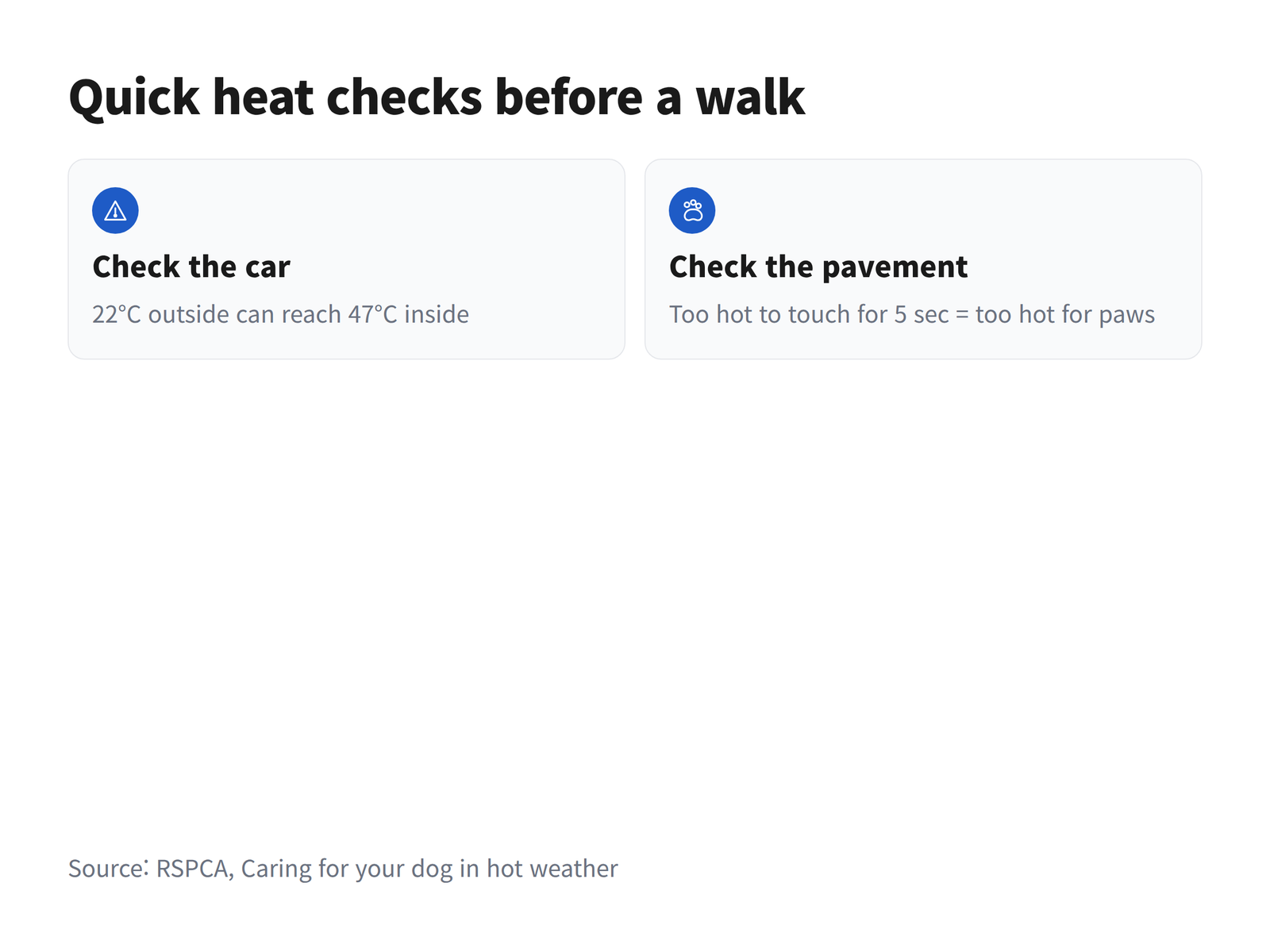
Two RSPCA figures are worth keeping in mind. An outside temperature of 22 °C (76 °F) can push the inside of a parked car to 47 °C (117 °F). And for pavement, the charity’s rule is direct: “If the ground is too hot to touch with your hand for five seconds, it’s too hot for paws!”
When is clipping a double-coated small dog still the right call?
Sometimes, and the decision belongs to a veterinarian rather than a blanket rule. The American Veterinary Medical Association does not tell owners never to clip. Its warm-weather guidance says: “Ask your veterinarian if your pet would benefit from a warm-weather haircut or other protection.” Surgery, skin treatment and severe matting are real reasons a clip happens.
Neglected mats are not a safe alternative either. Blue Cross advises detangling before washing, because mats only worsen during shampooing, and warns that home clipping “can also result in injury to you or your pet.” The same charity suggests professional grooming every four to twelve weeks for long-coated dogs. If a clip does happen, remember the sunburn risk that Dr. Jerry Klein describes and keep exposed skin covered or shaded.
How often does a small double-coated breed blow its coat?
More often than the usual spring-and-autumn assumption, especially in warm climates. Professional groomer Dale Martins, quoted by the American Kennel Club, explains: “Most double coats are meant for northern climates, so while the dog who lives in a colder place may shed their undercoat only in spring and fall, they could shed four times a year or all the time, if they live where temperatures are warmer.”
That changes the maintenance schedule rather than the verdict on clipping. A Pomeranian in a warm region may need the weekly slicker-and-comb routine year-round instead of twice a year.
Frequently asked questions
Will the coat grow back exactly as it was?
Often, but not always. Torres reports three to four months as the usual timeline, with texture and color changes possible when guard hairs are crowded out by faster-growing undercoat.
Is a shaved dog safer from heatstroke?
No. Research in Frontiers in Animal Science (2025) reports that dogs with short, smooth coats showed significantly higher surface temperatures than dogs with long or curly fur, and that severe heat-related illness carries a fatality rate above 50 percent. Brachycephalic small breeds cool less efficiently through panting regardless of coat length.
How do dogs cool themselves if not through the skin?
Through panting, vasodilation in the ears and face, and a small amount of sweat from merocrine glands in the paw pads. The apocrine glands across the body release pheromones rather than cooling sweat.
Is a sanitary or paw-pad trim the same as shaving?
No. The American Kennel Club distinguishes tidying paw pads, legs and the lower belly from clipping the body coat, and recommends only the former.
Sources
- American Kennel Club, “Should You Shave Your Dog in the Summer?”, updated 2026-03-27 — https://www.akc.org/expert-advice/health/is-it-ok-to-shave-your-dog/
- American Kennel Club, “How Should You Groom a Double-Coated Dog? What to Know”, updated 2024-11-19 — https://www.akc.org/expert-advice/health/how-to-groom-a-double-coated-dog/
- American Kennel Club, “Do Dogs Sweat? You May Be Surprised by the Answer”, updated 2026-08-05 — https://www.akc.org/expert-advice/health/do-dogs-sweat/
- Royal Kennel Club, “Pomeranian Breed Standard”, last updated 2025-04 — https://www.royalkennelclub.com/breed-standards/toy/pomeranian
- American Veterinary Medical Association, “Warm weather pet safety”, date not shown on page, accessed 2026-09-22 — https://www.avma.org/resources-tools/pet-owners/petcare/warm-weather-pet-safety
- RSPCA, “Caring for your dog in hot weather”, date not shown on page, accessed 2026-09-22 — https://www.rspca.org.uk/adviceandwelfare/seasonal/summer/dogs
- Blue Cross, “How to groom a dog”, 2017-07-26 — https://www.bluecross.org.uk/advice/dog/how-to-groom-a-dog
- Torres, Sheila M.F., “Canine Post-clipping Alopecia”, Small and Large Animal Dermatology Handbook, Vol. 2, University of Minnesota Libraries Publishing, 2025 — https://open.lib.umn.edu/animaldermatology2/chapter/canine-post-clipping-alopecia/
- Kwon, C.J. and Brundage, C.M., “Quantifying body surface temperature differences in canine coat types using infrared thermography”, Journal of Thermal Biology, Vol. 82, pp. 18–22, 2019 — https://www.sciencedirect.com/science/article/abs/pii/S0306456518305503
- do Nascimento, P.V. et al., “Heat stress in domestic dogs: morphological and environmental risk factors for dog welfare in a warming world”, Frontiers in Animal Science, 2025-12-04 — https://www.frontiersin.org/journals/animal-science/articles/10.3389/fanim.2025.1679377/full