A flat collar stays on because the skull is wider than the neck it sits behind. On a narrow-headed toy breed that difference shrinks to almost nothing, so the collar travels forward over the head instead of catching. The usual answer is to tighten the buckle, and that answer is wrong. What follows is what the American Kennel Club and the RSPCA say about slack, what the Kennel Club breed standards record about skull shape, and why a UK owner cannot simply retire the collar.
Why do collars slip off narrow-headed small dogs?
A collar slips off when the dog’s skull is no wider than its neck, because the collar can travel forward over the head rather than catching behind it. The American Kennel Club describes the group at risk as “dogs like Greyhounds and Whippets, whose heads are often smaller than their necks” (AKC, updated 2026-03-04). RSPCA Australia reaches the same conclusion from the other direction, advising a harness for any dog whose “neck isn’t narrower than their head (greyhounds, whippets)”.
Size is not what puts a breed in that group. The Kennel Club standard for the Italian Greyhound, a breed of only 3.6-4.5 kg (8-10 lb), describes a skull that is “long, flat and narrow” – the shape the American Kennel Club and RSPCA associate with collar escapes. Whether that describes an individual dog is a fit question rather than a breed ruling. A martingale collar answers that geometry with two loops: one that sits around the neck, and a second that tightens a limited amount when the leash is pulled. The American Kennel Club calls martingales “great for dogs whose necks are about the same size as their heads and can slip out of flat collars”.
Does the two-finger rule apply to a small dog’s collar?
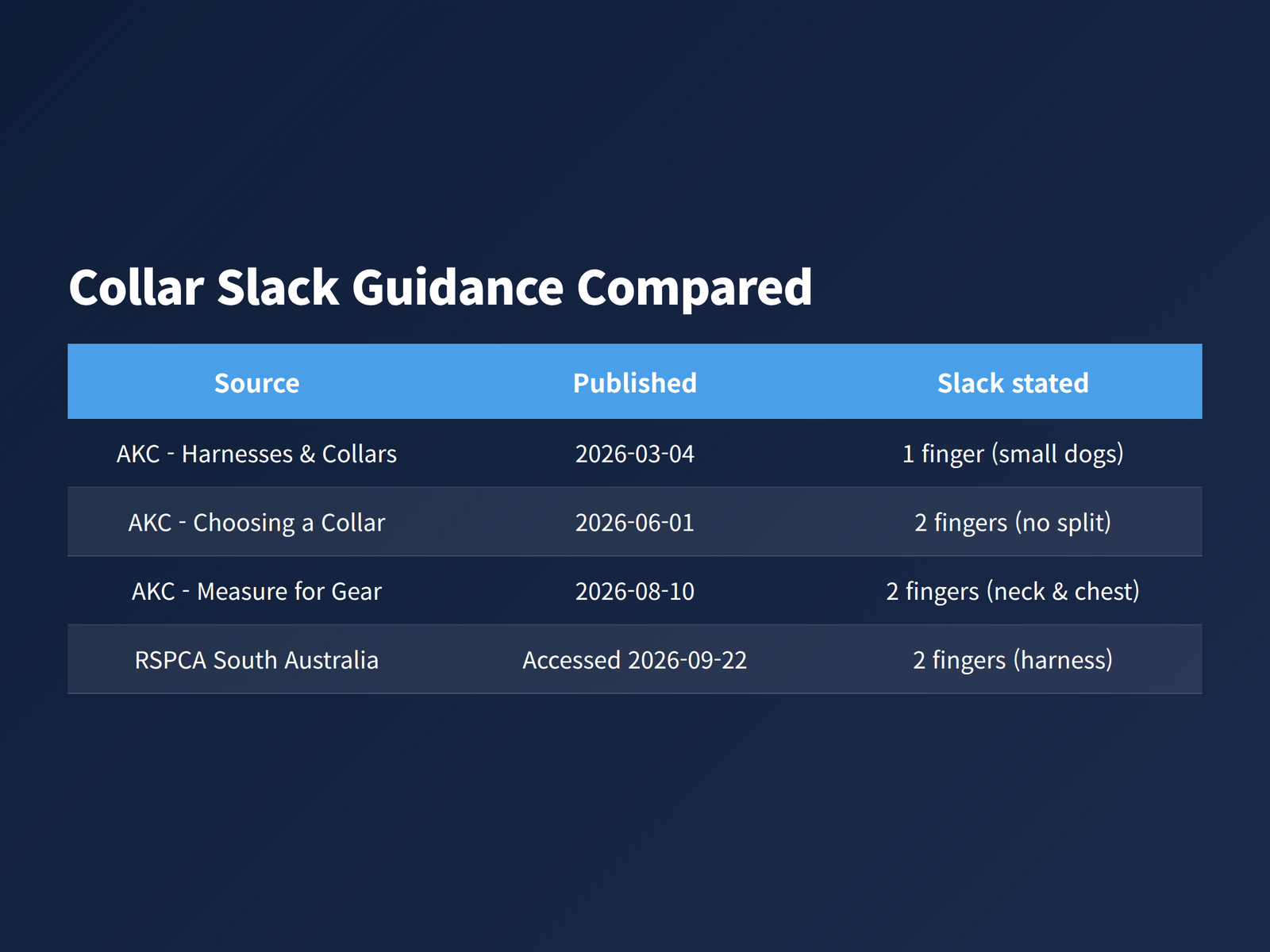
The two-finger rule is not settled for small dogs, and three American Kennel Club documents published in 2026 disagree with each other. The March 2026 edition of Dog Harnesses and Dog Collars splits the guidance by size: one finger of slack for small dogs, two for large breeds. Finding and Choosing the Right Dog Collar, updated 2026-06-01, gives two fingers with no size split. How to Measure Your Dog for Gear, updated 2026-08-10, applies the two-finger rule to neck and chest girth alike.
Treat the guidance as a range of one to two fingers on a small dog rather than a single number, because no A-grade source reconciles the three. The arithmetic is the reason the disagreement matters: on a dog of 3.6-4.5 kg, two adult fingers occupy a large share of the whole neck circumference. The tightness test itself is unambiguous, though. The American Kennel Club instructs owners to “attempt to slide two fingers underneath the collar. If you can’t, the collar is too tight – but if you can slide more fingers, it’s too loose.”
Does a harness stop a small dog from backing out?
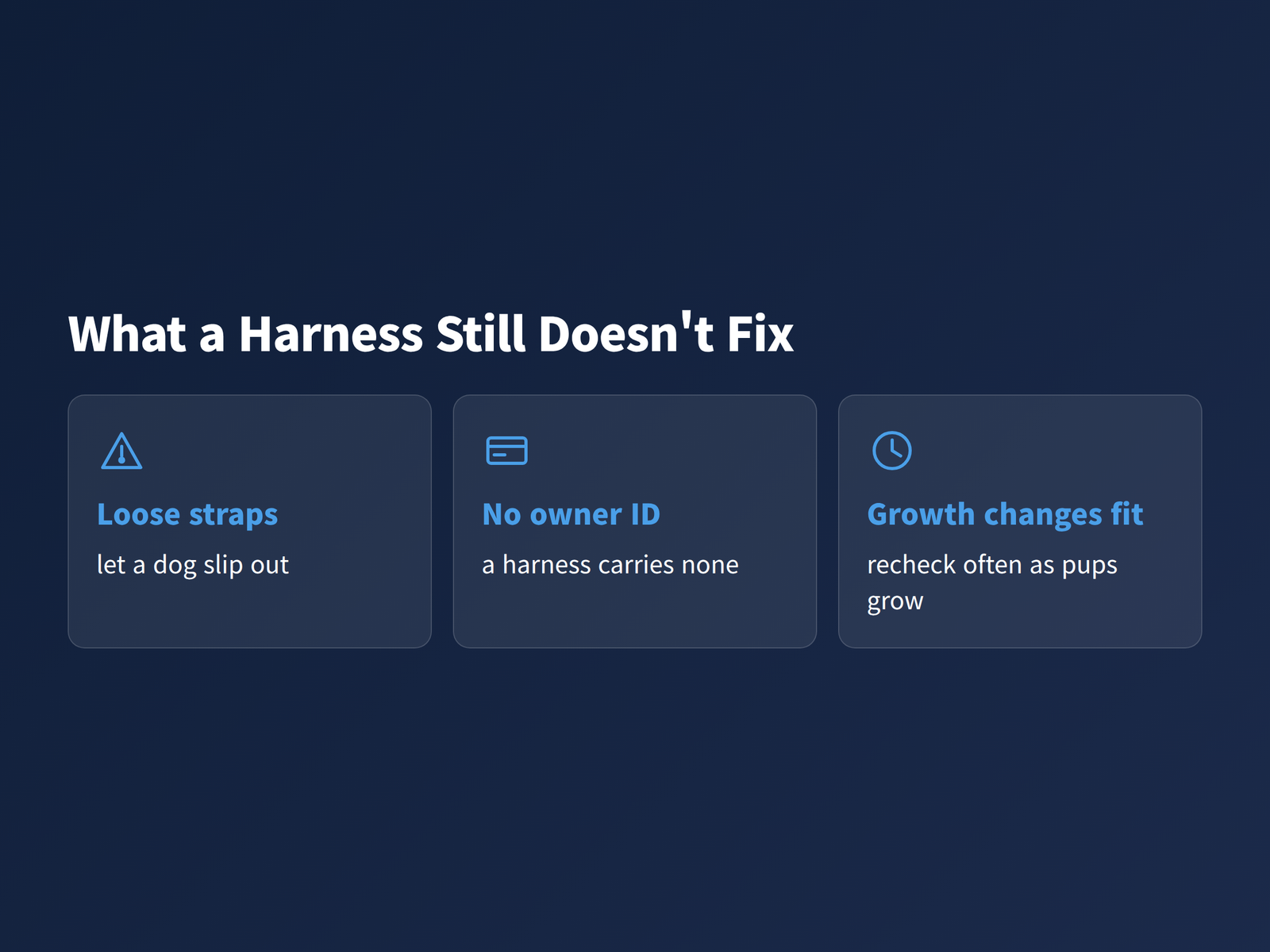
A harness does not stop a dog backing out on its own, and a loose one fails in a different way. RSPCA South Australia is direct about the failure mode: “If the harness is too loose, the dog can slip an elbow through the straps and back out of it.” Swapping equipment is not the fix; fitting it is.
The same organisation sets the check. Adjust the top straps around the chest and the bottom straps under the front legs so that two fingers fit underneath each. That is two separate checks, and the straps under the front legs are the ones most often left long. Growing dogs need the check repeated. RSPCA advice is that a puppy’s collar fit should be looked at least a few times a week, and harness fit needs the same frequent adjustment.
Which small breeds are most likely to slip a flat collar?
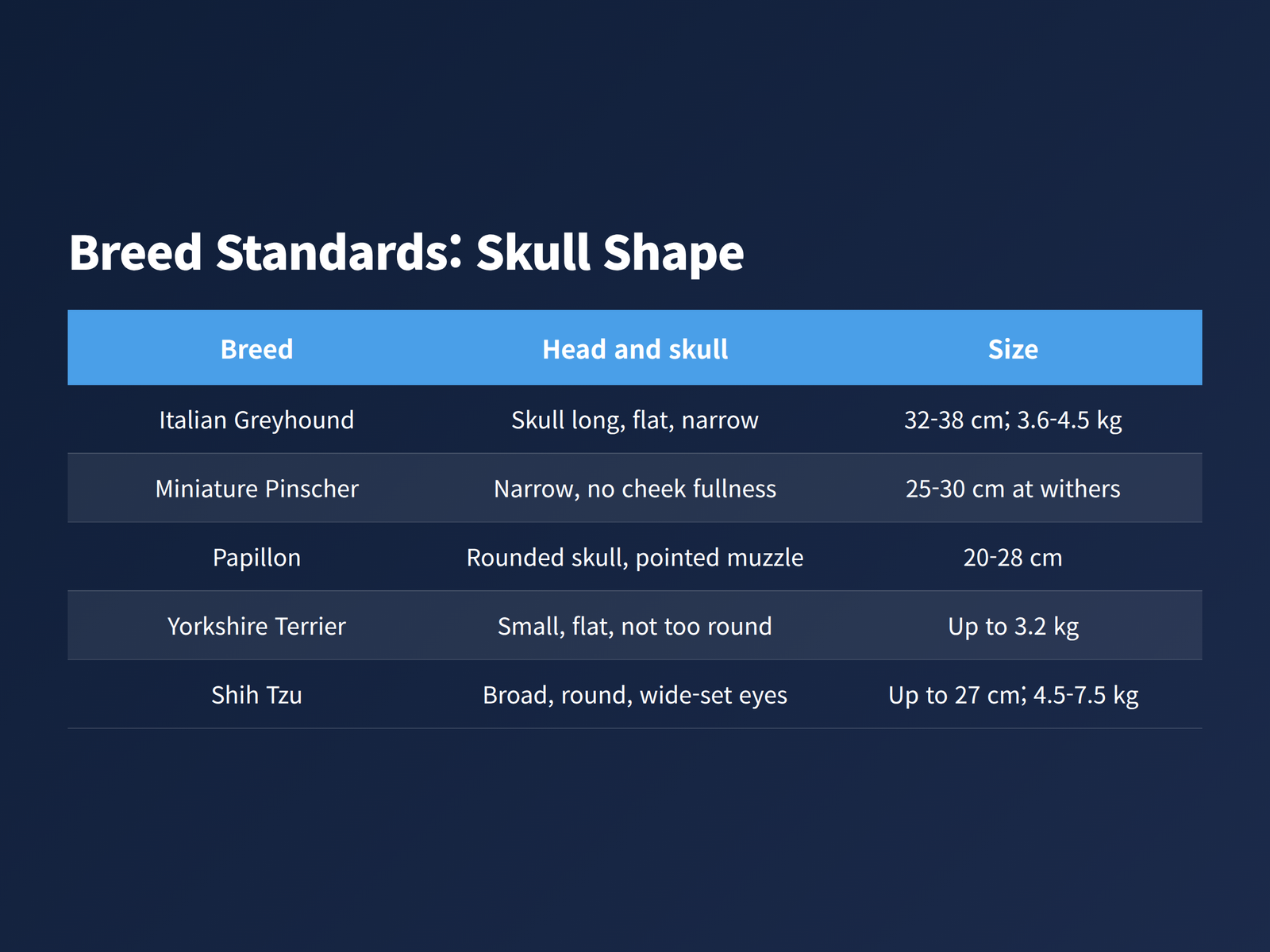
No breed standard predicts that a named breed will slip a collar, because the standards describe skull shape and size without giving a single measurement of head circumference. What the standards do provide is the wording an owner can compare against their own dog. The narrower the skull a standard describes, the more room a flat collar has to travel forward.
| Breed (Kennel Club standard) | Head and skull, as written in the standard | Size in the standard |
|---|---|---|
| Italian Greyhound | “Skull long, flat and narrow, slight stop” | 32-38 cm (12.5-15 in); ideal weight 3.6-4.5 kg (8-10 lb) |
| Miniature Pinscher | “More elongated than short and round. Narrow, without conspicuous cheek formation” | 25-30 cm (10-12 in) at withers |
| Papillon | “Skull slightly rounded between ears, muzzle finely pointed and abruptly finer than the skull” | 20-28 cm (8-11 in) |
| Yorkshire Terrier | “Rather small and flat, not too prominent or round in skull” | Weight up to 3.2 kg (7 lb) |
| Shih Tzu | “Head broad, round, wide between eyes” | Not more than 27 cm (10.5 in); ideal weight 4.5-7.5 kg (10-16 lb) |
The Shih Tzu row is a contrast, not a warning. A standard that opens with a broad, round head describes a skull that gives a flat collar something to catch on, which the Italian Greyhound standard does not.
Where should you measure a toy breed’s neck for a collar?
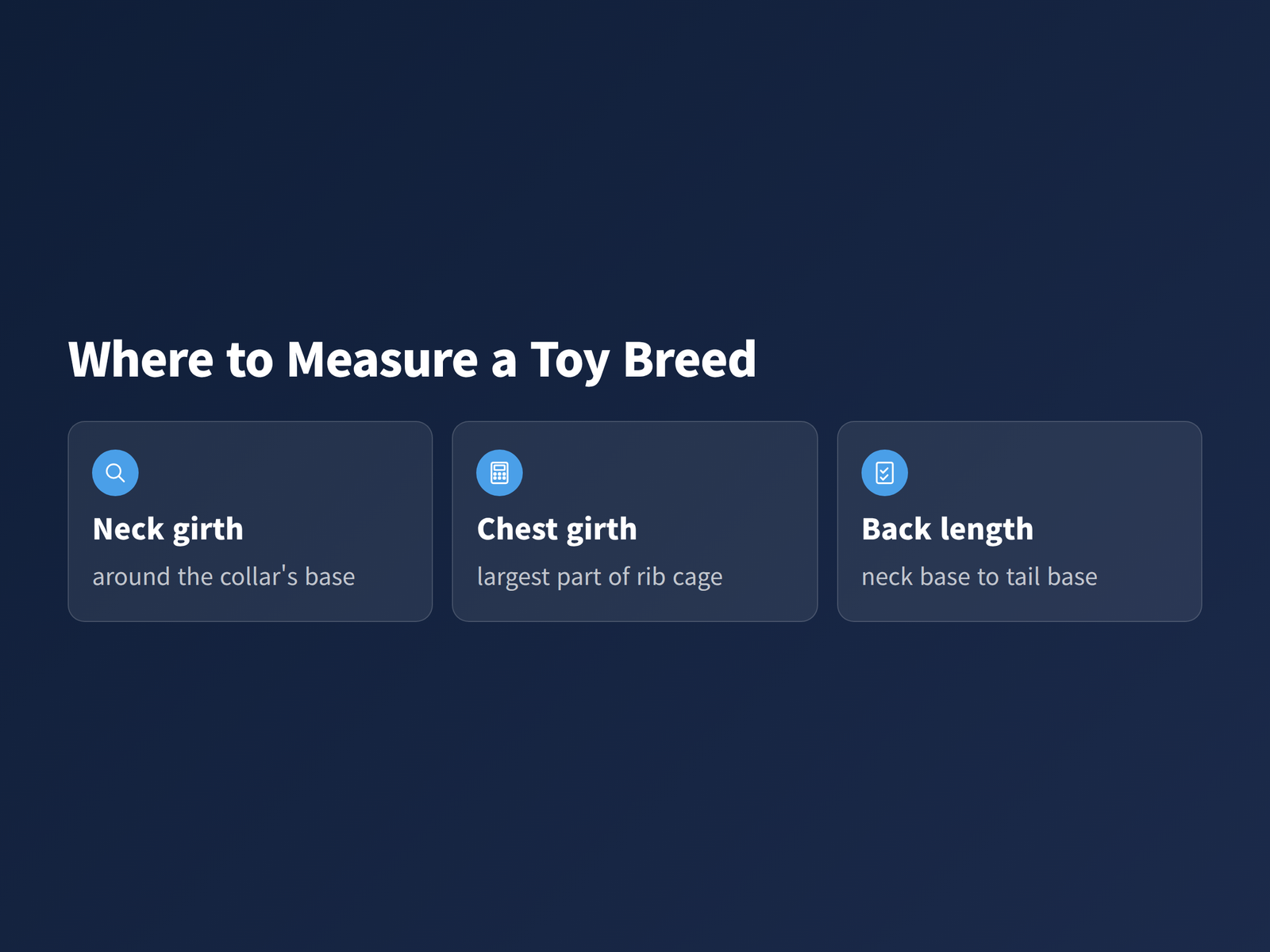
Measure around the base of the neck where the collar sits, not higher up near the jaw. The American Kennel Club sets out three measurements in How to Measure Your Dog for Gear (Courtney Campbell, updated 2026-08-10), and each one has a defined landmark rather than an eyeballed guess.
- Neck girth: “Measure around the base of your dog’s neck where the collar sits”, then apply the slack rule.
- Chest girth: “Wrap the measuring tape around the largest part of the rib cage, usually just behind the front legs”, with the dog standing and the tape “snug but not tight”.
- Back length: “Measure along the top of their spine from the base of the neck where it joins the body – usually where their collar sits – to the base of their tail.”
Neck and chest measurements, not body weight, decide collar and harness size. Whether the resulting number holds depends on skull width, which is the one figure the breed standards never publish.
Is a dog legally required to wear a collar in public in the UK?
Yes. The Control of Dogs Order 1992 requires that “every dog while in a highway or in a place of public resort shall wear a collar with the name and address of the owner inscribed on the collar or on a plate or badge attached to it” (Article 2(1), in force 1 April 1992). A harness does not satisfy that requirement, which makes “skip the collar and use a harness” inaccurate advice for a UK reader.
Article 2(2) of the same Order lists the exemptions, and they are narrow: packs of hounds, dogs used for sporting purposes, dogs used for the capture or destruction of vermin, dogs used for driving or tending cattle or sheep, dogs on official duties for the armed forces, customs or police, dogs engaged in emergency rescue work, and dogs registered with the Guide Dogs for the Blind Association.
A microchip is the backup, not the substitute. GOV.UK states that “all dogs in the UK must be microchipped and registered by the time they’re 8 weeks old”, that the owner is “responsible for keeping your pet’s microchip information up to date, for example if you move house”, and that “you can be fined up to GBP 500 if your dog or cat is not microchipped when they need to be”. When a collar does come off, current registration details are what brings the dog back.
What should you not use to stop a dog slipping a collar?
Do not answer a slipping collar with a check chain or a prong collar. RSPCA Australia is explicit: “Check chains (choker chains or slip collars) or pronged/pinch collars must not be used as they cause pain and distress to animals, and can cause damage to the neck.” That is the RSPCA’s position, quoted as written.
Tightening a flat collar past the slack range is the other tempting shortcut, and it trades one problem for another without addressing the skull width that caused the escape. A martingale sized to the measured neck girth, or a correctly fitted harness worn alongside the legally required collar, keeps the geometry rather than fighting it. If anything about the fit around your dog’s neck or airway concerns you, consult your veterinarian before changing equipment.
Frequently asked questions
Is a martingale collar the same as a slip collar?
No. A martingale has two loops and tightens a limited amount when the leash is pulled, as the American Kennel Club describes it. RSPCA Australia groups slip collars with check chains and prong collars among the equipment that must not be used.
How much should a martingale be allowed to tighten?
No A-grade source publishes a minimum and maximum circumference for a martingale. Figures circulating on retailer pages are not backed by a breed authority or welfare organisation, so treat them with caution and size from the measured neck girth instead.
Does a dog in the United States have to wear a collar in public?
The Control of Dogs Order 1992 is a UK instrument, and no equivalent federal requirement was verified for the United States. Licence and tag rules in the US are set at state and municipal level, so check locally rather than assuming the UK position applies.
Sources
- The Control of Dogs Order 1992 (SI 1992/901), UK statutory instrument, in force 1 April 1992 – https://www.legislation.gov.uk/uksi/1992/901/made
- GOV.UK, “Get your dog or cat microchipped”, accessed 2026-09-22 – https://www.gov.uk/get-your-dog-cat-microchipped
- American Kennel Club, “Dog Harnesses and Dog Collars: Which Is Right For Your Dog?”, AKC Staff, updated 2026-03-04 – https://www.akc.org/expert-advice/training/dog-harness-vs-collar/
- American Kennel Club, “Finding and Choosing the Right Dog Collar for Your Dog”, Colt Dodd, updated 2026-06-01 – https://www.akc.org/expert-advice/lifestyle/choosing-right-dog-collar/
- American Kennel Club, “How to Measure Your Dog for Gear”, Courtney Campbell, updated 2026-08-10 – https://www.akc.org/expert-advice/lifestyle/measure-dog-gear/
- The Kennel Club, “Breed Standard: Italian Greyhound (Toy)”, accessed 2026-09-22 – https://www.royalkennelclub.com/breed-standards/toy/italian-greyhound
- The Kennel Club, “Breed Standard: Miniature Pinscher (Toy)”, accessed 2026-09-22 – https://www.royalkennelclub.com/breed-standards/toy/miniature-pinscher
- The Kennel Club, “Breed Standard: Papillon (Toy)”, accessed 2026-09-22 – https://www.royalkennelclub.com/breed-standards/toy/papillon
- The Kennel Club, “Breed Standard: Yorkshire Terrier (Toy)”, accessed 2026-09-22 – https://www.royalkennelclub.com/breed-standards/toy/yorkshire-terrier
- The Kennel Club, “Breed Standard: Shih Tzu (Utility)”, accessed 2026-09-22 – https://www.royalkennelclub.com/breed-standards/utility/shih-tzu
- RSPCA Australia Knowledgebase, “What equipment should I use when teaching my dog or puppy to walk on a leash?”, updated 2023-01-10 – https://kb.rspca.org.au/categories/companion-animals/dogs/training/what-equipment-should-i-use-when-teaching-my-dog-or-puppy-to-walk-on-a-leash
- RSPCA South Australia, “How to fit your dog’s walking harness like a pro”, accessed 2026-09-22 – https://www.rspcasa.org.au/fitting-walking-harness-dogs/