Dental chews usually fail a Shih Tzu for three plain reasons: the chew is the wrong size for a 9 to 16 lb dog, the chew is too hard for small teeth, or the owner expects the chew to do the job of a toothbrush. This guide explains why dental chews fail for a Shih Tzu, what the VOHC Seal does and does not promise, and which owner checks come before buying another bag.
Why do dental chews often fail on a Shih Tzu’s short, undershot jaw?
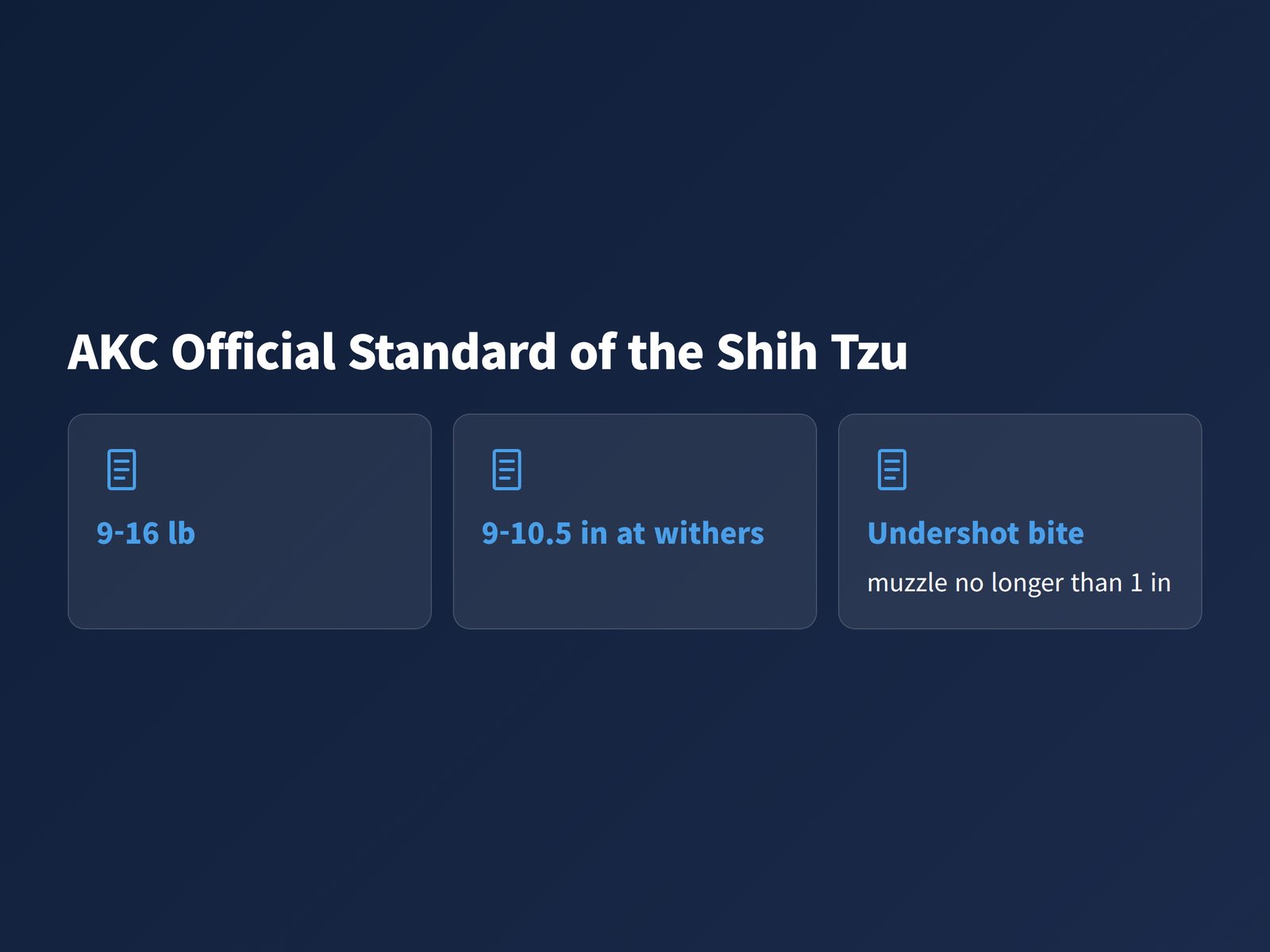
Dental chews often fail a Shih Tzu because the chew was designed around a weight range and a bite that may not match a small, flat-faced mouth. The American Kennel Club breed standard describes the Shih Tzu bite as “Undershot. Jaw is broad and wide,” with a muzzle ideally no longer than 1 in, on a dog of 9 to 16 lb and 9 to 10.5 in at the withers.
The American Animal Hospital Association (AAHA) adds a second layer. The AAHA 2019 Dental Care Guidelines note that brachycephalic breeds “tend to have more dental issues due to the rotation and crowding of teeth.” A Shih Tzu is a brachycephalic breed, so a Shih Tzu mouth starts with less room between teeth for a chew to reach. Whether that applies to one particular Shih Tzu depends on that dog’s own mouth, which only a veterinary exam can describe.
Size matters for dental care in general, too. AAHA states: “The owner of any puppy or kitten who will be smaller than 20-25 lbs at maturity should be informed that the level of dental care and prevention for their pet is likely to be more involved than that of a larger dog.” An adult Shih Tzu sits well below that line.
alt:
Does a VOHC Seal mean a dental chew is right for a 9-16 lb dog?
No. A VOHC Seal means the Veterinary Oral Health Council reviewed submitted data showing the product meets its standards for plaque and/or tartar control “when used as directed,” and it says nothing about fit or safety for an individual dog. The VOHC home page states plainly: “The VOHC does not test products itself.”
The Seal still carries weight. AAHA notes that “Only those that have been accepted by the VOHC have met preset standards.” The American Veterinary Medical Association (AVMA) makes a similar point: “There are many pet products marketed with claims that they improve dental health, but not all of them are effective.” A VOHC-accepted chew is a reasonable starting filter.
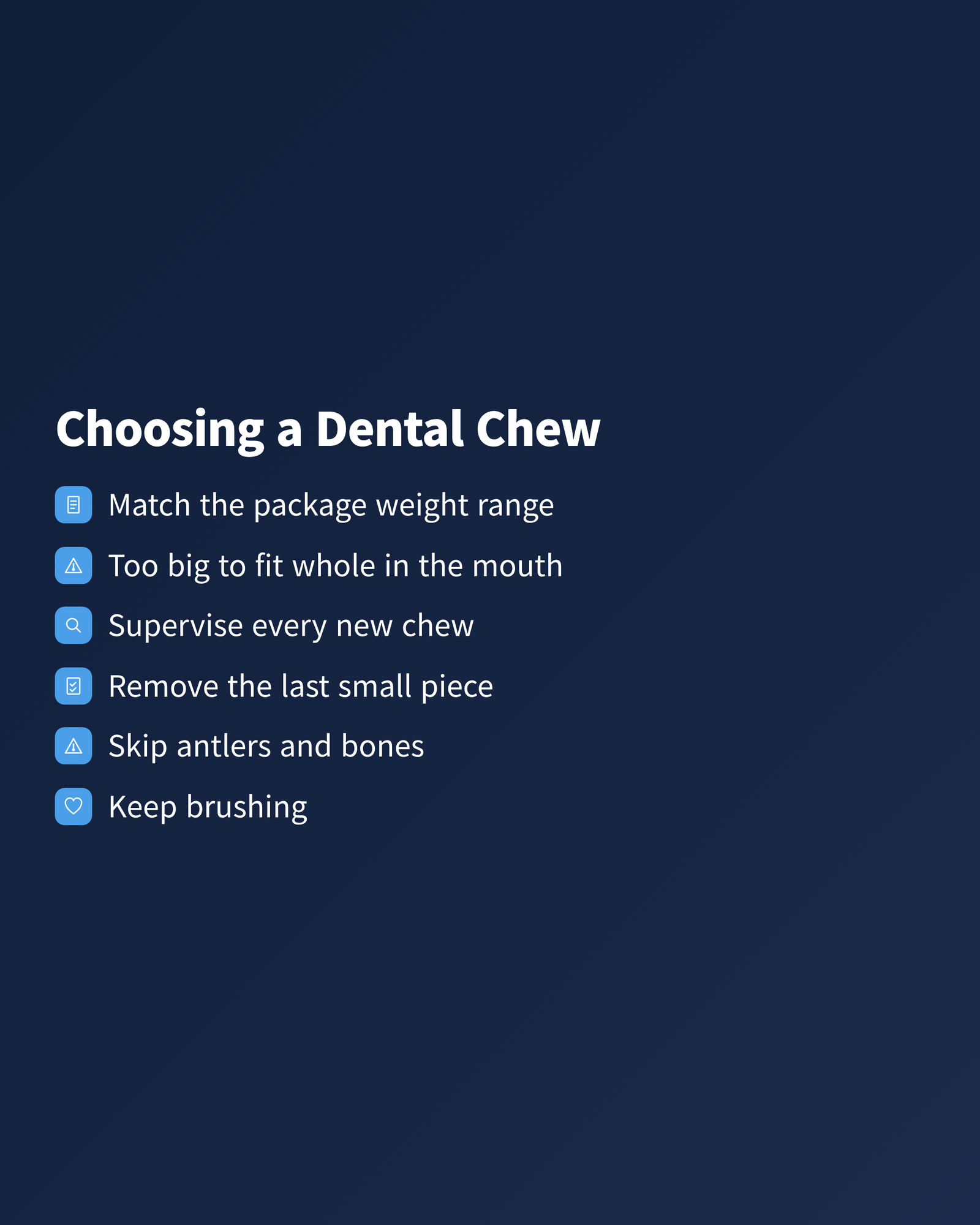
The catch sits in the phrase “when used as directed.” The directions include size. The VOHC Accepted Products for Dogs table (updated November 2025) tells owners: “For Chew and Treat Products, be sure to feed the right size – check the package for the right weight range.” A sealed chew in the wrong size is no longer being used as directed, so a Shih Tzu owner cannot count on the Seal alone.
What size dental chew fits a Shih Tzu, and why is “too small” the bigger risk?
The right dental chew for a Shih Tzu matches the package weight range to the dog’s current weight and is still too large for the dog to fit whole in its mouth. Many owners size down for a small breed, but the American Kennel Club (AKC) warns: “Chews that are too small for your dog present a choking risk. Pick edible dog chews that are large enough so your dog can’t get the entire thing in their mouth at once.”
The same AKC guidance on edible chews (updated 2025-11-06) covers the end of the chew: “When your dog has chewed the stick down to a nub, take it away before they can swallow what’s left.” A Shih Tzu that gulps treats is the dog to watch most closely. Dr. James Barr of the Texas A&M College of Veterinary Medicine & Biomedical Sciences put it this way in 2014: “dogs that want to quickly ingest their treats are the ones most likely to get things stuck.”
Weight ranges differ by brand, so read the range printed on the package. If a Shih Tzu has already swallowed a chew whole, call your veterinarian rather than waiting to see what happens.
Which hard chews should a Shih Tzu skip entirely?
A Shih Tzu should skip antlers, natural bones, synthetic bones, and other very hard chews. The AAHA 2019 guideline states “there is not a strong rationale for offering hard treats (antlers, synthetic, or natural bones) that could damage the structural integrity of the tooth.” Hard does not mean cleaner.
The AKC agrees on both counts. AKC guidance on edible chews says “Chews that are too hard can crack your dog’s teeth or cut their gums,” and the AKC article on antlers (updated 2026-02-17) calls “antlers and other excessively hard chews” “a common cause of broken teeth in dogs.”
Processed bone treats are a separate concern. In November 2017, the FDA Center for Veterinary Medicine warned against bone treats after reports of about 90 dogs becoming ill and about 15 deaths, with problems that included choking, obstruction, and wounds in the mouth and tonsils, as reported by ABC News and TIME. FDA veterinarian Carmela Stamper, DVM, was quoted as saying: “Giving your dog a bone treat might lead to an unexpected trip to your veterinarian, a possible emergency surgery, or even death.”
How do common chew types compare for a 9-16 lb Shih Tzu?
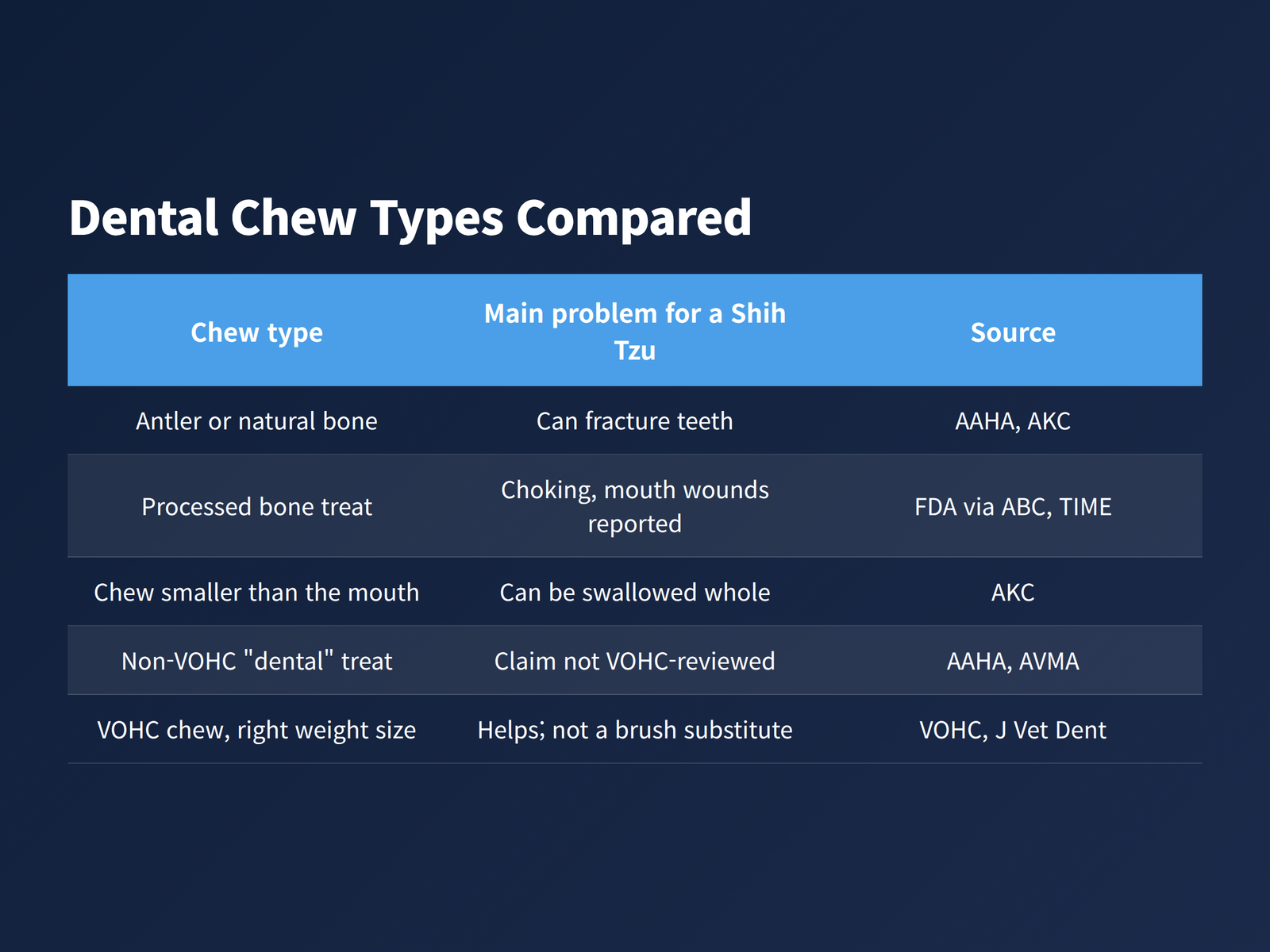
Only one common chew type passes on both efficacy and fit for a Shih Tzu in the 9 to 16 lb range, and the table below lines up the main problem with each of the others.
| Chew type | Main problem for a Shih Tzu | Source |
|---|---|---|
| Antler or natural bone | Can fracture teeth | AAHA, AKC |
| Processed bone treat | Choking, mouth wounds reported | FDA via ABC, TIME |
| Chew smaller than the mouth | Can be swallowed whole | AKC |
| Non-VOHC “dental” treat | Claim not VOHC-reviewed | AAHA, AVMA |
| VOHC chew, right weight size | Helps; not a brush substitute | VOHC, J Vet Dent |
The evidence for the last row is real but limited. A 2020 study in the Journal of Veterinary Dentistry followed toy-breed dogs (8 Yorkshire Terriers and 9 Chihuahuas) given 1 chew per day and reported gingivitis down 20%, plaque down 15%, calculus down 35%, and oral volatile sulfur compounds down 19%. A 2011 crossover trial in the same journal tested a vegetable dental chew on 16 toy dogs over 70 days and reported significant reductions in plaque, calculus, and gingivitis. Neither study included Shih Tzus.
Can a daily dental chew replace brushing for a small breed?
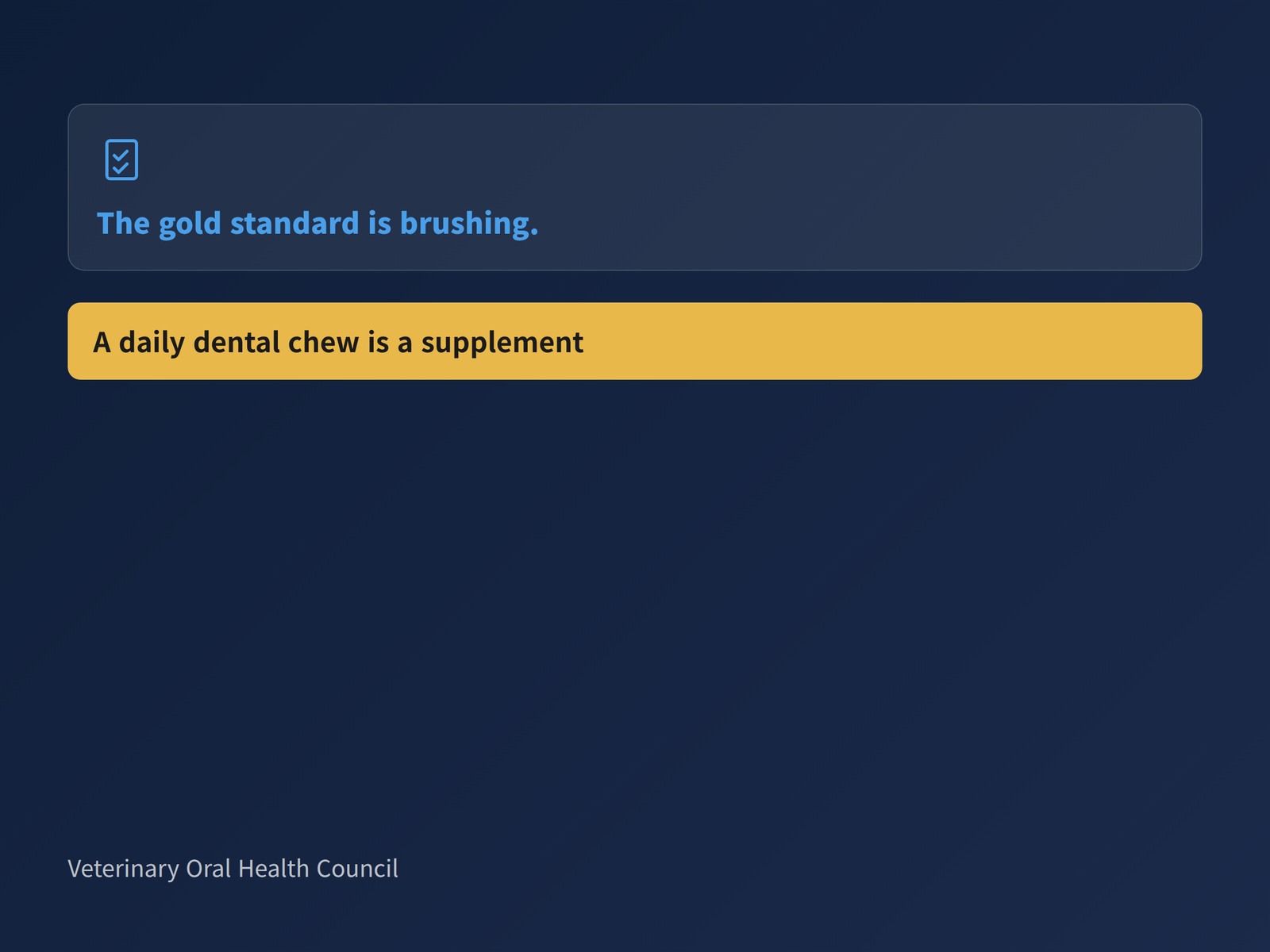
No. A daily dental chew is a supplement, and the Veterinary Oral Health Council says it directly: “The gold standard is brushing.” The chew trials above measured reductions, not a clean mouth.
AAHA goes one step further. The AAHA 2019 guideline states: “Even daily brushing does not preclude the need for anesthetized exams, radiographs, and therapy.” If brushing alone does not replace professional care, a chew alone does not either. For a Shih Tzu owner, the practical order is brushing first, a correctly sized VOHC-accepted chew second, and regular veterinary checks throughout.
When should a Shih Tzu owner book a dental check instead of trying another chew?
A Shih Tzu owner should book a dental check on the schedule the veterinarian sets, and should not use a new chew as a way to put off that visit. AAHA recommends a first dental prophylaxis by 1 year of age for small- to medium-breed dogs, compared with by 2 years for larger breeds.
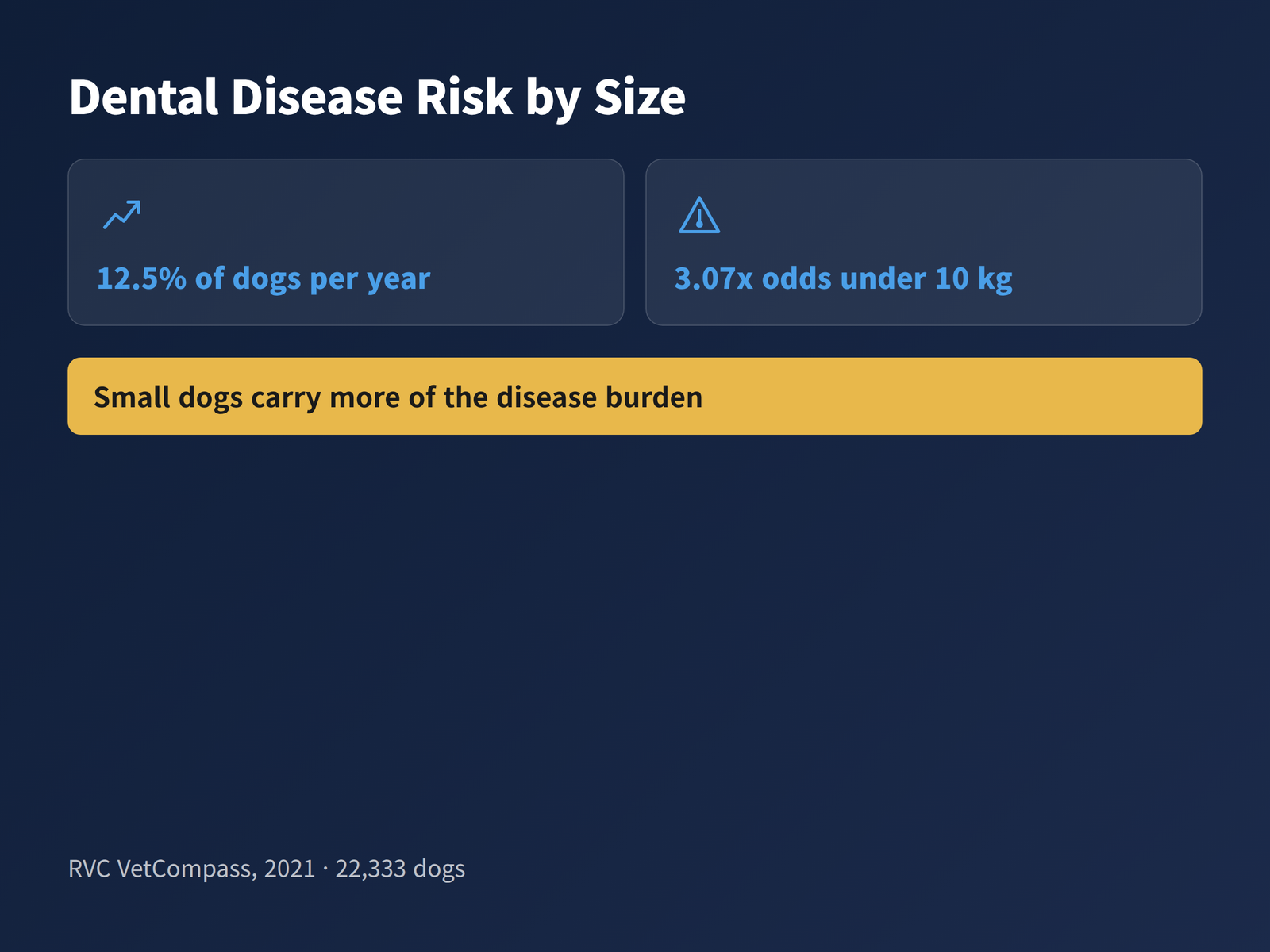
Small dogs carry more of the load in population data. A Royal Veterinary College VetCompass study of 22,333 dogs in UK primary care, published 2021-08-10, found dental disease in 12.5% of dogs per year (2,797 cases). Dogs under 10.0 kg had 3.07 times the odds of dogs weighing 30.0 to under 40.0 kg, and the Toy Poodle had the highest breed odds at 3.97 times. The summary did not report a Shih Tzu-specific rate. Lead author Dr. Dan O’Neill advised: “Ask your vet to give you an update on the dental health of your dog at every visit.”
If a Shih Tzu’s breath, chewing habits, or interest in chews changes, consult your veterinarian before switching products. A new chew cannot show what is happening inside the mouth; an exam can.
Frequently asked questions
Are VOHC-accepted chews safe for every Shih Tzu? The VOHC Seal covers plaque and tartar control when used as directed, not safety for an individual dog. Match the package weight range and supervise the dog while it chews.
Are antlers a good natural option for a Shih Tzu? AAHA sees no strong rationale for antlers or bones, and the AKC calls excessively hard chews a common cause of broken teeth in dogs.
How early should a Shih Tzu have a dental cleaning? AAHA recommends a first dental prophylaxis by 1 year of age for small- to medium-breed dogs. Ask your veterinarian what schedule suits your dog.
Sources
- Veterinary Oral Health Council, “VOHC” home page (accessed 2026-09-25) – https://vohc.org/
- Veterinary Oral Health Council, “VOHC Accepted Products for Dogs” table, updated November 2025 – https://vohc.org/wp-content/uploads/2025/11/VOHCAcceptedProductsTable_Dogs-11-14-25.pdf
- American Animal Hospital Association, “2019 AAHA Dental Care Guidelines for Dogs and Cats” (Bellows J, et al. JAAHA 2019;55:49-69) – https://www.aaha.org/wp-content/uploads/globalassets/02-guidelines/dental/aaha_dental_guidelines.pdf
- American Animal Hospital Association, “Preventing periodontal disease,” 2019 guideline page – https://www.aaha.org/resources/2019-aaha-dental-care-guidelines-for-dogs-and-cats/preventing-periodontal-disease/
- American Veterinary Medical Association, “Pet Dental Care” – https://www.avma.org/resources-tools/pet-owners/petcare/pet-dental-care
- American Kennel Club, “Official Standard of the Shih Tzu,” approved 1989-05-09 – https://images.akc.org/pdf/breeds/standards/ShihTzu.pdf
- American Kennel Club, Gibeault S., “How to Choose Edible Dog Chews That Are Also Safe,” updated 2025-11-06 – https://www.akc.org/expert-advice/nutrition/choosing-edible-chews-for-dogs/
- American Kennel Club, Burke A., “Antlers for Dogs: Are These Treats Safe for Dogs to Chew?,” updated 2026-02-17 – https://www.akc.org/expert-advice/health/are-antlers-for-dogs-safe/
- Royal Veterinary College VetCompass, “New RVC research gets to the root of dental disease in dogs,” 2021-08-10 – https://www.rvc.ac.uk/vetcompass/news/new-rvc-research-gets-to-the-root-of-dental-disease-in-dogs
- Mateo A, et al., “Evaluation of Efficacy of a Dental Chew to Reduce Gingivitis, Dental Plaque, Calculus, and Halitosis in Toy Breed Dogs,” Journal of Veterinary Dentistry 37(1), 2020 – https://journals.sagepub.com/doi/10.1177/0898756420926766
- Clarke DE, Kelman M, Perkins N., “Effectiveness of a vegetable dental chew on periodontal disease parameters in toy breed dogs,” Journal of Veterinary Dentistry 2011;28(4):230-5 – https://pubmed.ncbi.nlm.nih.gov/22416622/
- Texas A&M College of Veterinary Medicine & Biomedical Sciences, Pet Talk, “Biting off more than they can chew,” 2014-11-06 – https://vetmed.tamu.edu/news/pet-talk/biting-off-more-than-they-can-chew
- ABC News, “FDA warns pet owners against giving dogs bone treats,” 2017-11-28 – https://abcnews.com/US/fda-warns-pet-owners-giving-dogs-bone-treats/story?id=51444562
- TIME, “The FDA Says You Shouldn’t Feed Your Dog Bone Treats,” 2017-11-29 – https://time.com/5040318/fda-dog-bones-treats-warning/