A Pug Halloween costume that doesn’t restrict breathing leaves the neck loose, the face uncovered, and the body free of heavy, heat-trapping layers. Most costumes fail a Pug on exactly those three points. The Pug is a flat-faced (brachycephalic) breed with a thick neck and a wide chest, so a costume cut for an average small dog squeezes where a Pug needs room. Below: what does not fit, why, and when to skip the costume.
Why do so many dog costumes fit badly on a Pug?
Most dog costumes fit badly on a Pug because the Pug’s body shape does not match a single sizing measurement. The American Kennel Club breed standard describes the Pug as “proportion square,” with a neck that is “strong, thick” and a body that is “short and cobby, wide in chest.” The same standard puts desirable weight at 14 to 18 lb. A costume sized only by weight or only by neck length rarely accounts for a thick neck and a wide chest at the same time.
When a Pug costume fits the chest, the collar area is often too snug. When the collar fits, the chest panel may ride up toward the throat. No veterinary or kennel-club source publishes a Pug costume size chart, so treat any retailer chart as a starting point and check the fit on the dog itself.
Which costume features should a flat-faced dog avoid?
A flat-faced dog should avoid tight necklines, face coverings, full-body plush suits, small glued-on parts, and elaborate multi-piece outfits. The American Veterinary Medical Association (AVMA) sets the baseline test: a costume should fit properly, be comfortable, and not block “your pet’s sight, hearing, breathing, mouth, or movement.” The AVMA also warns against pieces that “easily can be chewed off or cause choking.”
The University of Cambridge Department of Veterinary Medicine lists the Pug alongside the French Bulldog, Bulldog, Pekingese, Shih Tzu, Japanese Chin, Boxer, and Boston Terrier as brachycephalic breeds. For these short-muzzled dogs, a costume feature that seems minor on a longer-nosed breed can matter more. The AKC’s costume safety page, updated 2026-09-15, adds a plain rule: “A safe costume should never interfere with your dog’s ability to see, hear, breathe, walk, or rest comfortably.”
How tight is too tight around a Pug’s neck?
Any costume neckline that presses on a Pug’s neck is too tight, because neck pressure can make flat-faced breathing problems worse. PDSA, a UK veterinary charity, states that for flat-faced dogs “pressure on their neck can make breathing problems worse.” Elastic collars, ruffs, and bow-tie bands are the usual culprits on a Pug costume.
A 2025 study by Bailey, Packer, and Wills in Veterinary Medicine and Science gives supporting evidence. In brachycephalic dogs, resting respiration rate rose from 24.07 to 26.60 breaths per minute with a collar on, and intraocular pressure rose from 15.93 to 18.40 mmHg while stationary. A harness showed no significant change. The study was small, with 20 dogs, and it tested collars rather than costumes. The finding still shows that neck pressure alone changes measurable values in flat-faced dogs.
Are hoods, masks, and hats a problem for a Pug?
Hoods, masks, and hats are a problem for a Pug when they cover the face, press on the muzzle, or block the eyes and mouth. The AKC lists “face coverings” among costume features to avoid, and the AVMA criteria rule out anything that blocks sight, breathing, or the mouth. On a short-muzzled Pug, a hood that droops even slightly can sit close to the nose.
Hats bring a second issue: the elastic chin strap. A strap under a Pug’s jaw adds pressure at the throat, the area PDSA flags for flat-faced dogs. A Pug costume without a hood or strap is the simpler route.
Can a costume make a Pug overheat even in October?
A costume can add enough heat load to matter for a Pug even in autumn, because clothing traps heat regardless of the season. The AKC states that “clothing and accessories can trap heat and make it difficult for dogs to regulate their body temperature.”
The Pug starts with a higher baseline risk. A 2020 study in Scientific Reports by Hall, Carter, and O’Neill, using 2016 UK primary-care data, found Pugs had 4.14 times the odds of heat-related illness compared with Labrador Retrievers. Brachycephalic dogs as a group had 2.10 times the odds of mesocephalic dogs, and 14.18% of the 395 recorded events were fatal. Dogs above their breed and sex mean weight had 1.42 times the odds. Separately, the RSPCA states that flat-faced dogs are “up to 16 times more likely” to suffer heat illness. These figures measure different comparisons. For a Pug, a full-body plush suit is the costume type most likely to add unwanted heat.
What are the signs a Pug is uncomfortable in a costume?
The signs a Pug is uncomfortable in a costume include the whites of the eyes showing, ears pinned low, a tucked tail, and cowering, according to the AKC. Blue Cross adds a caution about breathing noises: “Snorting, grunting and wheezing are not normal noises; they are signs that a flat-faced dog is struggling to breathe or of an obstruction to breathing.”
Owners often miss these cues. Blue Cross cites a Royal Veterinary College survey in which 58% of short-nosed dog owners did not recognise that their dog was struggling to breathe. Blue Cross also warns, “You may not be able to read your dog properly while they are wearing an outfit.” If a Pug shows any breathing difficulty or distress in a costume, remove the costume and consult your veterinarian, especially if the noises or effort continue afterward.
When is it better to skip the costume entirely?
Skipping the costume is often the better choice for a Pug, and Blue Cross advises against dressing up dogs in general. Blue Cross frames only functional clothing, such as winter coats for short-haired dogs or post-surgical vests, as acceptable. For Halloween night specifically, the Royal Kennel Club suggests owners “may wish to leave your dog at home” when going trick-or-treating.
A Pug that carries extra weight is a strong candidate for no costume at all, since PDSA notes that extra weight can put more pressure around the neck and airways. A plain photo moment without an outfit is a valid Halloween plan for any Pug.
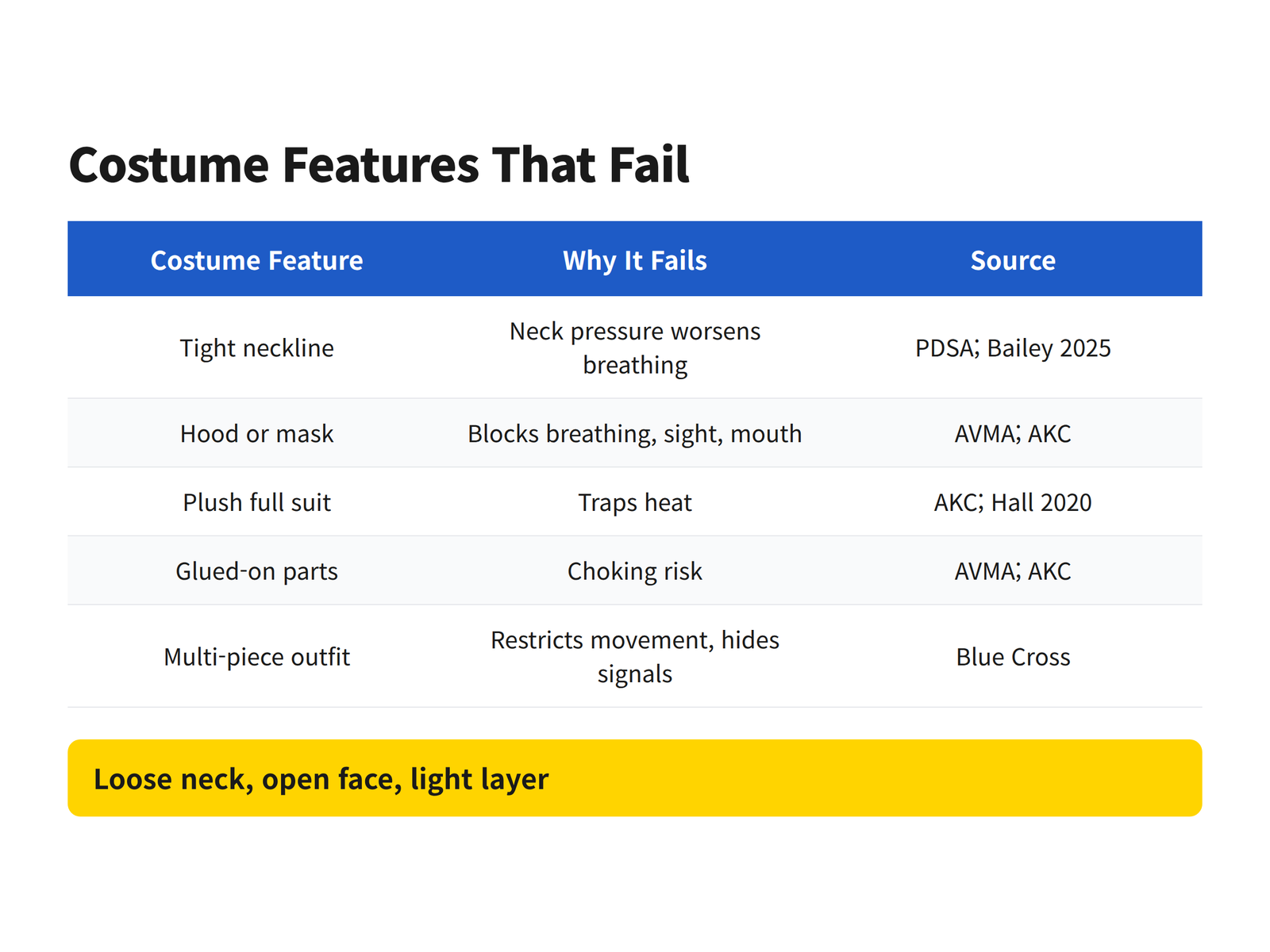
Which costume features fail on a Pug, at a glance?
Five common costume features fail on a Pug, and each links to a documented risk.
| Costume feature | Why it fails on a Pug | Source basis |
|---|---|---|
| Tight neckline | Neck pressure worsens breathing | PDSA; Bailey 2025 |
| Hood or mask | Blocks breathing, sight, mouth | AVMA; AKC |
| Plush full suit | Traps heat | AKC; Hall 2020 |
| Glued-on parts | Choking risk | AVMA; AKC |
| Multi-piece outfit | Restricts movement, hides signals | Blue Cross |
How should a Pug costume be checked before Halloween night?
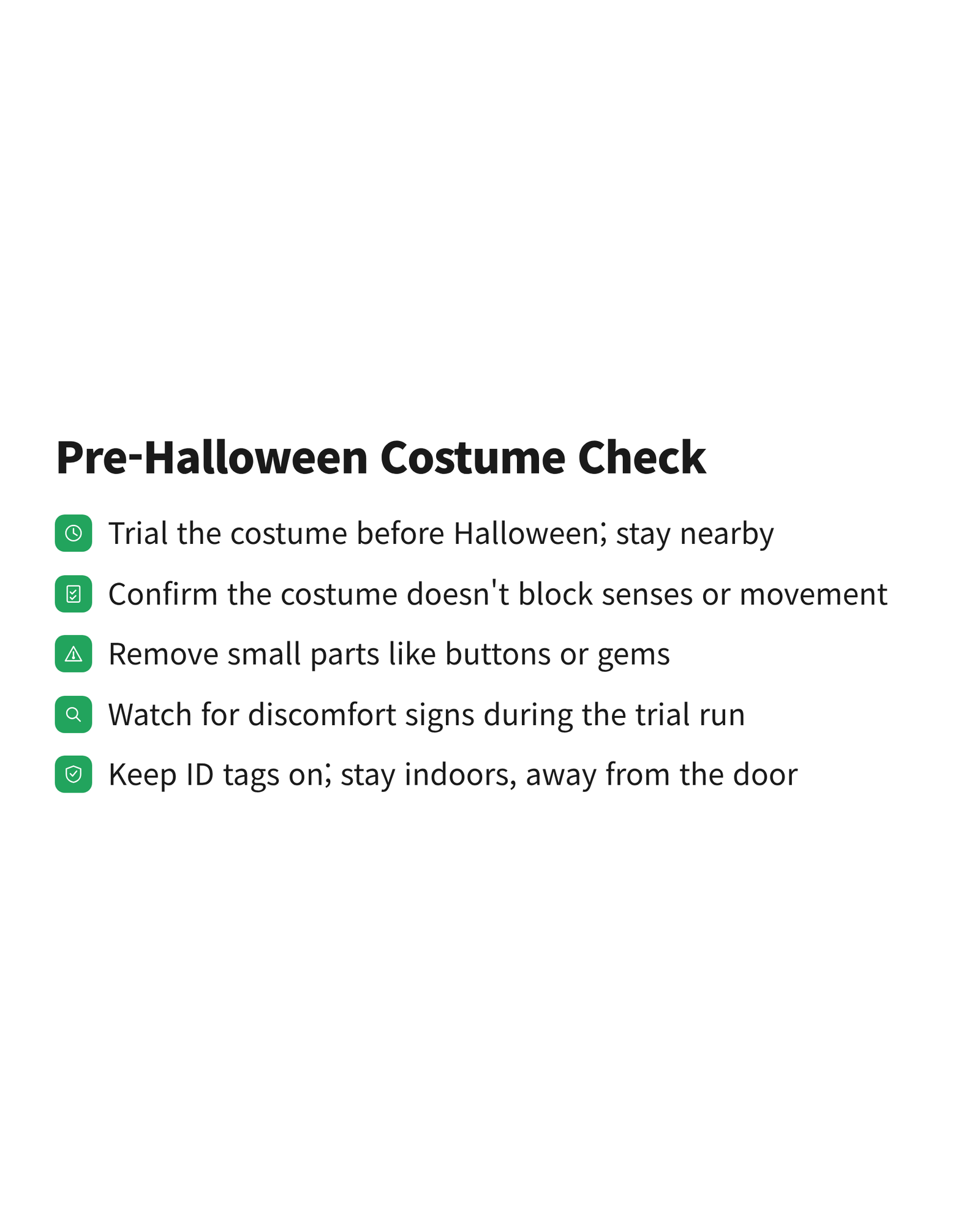
A Pug costume should be checked in advance using the AVMA and AKC steps below.
- Let the Pug get used to the costume before Halloween, and never leave a costumed pet unsupervised (AVMA).
- Confirm the costume does not block sight, hearing, breathing, mouth, or movement (AVMA; AKC).
- Remove detachable decorations such as buttons or gemstones that can be swallowed (AKC).
- Watch for discomfort signs during the trial run (AKC).
- Keep ID on, including microchip, collar, and tag, and keep the Pug indoors and away from the door during trick-or-treating (AVMA).
A minimal option, such as a loose bandana-style piece, keeps the neck and face clear. The AKC notes that bandanas should be worn only under supervision.
Frequently asked questions
Is any Halloween costume completely risk-free for a Pug? No costume can be called risk-free for a Pug. The AVMA criteria focus on fit, comfort, and supervision the whole time a Pug wears a costume.
Should a Pug wear a costume at an indoor party? Indoor parties can still be warm, and the AKC notes clothing can trap heat. Keeping costume time short and removing the outfit at the first sign of heavy panting or noisy breathing is a reasonable approach. Consult your veterinarian if your Pug has known breathing problems.
Sources
- American Veterinary Medical Association, “Halloween pet safety” (accessed 2026-09-25) – https://www.avma.org/resources-tools/pet-owners/petcare/halloween-pet-safety
- American Kennel Club, “Halloween Dog Costume Safety Tips Every Owner Should Know”, Jordan Upmalis, updated 2026-09-15 – https://www.akc.org/expert-advice/advice/costumes-for-dogs-dressed-up/
- American Kennel Club, “How to Make Halloween Costumes Fun and Safe for Your Dog” (no date shown) – https://www.akc.org/expert-advice/lifestyle/dog-halloween-costume-safety/
- American Kennel Club, “Official Standard of the Pug” (approved 2008-04-08) – https://images.akc.org/pdf/breeds/standards/Pug.pdf
- Royal Kennel Club, “Halloween dangers” (accessed 2026-09-25) – https://www.royalkennelclub.com/health-and-dog-care/health-dog-care/health/health-and-care/a-z-of-health-and-care-issues/halloween-dangers
- Royal Kennel Club, “Pug” breed page (accessed 2026-09-25) – https://www.royalkennelclub.com/search/breeds-a-to-z/breeds/toy/pug/
- RSPCA, “Caring for brachycephalic pets” (accessed 2026-09-25) – https://www.rspca.org.uk/adviceandwelfare/pets/brachycephalic/caring
- Blue Cross, “Dog Halloween costumes” (accessed 2026-09-25) – https://www.bluecross.org.uk/advice/dog/wellbeing-and-care/dog-costumes
- Blue Cross, “Things to think about before buying a flat-faced (brachycephalic) dog” (accessed 2026-09-25) – https://www.bluecross.org.uk/advice/dog/things-to-think-about-before-buying-a-flat-faced-brachycephalic-dog
- Hall EJ, Carter AJ, O’Neill DG, “Incidence and risk factors for heat-related illness (heatstroke) in UK dogs under primary veterinary care in 2016”, Scientific Reports 10:9128 (2020) – https://www.nature.com/articles/s41598-020-66015-8
- Bailey ME, Packer MJ, Wills AP, “Effect of a Collar and Harness on Intraocular Pressure and Respiration Rate of Brachycephalic and Dolichocephalic Dogs”, Veterinary Medicine and Science (2025) – https://pmc.ncbi.nlm.nih.gov/articles/PMC12036695
- University of Cambridge Department of Veterinary Medicine, “About BOAS” (accessed 2026-09-25) – https://www.vet.cam.ac.uk/boas/about-boas
- PDSA, “BOAS – breathing problems in flat-faced dogs” (accessed 2026-09-25) – https://www.pdsa.org.uk/pet-help-and-advice/pet-health-hub/conditions/boas-breathing-problems-in-flat-faced-dogs