The short answer to why a Bichon Frise still mats after brushing is that the brush only reaches the top of the coat. A Bichon Frise has a soft, dense undercoat under a coarser, curly outer coat, and mats form in that undercoat first. Three things usually explain the problem: brushing that never reaches the skin, the coat change between 8 months and a year, and a bath that ends before the coat is dry to the skin. This guide covers each one, plus the comb test that shows whether a Bichon coat is truly clear.
Why does a Bichon Frise still mat after brushing?
A Bichon Frise still mats after brushing because a brush can glide over a tangled undercoat without ever touching the knots underneath. The American Kennel Club breed standard describes the Bichon Frise coat as a double coat: “The undercoat is soft and dense, the outer coat of a coarser and curlier texture.” That curly outer layer springs back after brushing and hides whatever is packed against the skin. The Bichon Frise Club of America sets a stricter standard than a smooth surface: “It is imperative that when using a comb, you comb all the way to skin until it effortlessly glides through the coat.”
The second reason is how little a Bichon Frise sheds. The American Kennel Club notes that Bichons have hair rather than fur and shed little because loose hairs get caught in the undercoat. Those loose hairs do not fall onto the floor; they stay inside the Bichon coat. The Bichon Frise Club of America warns: “Dead hairs will quickly form mats and, if left unattended, will turn into a felt-like patterned mat.” A low-shedding coat therefore needs more combing, not less, because every dead hair that stays behind becomes raw material for the next mat.

Why do Bichon puppies start matting between 8 months and a year?
Bichon puppies start matting between 8 months and a year because the puppy coat is being replaced by the adult coat during that window. The Bichon Frise Club of America describes the change plainly: “Just before the adult coat comes in, he will begin to mat easily.” Owners who kept a puppy tangle-free with light brushing often see mats appear suddenly at this age, even though the routine has not changed.
The Bichon Frise Club of America also sets different tools for different ages. For a puppy under 4 months, the club suggests brushing every few days with a pin brush, mainly to establish the routine. After 4 months, the Bichon Frise Club of America recommends progressing to a slicker brush and comb. By the time the coat change arrives, the comb-to-the-skin check matters most, since the mix of shedding puppy hair and new adult hair tangles faster than a pin brush can manage.
Why do mats come back after a Bichon’s bath?
Mats come back after a Bichon’s bath when tangles are washed in or when the coat is left to air-dry. The Bichon Frise Club of America advises brushing and combing out tangles before the bath, because tangles “are less challenging to remove before the hair gets wet.” Wet tangles are harder to work out, so the Bichon Frise Club of America’s order is to clear the coat first and bathe second.
Drying is the other half of the problem. After the bath, the Bichon Frise Club of America says to towel dry and “immediately begin drying. You must completely dry the dog to the skin. Do not use hot air.” The club also advises brushing during drying “to straighten the curl all the way to the skin.” Stopping while the Bichon Frise coat is still damp near the skin skips the step the breed club treats as required.
- Brush and comb out tangles before the bath
- Bathe only once the comb glides through
- Towel dry, then start drying right away
- Dry to the skin with no hot air, brushing as you go
- Finish with a comb test through the whole coat
Where do mats hide on a Bichon Frise?
Mats on a Bichon Frise hide behind the ears, in the armpits, and where the body joins the legs. The Bichon Frise Club of America names these three areas, and the American Kennel Club’s home grooming guide also points to “behind the ears and under the legs.” These spots share one feature: they rub against collars, harnesses, or the dog’s own movement, and they are easy to skip during a quick brush.
A Bichon Frise that looks fluffy from above can still hide a firm mat in one of these three places. A practical routine is to start every session with the ears, armpits, and leg junctions, then move to the back and sides. Running the comb through each area to the skin confirms whether the section is clear. If the comb stops, that spot needs more work before moving on.
Slicker brush, pin brush, or comb: which one actually finds mats on a Bichon?
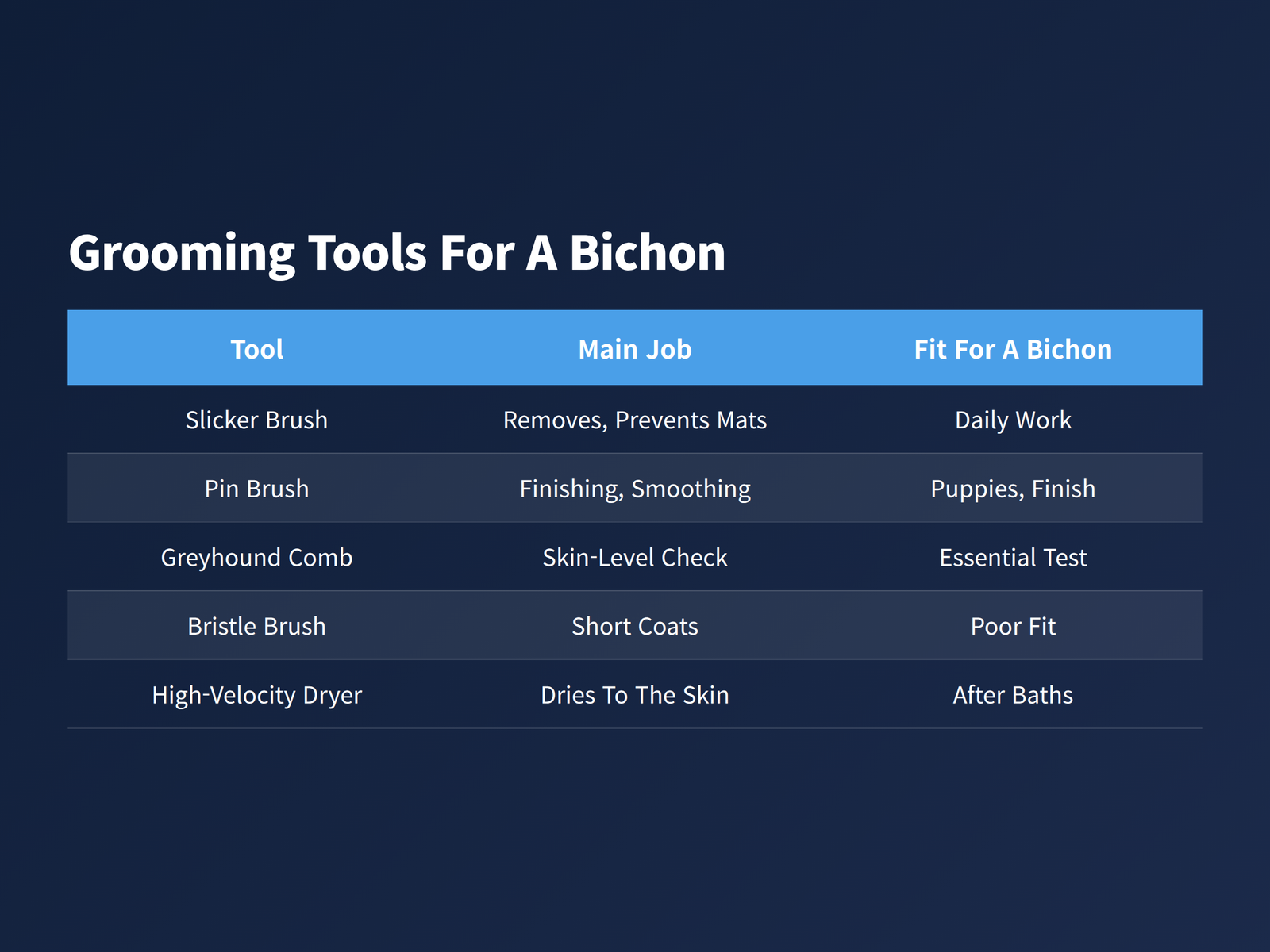
A comb is the tool that actually finds mats on a Bichon, while a slicker brush is the tool that helps remove and prevent them. According to the American Kennel Club, “Slicker brushes consist of brush heads covered with short, tightly-packed wire pins angled to go through the coat and avoid the skin,” and the AKC lists slicker brushes for curly and long coats. The AKC describes a pin brush as a finishing brush that smooths the hair, and a bristle brush as suited to short coats. The Bichon Frise Club of America uses a coarse-to-medium greyhound-type comb as the to-the-skin check.
| Tool | Main job | Fit for a Bichon |
|---|---|---|
| Slicker brush | Removes, prevents mats | Daily work |
| Pin brush | Finishing, smoothing | Puppies, finish |
| Greyhound-type comb | Skin-level check | Essential test |
| Bristle brush | Short coats | Poor fit |
| High-velocity dryer | Dries to the skin | After baths |
The table shows why a Bichon Frise owner who only uses a pin brush can still find mats. A pin brush smooths the outer coat, which is useful as a finish but does not confirm anything about the undercoat. The slicker brush does the daily work, and the comb decides whether the job is done. A high-velocity dryer used without hot air supports the drying step the Bichon Frise Club of America describes.
How often does a Bichon Frise need brushing and professional grooming?
A Bichon Frise needs daily brushing and regular professional grooming roughly every 4 to 6 weeks. The American Kennel Club recommends daily brushing and a trim every 4 to 6 weeks. The Bichon Frise Club of America suggests full-service professional grooming every 4 weeks. Taken together, the two sources put a sensible professional schedule at every 4 to 6 weeks, with the shorter end suiting coats that tangle easily.
For owners new to a Bichon Frise coat, a groomer can also teach the routine. The Royal Kennel Club puts it this way: “If you are new to looking after a specific type of coat, it can be a big help to take your dog to a professional groomer to begin with so that you can learn and pick up tips.” Asking the groomer to show the comb test and the three hidden mat spots turns one appointment into a lasting home routine.
What should you do when a mat is already tight to the skin?
When a mat is already tight to the skin, the safest step is to book a professional groomer rather than cutting it out at home. The Bichon Frise Club of America notes that severe mats may mean shaving down to the skin or a slow, painful removal of each mat. A groomer has the tools and experience to handle a matted Bichon Frise coat with less stress for the dog.
Choosing that groomer carefully matters. The RSPCA warns that dogs “have suffered severe burns or even died in grooming establishments when equipment has been faulty or where animals have been left unsupervised.” Look for a groomer who keeps dogs supervised during drying. If the skin under a mat looks red, sore, or broken, consult your veterinarian before any grooming, since matted coats can hide skin problems that need a professional look.
Frequently asked questions
Is daily brushing enough to stop a Bichon Frise from matting? Daily brushing helps, but a Bichon Frise coat is only clear when a comb glides all the way to the skin. The Bichon Frise Club of America treats the comb test, not the brush, as the final check.
Should a Bichon Frise be bathed when it has mats? No. The Bichon Frise Club of America advises brushing and combing out tangles before the bath, because tangles are harder to remove once the hair is wet.
Can a Bichon Frise air-dry after a bath? The Bichon Frise Club of America says to begin drying immediately and to dry the Bichon completely to the skin, without hot air. Air-drying leaves damp undercoat where mats can form.
How tall is a Bichon Frise? The American Kennel Club standard lists a height of 9½ to 11½ inches, which puts the Bichon Frise firmly in the small-breed group this site covers.
Sources
- American Kennel Club, “Official Standard of the Bichon Frise”, approved 1988-10-11 — https://images.akc.org/pdf/breeds/standards/BichonFrise.pdf
- American Kennel Club, “Is the Bichon Frise the Right Breed for Your Lifestyle?”, 2025-05-21 — https://www.akc.org/expert-advice/dog-breeds/bichon-frise/
- American Kennel Club, “Dog Brushes: How to Choose the Right Dog Brush for Your Pet”, updated 2026-03-03 — https://www.akc.org/expert-advice/health/types-dog-brushes-shedding/
- American Kennel Club, “How to Groom a Dog at Home”, updated 2026-09-02 — https://www.akc.org/expert-advice/dog-care/articles/how-to-groom-a-dog/
- Bichon Frise Club of America, “Grooming Tips” — https://bichon.org/about-bichons/breed-info/grooming-tips/
- The Royal Kennel Club, “Dog grooming” — https://www.royalkennelclub.com/health-and-dog-care/health-dog-care/health/health-and-care/a-z-of-health-and-care-issues/dog-grooming
- RSPCA, “Choosing the Right Dog Groomer” — https://www.rspca.org.uk/adviceandwelfare/pets/dogs/health/grooming