A deshedding tool on a Papillon is the wrong fit because the Papillon is a single-coated toy breed with no undercoat for that tool to reach. The manufacturer of the best-known deshedding tool also lists the Papillon among breeds its tool is not recommended for. A pin brush, a light-handed slicker brush and a wide-tooth comb match the long, silky Papillon coat far better. This guide explains what the breed standards say, why the Papillon still sheds, and when brushing should give way to a groomer or a veterinarian.
Does a Papillon have an undercoat?
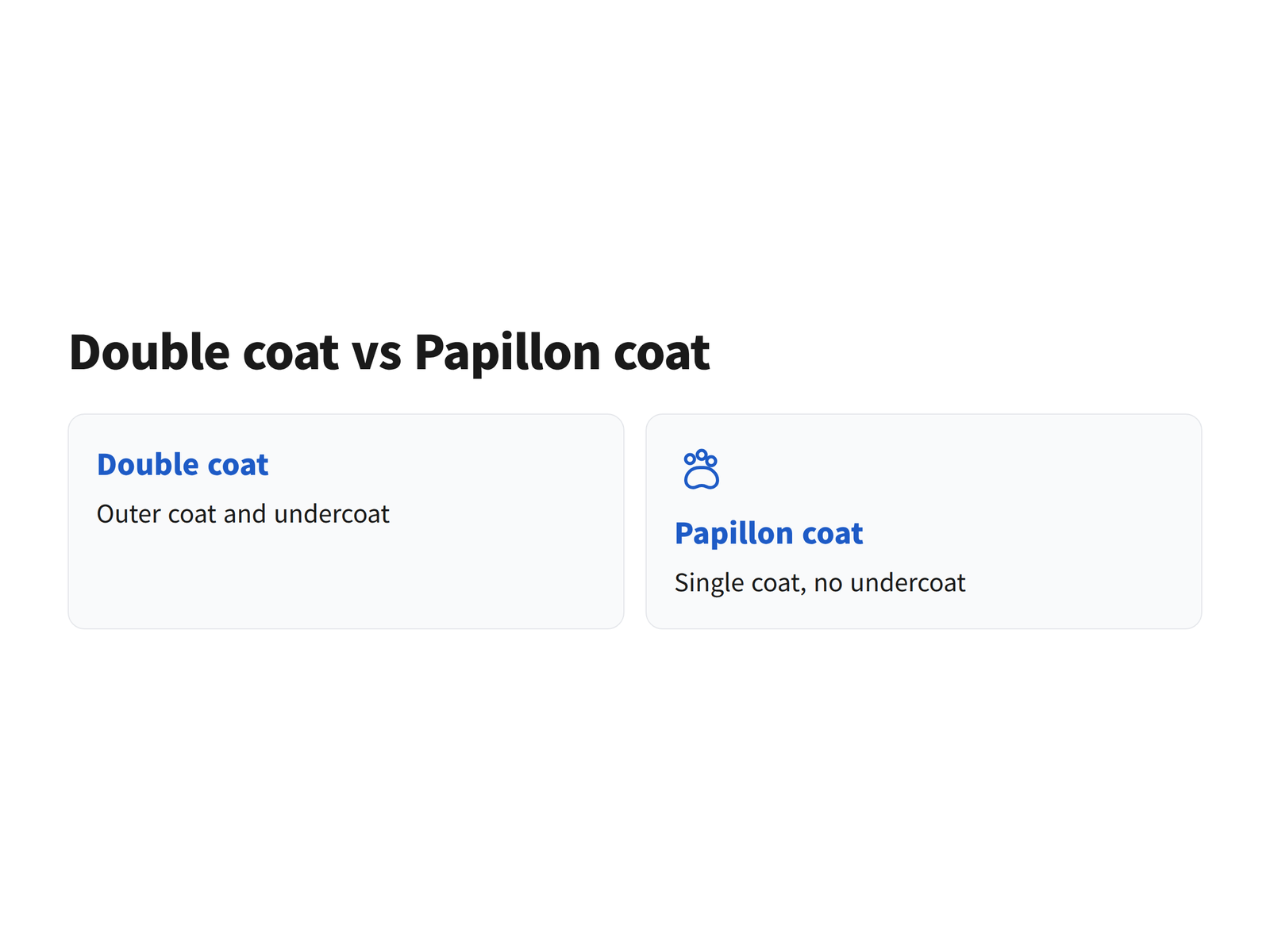
No, a Papillon does not have an undercoat; every major breed standard describes a single coat. The United Kennel Club standard (revised 2017-05-01) states plainly: “The breed is single-coated; there is no undercoat.” The Papillon Club of America, the AKC parent club, uses almost the same words, and the Royal Kennel Club standard (updated April 2025) describes the Papillon coat as “abundant, flowing but without undercoat.” The American Kennel Club standard adds that the coat is long, fine, silky and flat on the back and sides, with a profuse frill on the chest.
That coat sits on a small frame. The AKC standard sets Papillon height at 8 to 11 inches at the withers, and the Royal Kennel Club gives 20 to 28 cm. Neither the UKC nor the RKC sets a fixed weight; the UKC says weight should be in proportion to height. For grooming purposes, the key point is the single layer: what you see on the surface of a Papillon is the whole coat, with no dense, woolly layer underneath.
Why is a deshedding tool the wrong tool for a Papillon?
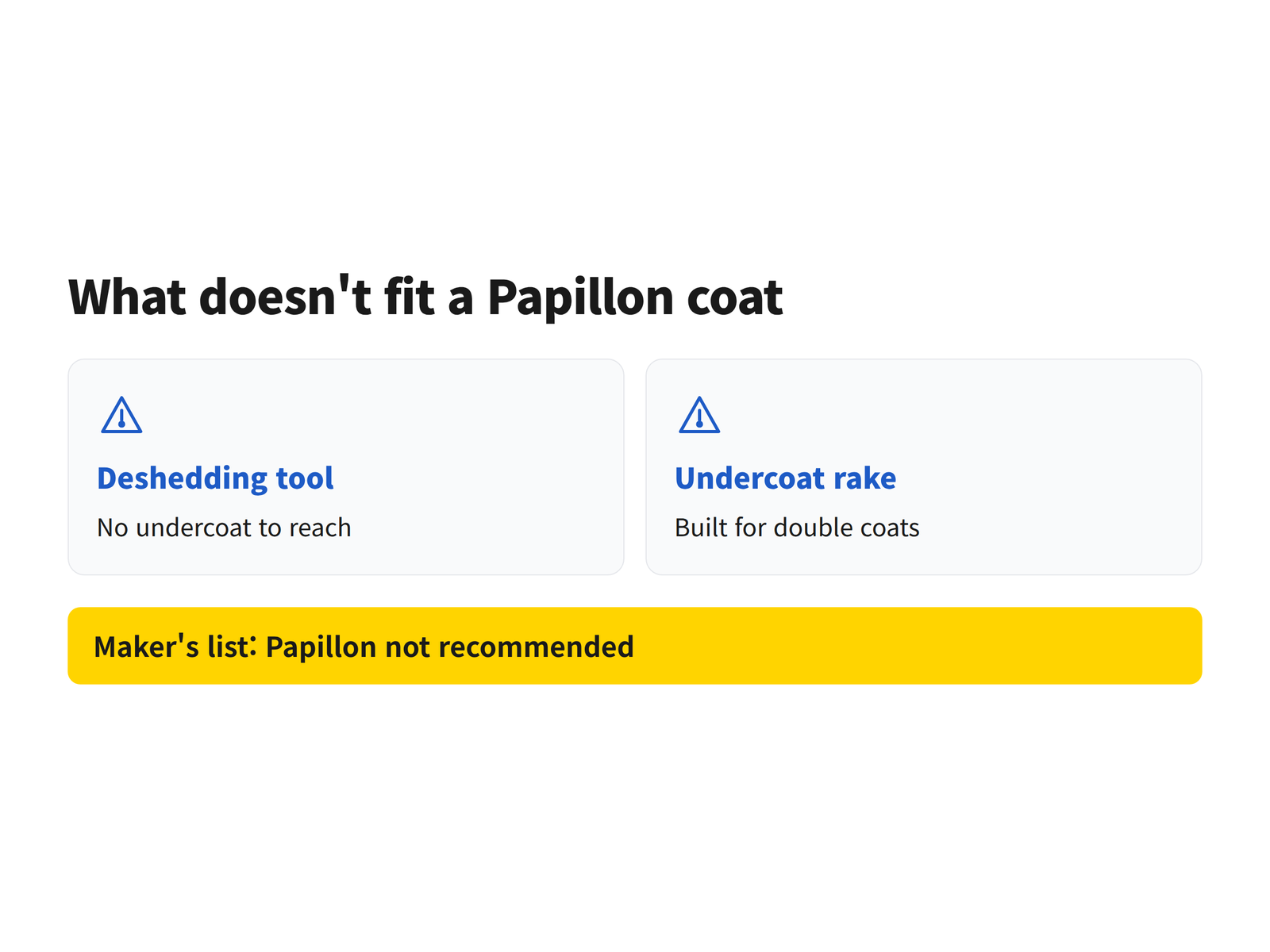
A deshedding tool is built to pull loose undercoat, and a Papillon has no undercoat layer for it to work on. The American Kennel Club describes the related undercoat rake as a tool “designed to penetrate through to the undercoat to remove loose fur” and says undercoat rakes suit double-coated breeds of all fur lengths. On a Papillon, the target layer those tools are designed around is simply absent.
The manufacturer says the same thing about its own product. The FURminator breed guide states that its Undercoat deShedding Tool “should not be used on non-shedding breeds or on pets with particularly sensitive skin,” and the Papillon appears on its list of breeds the tool is not recommended for. The guide suggests alternatives for dogs without undercoat: a dual grooming brush, a slicker brush, a curry comb, regular brushing, mild bathing and professional trimming.
Two limits apply to that list. First, the FURminator list is not a clean coat-type list; the same page names the Pomeranian, while RSPCA Australia advises an undercoat rake for double-coated long-haired dogs like Pomeranians. So the list is evidence about the Papillon only, not about toy breeds in general. Second, no veterinary or kennel club source reviewed for this article states that a deshedding blade damages a Papillon coat. The accurate claim is narrower: the Papillon lacks the layer the tool is designed for, and the maker does not recommend the tool for the breed.
If a Papillon has no undercoat, why does it still shed?
A Papillon still sheds because “no undercoat” only means there is no seasonal undercoat blow-out, not zero hair loss. The Royal Kennel Club breed information page marks Papillon shedding as “Yes.” The Papillon Club of America puts the distinction precisely: “They have no undercoat to shed out twice a year as with most long-haired breeds.”
Read together, the two sources say the Papillon lacks the heavy twice-yearly undercoat shed, not that the Papillon drops no hair at all. Owners who expect a hair-free house can be surprised, and some reach for a deshedding tool for that reason. No breed club or kennel club figure was found for how much a Papillon sheds or in which season, so a product claim that puts a number on Papillon shedding should be read with caution. Routine brushing with tools suited to a single coat is the approach the grooming guidance supports.
Slicker brush vs pin brush vs comb: which suits a Papillon coat?
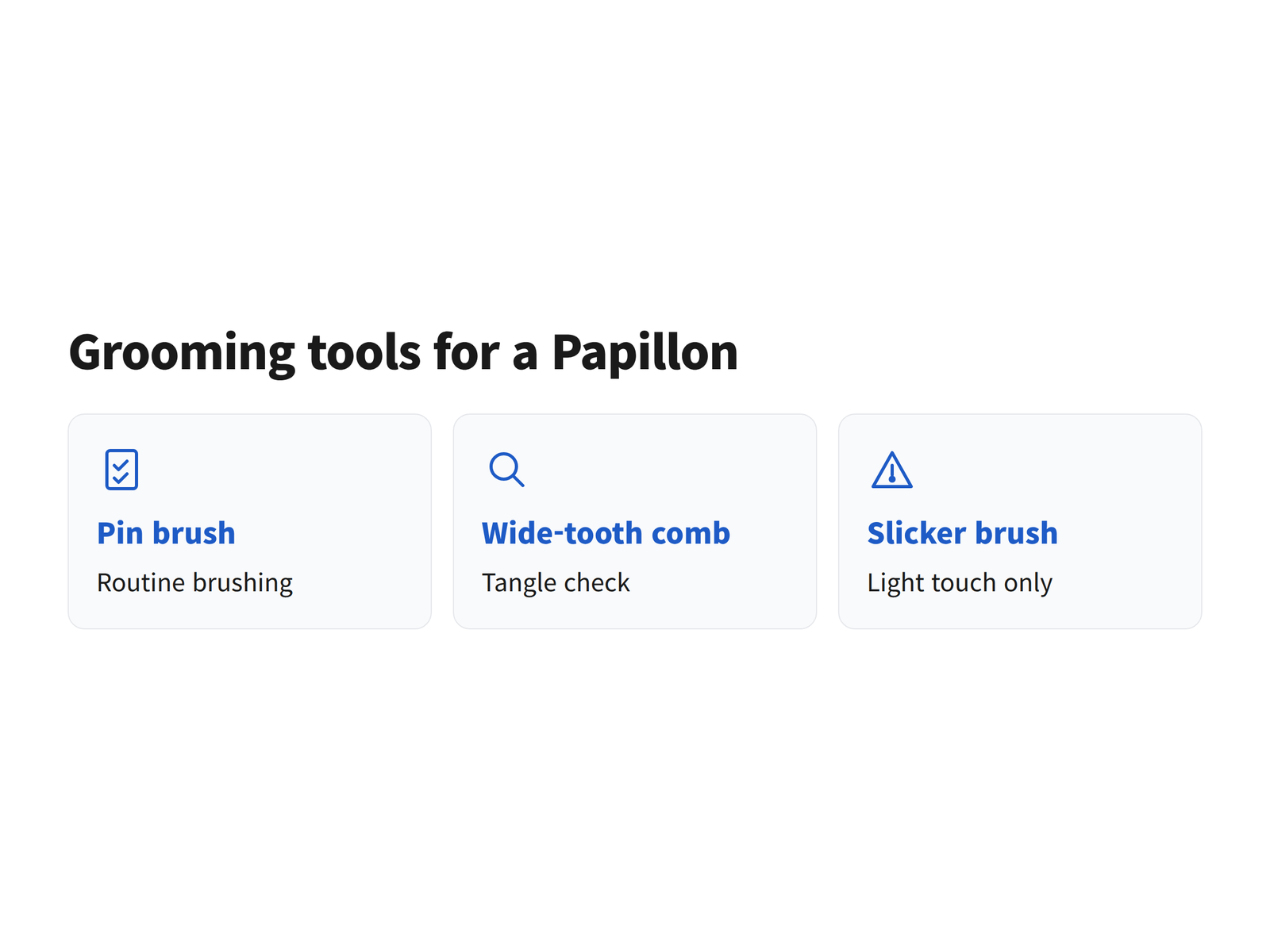
For a long, silky single coat like the Papillon’s, grooming guidance points to a pin brush for routine work, a wide-tooth comb for checks and a slicker brush used with a light touch. Blue Cross describes the pin brush as “good for smoothing out small tangles and removing dead fur,” and the AKC grooming tools guide describes its long, round-ended pins for long-haired breeds. The AKC notes that a comb can be used on almost any coat type and that wide-toothed combs can help remove mats and tangles.
The slicker brush needs more care. The AKC recommends slicker brushes for medium, long, wire and curly coats to remove mats, then warns: “Maintain a light touch when using slicker brushes, as pressing down hard could cause your dog discomfort.” Blue Cross agrees that the angled pins are meant to avoid scratching the skin, but only without too much pressure. On a toy breed of 8 to 11 inches, a light hand matters even more because there is little body to brace against.
How often? The Royal Kennel Club advises grooming a Papillon “more than once a week.” Blue Cross sets at least once a week for a smooth short coat and says long coats need grooming much more regularly. A pin brush and comb session several times a week fits both.
How do the common grooming tools compare on a Papillon coat?
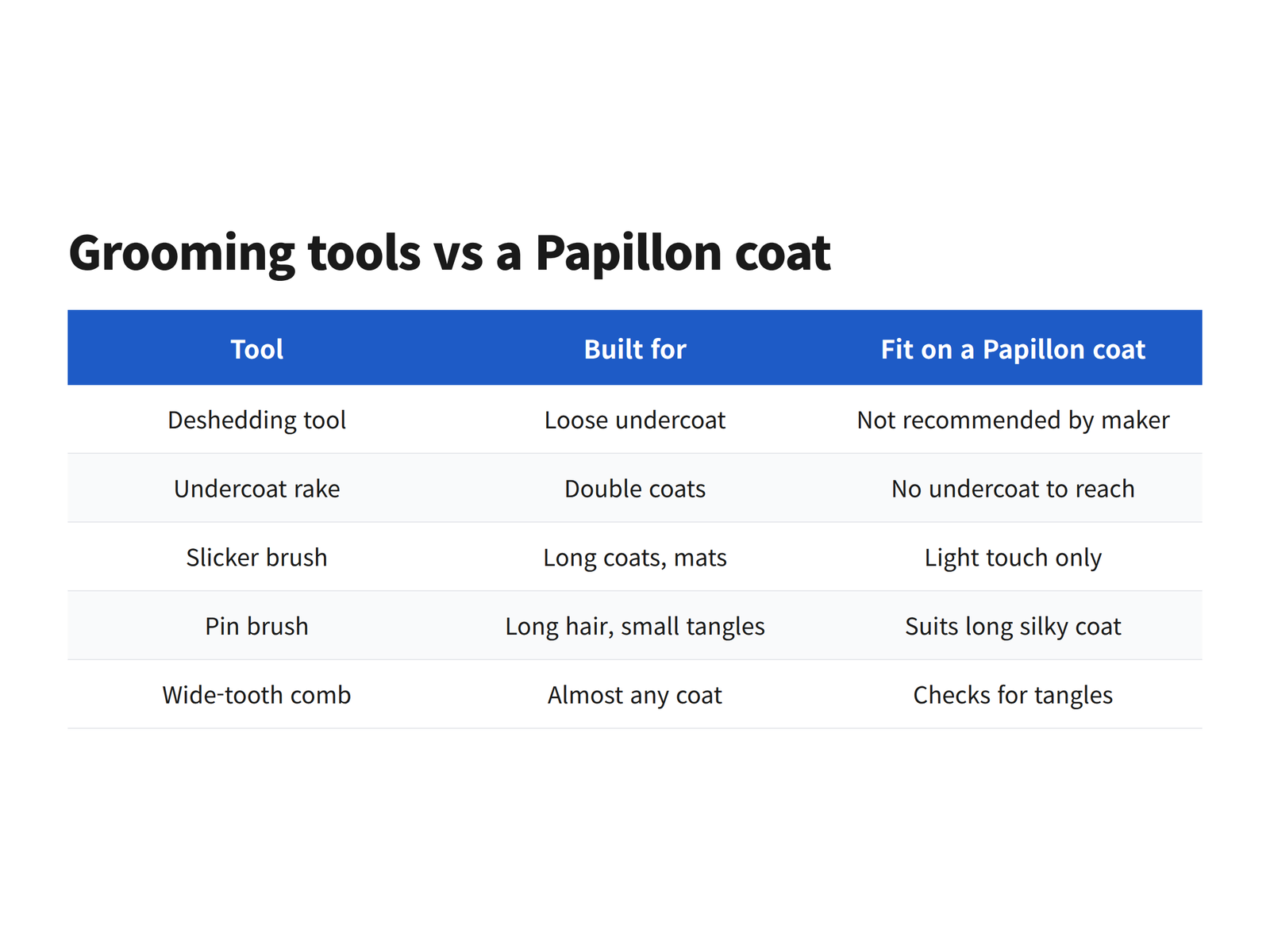
The table below summarizes what each tool is built for and how it fits a Papillon coat. The last three fit ratings reflect AKC and Blue Cross guidance for long, silky coats in general, not a Papillon-specific ruling by either organization.
| Tool | Built for | Fit on a Papillon coat |
|---|---|---|
| Deshedding tool | Loose undercoat | Not recommended by maker |
| Undercoat rake | Double coats | No undercoat to reach |
| Slicker brush | Long coats, mats | Light touch only |
| Pin brush | Long hair, small tangles | Suits long silky coat |
| Wide-tooth comb | Almost any coat | Checks for tangles |
Where does a Papillon coat tangle, and how should you work those areas?
The areas with the longest hair described in the Papillon breed standards, the ear fringes, chest frill, leg feathering and tail plume, deserve a comb check at every session. The UKC standard describes the ear fringes, leg feathering and tail plume, and the AKC and RKC standards both describe a profuse frill on the chest. No breed club or grooming authority source reviewed for this article documents exactly where Papillon mats form, so treat these zones as places to check rather than as proven trouble spots.
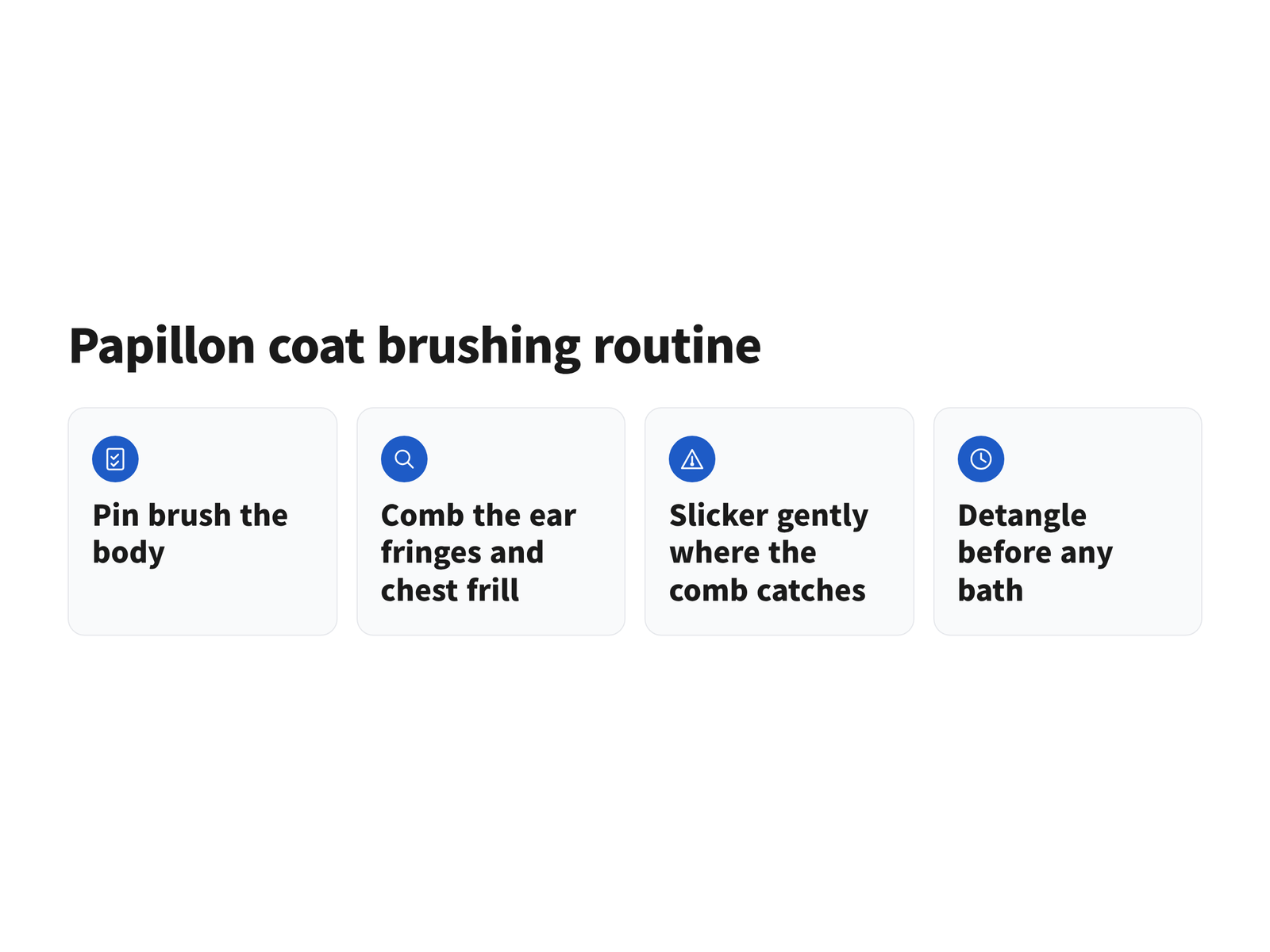
The Papillon Club of America says the Papillon’s “silky coat is not prone to matting” and that the “resilient coat texture sheds dirt and dry grass with the touch of a brush.” That is a breed-club description, and individual coats vary, so a tangle can still form. A practical order is to brush with the pin brush, run the wide-tooth comb through the fringes and frill, and use the slicker brush gently only where the comb catches. Blue Cross also advises: “Detangle any matts before washing as they will only get worse during shampooing.” Comb out the Papillon fully before any bath, not after.
When does a Papillon need a groomer or a vet instead of more brushing?
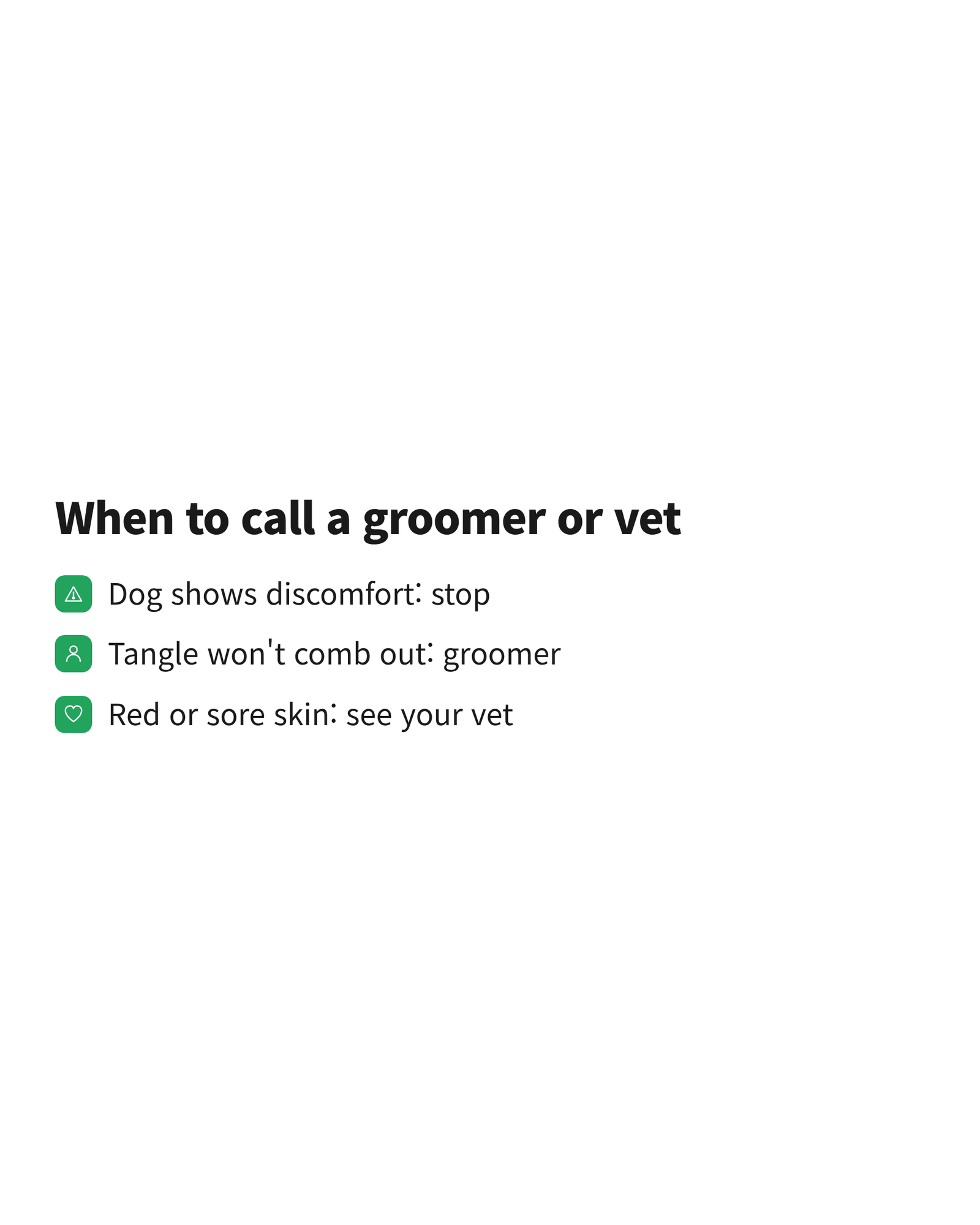
A Papillon needs a groomer or a veterinarian when brushing causes discomfort, when a tangle will not come out gently, or when the skin looks red, sore or broken. RSPCA Australia advises owners to “stop immediately” if a dog shows discomfort during grooming and notes that “it might be safest to have a professional groomer or veterinarian/veterinary nurse help you.”
More brushing is not the answer to irritated skin. If you notice redness, soreness, scabs or broken skin anywhere on your Papillon, pause grooming in that area and consult your veterinarian before continuing. This article covers tool fit only and is not a substitute for veterinary advice about the Papillon’s skin or coat condition. A professional groomer can also handle a stubborn tangle with less stress for a small dog than repeated attempts at home.
Frequently asked questions
Can you use a FURminator on a Papillon? The FURminator maker lists the Papillon among breeds its deShedding Tool is not recommended for, and the Papillon has no undercoat for the tool to reach. A pin brush and a wide-tooth comb are the tools that grooming guidance matches to long, silky coats.
Do Papillons shed? Yes. The Royal Kennel Club marks Papillon shedding as “Yes.” The Papillon Club of America explains that the breed has no undercoat to shed out twice a year, which means no heavy seasonal shed rather than no hair loss.
How often should a Papillon be brushed? The Royal Kennel Club advises grooming a Papillon more than once a week. Blue Cross notes that long coats need grooming much more regularly than the weekly minimum for smooth short coats.
Is a slicker brush safe for a Papillon? A slicker brush can be used on long coats to remove mats, but the AKC and Blue Cross both warn against pressing hard. Use a light touch, and stop if your Papillon shows discomfort.
Sources
- United Kennel Club, “Papillon Official UKC Breed Standard”, revised 2017-05-01 — https://www.ukcdogs.com/docs/breeds/papillon-breed-standard.pdf
- American Kennel Club, “Official Standard of the Papillon”, approved 1991-06-10 — https://images.akc.org/pdf/breeds/standards/Papillon.pdf
- Royal Kennel Club, “Papillon breed standard”, updated April 2025 — https://www.royalkennelclub.com/breed-standards/toy/papillon
- Royal Kennel Club, “Papillon” breed information page, viewed 2026-09-24 — https://www.royalkennelclub.com/search/breeds-a-to-z/breeds/toy/papillon/
- Papillon Club of America, “Papillon Standard”, undated — https://papillonclub.org/standard/
- Papillon Club of America, “The Papillon, What is it?”, undated — https://papillonclub.org/articles-the-papillon-what-is-it-2/
- American Kennel Club, “Dog Brushes: How to Choose the Right Dog Brush for Your Pet”, updated 2026-03-03 — https://www.akc.org/expert-advice/health/types-dog-brushes-shedding/
- American Kennel Club, “Grooming Your Dog” (grooming tools guide), undated — http://images.akc.org/pdf/public_education/grooming_tools.pdf
- Blue Cross, “How to groom your dog”, 2017-07-26 — https://www.bluecross.org.uk/advice/dog/how-to-groom-a-dog
- RSPCA Australia Knowledgebase, “Why and how should I groom my dog?”, updated 2022-01-19 — https://kb.rspca.org.au/categories/companion-animals/dogs/caring-for-my-dog/why-and-how-should-i-groom-my-dog
- FURminator (Spectrum Brands), “Dog breeds that are not recommended for a deShedding tool”, undated — https://www.furminator.net/guide/deshed/which-dog-breeds-are-not-recommended-for-an-undercoat-deshedding-tool