Hypoallergenic small dog breeds still cause allergies because “hypoallergenic” is a marketing label, not a measured standard. No dog breed has been shown to produce less of the major dog allergen, Can f 1. The American Kennel Club puts it plainly: “There are no 100% hypoallergenic dogs, dog breeds, or mixed-breeds, but there are many dog breeds that are less allergenic for people with dog allergies.” This guide covers what allergen studies actually measured, the one narrow exception tied to a dog’s sex, and how to test your reaction to one specific small dog before adopting.

Why do “hypoallergenic” small dog breeds still cause allergies?
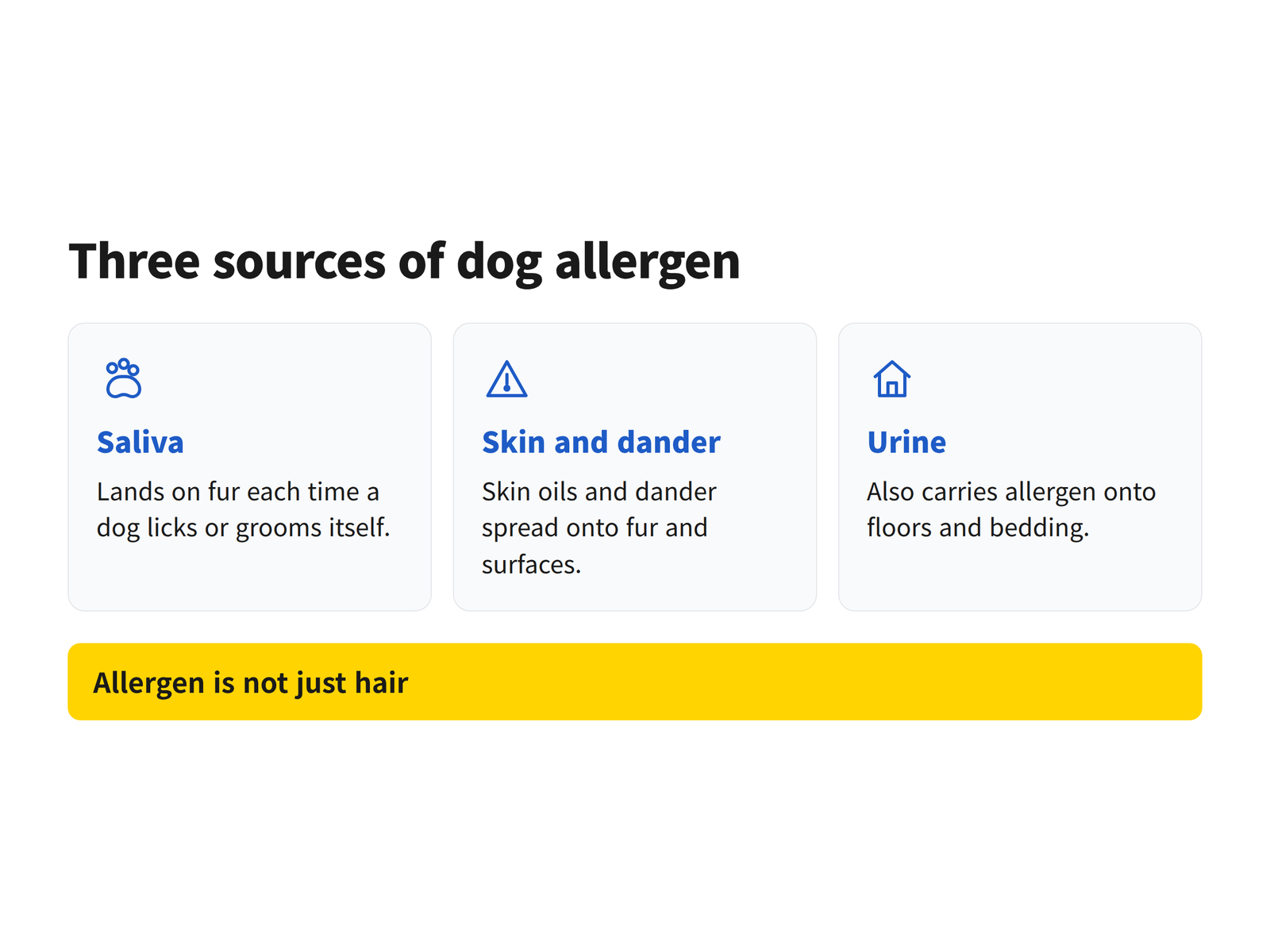
Hypoallergenic small dog breeds still cause allergies because every dog makes the proteins that trigger dog allergy. The RSPCA explains that pet allergens are “proteins found in an animal’s saliva, sweat, skin oils, urine, faeces and dander,” and that these proteins spread “onto fur, bedding, clothing, furniture and surfaces.” A Havanese, a Coton de Tulear, or a Chinese Crested has saliva, skin, and urine like any other dog. The RSPCA summary is direct: “No pet is truly hypoallergenic, but understanding your allergy can help you make a safer, more informed choice.”
The two best-known dog allergens, Can f 1 and Can f 2, are salivary proteins. A 1997 paper in the journal Immunology was titled “The major dog allergens, Can f 1 and Can f 2, are salivary lipocalin proteins.” Saliva ends up on the coat every time a dog licks or grooms itself, so a low-shedding small breed still carries dog allergen. The American College of Allergy, Asthma and Immunology (ACAAI) agrees: “Unfortunately there are no ‘non-allergenic’ cat or dog breeds! All of these have some level of allergen.”
Does a non-shedding coat mean less dog allergen?
A non-shedding coat does not mean less dog allergen, and one study found the opposite in the coat itself. A 2012 study in the Journal of Allergy and Clinical Immunology by Vredegoor and colleagues sampled 356 dogs in 6 groups, including Labradoodles, Poodles, Labradors, and a control group of 106 mixed dogs. In hair samples, the geometric mean Can f 1 level was 2.26 ug/g in the “hypoallergenic” group versus 0.77 ug/g in the control group. In coat samples, the figures were 27.04 versus 12.98 ug/g.
The Vredegoor study does not prove low-shedding dogs are worse for allergic owners. Airborne and floor-dust allergen in the homes showed minimal differences between breed groups. What the Vredegoor numbers do show is that a low-shedding coat can hold allergen on the dog rather than drop it around the house. The authors concluded: “There is no evidence for the classification of certain dog breeds as hypoallergenic.” For a small-dog shopper, the takeaway is that “non-shedding” describes the coat, not the allergen load.
What did studies find when they measured allergen in homes with hypoallergenic dogs?
Studies that measured allergen inside real homes found no meaningful difference between hypoallergenic and other dogs. A 2011 study in the American Journal of Rhinology and Allergy by Nicholas and colleagues analyzed 173 one-dog homes covering 60 breeds, 11 of them classed as hypoallergenic. Can f 1 was detectable in 163 of the 173 homes, or 94.2%. The researchers tested 4 different classification schemes for which breeds count as hypoallergenic, and none showed a difference.
The Nicholas paper states: “No classification scheme showed that the level of dog allergen in homes with hypoallergenic dogs differed from other homes.” Senior author Christine Cole Johnson, PhD, MPH, of Henry Ford Health, summarized the result in a press release: “We found no scientific basis to the claim hypoallergenic dogs have less allergen.” Taken together with the Vredegoor data, the home-level research points in one direction: the breed label on a small dog does not predict how much allergen ends up in your living room.
Are female dogs less allergenic than male dogs?
Female dogs may be less allergenic for a small group of people, but only those sensitized to one specific male-dog allergen, Can f 5. Can f 5 is prostatic kallikrein, a protein from male dogs. A 2009 study by Mattsson and colleagues found that 26 of 37 dog-allergic serum samples, or 70%, bound Can f 5. The Can f 5 exception applies narrowly: it only covers people sensitized to Can f 5 alone, not other dog allergens such as Can f 1 and Can f 2.
A 2020 randomized trial by Schoos and colleagues tested teens who were sensitized to Can f 5 alone. In skin prick testing, 7 of 7 reacted to male dog extract, while 1 of 7 reacted to female dog extract. In eye provocation testing, the split was 5 of 7 for male extract versus 1 of 7 for female extract. The trial was small, with 22 participants in total. The Schoos result does not mean female dogs are safe for allergic people. Whether the Can f 5 exception applies to you is a question for a board-certified allergist, who can discuss component testing.
Will allergen-free dogs ever be available?
Allergen-free dogs are not available to buy, and the only ones that exist are research animals. A paper by Walker and colleagues in The CRISPR Journal described two beagle puppies, Alfie and Bailey, whose Can f 1 gene was knocked out. The Walker paper reported no detectable Can f 1 in the puppies’ saliva or hair and dander. The paper notes that roughly 15% of the population has a dog allergy.
The Walker research is early-stage. No commercial timeline has been stated, one author has a financial interest, and a patent application has been filed. The knockout beagles also address Can f 1 only, not every dog allergen. For anyone choosing a small dog now, the Walker study is a research milestone, not a shopping option.
How can you test your reaction to one small dog before adopting?
The most reliable way to test your reaction is to spend time with the individual dog, not just the breed, before adopting. The RSPCA warns: “Allergic reactions can vary, so meeting one animal doesn’t guarantee you’ll react the same way to another.” The American Kennel Club suggests spending 15 to 20 minutes with a breed before adopting. Because no breed-level allergen data was found for the Havanese, Coton de Tulear, or Chinese Crested, time with the specific dog tells you more than any breed list.
Practical steps drawn from RSPCA, AKC, and ACAAI guidance:
- Visit the specific small dog, more than once if possible, before committing.
- Talk to a board-certified allergist about testing before adopting, which is consistent with ACAAI’s guidance on allergist testing.
- Keep the bedroom dog-free.
- Use HEPA air filtration, vacuum regularly, and wash dog bedding often.
- Choose hard floors over carpet where you can.
- Wash your hands after handling the dog and the dog’s bedding.
These steps reduce exposure; they do not guarantee you will not react. If your new dog has skin, coat, or grooming concerns of its own, consult your veterinarian.
How does the hypoallergenic label compare with the evidence?
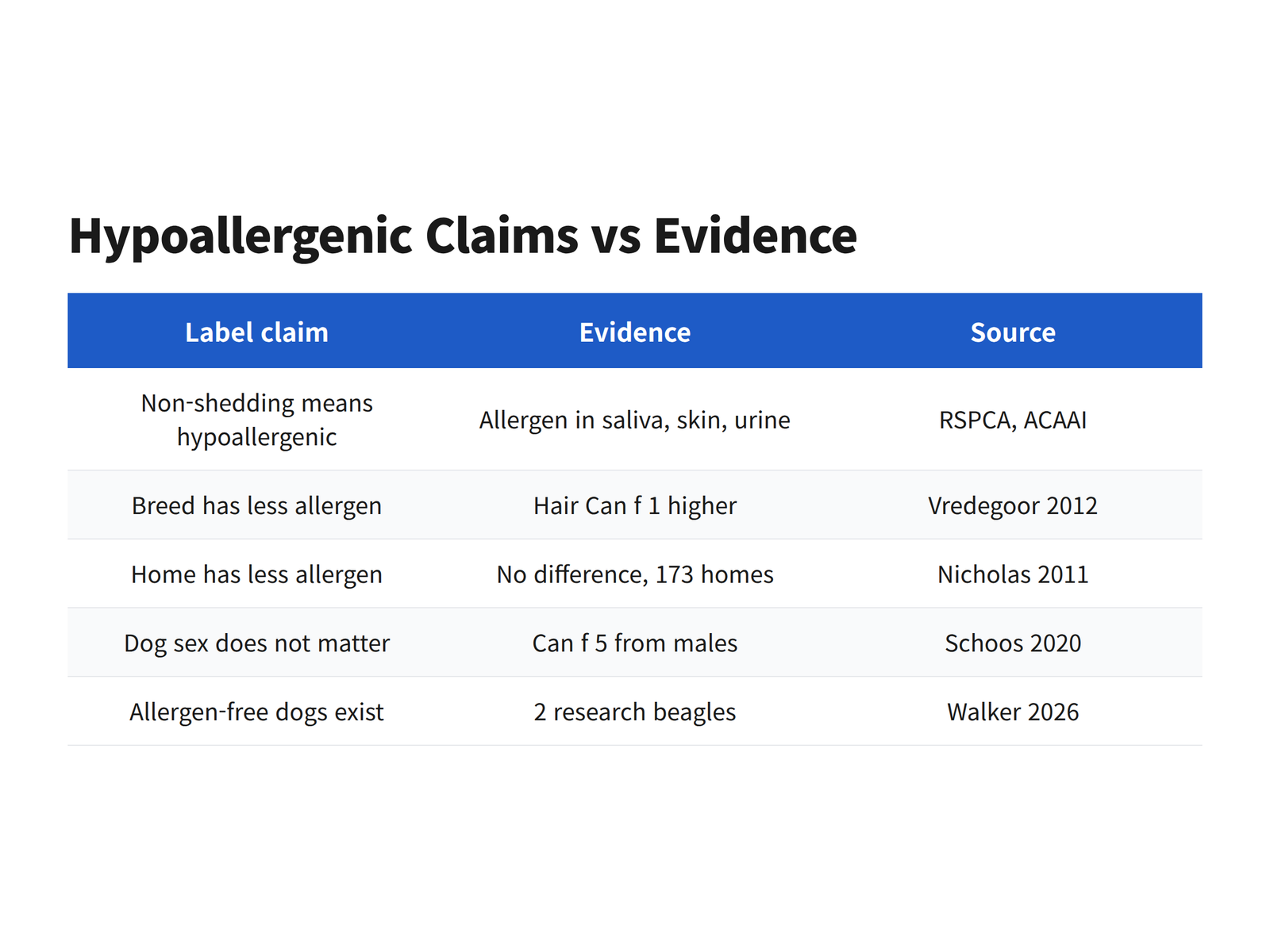
The hypoallergenic label makes five common promises, and the research contradicts or narrows each one.
| Label claim | Evidence | Source |
|---|---|---|
| Non-shedding means hypoallergenic | Allergen in saliva, skin, urine | RSPCA, ACAAI |
| Breed has less allergen | Hair Can f 1 higher | Vredegoor 2012 |
| Home has less allergen | No difference, 173 homes | Nicholas 2011 |
| Dog sex does not matter | Can f 5 from males | Schoos 2020 |
| Allergen-free dogs exist | 2 research beagles | Walker 2026 |
Frequently asked questions
Is a Coton de Tulear really hypoallergenic?
A Coton de Tulear is not truly hypoallergenic, because no dog breed is. The American Kennel Club lists some breeds as less allergenic, but no breed-level allergen data was found for the Coton de Tulear. Spending time with the individual Coton de Tulear before adopting is the practical test.
Do smaller dogs produce less allergen than bigger dogs?
No source has shown that smaller dogs produce less allergen because of body size. The home study by Nicholas and colleagues found Can f 1 in 94.2% of one-dog homes, and breed classification made no difference.
Should I get a female small dog if I have dog allergies?
A female small dog may help only people sensitized to Can f 5 alone, based on one small trial. The exception does not cover other dog allergens such as Can f 1 and Can f 2, so talk to a board-certified allergist about your specific triggers before relying on the sex of the dog.
Sources
- American Kennel Club, “Hypoallergenic Dogs” (breed list page) — https://www.akc.org/dog-breeds/hypoallergenic-dogs/
- American Kennel Club, Gemma Johnstone, “Does a Completely Hypoallergenic Dog Exist?”, 2026-08-17 — https://www.akc.org/expert-advice/dog-breeds/do-hypoallergenic-dog-exist/
- RSPCA, “Are There Hypoallergenic Pets?” — https://www.rspca.org.uk/findapet/advice/allergy
- American College of Allergy, Asthma and Immunology, “Pet Allergies” — https://acaai.org/resource/pet-allergies/
- Vredegoor DW et al., “Can f 1 levels in hair and homes of different dog breeds: Lack of evidence to describe any dog breed as hypoallergenic,” Journal of Allergy and Clinical Immunology, 2012;130(4):904-909.e7 — https://www.sciencedirect.com/science/article/abs/pii/S0091674912007932
- Nicholas CE et al., “Dog allergen levels in homes with hypoallergenic compared with nonhypoallergenic dogs,” American Journal of Rhinology and Allergy, 2011;25(4):252-256 — https://pmc.ncbi.nlm.nih.gov/articles/PMC3680143
- ScienceDaily, “Hypoallergenic dogs don’t have lower household allergen levels than other dogs, study finds” (Henry Ford Health release), 2011-07-07 — https://www.sciencedaily.com/releases/2011/07/110707161738.htm
- Mattsson L et al., “Prostatic kallikrein: A new major dog allergen,” Journal of Allergy and Clinical Immunology, 2009;123(2):362-368.e3 — https://www.sciencedirect.com/science/article/abs/pii/S0091674908022148
- Schoos AMM et al., “Children Monosensitized to Can f 5 Show Different Reactions to Male and Female Dog Allergen Extract Provocation: A Randomized Controlled Trial,” Journal of Allergy and Clinical Immunology: In Practice, 2020;8(5):1592-1597.e2 — https://www.sciencedirect.com/science/article/abs/pii/S2213219819310360
- Walker MWG et al., “Targeted Genetic Knockout of Can f 1, the Major Allergen in Dogs,” The CRISPR Journal, 2026-08-05 — https://journals.sagepub.com/doi/10.1177/25731599261473124
- Konieczny A et al., “The major dog allergens, Can f 1 and Can f 2, are salivary lipocalin proteins,” Immunology, 1997 — https://onlinelibrary.wiley.com/doi/10.1046/j.1365-2567.1997.00386.x