Lhasa Apso vs Tibetan Spaniel comes down to coat work more than size. The Lhasa Apso carries a long coat that the Royal Kennel Club says needs grooming every day, while the Tibetan Spaniel has a medium coat that needs grooming more than once a week. Both small breeds come from Tibet, both worked as monastery sentinels, and the American Kennel Club describes both as aloof with strangers.

What is the main difference between a Lhasa Apso and a Tibetan Spaniel?
The main difference between a Lhasa Apso and a Tibetan Spaniel is the coat: long and groomed daily on the Lhasa Apso, medium and groomed more than once a week on the Tibetan Spaniel. The AKC standard calls the Lhasa Apso coat “heavy, straight, hard, dense.” The Tibetan Spaniel standard describes a “double coat, silky in texture,” of moderate length and lying rather flat, with a more pronounced “shawl” in males.
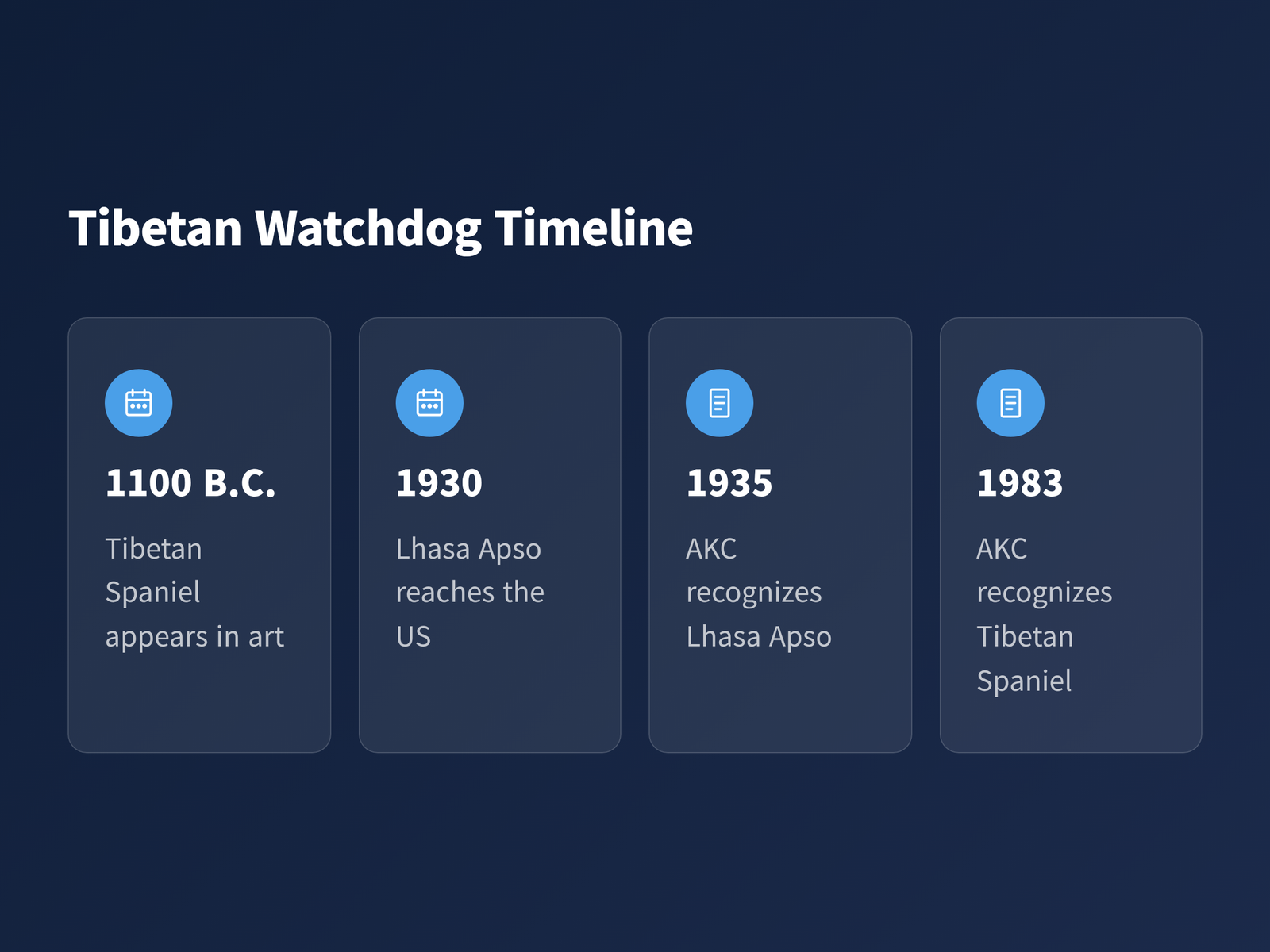
Height is close. The AKC standard puts the Lhasa Apso ideally between 10 and 11 inches at the shoulder, and the Tibetan Spaniel standard gives about 10 inches with an ideal weight of 9 to 15 pounds. The Lhasa Apso standard gives height only, so no Lhasa Apso weight range appears in this comparison. The American Kennel Club recognized the Lhasa Apso in 1935 and the Tibetan Spaniel in 1983, and the Royal Kennel Club places both in the Utility group.
Why is the Tibetan Spaniel not a true spaniel?
The Tibetan Spaniel is not a true spaniel because the breed shares no ancestry with the traditional spaniel breeds. AKC writer Katherine Ripley puts it directly: “Tibetan Spaniels don’t share any common ancestry with the traditional spaniel breeds.” The Tibetan Spaniel was bred for sentinel work, so a buyer expecting spaniel traits from the name is reading the label rather than the breed.
The Tibetan Spaniel’s original job was to sit on monastery walls and bark at approaching intruders. According to the AKC, the Tibetan Spaniel appears in art dating to 1100 B.C., making the breed “at least 3,000 years old.” The Tibetan name “Simkhyi” means housedog, room dog or bedroom dog, the dogs were called “little lions,” and they were never sold, only gifted.
The watchdog instinct is still part of the breed description. The Tibetan Spaniel Club of America says “they will vigorously alert you to any unusual event or arrival, yet, they do not bark unnecessarily.” How that alert instinct shows up in a given home depends on the individual Tibetan Spaniel.
Why is a Lhasa Apso wary of strangers?
A Lhasa Apso is wary of strangers because the breed was developed as an alarm dog for Himalayan palaces and monasteries. The AKC describes the Lhasa Apso as a breed “who served as sentinels at palaces and monasteries isolated high in the Himalayas.” In that system, “The Lhasa would sound the alarm at the approach of an intruder, and the Tibetan Mastiff would meet the threat with some serious muscle.”
The AKC standard describes the Lhasa Apso as “alert and sensitive to their surroundings” and notes the breed may be aloof with strangers. The AKC breed page adds: “Smart, confident, and complex, Lhasas are family comedians but regally aloof with strangers.” The Tibetan name, Apso Seng-kyi, loosely translates as “bearded lion dog.” The Lhasa Apso reached the US through two dogs, Taikoo and Dinkai, gifted by the 13th Dalai Lama to Charles Suydam Cutting in 1930.
Wariness is only half of the Lhasa Apso description. AKC staff write that Lhasas are “wary of strangers until proper introductions are made” and deeply devoted to their families. The Tibetan Spaniel standard also lists aloofness with strangers and counts nervousness as a fault. Neither breed is an instant greeter, so a household expecting a dog to welcome every visitor should weigh that first.
How often does a Lhasa Apso need grooming compared with a Tibetan Spaniel?
A Lhasa Apso needs grooming every day, while a Tibetan Spaniel needs grooming more than once a week, according to Royal Kennel Club breed pages. The Royal Kennel Club lists the Lhasa Apso coat as long and the Tibetan Spaniel coat as medium. That coat-length gap drives most of the difference in weekly coat work.
The Royal Kennel Club labels the Lhasa Apso “No” for shedding, yet the same page sets grooming at every day. A low-shedding label does not mean a low-maintenance coat. The shedding entry is a registry category, not an allergy claim, and it says nothing about how a particular person will react to a Lhasa Apso.
The Tibetan Spaniel runs the other way. The Royal Kennel Club lists shedding as “Yes” for the Tibetan Spaniel, and the Tibetan Spaniel Club of America says “only minimum grooming is needed.” Both statements fit together: the Tibetan Spaniel coat asks for less work than the Lhasa Apso coat, yet the UK registry still expects grooming more than once a week.
Can a Lhasa Apso or a Tibetan Spaniel live in an apartment?
Yes, the Royal Kennel Club lists both the Lhasa Apso and the Tibetan Spaniel as suited to a flat or apartment. The Royal Kennel Club also gives both breeds the same exercise guide of up to one hour per day. With the same home-size listing and exercise figure, the apartment question for these two breeds shifts from space to noise and household routine.
Noise is where the sentinel history matters. The Lhasa Apso was bred to sound the alarm, and the Tibetan Spaniel barked from monastery walls, though the Tibetan Spaniel Club of America notes the Tibetan Spaniel does not bark unnecessarily. In a building with frequent hallway traffic, that alert instinct is worth weighing before choosing either breed.
Household fit matters as much as floor space. The Tibetan Spaniel Club of America says the breed needs “a home that is free from cruelties,” including teasing, hitting or rough handling. For homes with young children, that points to supervised contact between children and a Tibetan Spaniel.
How long do Tibetan Spaniels and Lhasa Apsos typically live?
Both breeds typically live more than 12 years, according to the Royal Kennel Club, and one large UK study put the Tibetan Spaniel median lifespan at 15.2 years. That study, by McMillan and colleagues in Scientific Reports, covered 584,734 dogs across more than 150 breeds and crossbreeds. The overall median was 12.5 years, which places the Tibetan Spaniel among the longest-lived breeds in the dataset.
The study did not name the Lhasa Apso in its text, so this comparison uses only the Royal Kennel Club band of over 12 years for the Lhasa Apso. A median is a population figure, not a promise for any single dog. Lead author Dr Kirsten McMillan said: “We found life expectancy varies between breed, body size, face shape and sex.”
The Royal Kennel Club lists screening schemes for both breeds: a PRA4 DNA test and the BVA/KC/ISDS Eye Scheme for the Lhasa Apso, and a PRA3 DNA test plus the same eye scheme for the Tibetan Spaniel. The Lhasa Apso sits in Breed Watch Category 1, with no breed-specific points of concern flagged for judges. These are screening programs, not conditions a dog has. For questions about an individual dog’s health, consult your veterinarian.
How do the Lhasa Apso and Tibetan Spaniel compare side by side?
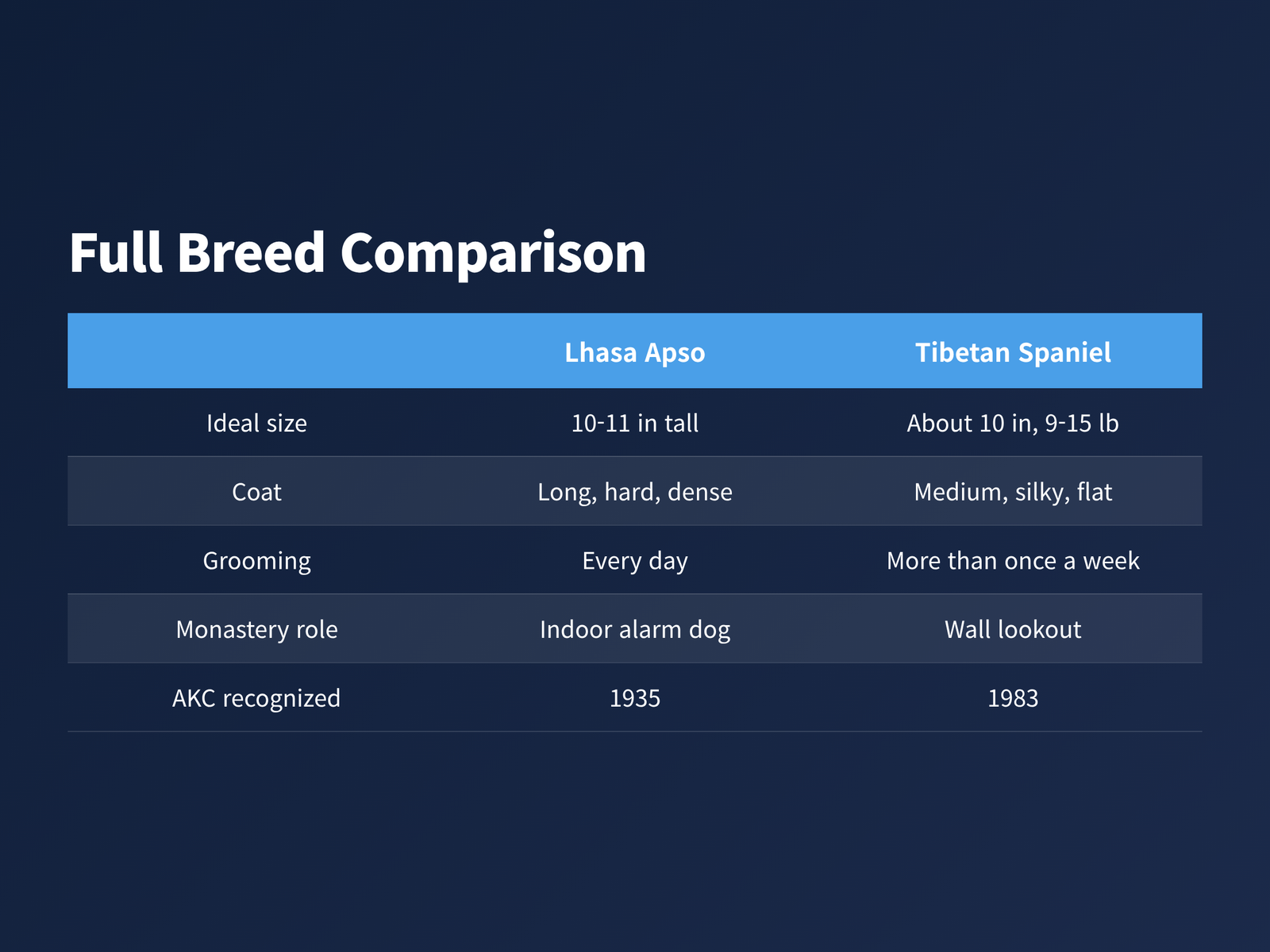
The Lhasa Apso and Tibetan Spaniel are close in height and differ most in coat, grooming and monastery role. The table below pulls the AKC standards, the AKC recognition years and the Royal Kennel Club grooming data into one view.
| Lhasa Apso | Tibetan Spaniel | |
|---|---|---|
| Ideal size | 10-11 in tall | About 10 in, 9-15 lb |
| Coat | Long, hard, dense | Medium, silky, flat |
| Grooming | Every day | More than once a week |
| Monastery role | Indoor alarm dog | Wall lookout |
| AKC recognized | 1935 | 1983 |
Frequently asked questions
Is a Lhasa Apso a good choice for a first-time owner?
That depends on available time and household routine. The Royal Kennel Club sets Lhasa Apso grooming at every day, and the AKC describes the breed as wary of strangers until proper introductions are made.
Does a Tibetan Spaniel shed?
Yes. The Royal Kennel Club lists shedding as “Yes” for the Tibetan Spaniel and sets grooming at more than once a week.
Which breed is older, the Lhasa Apso or the Tibetan Spaniel?
The AKC describes the Tibetan Spaniel as at least 3,000 years old, based on art dating to 1100 B.C., and calls the Lhasa Apso a thousand-year-old breed.
Sources
- American Kennel Club, “Lhasa Apso Dog Breed Information” (accessed 2026-10-06) — https://www.akc.org/dog-breeds/lhasa-apso/
- American Kennel Club, “Tibetan Spaniel Dog Breed Information” (accessed 2026-10-06) — https://www.akc.org/dog-breeds/tibetan-spaniel/
- American Kennel Club, “Official Standard of the Lhasa Apso” (approved 2019-08-13) — https://images.akc.org/pdf/breeds/standards/LhasaApso.pdf
- American Kennel Club, “Official Standard of the Tibetan Spaniel” (approved 2010-05-11) — https://images.akc.org/pdf/breeds/standards/TibetanSpaniel.pdf
- American Kennel Club, “Lhasa Apso History: Tiny Tibetan Watchdogs” (2023-02-23) — https://www.akc.org/expert-advice/dog-breeds/lhasa-apso-history-tibetan-watchdogs/
- American Kennel Club, Katherine Ripley, “7 Tibetan Spaniel Facts” (2023-06-05) — https://www.akc.org/expert-advice/lifestyle/7-facts-tibetan-spaniel
- American Kennel Club, “Breeds by Year Recognized” (accessed 2026-10-06) — https://www.akc.org/press-center/articles-resources/facts-and-stats/breeds-year-recognized/
- Royal Kennel Club, “Lhasa Apso” breed page (accessed 2026-10-06) — https://www.royalkennelclub.com/search/breeds-a-to-z/breeds/utility/lhasa-apso
- Royal Kennel Club, “Tibetan Spaniel” breed page (accessed 2026-10-06) — https://www.royalkennelclub.com/search/breeds-a-to-z/breeds/utility/tibetan-spaniel
- McMillan KM et al., “Longevity of companion dog breeds: those at risk from early death”, Scientific Reports (2024-02-01), DOI 10.1038/s41598-023-50458-w — https://www.nature.com/articles/s41598-023-50458-w
- Liverpool John Moores University, “Which dogs live longest?” (2024-02-01) — https://www.ljmu.ac.uk/about-us/news/articles/2024/2/1/dog-longevity
- Tibetan Spaniel Club of America, breed flier (hosted by AKC) — http://cdn.akc.org/TibetanSpaniel-club-flier.pdf