
Standard basket muzzles for flat-faced small dogs often fail because off-the-shelf sizes are built around a longer snout, not because the basket design is wrong. Organizations such as Blue Cross, Dogs Trust, the American Kennel Club (AKC) and AAHA all favor basket muzzles. The problem is narrower: a very short nose leaves a standard basket with nowhere to sit. This guide explains why the mismatch happens, why a fabric sleeve is not the answer, and how to check whether a muzzle still lets a flat-faced dog pant, drink and see.

Why don’t standard basket muzzles fit flat-faced small dogs?
Standard basket muzzles don’t fit flat-faced small dogs because the nose-piece has to rest on a snout that is barely there. Blue Cross describes a basket muzzle as an open basket weave “allowing your dog to breathe freely, drink water and accept treats,” and says the nose-piece should not rub or get in the way of the dog’s eyes. On a short-nosed dog, a standard nose-piece has little room before the eyes, so a basket sized for an average snout can ride up toward the face.
The Pekingese shows the problem in its breed standard. The AKC standard describes the Pekingese muzzle as “very flat,” with the stop “obscured from view by the over-nose wrinkle,” and sets a weight limit of 14 pounds. None of this makes the basket design a bad choice for a flat-faced small dog. It means the standard size, not the basket style, is what usually fails.
Why is a fabric sleeve muzzle the wrong fix for a short-nosed dog?
A fabric sleeve muzzle is the wrong fix for a short-nosed dog because it closes the mouth and stops panting. The AKC states that soft muzzles “prevent your dog from panting, which is the only way he has of dispersing heat,” and advises against them in hot weather. Blue Cross makes the same point: “Muzzles that completely close your dog’s mouth do not allow them to pant, preventing them from losing heat.”
AAHA Trends lays out the dilemma clearly: “Fabric muzzles are not recommended. When fitted to allow panting, they can be unsafe, as a dog may still bite. When fabric muzzles are fitted to prevent biting, dogs can no longer regulate their temperature or vomit.” A fabric sleeve muzzle therefore fails a flat-faced dog either way. Loose enough to pant, the fabric sleeve does not do its job. Tight enough to work, the fabric sleeve blocks cooling.
What must a muzzle still let a flat-faced dog do?
A muzzle must still let a flat-faced dog pant fully, drink, take treats and see clearly. Dogs Trust advises owners to “choose a muzzle that your dog can eat, drink and pant through,” and adds that a muzzle “shouldn’t obscure their vision, dig into their face, or restrict their mouth movement.” Blue Cross asks for a nose-piece that sits clear of the eyes so the dog is “able to pant fully.”
Panting matters even more for a flat-faced small dog. The RSPCA explains that “dogs typically cool down by panting, but dogs with brachycephaly are unable to pant effectively, due to the shortened nose and malformed soft tissue in the nose and throat.” The RSPCA also states that brachycephalic dogs are up to 16 times more likely to suffer heat-related illness. A peer-reviewed study by Hall, Carter and O’Neill in the journal Animals also found higher odds of heat-related illness in brachycephalic dogs. Any muzzle that limits panting removes a margin a flat-faced dog may not have.
Breathing and heat tolerance vary from one dog to the next, and a muzzle choice should never be used to judge how well a dog breathes. If your dog struggles to breathe, overheats easily, or seems distressed while muzzled, consult your veterinarian before continuing muzzle use.
How do you check muzzle fit on a dog with almost no snout?
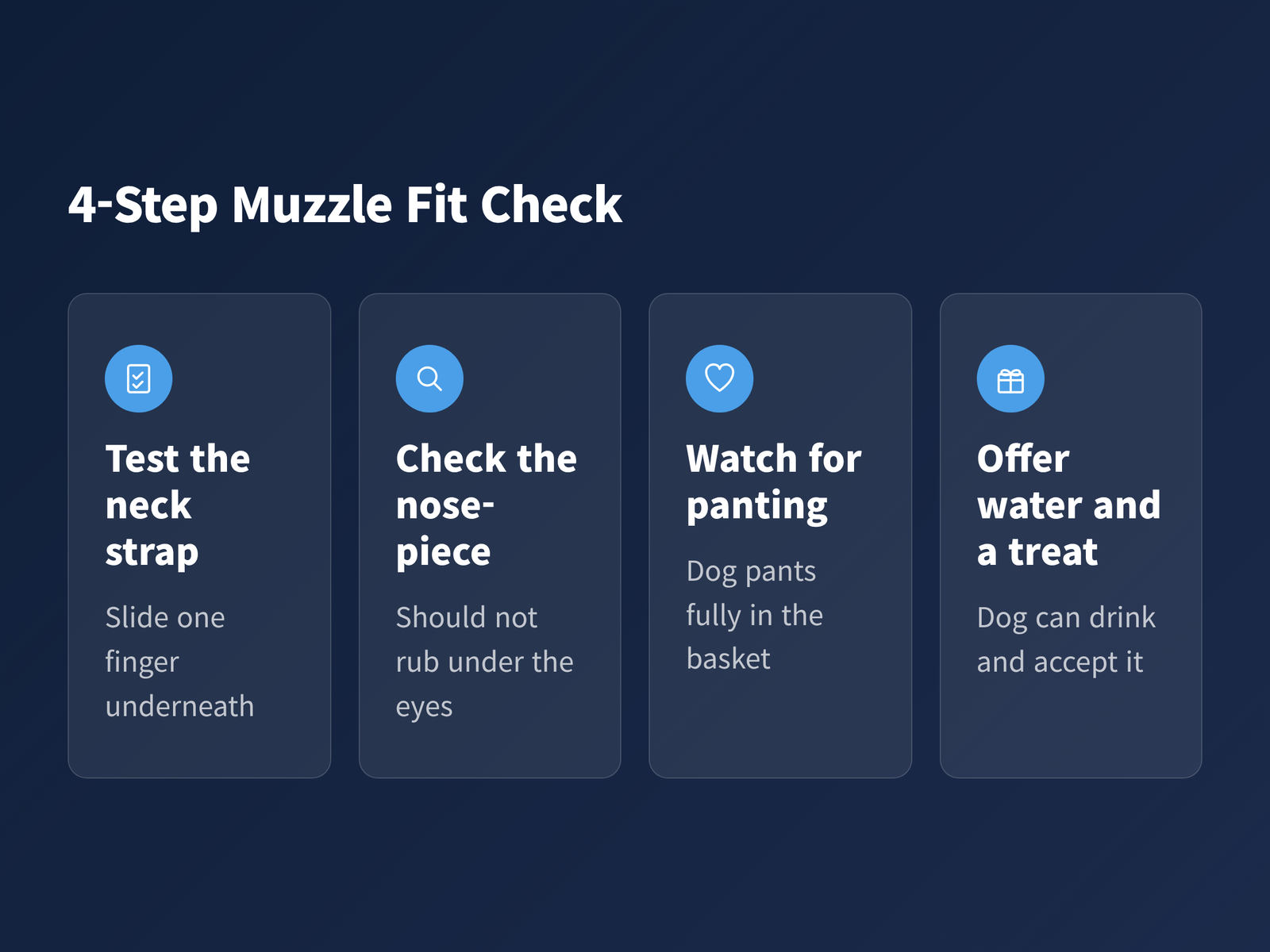
You check muzzle fit on a dog with almost no snout by testing the neck strap, the nose-piece, panting and drinking in that order. The AKC and Blue Cross both use a finger test for the strap, and Blue Cross and Dogs Trust both focus on the eyes and face. A short fit check covers the points that most often go wrong on a flat face:
- Slide a finger under the neck strap. The AKC says one finger; Blue Cross says the strap should “not allow more than one small finger.”
- Look at the nose-piece. It should not rub under the eyes or block vision.
- Watch the dog open its mouth. The dog should be able to pant fully inside the basket.
- Offer water and a treat. The dog should be able to drink and accept the treat.
If the nose-piece rubs, Dogs Trust suggests that “you can try wrapping a non-irritant fabric around the inside of the nose-piece.” If the four checks still fail, the size is likely wrong for that face, and padding will not fix a muzzle that sits on the eyes.
When does a flat-faced small dog need a custom-made muzzle?
A flat-faced small dog needs a custom-made muzzle when standard sizes keep failing the fit check. The AKC notes that flat-faced dogs can wear a muzzle, “although a custom-fitted option may be the best solution.” Blue Cross adds that “some companies will make a custom size using your dog’s measurements.” For a short-nosed dog, a custom-fitted basket muzzle keeps the open design that agencies recommend while matching the actual face.
A custom-fitted muzzle still needs training. AAHA encourages owners to “train patients and pets to accept a basket muzzle in case it is needed,” and certified animal behaviourist Roz Pooley, quoted by AAHA Trends, advises that “it’s important to keep things short, so the muzzle is taken off before it’s a problem for the dog.” The AKC also states that muzzles are “only meant to be used for short periods of time, and only when your dog is supervised.” Even a well-fitted muzzle is a short-term, supervised tool, not something for a flat-faced dog to wear all day.
Basket vs mesh vs fabric vs custom – what changes for a short nose?
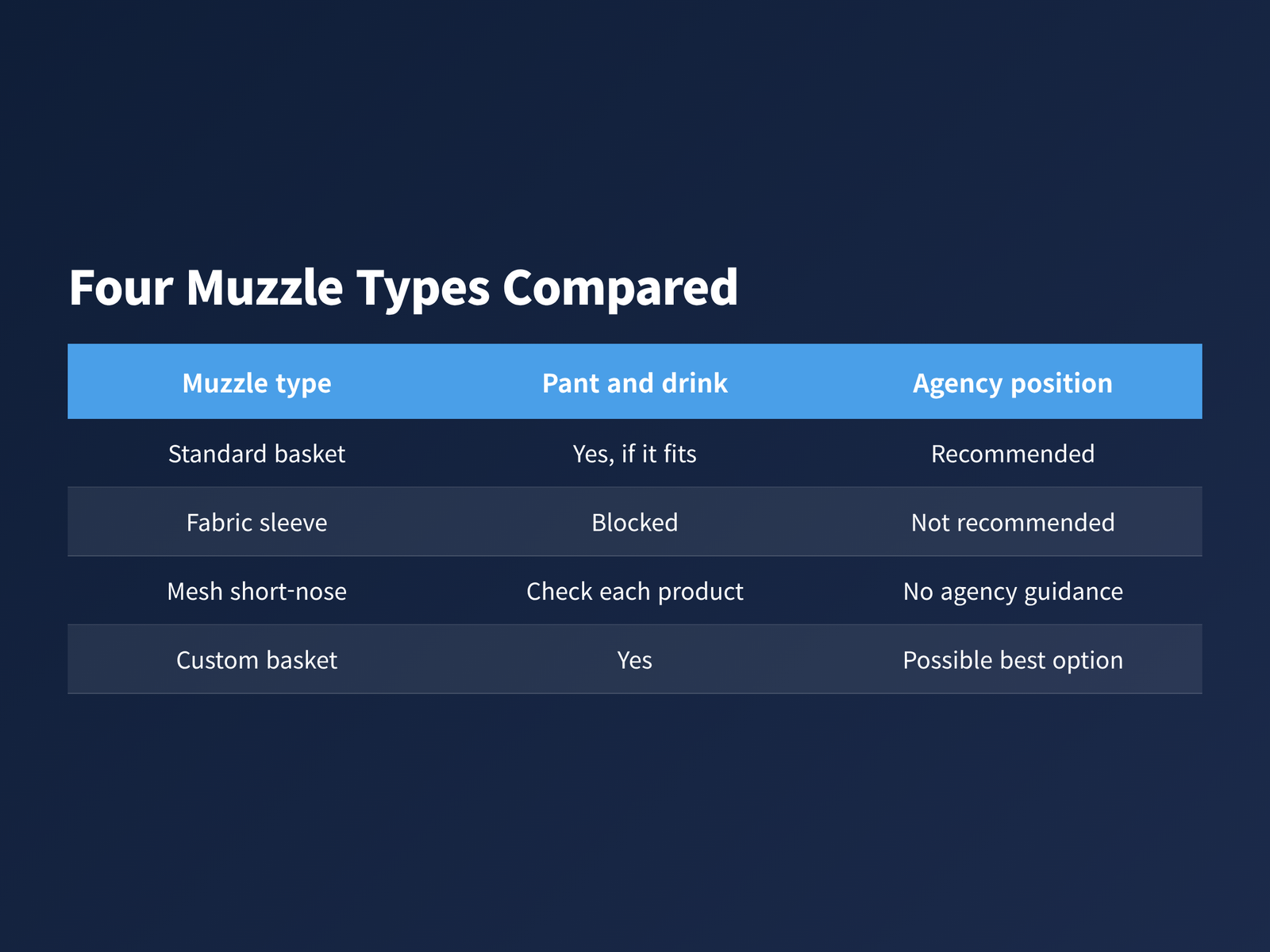
What changes between muzzle types is whether a short-nosed dog can still pant and drink, and whether any agency backs the design. The table below sums up the four types an owner of a flat-faced small dog is likely to compare. Mesh short-nose muzzles are sold for flat faces, but no agency guidance covers them, so each mesh product needs the same fit check described above.
| Muzzle type | Pant and drink | Agency position |
|---|---|---|
| Standard basket | Yes, if it fits | Recommended |
| Fabric sleeve | Blocked | Not recommended |
| Mesh short-nose | Check each product | No agency guidance |
| Custom basket | Yes | Possible best option |
Frequently asked questions
Are basket muzzles bad for flat-faced dogs?
Basket muzzles are not bad for flat-faced dogs. Blue Cross, Dogs Trust, the AKC and AAHA all favor the open basket design because it allows breathing, drinking and treats. The usual problem is that a standard-size basket muzzle does not match a very short snout, so the nose-piece may ride toward the eyes.
Can a flat-faced small dog wear a fabric muzzle in warm weather?|
A fabric muzzle is a poor choice for a flat-faced small dog in warm weather. The AKC advises against soft muzzles in hot weather because they stop panting, and the RSPCA notes that brachycephalic dogs already pant less effectively. Consult your veterinarian if your dog needs any restraint during hot conditions.
How long can a flat-faced dog wear a muzzle?
The AKC states that muzzles are meant for short periods and only under supervision. Roz Pooley, quoted by AAHA Trends, advises keeping sessions short so the muzzle comes off before it becomes a problem for the dog. A flat-faced dog should never be left muzzled and unattended.
Sources
- American Kennel Club, “Dog Muzzles: When, Why, and How to Correctly Use Them” (Stephanie Gibeault, updated 2026-03-12) — https://www.akc.org/expert-advice/training/dog-muzzles-when-why-how-to-use/
- Blue Cross, “Dogs and muzzle training” (reviewed 2023-12-07) — https://www.bluecross.org.uk/advice/dog/behaviour-and-training/dogs-and-muzzle-training
- RSPCA, “Caring for Brachycephalic Pets” — https://www.rspca.org.uk/adviceandwelfare/pets/genetics/caring
- AAHA, “Humane Restraint of Animals” position statement (last revised June 2017) — https://www.aaha.org/humane-restraint-of-animals/
- AAHA Trends, “Are muzzles misunderstood?” (Colette Kase, 2025-11-25) — https://www.aaha.org/trends-magazine/publications/muzzles-are-misunderstood/
- American Kennel Club, “Official Standard of the Pekingese” (approved 2004-01-13) — https://images.akc.org/pdf/breeds/standards/Pekingese.pdf
- Hall E.J., Carter A.J., O’Neill D.G., “Dogs Don’t Die Just in Hot Cars,” Animals 10(8):1324 (2020) — https://rvc-repository.worktribe.com/output/1376433
- Dogs Trust, “Teach your dog to wear a muzzle” — https://www.dogstrust.org.uk/dog-advice/training/outdoors/muzzle-training