The Coton de Tulear and the Bolognese look alike at a glance, but the breed standards separate them on four checkable points: weight, coat texture, color rules and AKC show status. By FCI standard, the Bolognese is as tall as or taller than the Coton de Tulear, yet clearly lighter. The Bolognese must also be pure white, while the Coton de Tulear may carry light shading on the ears.
The Coton de Tulear is a small, long-haired companion dog from Madagascar with a white, cotton-textured coat, and the Bolognese is a small Italian Bichon-type companion dog with a long, pure-white coat that lies in flocks.

What is the difference between a Coton de Tulear and a Bolognese?
The main difference is that the Coton de Tulear is a heavier dog with a cotton-soft coat, while the Bolognese is a lighter dog with an off-standing, pure-white coat that falls in flocks. Both breeds sit in FCI Group 9, Companion and Toy Dogs, among the Bichons and related breeds. The FCI gives Madagascar as the Coton de Tulear’s origin, with France as the country of patronage, while the Bolognese comes from Italy. FCI Standard No. 283 describes the Coton de Tulear as a “small, long-haired, companion dog with a white cotton textured coat.”
Comparing the Coton de Tulear with the Maltese for the American Kennel Club, Coton breeder and judge Eileen Boyer Narieka said: “A Coton has a unique, soft cotton-like coat, is larger in size, and has a definite rectangular silhouette.” Coat feel is also the first check when a Coton de Tulear stands next to a Bolognese.
Which is bigger, the Coton de Tulear or the Bolognese?
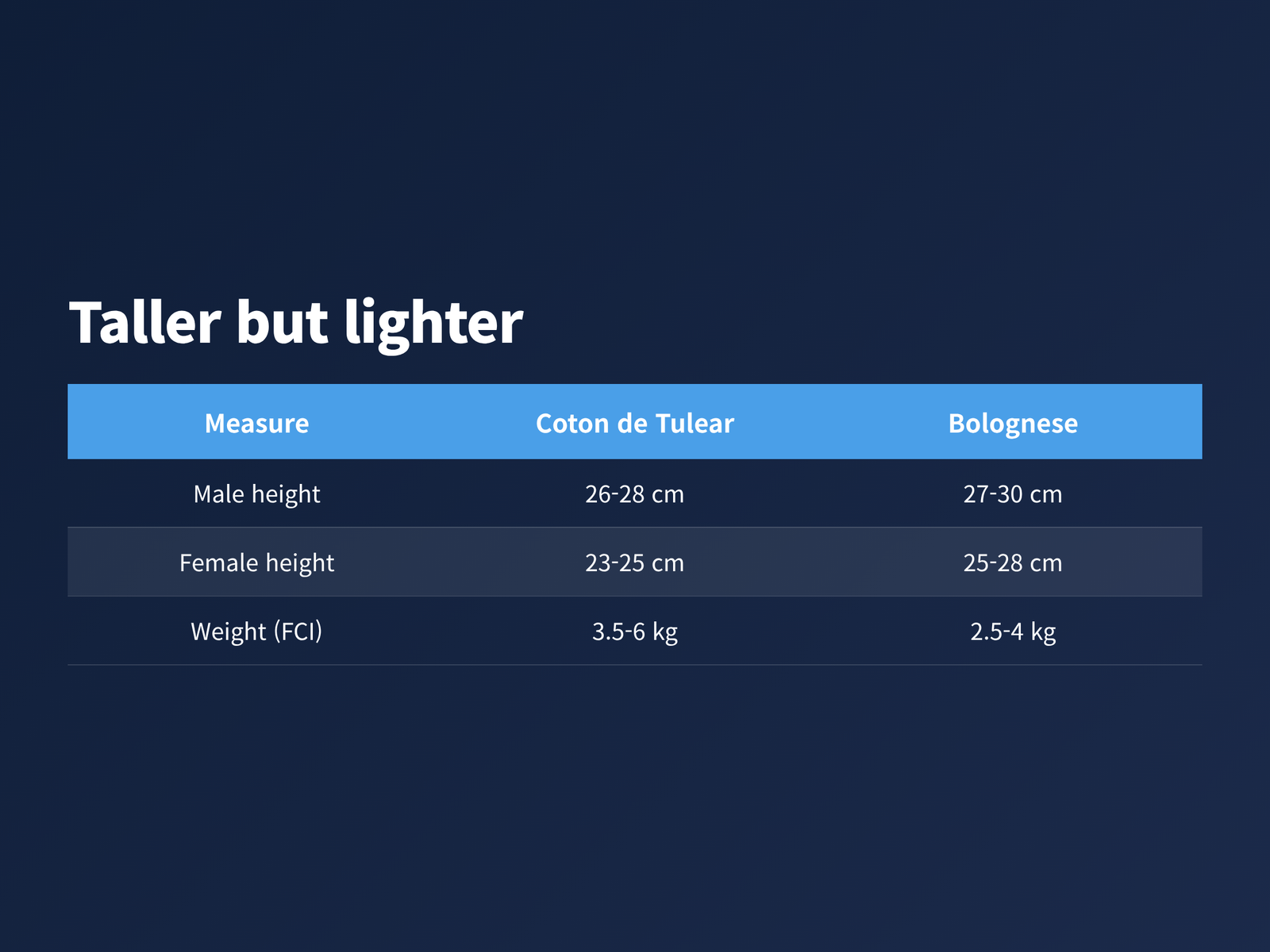
By FCI standard, the Bolognese is as tall as or slightly taller than the Coton de Tulear, but the Coton de Tulear is the heavier breed. FCI Standard No. 283 sets Coton de Tulear males at 26-28 cm and females at 23-25 cm at the withers, with a tolerance of +2 cm and -1 cm. Coton de Tulear weight runs up to 4-6 kg for males and 3.5-5 kg for females. FCI Standard No. 196 sets Bolognese males at 27-30 cm, females at 25-28 cm, and weight at 2.5-4 kg.
US registries use inches and pounds with different ranges. The AKC Coton de Tulear standard gives an ideal height of 9-10 in for bitches and 10-11 in for dogs, with an ideal weight of 8-13 lb for bitches and 9-15 lb for dogs. The UKC Bolognese standard gives 10.5-12 in for males and 9.5-11 in for females, with an average weight of 5.5-9 lb. Compare the two breeds within one registry rather than mixing FCI and AKC numbers.
How does a Coton coat feel different from a Bolognese coat?
A Coton de Tulear coat feels cotton-soft and supple, while a Bolognese coat stands slightly away from the body and falls in flocks instead of fringes. FCI Standard No. 283 calls the Coton de Tulear coat “very soft and supple, with the texture of cotton, never hard or rough,” and allows the coat to be very slightly wavy. The same standard disqualifies atypical, tightly curled, woolly or silky hair.
The Bolognese coat is described differently. FCI Standard No. 196 asks for a coat that is long all over the body, shorter on the muzzle, “rather off-standing,” and one that “never shows fringes.” The UKC Bolognese standard says the coat “lies in flocks, not fringe.” Unlike the Coton de Tulear standard, the FCI Bolognese standard lists no texture-based disqualification.
Does “non-shedding” mean a Coton or Bolognese is low-maintenance?
No, “non-shedding” does not mean low grooming for either breed: the Royal Kennel Club lists both as “Sheds: No” but grooming “Every day.” The Royal Kennel Club gives the Coton de Tulear and the Bolognese the same profile: exercise of up to 30 minutes per day, daily grooming, no shedding, and a lifespan of over 12 years.
Show rules also limit how much of the coat can be cut. The AKC Coton de Tulear standard allows only the hair on the very bottom of the feet and between the pads to be trimmed, and treats other trimming or sculpting that alters the natural look as a severe fault. The UKC Bolognese standard says the coat is shown at natural length, “with no trimming except for neatening.” Pet trims for dogs that will not be shown are a separate owner choice.
Can a Bolognese be shown at AKC dog shows like a Coton de Tulear?
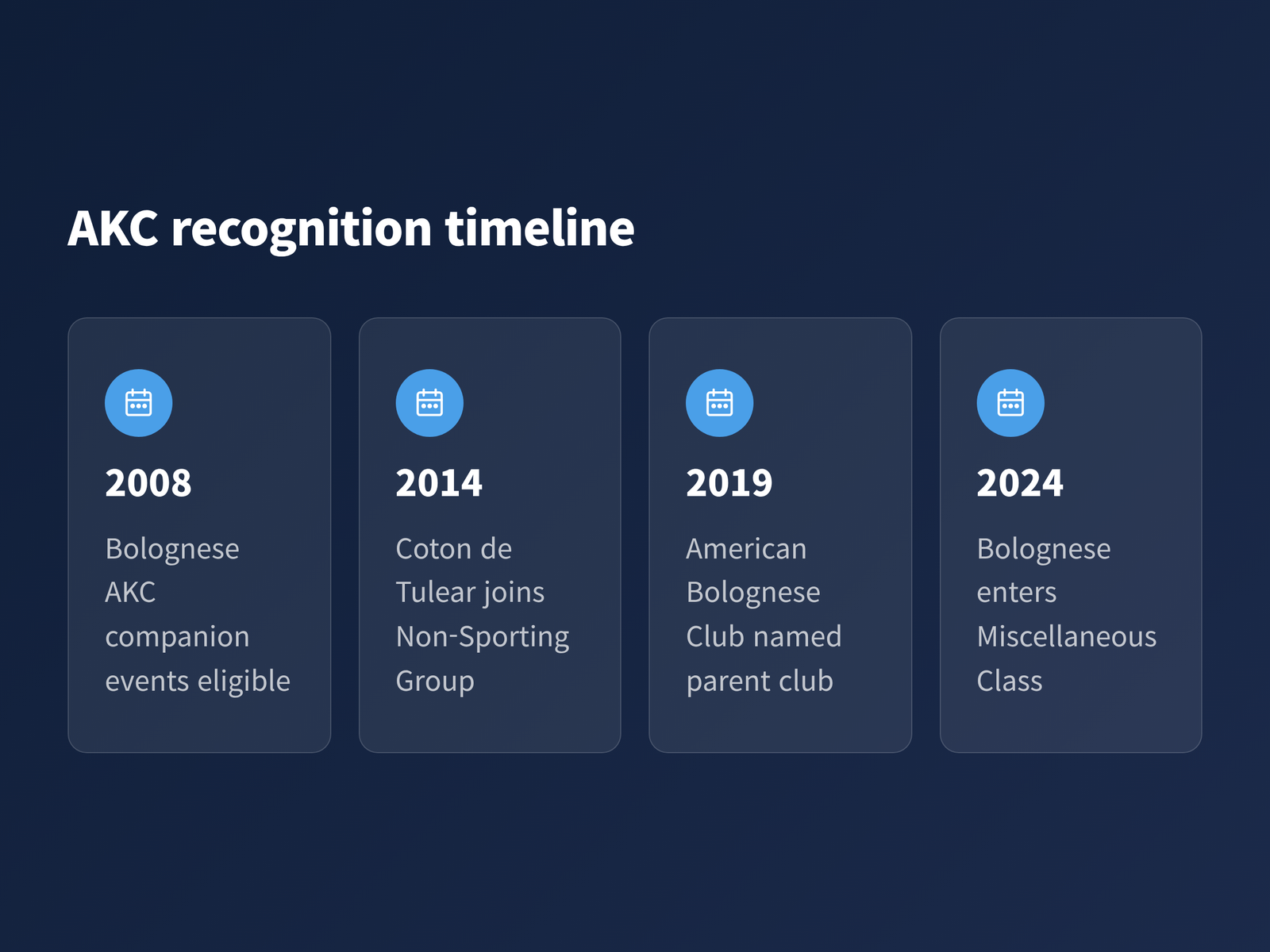
A Bolognese can compete in the AKC Miscellaneous Class, approved effective June 26, 2024, but that is not the full recognition the Coton de Tulear holds. The AKC board approved the Coton de Tulear in September 2013 to compete in the Non-Sporting Group from July 2014, bringing the AKC breed count to 180. Announcing the change, AKC spokesperson Gina DiNardo said, “The AKC is excited to recognize these friendly, outgoing breeds.”
The Bolognese path has been slower. The Bolognese became eligible for AKC companion events from 2008, and the American Bolognese Club was named the AKC parent club in 2019. Outside the United States, the FCI accepted the Bolognese definitively in 1956, and the Royal Kennel Club lists the Bolognese in its Toy group. Check the AKC Bolognese breed page for the current status before planning a show entry.
What color markings disqualify a Coton de Tulear or a Bolognese?
Black markings disqualify a Coton de Tulear, while any color other than white, including patches and flecks, disqualifies a Bolognese. FCI Standard No. 283 sets a white ground color for the Coton de Tulear, allows slight light grey or red-roan shading on the ears, and tolerates it elsewhere if the shading does not change the white look. The FCI disqualifies a heavily marked Coton de Tulear or any marking of a definite black, and the AKC disqualifies black on the body at any age.
The Bolognese rule is stricter. FCI Standard No. 196 asks for “pure white,” noting that very slight shades of ivory are not disqualifying, and disqualifies “any other colour than white” as well as “patches and flecks.” The UKC Bolognese standard matches this, disqualifying any color other than white or any patching or flecking in the coat. A Bolognese puppy with colored patches does not meet the breed standard.
Is a Coton de Tulear or a Bolognese really hypoallergenic?
Neither breed is proven hypoallergenic, and the American Kennel Club states that “there are no 100% hypoallergenic dogs, dog breeds, or mixed-breeds.” The AKC does list the Coton de Tulear and the Bolognese among dogs with a non-shedding coat that produces less dander. A 2012 study in the Journal of Allergy and Clinical Immunology concluded: “There is no evidence for the classification of certain dog breeds as being ‘hypoallergenic.'” That study tested other breeds, such as the Labradoodle, Poodle and Labrador, not the Coton de Tulear or the Bolognese.
If anyone in your home has a dog allergy, talk to your doctor before choosing either breed, and consult your veterinarian about coat care once a dog arrives. A non-shedding label describes the coat, not how a specific person will react to a specific Coton de Tulear or Bolognese.
How do the Coton de Tulear and Bolognese compare side by side?
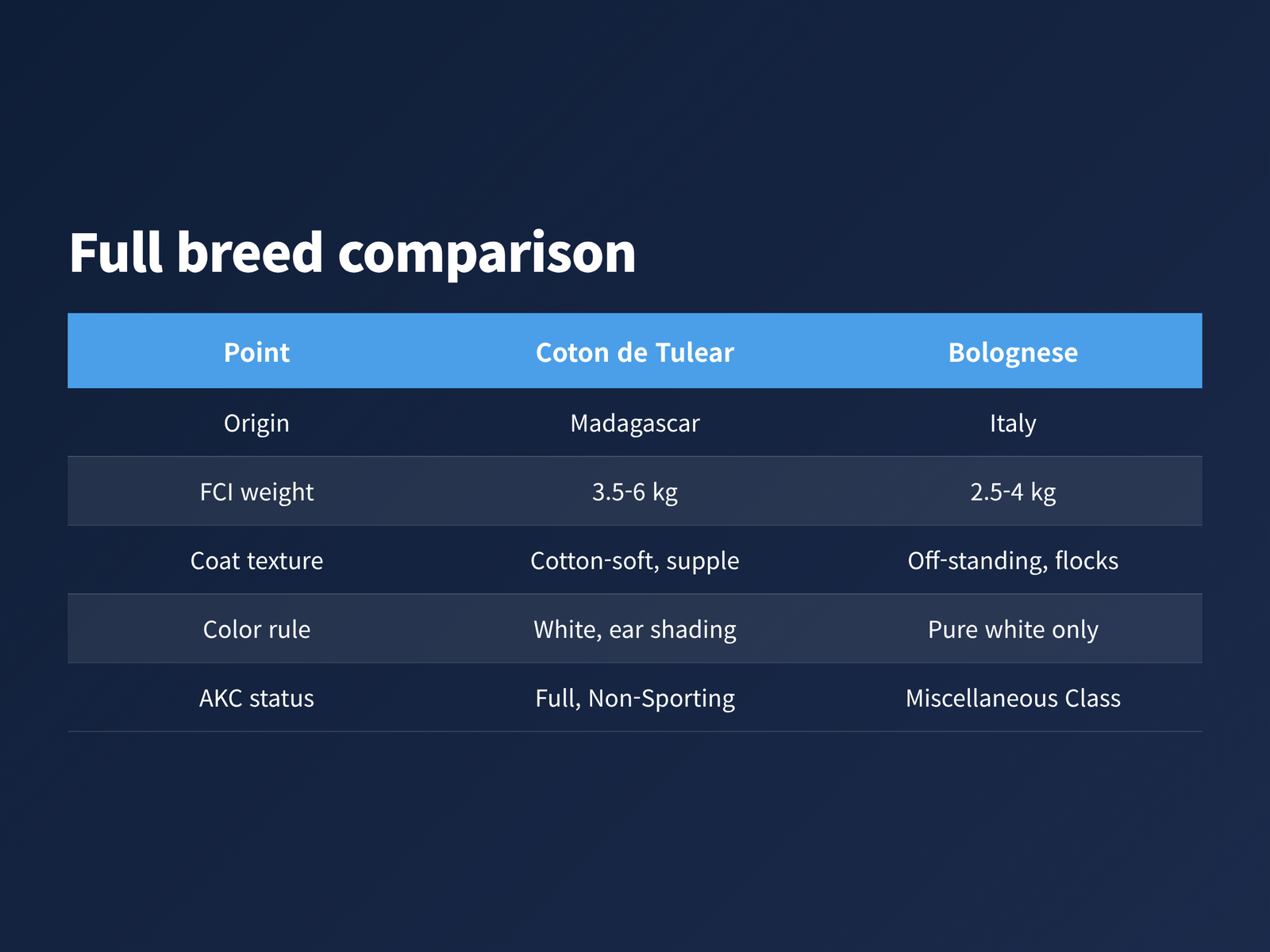
The Coton de Tulear and the Bolognese differ most on weight, coat texture, color rules and AKC status, as the table below shows. Origin is the clearest background difference: Madagascar for the Coton de Tulear and Italy for the Bolognese. Weight figures use the FCI standards.
| Point | Coton de Tulear | Bolognese |
|---|---|---|
| Origin | Madagascar | Italy |
| FCI weight | 3.5-6 kg | 2.5-4 kg |
| Coat texture | Cotton-soft, supple | Off-standing, in flocks |
| Color rule | White, light ear shading | Pure white only |
| AKC status | Full, Non-Sporting | Miscellaneous Class |
Frequently asked questions
Is the Bolognese calmer than the Coton de Tulear?
The breed standards describe different temperaments. FCI Standard No. 196 calls the Bolognese “Very serene, generally not very active,” while FCI Standard No. 283 describes the Coton de Tulear as “Of a happy temperament, stable, very sociable with humans and with other dogs.” Bolognese breeder Ikuko Hisaka told the AKC the breed is “known to be happy, playful, friendly, intelligent, and loyal.” Individual dogs vary, so a standard describes the breed type, not every dog.
Can a Coton de Tulear have colored ears?
Yes. FCI Standard No. 283 allows slight light grey or red-roan shading on the ears of a Coton de Tulear, as long as the ground color stays white. Black markings on the body, by contrast, are disqualifying under the AKC Coton de Tulear standard.
Sources
- FCI, Standard No. 283 Coton de Tulear (valid 1999-11-25, published 2000-02-04) – https://www.fci.be/Nomenclature/Standards/283g09-en.pdf
- FCI, Coton de Tulear (No. 283) nomenclature page – https://www.fci.be/en/nomenclature/COTON-DE-TULEAR-283.html
- FCI, Standard No. 196 Bolognese (valid 2015-11-13, English 2015-12-17) – https://www.fci.be/Nomenclature/Standards/196g09-en.pdf
- FCI, Bolognese (No. 196) nomenclature page – https://www.fci.be/en/nomenclature/BOLOGNESE-196.html
- American Kennel Club, Official Standard of the Coton de Tulear (approved 2013-09-11, effective 2013-10-01) – https://images.akc.org/pdf/breeds/standards/CotondeTulear.pdf
- American Kennel Club, Highlights from the September 2013 AKC Delegate and Board Meetings – https://www.akc.org/press-releases/highlights-from-the-september-2013-akc-delegate-and-board-meetings/
- American Kennel Club, AKC Announces Two New Breeds – https://www.akc.org/expert-advice/news/akc-announces-two-new-breeds/
- American Kennel Club, FSS News Updates (Bolognese entries 2007-05-07, 2008-01-08, 2019-08-12, 2023-08-07) – https://www.akc.org/breeder-programs/foundation-stock-service-program/fss-news-updates/
- American Kennel Club, Maltese vs. Coton de Tulear: Similarities and Differences (updated 2026-08-18) – https://www.akc.org/expert-advice/dog-breeds/maltese-versus-coton-de-tulear-how-to-tell-the-difference/
- American Kennel Club, Breeder Spotlight: Ikuko Hisaka (2025-06-24) – https://www.akc.org/expert-advice/news/breeder-spotlight-ikuko-hisaka/
- American Kennel Club, Hypoallergenic Dogs – https://www.akc.org/dog-breeds/hypoallergenic-dogs/
- American Kennel Club, Bolognese breed page – https://www.akc.org/dog-breeds/bolognese/
- The Royal Kennel Club, Coton de Tulear breed page – https://www.royalkennelclub.com/search/breeds-a-to-z/breeds/toy/coton-de-tulear
- The Royal Kennel Club, Bolognese breed page – https://www.royalkennelclub.com/search/breeds-a-to-z/breeds/toy/bolognese
- United Kennel Club, Bolognese Official Breed Standard (revised 2013-07-01) – https://www.UKCDogs.com/docs/breeds/bolognese.pdf
- Peer-reviewed study, “Can f 1 levels in hair and homes of different dog breeds: lack of evidence to describe any dog breed as hypoallergenic,” J Allergy Clin Immunol 2012;130(4):904-9.e7 – https://pubmed.ncbi.nlm.nih.gov/22728082/