Most tear stain removers underdeliver because they treat the stain, not the tears that keep making it. Wipes lift fresh residue but not set-in color. Trims remove stained hair that grows back. Antibiotic powders were flagged by the U.S. Food and Drug Administration as unapproved drug use. This guide explains why tear stain removers don’t work as the packaging suggests, what the FDA objected to, and when staining belongs with a veterinarian.
Why don’t tear stain removers work on small white dogs?
Tear stain removers fail on small white dogs mainly because the stain is a pigment that tears keep depositing every day. The American Kennel Club defines tear staining as reddish-brown discoloration of the fur below the eyes caused by porphyrins, iron-containing compounds excreted in tears and saliva. AKC Chief Veterinary Officer Dr. Jerry Klein puts it plainly: “Iron is the nasty ingredient that especially stains white fur.” A light coat simply shows porphyrin color that a darker coat hides, so a product that only cleans the surface is fighting a stain that refills itself.
A wipe, a trim or a chew can each address one part of that cycle, yet none of them stops the tears themselves. Kansas State University veterinary ophthalmologist Dr. Jessica Meekins notes that “tear staining by itself does not cause a health problem.” For most small dogs, tear staining is a coat and cosmetic issue, which limits what any product can honestly promise.
Why did the FDA warn tear stain powders that contained tylosin?
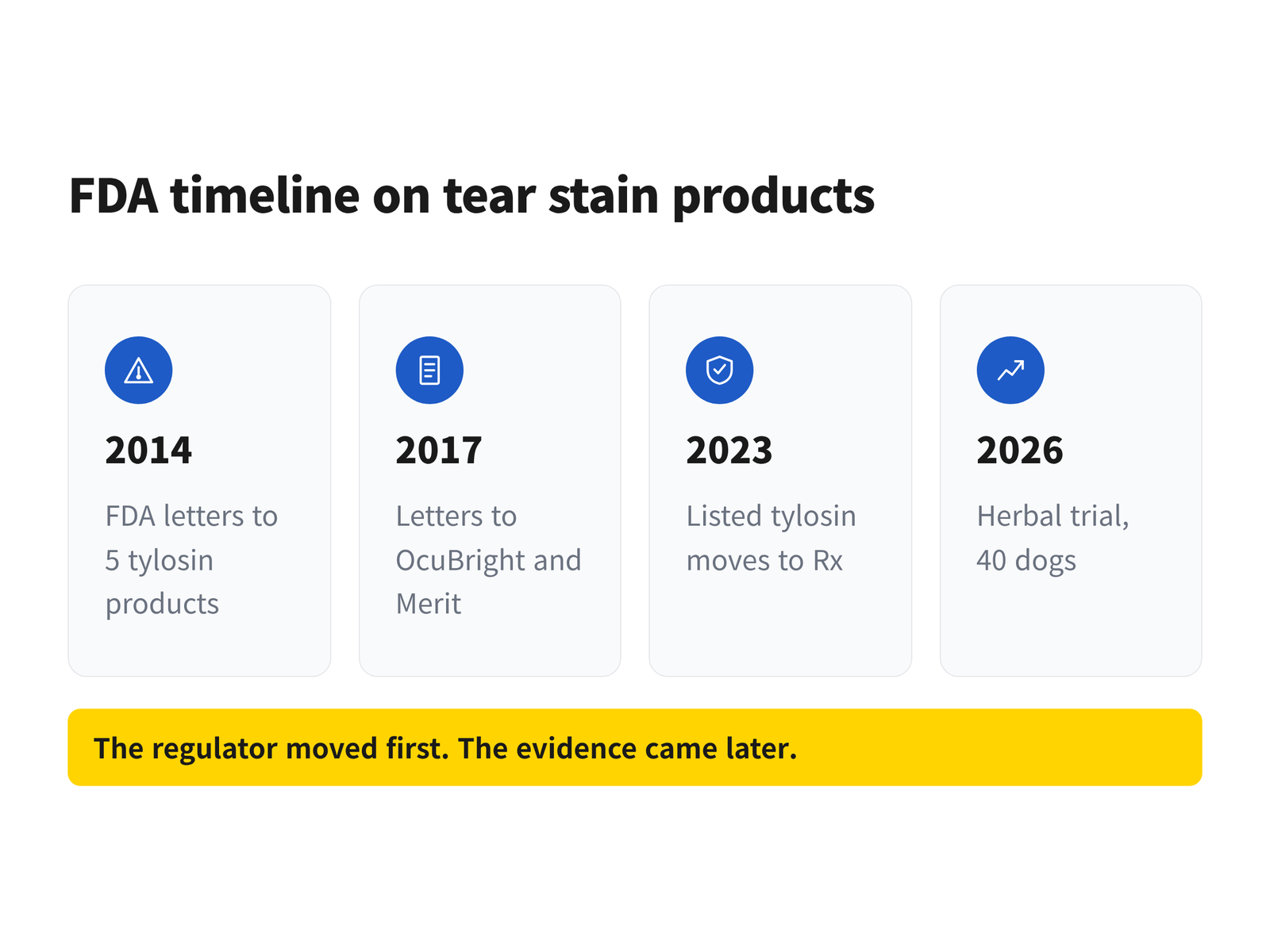
The FDA warned tear stain powders containing tylosin because the agency treated those products as unapproved new animal drugs. In 2014 the FDA sent warning letters to the makers of five tylosin tear stain products: Angels’ Eyes, Angels’ Glow, Pets’ Spark, Glow Groom and Health Glow, according to a Kansas State University release and dvm360. Trade press reports at the time said tylosin was not approved for use in dogs or cats for tear staining.
In May 2017 the FDA followed with two more letters. The letter to OcuBright Tear Stain Remover, dated May 16, 2017, covered four SKUs containing tylosin tartrate. The letter to Merit Pet Products, maker of Tear-Stain Away, dated May 12, 2017, stated: “your use of Tylosin tartrate in your product is not a use covered by its approved application.” Under the Federal Food, Drug, and Cosmetic Act, a product intended to treat or prevent disease, or to affect the structure or function of the body, is a drug.
Because these tear stain products had no approved application for that use, the FDA letter to OcuBright called the product “unsafe within the meaning of section 512(a)” and adulterated under section 501(a)(5). Dr. Jessica Meekins summarized the clinical view: “Tear stains are not significant enough to risk giving antibiotics to your pet.” Her reasoning was that antibiotics “should be reserved for use in bacterial infections, and tear staining is not related to an infection.”
Did the 2023 FDA rule change make tylosin prescription-only?
Yes, for the listed products: FDA Guidance for Industry #263 moved medically important antimicrobials still sold over the counter to prescription labeling, with a target date of June 11, 2023. The FDA Center for Veterinary Medicine publishes a list of approved applications affected by GFI #263, and that list includes eight tylosin applications. The guidance allowed existing over-the-counter inventory to sell through rather than be pulled overnight.
For a small dog owner, the practical meaning is narrow. GFI #263 does not say that any tear stain powder on a shelf today contains tylosin. GFI #263 does mean that the antibiotic at the center of the earlier warning letters now sits behind a veterinarian, so any antibiotic decision belongs there, not in a checkout cart.
Which tear stain product does what: wipes, trims, powders or chews?
Each tear stain product type handles one piece of the problem, and none handles all of it. The comparison below draws on the AKC, Kansas State University, FDA warning letters and a 2026 study in the journal Animals, with short cells for quick scanning.
| Product type | What it does | Main limit |
|---|---|---|
| Eye-area wipes | Removes fresh residue | Not fully effective on set-in stain |
| Hair trimming | Removes stained, damp hair | Stain returns as hair regrows |
| Antibiotic powders | FDA: unapproved drug use | Warning letters 2014 and 2017 |
| Herbal chews (study) | Lower stain scores in 1 trial | 40 dogs, 28 days, 2 breeds |
| Vet exam | Checks ducts and eyes | Needed if staining is sudden |
Dog-specific eye wipes are the daily maintenance tool. Dr. Jessica Meekins said wipes “aren’t fully effective” on established staining. On a pale small dog, that means the newest layer comes off while the older color stays. Trimming the hair around the eyes, or having a groomer do it, removes stained and damp hair that holds crust, as the AKC notes. Trimming is temporary, though, because the new coat grows into the same wet zone.
Tear stain chews and supplements have the thinnest evidence of the group. This article names no current product as safe or unsafe, because what a specific product contains today has not been verified here. Reading the label, and asking a veterinarian about any ingredient that sounds like a drug, is the sensible filter.
What does the newest research on tear stain supplements actually show?
The newest research shows a measurable reduction in tear staining from herbal extracts in one small, short trial, and nothing more than that yet. Wang and colleagues published the study in Animals in 2026. The researchers fed 40 dogs, 28 Bichon Frise and 12 Poodles, in four groups of ten for 28 days.
Compared with the control group, the herbal tear stain groups showed tear staining scores 38% to 49% lower at day 14 and day 28, and stain length 33% to 57% shorter at day 28. Schirmer tear test values and tear pH did not differ between groups. In other words, the dogs did not produce fewer tears or chemically different tears in a way the study could detect, even as the visible stain faded.
The authors call the extracts “promising dietary strategies,” while describing the iron and porphyrin mechanism as speculative. The trial was short, covered only two breeds, and tested herbal extracts rather than commercial tear stain products. One trial is a starting point, not proof that a chew on a store shelf will do the same.
What non-drug steps does the AKC suggest for daily tear stain care?
The AKC suggests three owner-level steps: trim the hair around the eyes, wipe the area daily with dog-specific eye wipes, and keep the muzzle hair combed and dry. These steps target the damp hair where porphyrin color sets, which is the part of the problem an owner can actually manage at home.
- Trim the hair around the eyes, or ask a groomer to do it
- Use dog-specific eye wipes once a day, keeping solution out of the eyes
- Comb and dry the hair on the muzzle so it does not stay wet
- AKC also suggests distilled drinking water may help some dogs
The AKC water suggestion comes without a stated mechanism, so treat it as optional rather than a fix. Tear stain care at home stays cosmetic, and it does not replace an eye exam when something about the eye changes.
When is tear staining a reason to see a veterinarian?
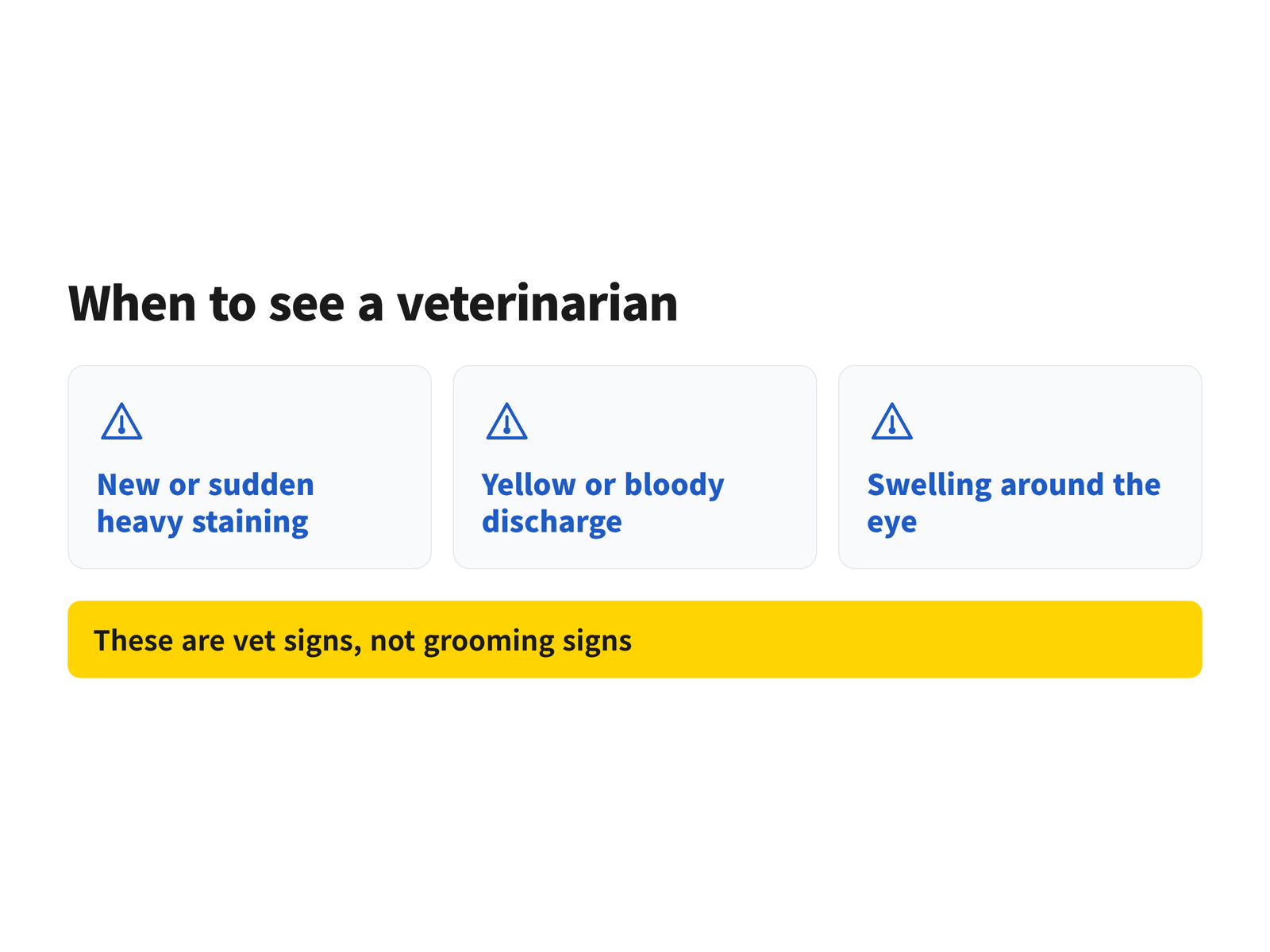
Tear staining becomes a veterinary matter when it is new, sudden, heavy or one-sided, or when it comes with discharge or swelling. The AKC lists new or suddenly heavier staining, yellow or bloody discharge, and swelling around the eye as reasons to contact a veterinarian. Those signs point past grooming, and no tear stain remover is designed to address them.
Sources also differ on antibiotics. The AKC notes that a veterinarian may prescribe tylosin short-term, while Kansas State University’s Dr. Jessica Meekins advises against antibiotics for tear stains. The safe reading is simple: only a veterinarian decides whether any medication fits a specific small dog. If staining changes or the eye looks irritated, consult your veterinarian before trying another product.
Frequently asked questions
Are tear stain removers safe to use on small dogs?
The AKC suggests dog-specific eye wipes used daily, taking care not to get the solution in the eyes. Products with antibiotics are a different matter: the FDA sent warning letters in 2014 and 2017 over tylosin tear stain products used without an approved application. Consult your veterinarian before using anything that sounds like a drug.
Why does the tear stain come back after trimming?
Trimming removes stained hair, but the tears keep flowing and the new hair grows into the same damp area. Porphyrins in tears then color the fresh coat again, which is why the AKC pairs trimming with daily wiping and drying.
Do tear stain chews work?
One 2026 trial in Animals found 38% to 49% lower staining scores with herbal extracts in 40 dogs over 28 days. That trial tested extracts, not retail chews, and covered only two breeds, so results for any specific product remain unproven.
Sources
- U.S. Food and Drug Administration, Warning Letter FLA 17-10 to Ocubright Tear Stain Remover, Inc., 2017-05-16 — https://www.fda.gov/inspections-compliance-enforcement-and-criminal-investigations/warning-letters/ocubright-tear-stain-remover-inc-523344-05162017
- U.S. Food and Drug Administration, Warning Letter CMS 524285 to Merit Pet Products, LLC, 2017-05-12 — https://www.fda.gov/inspections-compliance-enforcement-and-criminal-investigations/warning-letters/merit-pet-products-llc-524285-05122017
- FDA Center for Veterinary Medicine, “List of Approved New Animal Drug Applications Affected by GFI #263”, 2024-05-22 — https://www.fda.gov/animal-veterinary/antimicrobial-resistance/list-approved-new-animal-drug-applications-affected-gfi-263
- American Kennel Club, “How to Prevent & Clean Tear Stains on Your Dog’s Face”, Colt Dodd, updated 2026-03-17 — https://www.akc.org/expert-advice/health/tear-stains-prevent-and-clean/
- American Kennel Club, “Tear Stains on Dogs”, Colt Dodd, updated 2026-03-17 — https://www.akc.org/expert-advice/family-dog/canine-conditions-tear-stains-on-dogs/
- American Kennel Club, “Why Does My Dog’s Fur Turn Pink or Brown?”, Gemma Johnstone, updated 2026-06-29 — https://www.akc.org/expert-advice/health/why-is-my-dogs-fur-changing-color/
- Wang E. et al., “Effects of Traditional Chinese Herbal Extracts on Tear Staining, Iron Status, Immune Function, and Antioxidant Capacity in Dogs”, Animals 16:1596, 2026 — https://mdpi-res.com/d_attachment/animals/animals-16-01596/article_deploy/animals-16-01596.pdf
- Kansas State University, news release quoting Dr. Jessica Meekins, 2014-10-22 — https://www.k-state.edu/news/newsreleases/oct14/tearstains102114.html
- dvm360, “FDA warns makers of tear stain removers to pull products from market”, 2014-09-19 — https://dvm360.com/view/fda-warns-makers-tear-stain-removers-pull-products-market
- Fierce Pharma, “Pet tear-stain removers still widely available despite FDA warnings”, 2015-02-09 — https://www.fiercepharma.com/r-d/pet-tear-stain-removers-still-widely-available-despite-fda-warnings