A dog food storage container without the bag loses one thing that matters more than freshness: the lot number. The U.S. Food and Drug Administration (FDA) and the American Veterinary Medical Association (AVMA) both advise keeping dry food in its original bag, ideally with the bag placed inside a clean, airtight container. Yet a peer-reviewed survey in PLOS ONE found that 65% of dog owners store food outside the original bag.
What do you lose when you pour dog food into a storage bin?
Pouring kibble into a bin and throwing away the bag removes the lot number, the best-by date, the UPC and the product name in one move. The FDA defines a pet food lot number as a printed string of numbers and letters that tells the company where and when the product was made. In the words of the FDA, “The lot number is a crucial piece of information when you’re trying to identify if a product has been recalled.” Without the bag, a recall check turns into guesswork.
The habit is common. The PLOS ONE survey by Luisana and colleagues found that 65% of respondents kept pet food outside the original bag, although 81% did seal their bag or container. The authors concluded that “The majority of respondents reported storing their pet food against FDA and most manufacturers’ recommendations.” Only 4.7% of 417 respondents were aware of the FDA pet food handling guidelines at all, so the gap is mostly about awareness rather than effort.
Where is the lot number on a bag or can of dog food?
The lot number is usually printed near the best-by date. According to the FDA, cans tend to carry the lot number on the bottom, while bags and pouches tend to carry it on the bottom, the side, or near the top. Print positions vary by manufacturer.
A small dog may take a while to work through a large bag, so the bag may need to stay around longer than expected. The FDA puts the reason plainly: “By keeping food in its original package, you keep the lot number and other information nearby.” Finding the lot code on day one, before any kibble goes into a bin, is the simplest way to keep that information available until the last scoop.
Why might your dog’s food not appear on a recall list?
A pet food recall often covers specific production batches, not every bag of a brand on the shelf. The FDA notes that a recall may apply only to certain lots, so the lot number on your bag is what tells you whether your dog’s food is affected. A brand name match alone is not enough to confirm or rule out a recall.
The opposite mistake also happens. The FDA Center for Veterinary Medicine Recalls & Withdrawals page shows recent notices and links to an archive, and the FDA does not describe that page as a complete list of every recall. A product missing from the recent list is not proof that the product is safe. If your dog seems unwell after eating, consult your veterinarian rather than relying on a recall list.
Should dry dog food stay in the bag inside the container?
Yes. Both the FDA and the AVMA prefer the bag-inside-the-bin method. The FDA advice reads: “Store dry pet food in its original bag and keep the top of the bag tightly folded down.” The AVMA adds the container step: “If possible, store dry pet food in its original bag inside a clean, dedicated, airtight container.” The bag keeps the label, and the container adds a sealed outer layer.
The FDA and the AVMA set a few clear storage conditions. Dry pet food should be kept below 80°F. The storage container should be clean, dry, and have a lid that fits snugly. Leftover canned food should be refrigerated at 40°F or below or thrown out. Neither agency gives a set number of hours or days for leftovers in the fridge, so the AVMA points owners to the label directions. After handling food, the FDA and the AVMA advise washing your hands with soap for at least 20 seconds; the PLOS ONE survey found only 34% of owners did so after feeding.
How do the five common storage methods compare on recall tracking?
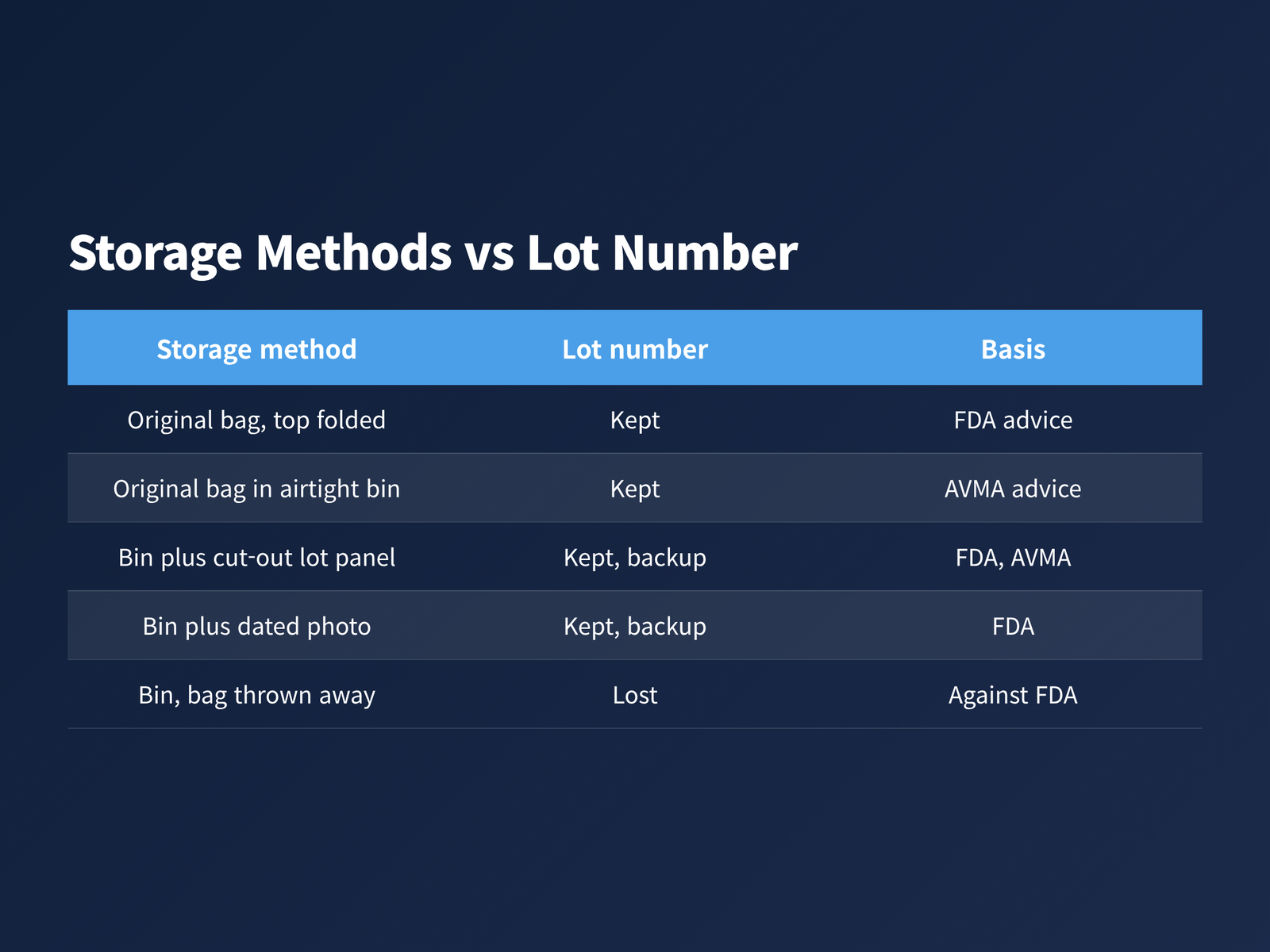
Four of the five common storage methods keep recall tracking possible, and only one loses it completely. The table below sorts the options by whether the lot number and recall check survive, based on FDA and AVMA guidance.
| Storage method | Lot number | Basis |
|---|---|---|
| Original bag, top folded | Kept | FDA advice |
| Original bag in airtight bin | Kept | AVMA advice |
| Bin plus cut-out lot panel | Kept, backup | FDA, AVMA |
| Bin plus dated photo | Kept, backup | FDA |
| Bin, bag thrown away | Lost | Against FDA |
If the bag must go, two backup methods keep the key details. The AVMA suggests saving the part of the bag that shows the product name, manufacture date and lot number. The FDA suggests cutting out the lot number section and taping it to the container, or saving a dated photo of it on your phone. These options keep recall tracking possible, although a whole bag inside the bin still keeps more information in one place.
What does the FDA ask for when you report a pet food problem?
The FDA asks for product details, the lot number, and the story of what went wrong, submitted through the Safety Reporting Portal. Many of those details are printed on the bag, which is why the FDA asks owners to “save the original packaging until the pet food has been consumed.” A dog food storage container without the bag leaves most of that list blank.
The FDA pet food complaint page lists these items to have ready:
- Product name, description, and type of container
- Lot number, best-by date, UPC barcode, and net weight
- Purchase date and the store where the food was bought
- How the food was stored, prepared, and handled
- What looked wrong: odor, color, swollen or leaking containers, foreign objects
- If the dog became sick: signs, timing, other foods or medicines, and veterinary records
The FDA reviews each report and decides whether to follow up, which may include collecting the food or asking for diagnostic samples. The FDA also states that “The FDA cannot pay for private laboratory testing costs,” and the agency does not cover veterinary bills. A diagnosis belongs to your veterinarian, and those veterinary records are part of what the FDA requests.
How often should a small dog’s food bowl be washed, and in what water?
The FDA handling guidelines call for washing bowls after use, and the PLOS ONE study found that hot water or a dishwasher made a measurable difference. Researchers tested 68 bowls from 50 owners. After one week, the group following the FDA guidelines showed a 1.4-1.5 log drop in bacterial counts. Washing in water hotter than 160°F (71.1°C), or in a dishwasher, gave an extra 1.5 log reduction compared with cold or lukewarm water.
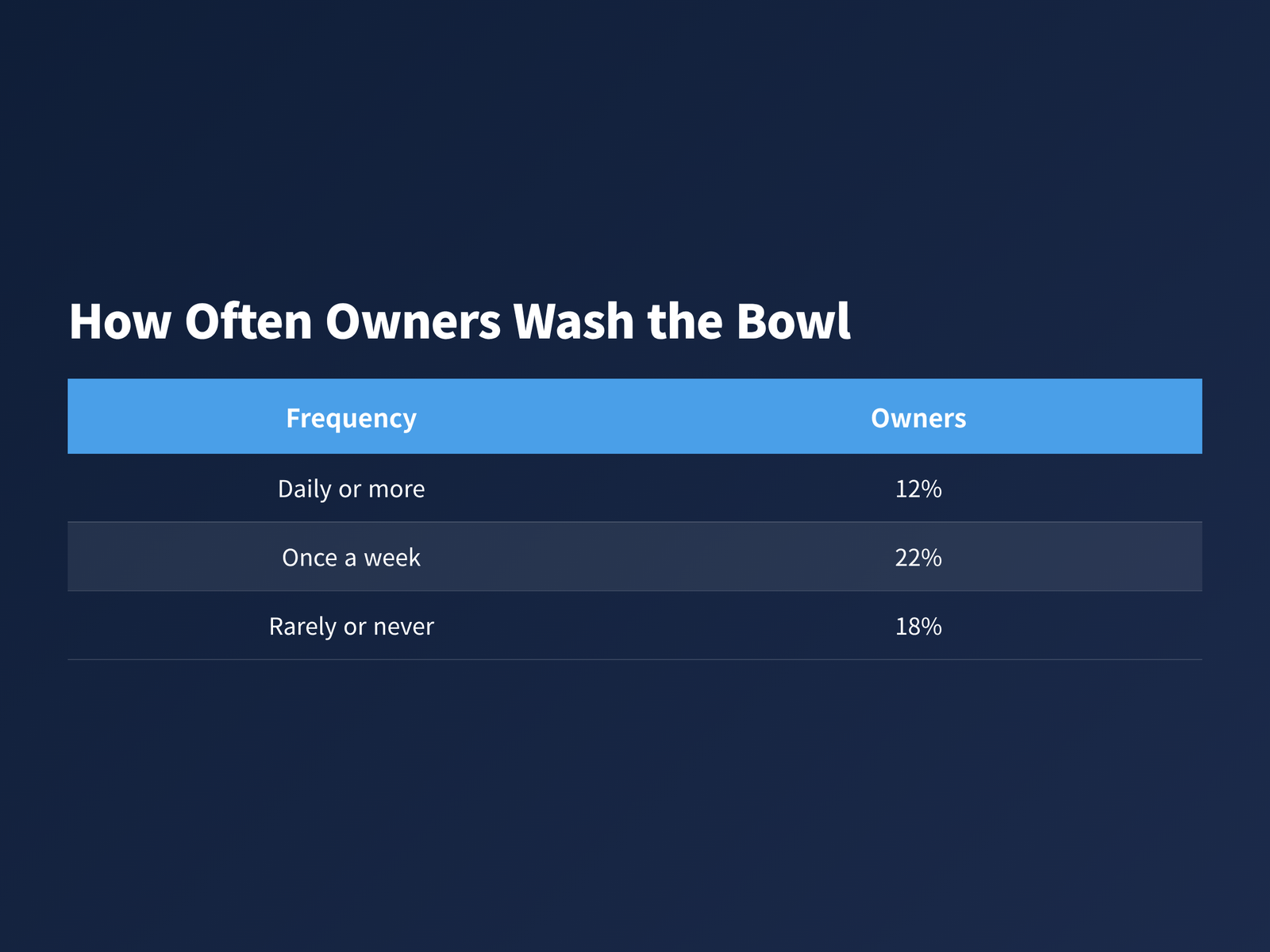
Daily habits in the survey varied widely. About 12% of owners washed the bowl daily or more often, 22% washed it once a week, and 18% washed it less than once every three months or never. The survey also found that 43-44% of owners stored pet food within 0 to 5 feet of human food. Only 8% said they would follow all of the guidelines over the long term, which suggests that simple, repeatable steps matter more than a long checklist.
Frequently asked questions
Is it bad to keep dog food in a plastic storage bin?
The FDA and the AVMA do not ban bins. The AVMA advises a clean, dedicated, airtight container with the original bag inside it, so a bin works as an outer layer rather than a replacement for the bag.
What if the bag is already in the trash?
From the next bag onward, cut out the panel with the lot number and best-by date and tape the panel to the container, or keep a dated photo of the panel, as the FDA suggests.
Does a brand name on the FDA recall page mean my dog’s food is recalled?
Not always. Recalls can apply to specific lots only, so compare the lot number on your bag with the recall notice. If your dog shows signs of illness, consult your veterinarian.
Sources
- U.S. Food and Drug Administration, “Save Your Pet Food Lot Number!”, 2024-07-10 — https://www.fda.gov/animal-veterinary/animal-health-literacy/save-your-pet-food-lot-number
- U.S. Food and Drug Administration, “Tips for Safe Handling of Pet Food and Treats”, 2024-05-23 — https://www.fda.gov/animal-veterinary/animal-health-literacy/tips-safe-handling-pet-food-and-treats
- U.S. Food and Drug Administration, “Proper Storage of Pet Food & Treats”, undated — https://www.fda.gov/animal-veterinary/animal-health-literacy/proper-storage-pet-food-treats
- U.S. Food and Drug Administration, “How to Report a Pet Food Complaint”, content current as of 2026-07-20 — https://www.fda.gov/AnimalVeterinary/SafetyHealth/ReportaProblem/ucm182403.htm
- U.S. Food and Drug Administration, Center for Veterinary Medicine, “Recalls & Withdrawals”, 2026-09-18 — https://www.fda.gov/animal-veterinary/safety-health/recalls-withdrawals
- American Veterinary Medical Association, “Safe handling of pet food and pet treats”, undated — https://www.avma.org/resources-tools/pet-owners/petcare/safe-handling-pet-food-and-pet-treats
- Luisana E, Saker K, Jaykus L-A, Getty C, “Survey evaluation of dog owners’ feeding practices and dog bowls’ hygiene assessment in domestic settings”, PLOS ONE 17(4): e0259478, 2022 — https://doi.org/10.1371/journal.pone.0259478