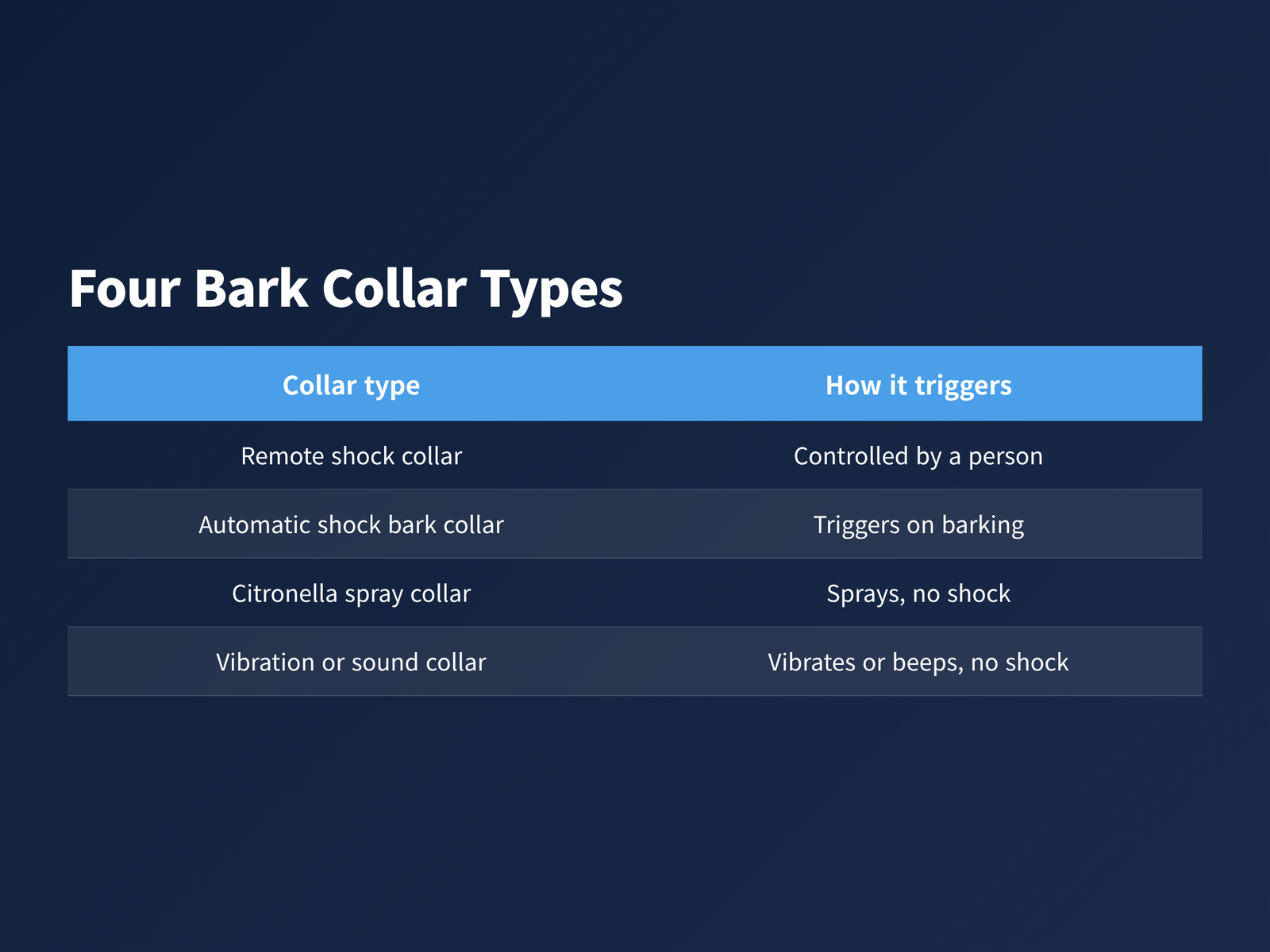
Anti-bark collar rules for a small dog in the UK depend on which nation the dog lives in. Wales bans any collar designed to administer an electric shock, including automatic anti-bark shock collars. England, Scotland and Northern Ireland have no bark collar ban in force. Small dogs face a second problem: bark collars can misfire, and some are labelled for heavier dogs. This guide separates the legal question from the fit question, using the Schipperke as a worked example.

Are anti-bark collars legal in England right now?
Yes, anti-bark collars are currently legal to use and sell in England. The Royal Kennel Club states that “the use and sale of electric shock collars is currently not prohibited in England.” In its Animal Welfare Strategy for England, the UK Government committed in December 2025 only to consult on whether to ban the use of electric shock collars. The strategy says the Government “will gather views and evidence on the current use of e-collars to inform whether to take forward a ban.” Check GOV.UK for the latest England position.
Did England ban shock collars in February 2024?
No, England did not ban shock collars in February 2024, because the planned regulations were never made. The draft Animal Welfare (Electronic Collars) (England) Regulations 2023 set a February 2024 start date, and the British Veterinary Association later reported that the date passed without the ban taking effect. Many pages still describe an England shock collar ban as if it were law. A small-dog owner reading those pages could wrongly assume a bark collar is illegal in England.
The England draft would not have caught bark collars anyway. The draft covered only collars “activated and directly controlled by a person by means of a remote-control device.” The Defra Explanatory Memorandum states that “anti-bark collars, and containment systems will remain legal for cats and dogs in England.”
Why is a shock bark collar illegal in Wales but not in England?
A shock bark collar is illegal in Wales because the Welsh definition covers every collar designed to deliver a shock, not only remote-controlled ones. The Animal Welfare (Electronic Collars) (Wales) Regulations 2010 define an electronic collar as “a collar designed to administer an electric shock.” An automatic bark-triggered shock collar fits that wording. Breaking the Welsh rules can lead to up to 51 weeks’ imprisonment, a level 5 fine, or both.
The Welsh Government later reviewed anti-bark collars and kept the ban. Deputy Minister Rebecca Evans said “the conclusion is that the welfare cost exceeds the benefits for such collars.” England’s draft took the narrower remote-control approach, which is why the two nations differ so sharply on bark collars.
Is a citronella or vibration bark collar treated differently under UK law?
Yes, citronella spray and vibration collars fall into a different category because they do not deliver an electric shock. The Defra memorandum confirms that collars emitting “sound, vibration or some other non-shock signals are not prohibited” in England. In Wales, citronella and vibration collars sit outside the Welsh definition, which covers collars designed to administer an electric shock. No Welsh official text found for this guide calls those collars expressly legal. Scotland’s guidance criticises devices that squirt oils “such as citronella.”
What are the rules in Scotland and Northern Ireland?
Shock collars, including anti-bark shock collars, are not banned in Scotland or Northern Ireland. The Royal Kennel Club states that “electric shock collars are currently legal in Scotland.” Scottish Government guidance says the government “does not condone” electronic anti-bark collars, but that guidance is not a law, and a Scottish Animal Welfare Commission report found no legal control of e-collar use, supply or possession. STV News reported that MSPs rejected a Scottish Greens ban amendment by 28 votes to 84. For Northern Ireland, the Royal Kennel Club states there are “no legal restrictions on the use or sale” of shock collars.
How do England and Wales compare by collar type?
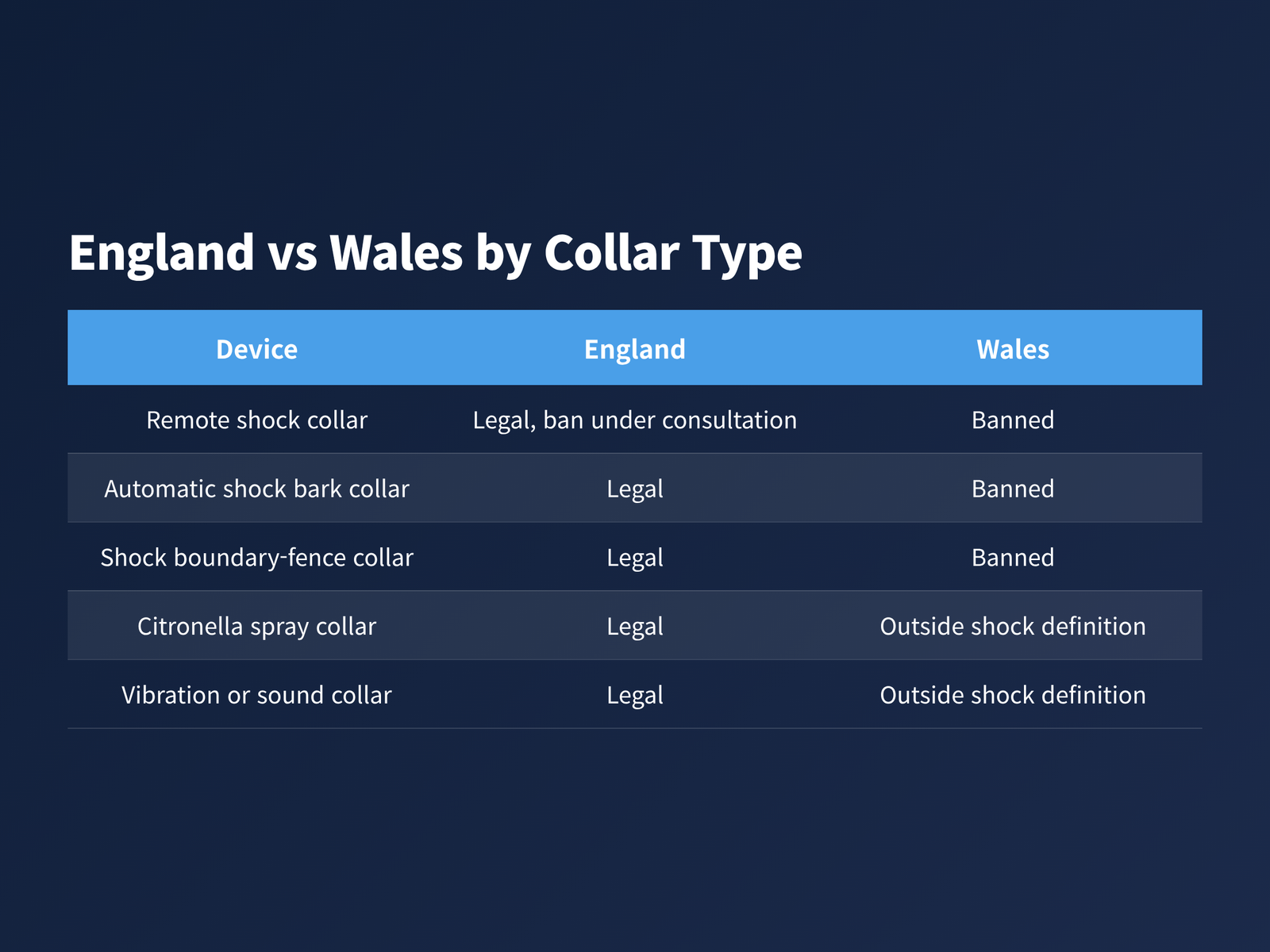
England allows every bark collar type, while Wales bans every collar designed to give a shock. Scotland and Northern Ireland follow the England column for legality, although Scottish guidance discourages electronic anti-bark collars. The Wales column follows the 2010 definition, which turns on whether a collar is designed to administer an electric shock.
| Device | England | Wales |
|---|---|---|
| Remote shock collar | Legal, ban under consultation | Banned |
| Automatic shock bark collar | Legal | Banned |
| Shock boundary-fence collar | Legal | Banned |
| Citronella spray collar | Legal | Outside shock definition |
| Vibration or sound collar | Legal | Outside shock definition |
Why do many anti-bark collars not suit very small dogs?
Many anti-bark collars do not suit very small dogs because the devices misfire and small dogs often sit outside the tested or labelled range. A peer-reviewed citronella collar study by Sargisson, Butler and Elliffe excluded dogs under 5 kg. In that study, “several owners found the collar oversensitive to extraneous stimuli.” Head-shaking, vigorous movement and panting sometimes set the collar off, and the collar sometimes failed to spray after a bark. The collar worked for only 3 of the 7 dogs analysed, and the initial reduction “was not maintained.”
An older Cornell study in the Journal of the American Animal Hospital Association reported efficacy of “88.9% for the citronella spray collar and 44.4% for the electronic shock collar,” from 9 selected dogs, 8 of which completed both trials. Lead author Soraya V. Juarbe-Diaz, D.V.M., said “either type of collar can be a supplement or an alternative to behavior modification.”
How does a Schipperke compare with bark collar weight limits?
A Schipperke usually clears the minimum weight on at least one common spray collar, but the weight check still matters. The Royal Kennel Club breed standard gives the Schipperke a weight of about 5.5 to 7.5 kg, or 12 to 16 lb. PetSafe lists its Spray Bark Collar as fitting pets 8 pounds and up, so a Schipperke at around 12 lb is above that figure. Other brands may set different minimums, so compare the label with your dog’s weight.
The American Kennel Club notes that, “in spite of their size, they possess a healthy bark, which can be a bit surprising and unexpected to a stranger.” A loud Schipperke bark does not change the law in Wales, and a Schipperke that meets the weight label can still face the false triggers recorded in the citronella study.
What do UK welfare charities recommend instead of a bark collar?
UK welfare charities recommend finding the cause of the barking before reaching for a collar. Blue Cross warns that “items like bark collars seem to offer a ‘quick fix’ but they do not address the cause.” Blue Cross lists common triggers such as the doorbell, passers-by, being left alone, attention-seeking and boredom, and describes the main function of such devices as to “startle, cause pain or discomfort, or scare a barking dog.”
The RSPCA advises owners to “always speak to your vet” if barking increases and hearing or another health problem may be involved, so consult your veterinarian before treating barking as purely behavioural. For a treatment plan, the RSPCA suggests contacting a clinical animal behaviourist.
Frequently asked questions
Is a shock bark collar allowed on a small dog in England?
Using a shock bark collar in England is not currently prohibited. The UK Government has committed to consult on whether to ban the use of electric shock collars, and the earlier England draft would have left anti-bark collars legal.
Is a citronella bark collar banned in Wales?
The Welsh rules cover collars designed to administer an electric shock. A citronella spray collar falls outside that shock-only definition.
Is there a minimum weight for a bark collar?
Each manufacturer sets its own minimum. PetSafe lists its Spray Bark Collar for pets 8 pounds and up.
Does a bark collar stop barking for good?
In the citronella collar study, the initial reduction in barking “was not maintained,” and only 3 of 7 dogs responded.
Sources
- legislation.gov.uk, “The Animal Welfare (Electronic Collars) (Wales) Regulations 2010” (WSI 2010/943), 2010 — https://www.legislation.gov.uk/wsi/2010/943/made
- legislation.gov.uk, Draft “The Animal Welfare (Electronic Collars) (England) Regulations 2023”, 2023 — https://www.legislation.gov.uk/ukdsi/2023/9780348247305
- Defra, Explanatory Memorandum to the draft Animal Welfare (Electronic Collars) (England) Regulations 2023, 2023 — https://www.legislation.gov.uk/ukdsi/2023/9780348247305/pdfs/ukdsiem_9780348247305_en.pdf
- GOV.UK, “Animal welfare strategy for England”, 22 Dec 2025 — https://www.gov.uk/government/publications/animal-welfare-strategy-for-england/animal-welfare-strategy-for-england
- GOV.UK / Defra, “Defra announces biggest animal welfare reforms in a generation”, 21 Dec 2025 — https://www.gov.uk/government/news/defra-announces-biggest-animal-welfare-reforms-in-a-generation
- Welsh Government, “Written Statement – Electronic shock collars”, Rebecca Evans, 11 Mar 2016 — https://www.gov.wales/written-statement-electronic-shock-collars
- Scottish Government, “Dog training aids: guidance”, 15 Oct 2018 — https://www.gov.scot/publications/guidance-dog-training-aids/pages/1/
- Scottish Government / Scottish Animal Welfare Commission, report on e-collars in dog training, 11 Apr 2023 — https://www.gov.scot/publications/report-use-handheld-remote-controlled-training-devices-e-collars-dog-training-scottish-animal-welfare-commission/pages/4/
- Royal Kennel Club, “Ban electric shock collars” campaign page, undated — https://www.royalkennelclub.com/about-us/about-the-rkc/campaigns/electric-shock-collars/
- Royal Kennel Club, Schipperke breed standard, last updated Nov 2025 — https://www.royalkennelclub.com/breed-standards/utility/schipperke/
- British Veterinary Association, “Government must deliver on its commitment to ban cruel electric shock collars”, 5 Feb 2024 — https://www.bva.co.uk/news-and-blog/news-article/government-must-deliver-on-its-commitment-to-ban-cruel-electric-shock-collars-say-leading-veterinary-and-animal-welfare-organisations/
- STV News, “MSPs reject bid by Scottish Greens to bring in outright ban on shock collars for dogs”, 24 Jan 2025 — https://news.stv.tv/politics/msps-reject-bid-by-scottish-greens-to-bring-in-outright-ban-on-shock-collars-for-dogs
- American Kennel Club, “Schipperke History: The Little Captain of Belgian Dockyards”, 28 Mar 2022 — https://www.akc.org/expert-advice/dog-breeds/schipperke-history-little-captain-docks/
- Blue Cross, “How to stop your dog barking”, published 23 May 2017, reviewed 22 Sep 2026 — https://www.bluecross.org.uk/advice/dog/behaviour-and-training/how-to-stop-a-dog-from-barking
- RSPCA, “How to stop your dog barking too much”, undated — https://www.rspca.org.uk/adviceandwelfare/pets/dogs/behaviour/barking
- Juarbe-Diaz & Houpt, “Comparison of two antibarking collars for treatment of nuisance barking”, Journal of the American Animal Hospital Association 32(3):231-235, 1996 — https://jaaha.kglmeridian.com/view/journals/aaha/32/3/article-p231.xml
- Cornell Chronicle, Roger Segelken, 6 Jun 1996 — https://news.cornell.edu/node/281839
- Sargisson, Butler & Elliffe, “An Evaluation of the Aboistop Citronella-Spray Collar as a Treatment for Barking of Domestic Dogs”, ISRN Veterinary Science, 23 Jan 2012 — https://pmc.ncbi.nlm.nih.gov/articles/PMC3658554
- PetSafe, Spray Bark Collar product page (manufacturer specification), viewed 10 Oct 2026 — https://www.petsafe.com/en-ca/p/spray-bark-collar/PBC17-16369/