Some denied luxating patella claims come down to three policy mechanisms, not to the knee itself: an orthopedic waiting period, a pre-existing condition rule that reaches back to early “signs or symptoms,” and a bilateral clause that can link one knee to the other. If you are asking why pet insurance won’t cover luxating patella for a small dog, the answer usually sits in the policy wording and in your state’s law. This guide covers insurance terms only. For anything about your dog’s knees, consult your veterinarian.
Why do pet insurance policies treat luxating patella differently from other illnesses?
Some pet insurance policies file luxating patella under “orthopedic,” and orthopedic conditions can carry their own, longer waiting period. The NAIC Pet Insurance Model Act defines orthopedic as conditions affecting “the bones, skeletal muscle, cartilage, tendons, ligaments, and joints.” At least one US insurer’s California disclosure names patellar luxation directly in its orthopedic list, alongside hip dysplasia, elbow dysplasia and ruptured cranial cruciate ligaments. That is one insurer’s own wording, not an industry rule, but it shows how a kneecap claim can be routed into a separate category with separate timing.
Classification matters because the orthopedic label, not the diagnosis, decides which waiting period and which exclusions apply. An older PetPartners sample policy sold under the AKC name went further and listed luxating patella under “Conditions Always Excluded.” That sample form is not a current policy, so it says nothing about today’s AKC terms. It does show why reading the current policy documents for the exact plan matters more than any general rule about pet insurance.
How long is the orthopedic waiting period, and do some states cap it?
In states that follow the NAIC Model Act rules, the waiting period for illness and orthopedic conditions cannot exceed 30 days, and waiting periods for accidents are prohibited. The 30-day cap is verified in statute text for Maine and Washington; Washington’s pet insurance law took effect at the start of 2024. The NAIC state chart lists 24 jurisdictions, but that chart mixes full adoptions with “related activity,” so the cap should not be assumed in every listed state.
Outside those rules, waiting periods can be much longer. Fetch’s own FAQ describes a 6-month orthopedic waiting period that varies by state. Healthy Paws’ California disclosure lists 15 days for illness, 15 days for orthopedic conditions other than hip dysplasia, and 30 days for hip dysplasia. Each figure is an example of that insurer’s own terms. Whether a cap applies to your policy depends on where you live, so check your state law and the policy’s disclosure page.
Can a vet exam waive the orthopedic waiting period?
Yes, in many cases a vet exam can waive the orthopedic waiting period, but the deadline and conditions come from the policy or state law. The NAIC Model Act requires that policies allow waiting periods to be waived after a medical exam, and an insurer may require that exam by a licensed veterinarian after purchase. Under Maine’s statute, the owner pays for that exam unless the policy says the insurer pays.
Insurer examples differ. Fetch’s own FAQ says its knee-condition waiting period can be waived through a vet exam completed within 180 days of enrollment, with records sent along with the first claim. Healthy Paws’ California disclosure says its waiting periods are waived after a complete clinical exam. Because the window and paperwork rules vary by insurer, confirm the exact steps in writing before relying on a waiver.
What is a bilateral condition clause, and why does it matter for the other knee?
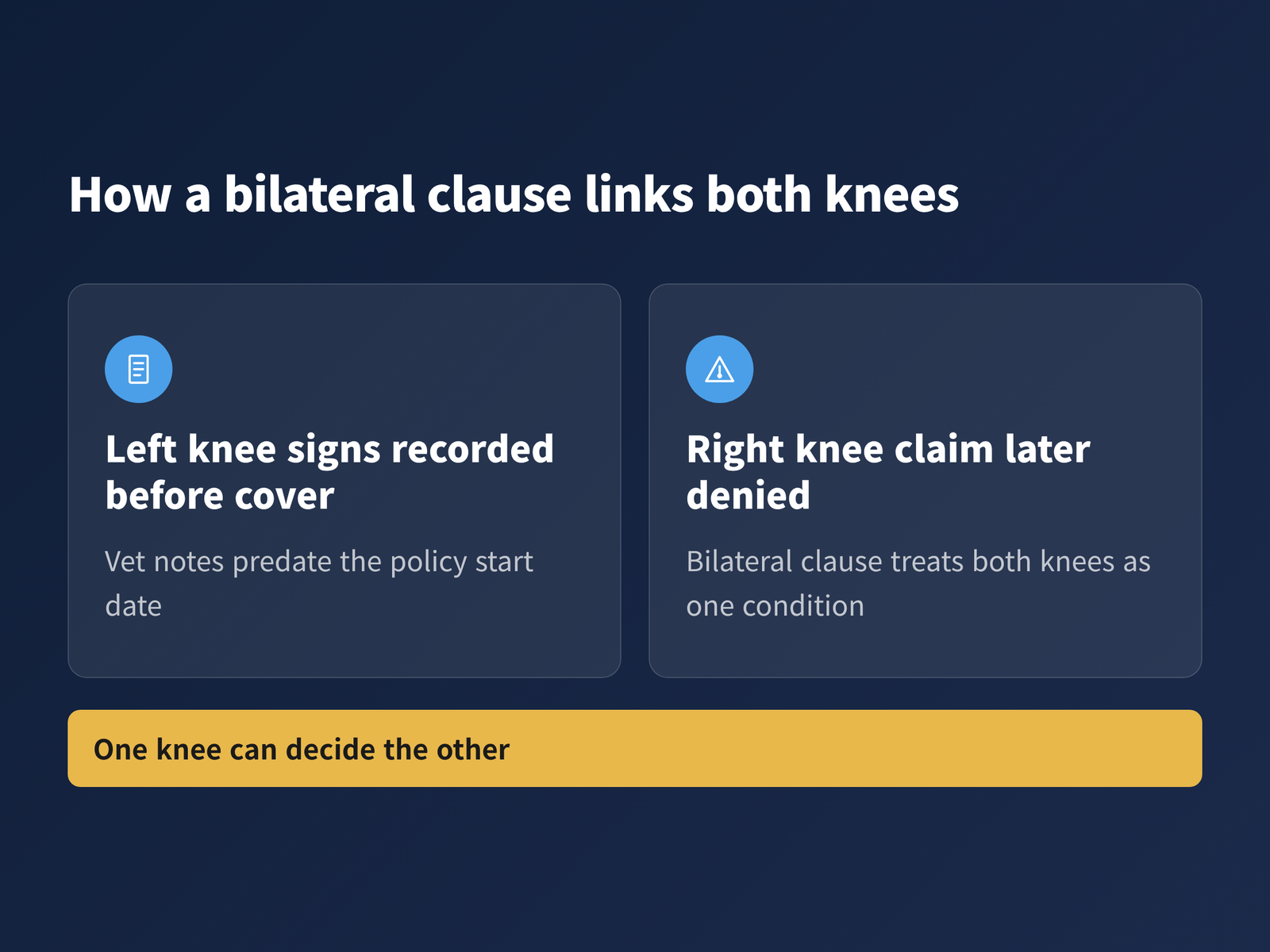
A bilateral condition clause treats the same condition on a paired body part, such as both knees, as one condition. Animal Friends, a UK insurer, defines a bilateral condition as one affecting a paired body part on either side, including knees, hips, elbows and eyes. Its FAQ states that if luxating patella in the left knee existed before cover began, a later right-patella problem “also won’t be covered.”
The bilateral clause matters for small dogs because luxating patella often appears in both knees. In a study of dogs seen at primary-care practices in England, 273 of 722 cases with limb data were bilateral. The NAIC Model Act does not address bilateral clauses, so in the US the policy wording decides. An older PetPartners sample policy contained one, while no US court or regulator ruling on these clauses was found.
Does a vet noting a “loose kneecap” early on make it pre-existing?
Not automatically; outcomes depend on the exact policy wording and the evidence. Under the NAIC Model Act, a pre-existing condition is one where, before the policy effective date, a vet gave medical advice, the pet received treatment, or verifiable sources show signs or symptoms directly related to it. In Model Act states such as Maine and Washington, the insurer must prove the pre-existing exclusion applies.
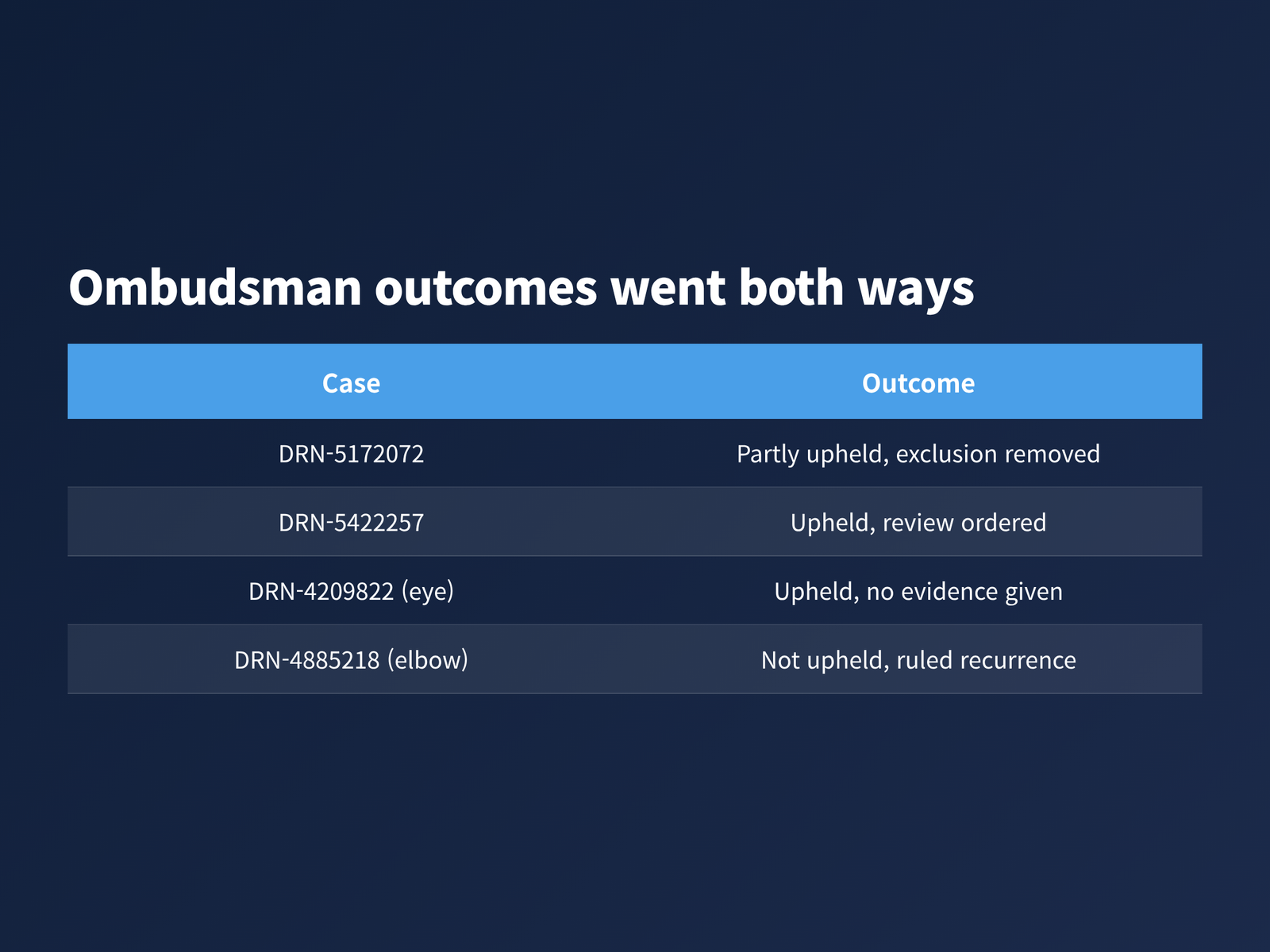
UK Financial Ombudsman Service decisions show both directions. In DRN-5172072, an insurer declined a patella claim and a later cruciate claim as starting in the first 14 days; the ombudsman agreed on those claims but ordered removal of a blanket, backdated patella exclusion. In DRN-5422257, the ombudsman ordered reconsideration, noting: “The policy terms do not exclude claims that result from physical abnormalities noticed within the first 14 days.” Keep copies of early vet records, and consult your veterinarian about what was written down.
Why are toy breeds hit hardest by these exclusions?
Toy breeds face these exclusions more often because patellar luxation is far more common in them. The O’Neill study from the Royal Veterinary College’s VetCompass program found a prevalence of 1.30% across 210,824 dogs. Pomeranians reached 6.5%, Yorkshire Terriers 5.4% and Chihuahuas 4.9%, with odds ratios of 6.5, 5.5 and 5.9 compared with crossbreds.
The same study found a median age at diagnosis of 4.0 years, and dogs below their breed’s mean bodyweight had 1.4 times the odds. The authors concluded that “Patellar luxation warrants inclusion as a welfare priority in dogs.” For insurance, higher prevalence means a toy breed owner is more likely to meet the waiting period, pre-existing and bilateral clauses in practice. These are population figures, not a prediction for any single dog.
How do the rules compare across policy types?
The main difference is that Model Act rules set limits, while other policies follow their own wording. The table below compares five policy elements, using named insurer documents only as examples of their own terms.
| Policy element | Model Act states | Other policies (examples) |
|---|---|---|
| Orthopedic wait | Max 30 days | 6 months (Fetch) |
| Accident wait | Prohibited | 3 days (older sample) |
| Exam waiver | Must be offered | Some offer it |
| Bilateral clause | Not addressed | In sample policies |
| Pre-existing proof | Insurer’s burden | Policy wording |
Renewal is a separate protection under the Model Act: no new waiting period applies on renewal, no vet exam is required, and a condition covered under the policy cannot become pre-existing at renewal. Insurers must also disclose whether they exclude pre-existing, hereditary, congenital or chronic conditions, and the Model Act gives a 15-day free-look period from receipt unless a claim has been filed.
What should you ask an insurer before enrolling a small dog?
Ask five questions about policy wording before enrolling a small dog. The AVMA advises owners to “find out how the provider defines and handles pre-existing conditions, including any diseases and conditions your pet has now or had in the past before you bought your insurance plan.”
- Does your state appear on the NAIC chart, and what does your state law say?
- What is the orthopedic waiting period, and is patellar luxation named?
- Does a vet exam waive it, and by what deadline?
- Does the policy contain the word “bilateral”?
- What did the first vet visit record about the knees?
UK rulings also show that bilateral arguments can be stretched. In DRN-4209822, an eye case, the ombudsman upheld a complaint where the insurer relied on a bilateral argument without medical evidence; in DRN-4885218, an elbow case found to be a recurrence, the complaint was not upheld. Coverage outcomes depend on the specific policy, so read the documents before enrolling.
Frequently asked questions
Is luxating patella always excluded by pet insurance?
No. Exclusions depend on the policy. An older sample policy listed luxating patella as always excluded, while at least one current disclosure lists it as an orthopedic condition with a waiting period instead.
Does the 30-day cap apply in every US state?
No. The 30-day cap applies where states adopted Model Act rules; it is verified in Maine and Washington statutes. Other policies can use longer periods, such as Fetch’s 6-month orthopedic wait.
Can a covered knee become pre-existing when the policy renews?
Under the NAIC Model Act, a condition covered under the policy cannot become pre-existing at renewal. Check whether your state follows those rules.
This article is for information only and is not insurance or veterinary advice. Coverage depends on the policy and state law, so read the policy documents before enrolling and consult your veterinarian about your dog’s health.
Sources
- NAIC, “Pet Insurance Model Act” (Model #633), Summer 2022 — https://content.naic.org/sites/default/files/model-law-633.pdf
- NAIC, “Pet Insurance Model Act — State page chart,” Summer 2026 — https://content.naic.org/sites/default/files/model-law-state-page-633_1.pdf
- Maine Legislature, 24-A M.R.S. §3156 — https://legislature.maine.gov/statutes/24-A/title24-Asec3156.html
- Washington State Legislature, SB 5319 Final Bill Report, 2023 — https://lawfilesext.leg.wa.gov/biennium/2023-24/Htm/Bill%20Reports/Senate/5319%20SBR%20FBR%2023.htm
- Washington State Legislature, HB 1078, 2025 — https://lawfilesext.leg.wa.gov/biennium/2025-26/Htm/Bills/House%20Bills/1078.htm
- O’Neill DG et al., “The epidemiology of patellar luxation in dogs attending primary-care veterinary practices in England,” Canine Genetics and Epidemiology 3:4, 2016-06-08, doi 10.1186/s40575-016-0034-0
- RVC VetCompass, paper announcement — https://www.rvc.ac.uk/vetcompass/news/new-paper-published-on-canine-patellar-luxation
- AVMA, “Do you need pet insurance?” — https://www.avma.org/resources-tools/pet-owners/petcare/do-you-need-pet-insurance
- AVMA News, “Association of insurance commissioners passes Pet Insurance Model Act,” 2022-09-19 — https://www.avma.org/news/association-insurance-commissioners-passes-pet-insurance-model-act
- UK Financial Ombudsman Service, DRN-5172072 — https://www.financial-ombudsman.org.uk/decision/DRN-5172072.pdf
- UK Financial Ombudsman Service, DRN-5422257 — https://www.financial-ombudsman.org.uk/decision/DRN-5422257.pdf
- UK Financial Ombudsman Service, DRN-4209822 — https://www.financial-ombudsman.org.uk/decision/DRN-4209822.pdf
- UK Financial Ombudsman Service, DRN-4885218 — https://www.financial-ombudsman.org.uk/decision/DRN-4885218.pdf
- Healthy Paws / Westchester Fire Insurance Co., California disclosure PI-60362CA (08/26) — https://www.healthypawspetinsurance.com/content/dam/healthypaws/documents/policies/CA/california-insurer-disclosure-of-important-policy-provisions.pdf
- Fetch, Waiting period FAQ, accessed 2026-10-12 — https://www.fetchpet.com/faqs/waiting-period
- PetPartners / American Pet Insurance Co., AKC sample terms PPI-BASE-ILL-TC-003 (09/13) — https://akcpetinsurance.com/res/common/policy/003/ppi-cplus-tc-003-sample.pdf
- Animal Friends, “What is a bilateral condition?” — https://www.animalfriends.co.uk/contact/frequently-asked-questions/our-policies/what-is-a-bilateral-condition/