Baby gates fail small dogs for a simple reason: the US federal gate standard is written around a toddler’s body, not a dog’s. A passing baby gate has shown that a child torso probe cannot be pushed through its openings, which says nothing about a small dog. Gates sold for pets only sit outside the standard altogether. Below: what the test measures, why a 2026 rule bars pet doors on child gates, and what to check before buying.
Why do baby gates fail to stop small dogs?
Baby gates fail to stop small dogs mostly because nothing in the child gate standard was measured against a dog. The US Consumer Product Safety Commission (CPSC) names the intended users of child gates as “young children age 6 months through 24 months,” and the opening test uses a probe shaped like a child’s torso. Neither the CPSC nor the AKC publishes small-breed chest or head widths matched against gate gaps, so a passing baby gate tells you little about your dog.
A small dog can beat a baby gate in three ways: through an opening, over the top, or up the frame. Dr. Kelly Hood, DVM, puts the height point plainly in the American Kennel Club (AKC) guide Dog Gates 101: “The gate should be tall enough so that your dog can’t jump over it.” The AKC also warns that horizontal bars can give a climbing dog footholds. The right height and gap depend on the individual dog, so measuring your own dog matters more than the label on the box.
What does the US baby gate standard actually test?
The US baby gate standard tests whether a child-sized probe can be forced through the gate, whether the gate is tall enough for a toddler, and whether the gate holds when pushed. The rule is 16 CFR part 1239, which makes ASTM F1004 mandatory and took effect on July 6, 2021. The CPSC describes an expansion gate as a “barrier intended to be erected in an opening, such as a doorway, to prevent the passage of young children.”
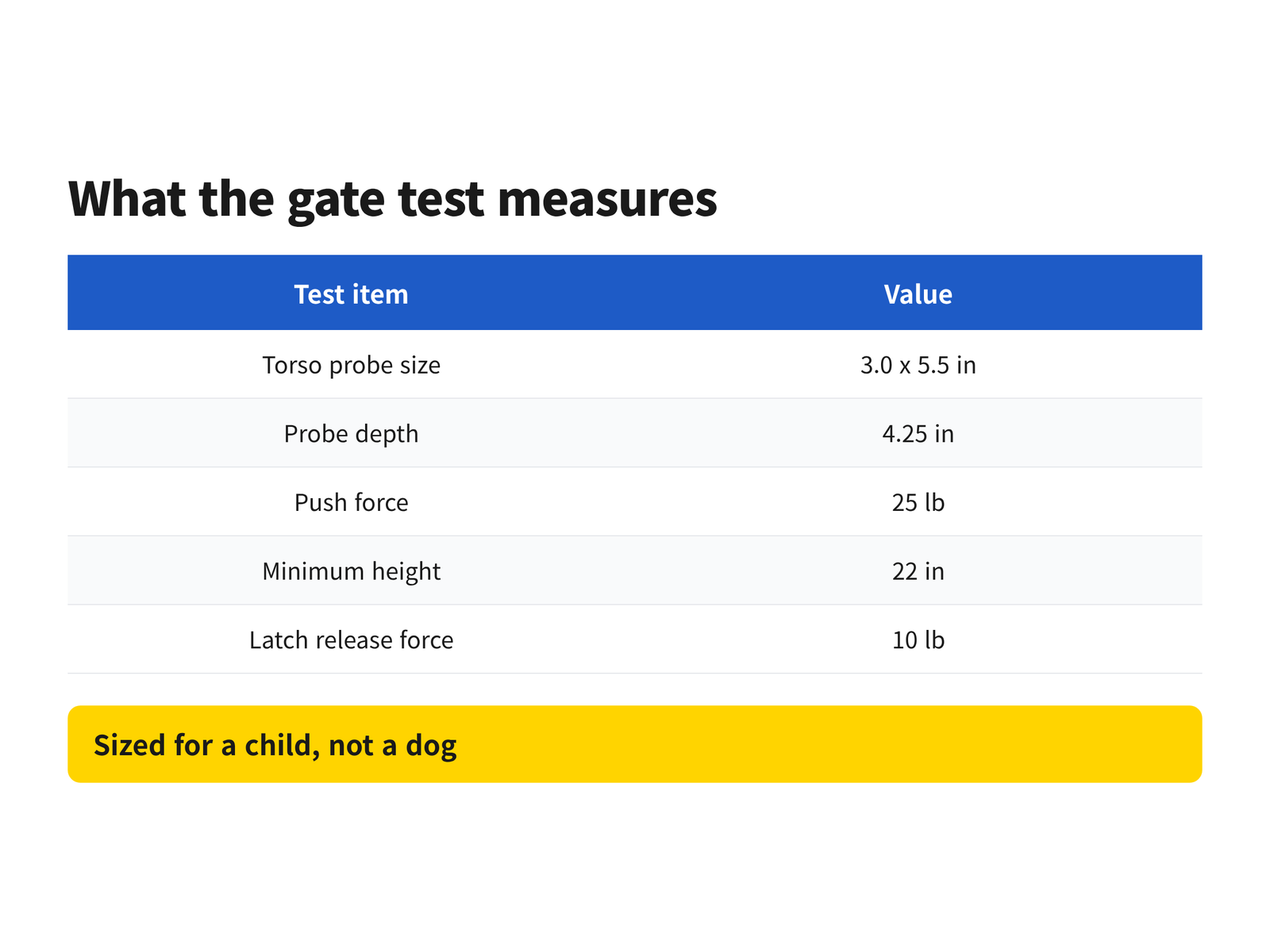
The measurements in the baby gate standard are specific. Bounded openings must not let a small torso probe pass: a block with a cross-section of 3.0 by 5.5 inches and an overall depth of 4.25 inches, pushed in with a 25-pound force. The top edge must sit no less than 22 inches above the floor. Partly bounded openings at the top edge must not be “greater than 1.5 inches in width and more than 0.64 inches in depth.” Push-out resistance must average more than 30 pounds across five test locations, and a single-action latch must need at least 10 pounds of force to open.
Those numbers grew out of child injury data. Between January 2008 and January 2020, the CPSC counted 478 incidents involving child gates, including 22 deaths, and hardware issues accounted for 183 of those incidents, or 38%. Every figure in the baby gate standard is tuned to a toddler. A small dog’s chest, head and jumping ability were never part of the test.
Are pet gates held to the same safety standard as baby gates?
No. In the US, products “intended for pets only, are not covered under the scope of ASTM F1004–19,” according to a footnote in the CPSC’s 2020 final rule. A gate sold as a pet gate does not have to pass the torso probe test, the 22-inch height rule or the push-out tests.
That does not make every pet gate flimsy. The CPSC itself noted that “Some of the pet gates already comply with ASTM and JPMA.” The concern runs the other way: CPSC staff noted that manufacturers might remarket gates that fail the child standard as pet gates, and noncompliant enclosures “as dog pens.” For a small dog owner, the pet gate label alone says nothing about how a gate was tested.
Australia draws the same line. Product Safety Australia, run by the Australian Competition and Consumer Commission (ACCC), tells parents: “Don’t buy or use a pet gate. They are not secure enough or designed for children.” That advice concerns children, not dogs, but it shows regulators treat pet gates and child gates as different products. The ACCC’s bar spacing guide for child gates runs between 5 cm and 9.5 cm.
Why did a 2026 rule bar pet doors from baby gates?
A 2026 CPSC rule bars built-in pet doors on baby gates because children can slip through those openings or get their heads stuck in them. The direct final rule, published on April 1, 2026, updated 16 CFR part 1239 to ASTM F1004-25. Under the rule, a gate “shall not include any features or openings within the gate that allow for unassisted pet entry or egress.” The rule carries a stated effective date of July 19, 2026.
The CPSC explained that “children can escape through or entrap their heads in these openings, causing potential serious injury and death.” The agency noted that these openings are “generally designed for cats and dogs,” and that some “can be locked to stay open and/or do not have a latching or locking mechanism.” Horizontal parts of a pet door frame also “create places in the gate where children can place their feet to climb over the gate or enclosure.”
A recall showed the problem before the rule. Under CPSC recall 25-122, about 1,500 UVIPC baby gates sold on Amazon from November 2022 to September 2024 were recalled, and the CPSC stated: “For the versions with a pet door, a child’s torso can fit through the secondary opening.” For small dog owners, the key point is scope: gates sold for pets only can still include cat or dog doors, so a gate with a built-in pet door is a pet product rather than a child gate.
Pet gate vs baby gate: which works better for a small dog?
Neither gate type is built around a small dog’s body, so the better choice is the gate whose openings, height and mounting match your dog. A baby gate brings a federal test designed for toddlers; a pet gate brings no federal test at all. The table compares the two in the US.
| Feature | Child gate (US) | Pet-only gate |
|---|---|---|
| Federal standard | ASTM F1004 mandatory | Outside F1004 scope |
| Opening test | 3.0 x 5.5 in probe | No federal test |
| Minimum height | 22 in | No federal minimum |
| Built-in pet door | Prohibited (2026 rule) | Allowed |
| Sized for | Children 6-24 months | Varies by maker |
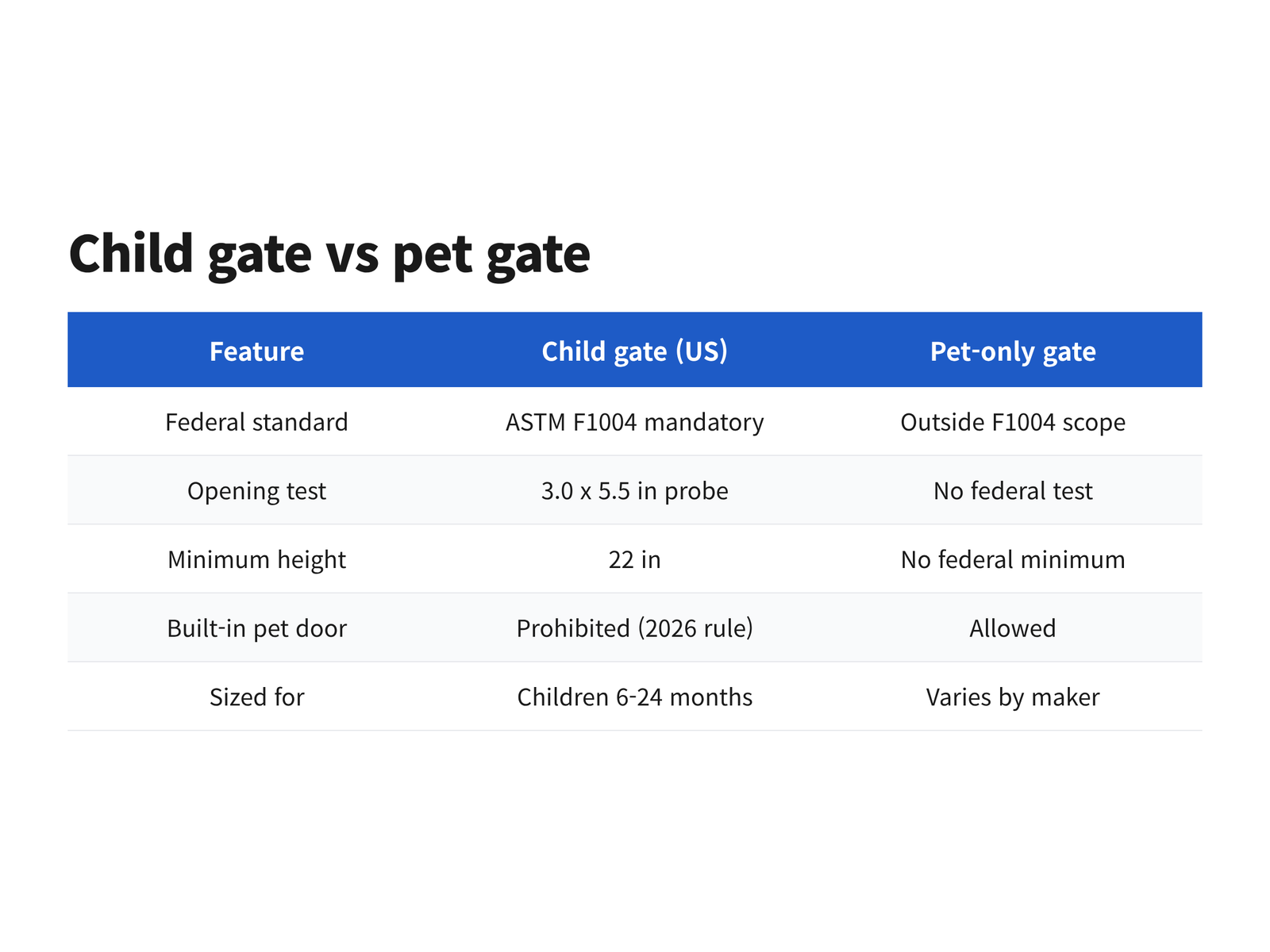
The height row matters most for small dogs that jump. The AKC says “A gate that is 20 inches high may work well for puppies or small breeds,” and recommends a gate “at least 30 inches high” for jumpers. A baby gate at the 22-inch federal minimum clears the first figure but not the second, so a small dog that jumps well may need a taller gate of either type.
What should you check before buying a gate for a small dog?
Check the opening width, the gate height, the bar layout, the mounting type and the recall history before buying a gate for a small dog. Guidance from the AKC’s Dog Gates 101 and from Product Safety Australia covers most of the list:
- Fit: confirm the opening width falls inside the gate’s adjustable range (AKC).
- Height: about 20 inches for small breeds; at least 30 inches for jumpers (AKC).
- Gaps: look for “openings that are small enough to prevent a dog’s paws or head from becoming trapped” (AKC).
- Bars: avoid horizontal bars on a gate for a climber, and keep furniture away (AKC).
- Stairs: hardware-mounted, not pressure-mounted, at the top of stairs (AKC, ACCC).
- Recalls: check a child gate model against CPSC recalls such as 25-122.
The top of a staircase is where mounting matters most. The AKC states: “Hardware-mounted gates are generally considered the safest option for the top of staircases because they are securely attached and less likely to fail under pressure.” The ACCC likewise calls hardware-mounted gates “the most secure and able to withstand pressure” for high-risk areas such as stairs. If your dog gets a paw or head caught in a gate and is hurt, consult your veterinarian.
Frequently asked questions
Is a baby gate enough to contain a small dog?
A baby gate is tested for toddlers, not dogs. Whether a given baby gate contains your small dog depends on your dog’s size, jumping and climbing, so compare the gaps and the height with your own dog. The US test uses a 3.0 by 5.5 inch torso probe and a 22-inch minimum height, both set for children.
Do pet gates have to meet a safety standard in the US?
No. Pet-only gates fall outside the scope of ASTM F1004, though the CPSC noted that some pet gates already comply with ASTM and JPMA standards. Check what a specific pet gate says it was tested to before relying on it for a small dog.
Can you still buy a baby gate with a pet door?
Not as a child gate. A 2026 CPSC rule prohibits built-in pet doors on child gates, with a stated effective date of July 19, 2026, while gates sold for pets only can still include them. Treat any gate with a cat or dog door as a pet product rather than a child gate.
Sources
- US Consumer Product Safety Commission, “Safety Standard for Gates and Enclosures” final rule, 85 FR 40100, 2020-07-06 — https://www.govinfo.gov/content/pkg/FR-2020-07-06/pdf/2020-12561.pdf
- US Consumer Product Safety Commission, “Safety Standard for Gates and Enclosures” direct final rule, 91 FR 16162, 2026-04-01 — https://www.federalregister.gov/documents/2026/04/01/2026-06306/safety-standard-for-gates-and-enclosures
- US Consumer Product Safety Commission, “Safety Standard for Gates and Enclosures” proposed rule, 2019-07-08 — https://www.govinfo.gov/content/pkg/FR-2019-07-08/pdf/2019-14295.pdf
- US Consumer Product Safety Commission, Recall 25-122, “UVIPC Baby Gates Recalled Due to Entrapment Hazard”, 2025-02-06 — https://www.cpsc.gov/Recalls/2025/UVIPC-Baby-Gates-Recalled-Due-to-Entrapment-Hazard-Violation-of-Federal-Regulations-for-Gates-and-Enclosures-Sold-Exclusively-on-Amazon-com-by-Xianshengyouli
- American Kennel Club, “Dog Gates 101: Choosing the Right Dog Gate for Your Home”, Nandini Maharaj, updated 2026-08-10 — https://www.akc.org/expert-advice/home-living/dog-gates/ (also at https://www.akc.org/expert-advice/training/dog-gates/)
- Australian Competition and Consumer Commission, Product Safety Australia, “Safety gates”, accessed 2026-10-14 — https://Productsafety.gov.au/products/babies-kids/kids-equipment/safety-gates