The Dandie Dinmont Terrier vs Dachshund question has a short answer: both dogs are long and low, but they are separate breeds with different registry groups, different size rules and very different availability. The Dandie Dinmont Terrier is a heavier working terrier with a curved outline, while the Dachshund is sized by chest girth and sits in its own FCI group. The sections below compare the two breeds using the official breed standards, Kennel Club registration data and American Kennel Club reporting.
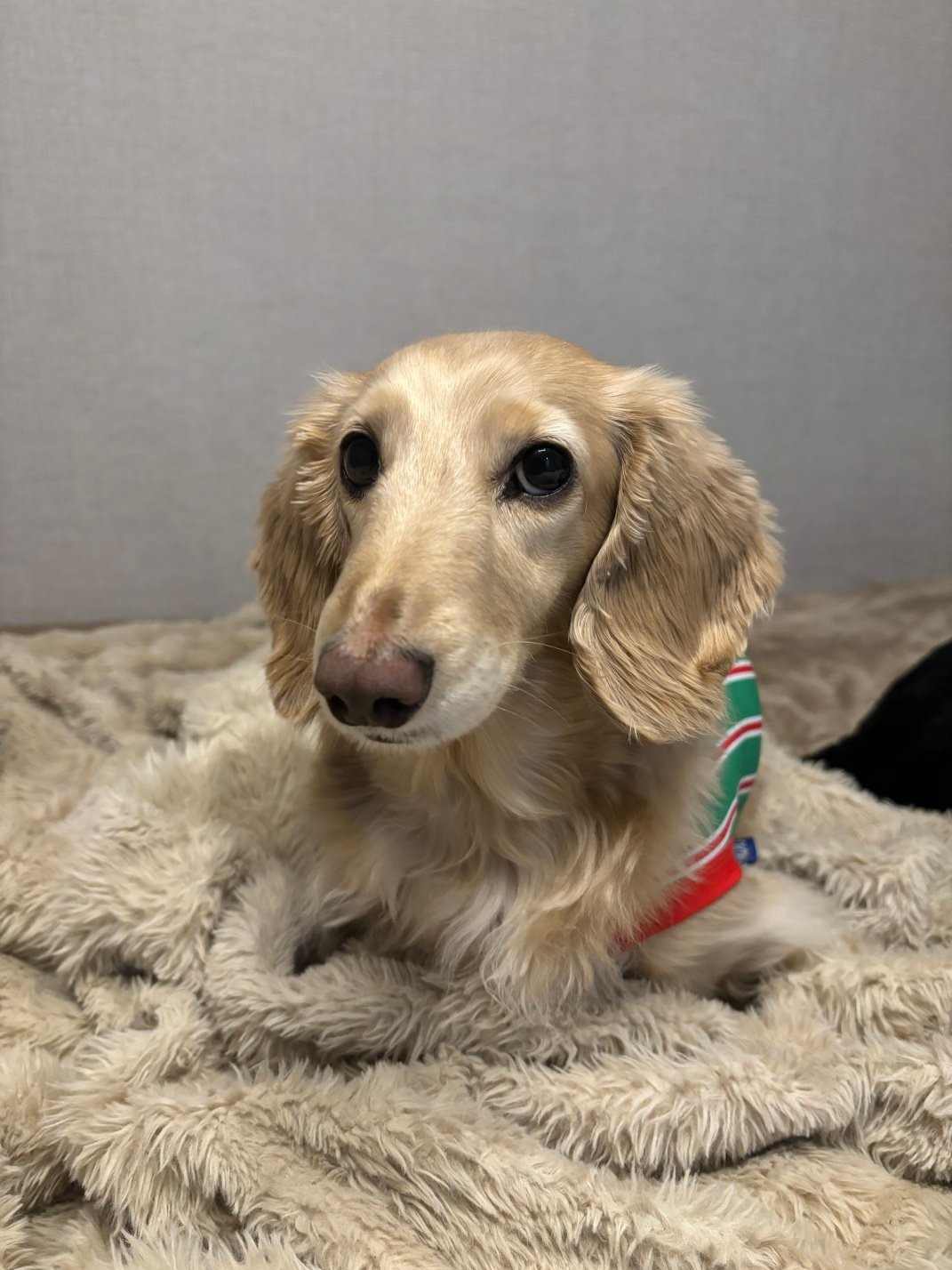
Is a Dandie Dinmont Terrier just a terrier version of a Dachshund?
No, the Dandie Dinmont Terrier is not a variety of Dachshund; the two dogs are separate breeds in different FCI groups. The FCI places the Dandie Dinmont Terrier in Group 3, Terriers, under Section 2 for small-sized terriers. The Dachshund has a group of its own, FCI Group 4, Dachshunds. The American Kennel Club standard describes the Dandie Dinmont Terrier as a dog “originally bred to go to ground,” and the AKC breed page calls it “a tough but dignified little exterminator.”
The Dandie Dinmont Terrier also has a separate history. According to the AKC, the breed developed in the border country between northern England and southern Scotland, in the area once called Northumbria, “since at least the early 1700s.” The breed name comes from a character in Sir Walter Scott’s novel Guy Mannering, published in 1815. A shared long-and-low silhouette is the main thing a Dandie Dinmont Terrier and a Dachshund have in common.
How big is a Dandie Dinmont Terrier compared with a Dachshund?
A Dandie Dinmont Terrier stands 8–11 in (20–28 cm) at the shoulder and weighs 18–24 lb (8–11 kg), so the breed sits at the upper edge of what most owners call a small dog. The AKC, The Kennel Club and the FCI all give the same weight band, and The Kennel Club and FCI add that lower weights are preferred. The UK veterinary charity PDSA lists the Dandie Dinmont Terrier in its medium-dog category.
The Dachshund is measured differently. The FCI standard sorts every Dachshund into one of three sizes by chest girth, measured once the dog is at least 15 months old, rather than by body weight. The three Dachshund size bands in the FCI standard are:
- Standard Dachshund: males over 37 cm up to 47 cm, females over 35 cm up to 45 cm
- Miniature Dachshund: males over 32 cm up to 37 cm, females over 30 cm up to 35 cm
- Rabbit Dachshund: males 27–32 cm, females 25–30 cm
Because the Dandie Dinmont Terrier is weighed and the Dachshund is girthed, a direct pound-for-pound comparison is not possible from the standards alone. The practical point is that a Dandie Dinmont Terrier should not be assumed to fit the carriers, crates or in-cabin travel limits that suit a Miniature Dachshund. Check each airline or product limit against the actual dog.
What does the curved outline of a Dandie Dinmont Terrier mean for its shape?
The curved outline means the Dandie Dinmont Terrier’s topline rises in an arch over the loin instead of running level, which is the breed’s most recognizable feature. The AKC standard calls the Dandie Dinmont Terrier “a long, low-stationed working terrier with a curved outline.” That arch is written into the standard, so a Dandie Dinmont Terrier with a flat back would not match its own breed description.
Body length differs too. Under the AKC and Kennel Club standards, the Dandie Dinmont Terrier’s length from the top of the shoulders to the root of the tail should be 1–2 in less than twice its height. A 10-in Dandie Dinmont Terrier would therefore measure roughly 18–19 in along the body. The FCI Dachshund standard sets the ratio of body length to height at about 1.7–1.8 to 1. Both breeds are clearly long-backed, and the Dandie Dinmont Terrier can run slightly longer relative to its height.
A long back is relevant to health as well as looks. PDSA lists intervertebral disc disease (IVDD) among the health issues seen in the Dandie Dinmont Terrier. Breed lists like this do not predict what any single dog will develop, so consult your veterinarian about back care, weight and activity for your own dog.
Why are Dandie Dinmont Terrier puppies so hard to find?
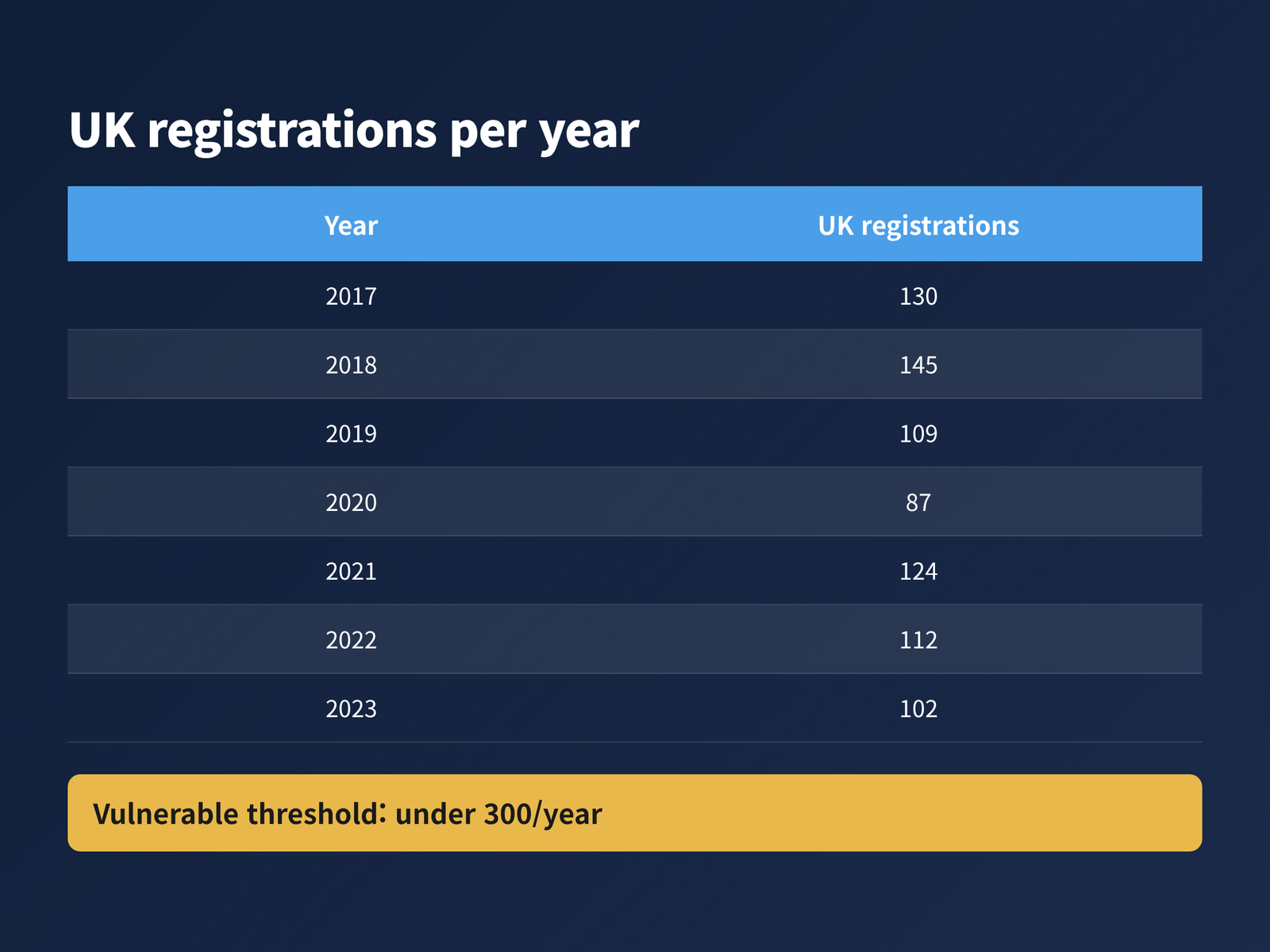
Dandie Dinmont Terrier puppies are hard to find because very few are born each year in both the UK and the US. The Kennel Club treats any native breed with fewer than 300 registrations a year as vulnerable, and the Dandie Dinmont Terrier has stayed far below that line. UK Kennel Club registrations were:
- 2017: 130
- 2018: 145
- 2019: 109
- 2020: 87
- 2021: 124
- 2022: 112
- 2023: 102
The US picture is similar. AKC writer Denise Flaim reports that only 75 Dandie Dinmont Terrier puppies were produced in the United States in 2016, and the breed ranked 180th of 201 breeds in AKC popularity for 2024. The Kennel Club recognized the Dandie Dinmont Terrier as a Vulnerable Native Breed in 2016. Ian Lynch, writing for the AKC, put the situation plainly: “If the Dandie Dinmont Terrier were a wild species, it would be on the endangered list.” The same article notes that “When the war ended, the Dandie never really picked up where they left off.”
How do you find a Dandie Dinmont Terrier breeder?
Finding a Dandie Dinmont Terrier usually means joining a breeder’s waitlist rather than buying an available puppy. The AKC article by Ian Lynch explains: “Once the breeder decides that you would be a good fit as an owner of their breed, you may be put on a waitlist as there might not be any puppies currently available.” Expect a breeder to ask questions about your home before agreeing.
The same AKC piece lists the main search routes: the Canadian Kennel Club Puppy List, AKC Marketplace, and breed club websites and Facebook pages. In the UK, buyers can ask whether a breeder belongs to The Kennel Club Assured Breeder Scheme and request the parents’ screening results, covered in the health section below.
Is a Dandie Dinmont Terrier a poor fit for first-time owners?
A Dandie Dinmont Terrier can be a challenging first dog because its own breed standards describe an independent, determined temperament. The AKC standard uses the words “Independent, determined, reserved and intelligent.” The Kennel Club and FCI standards say “Independent, highly intelligent, determined, persistent, sensitive, affectionate and dignified.” By contrast, the FCI Dachshund standard describes a dog that is “Friendly by nature, neither fearful nor aggressive, with even temperament.”
PDSA adds that Dandie Dinmont Terriers are “intelligent dogs but can be quite stubborn,” may be cautious around strangers and other pets, and benefit from early socialization. PDSA also suggests about one hour of exercise a day. None of that rules out a first-time owner, but a Dandie Dinmont Terrier rewards patient, consistent training more than a quick-start approach. Whether the breed suits your household depends on your time, your other pets and how much training you plan to do.
What health screening should a Dandie Dinmont Terrier breeder show you?
A UK Dandie Dinmont Terrier breeder in the Assured Breeder Scheme should be able to show gonioscopy results for the parent dogs. The Kennel Club states: “Breeders are required to get their stock tested every three years via gonioscopy.” Gonioscopy is an eye examination used to screen breeding dogs for inherited eye disease. In its January 2023 scheme update, The Kennel Club kept gonioscopy as a requirement and moved the general eye examination from required to recommended.
Asking for these results is a reasonable step with any Dandie Dinmont Terrier breeder, inside or outside the UK. A screening certificate describes the parents at the time of testing and is not a guarantee about a puppy. For questions about eye health or back health in a specific dog, consult your veterinarian.
Dandie Dinmont Terrier vs Dachshund at a glance
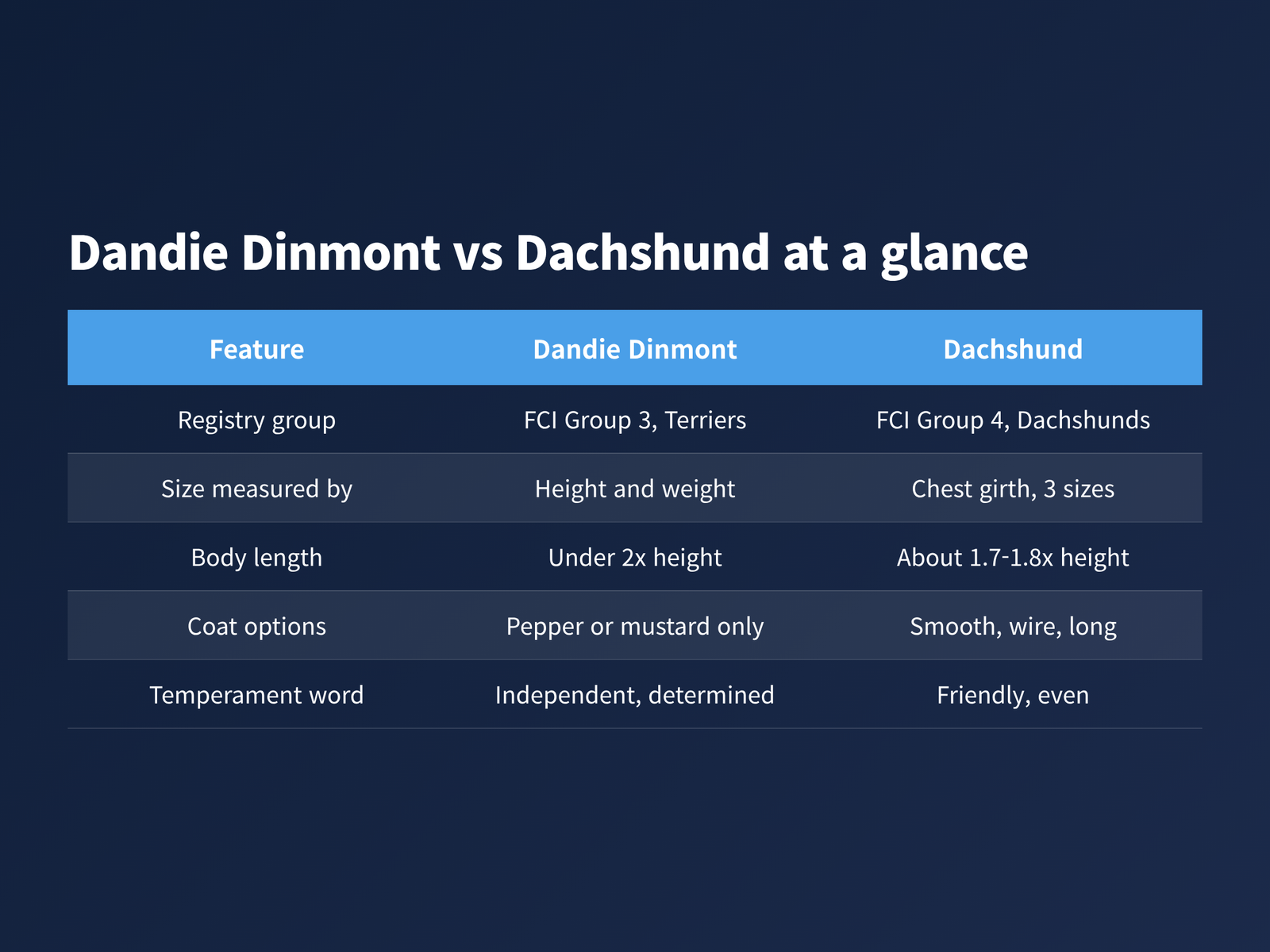
The table below sums up the Dandie Dinmont Terrier vs Dachshund comparison using the AKC, Kennel Club and FCI standards. Each cell is a short summary, so use the sections above for the exact figures, the full standard wording and the registration numbers behind each row.
| Feature | Dandie Dinmont Terrier | Dachshund |
|---|---|---|
| Registry group | FCI Group 3, Terriers | FCI Group 4, Dachshunds |
| Size measured by | Height and weight | Chest girth, 3 sizes |
| Body length | Under 2x height | About 1.7–1.8x height |
| Coat options | Pepper or mustard only | Smooth, wire, long |
| Temperament word | Independent, determined | Friendly, even |
Frequently asked questions
Is a Dandie Dinmont Terrier a small dog? A Dandie Dinmont Terrier is small in height at 8–11 in, but at 18–24 lb it sits at the top of the small-dog range, and PDSA groups the breed with medium dogs rather than small ones.
What colors does a Dandie Dinmont Terrier come in? The AKC and Kennel Club standards allow two colors only: pepper and mustard. The Dachshund, by comparison, comes in three coat varieties under the FCI standard: smooth, wire and long.
Is the Dandie Dinmont Terrier endangered? The Dandie Dinmont Terrier is not a wild species, but The Kennel Club lists it as a Vulnerable Native Breed because UK registrations stay under 300 a year, with only 102 registrations recorded in 2023.
Sources
- American Kennel Club, “Official Standard of the Dandie Dinmont Terrier”, approved February 9, 1991 — https://images.akc.org/pdf/breeds/standards/DandieDinmontTerrier.pdf
- American Kennel Club, “Dandie Dinmont Terrier” breed page — https://www.akc.org/dog-breeds/dandie-dinmont-terrier/
- American Kennel Club, Denise Flaim, “Dandie Dinmont Terrier History”, updated March 28, 2025 — https://www.akc.org/expert-advice/dog-breeds/dandie-dinmont-terrier-history/
- American Kennel Club, Ian Lynch, “Going Rare: The Joys of Owning a Vulnerable Breed”, July 14, 2022 — https://www.akc.org/expert-advice/dog-breeding/going-rare-the-joys-of-owning-a-vulnerable-breed/
- The Kennel Club, “Dandie Dinmont Terrier breed standard” — https://www.thekennelclub.org.uk/breed-standards/terrier/dandie-dinmont-terrier/
- The Kennel Club, “Vulnerable native breeds” — https://thekennelclub.org.uk/vulnerablebreeds
- The Kennel Club, “ABS updates January 2023” — https://thekennelclub.org.uk/media-centre/2023/january/abs-updates-january-2023
- FCI, “Standard No. 168 Dandie Dinmont Terrier”, August 22, 2017 — https://dev.fci.be/Nomenclature/Standards/168g03-en.pdf
- FCI, “Standard No. 148 Dachshund”, May 25, 2021 — https://www.fci.be/Nomenclature/Standards/148g04-en.pdf
- PDSA, “Dandie Dinmont Terrier breed information” — https://www.pdsa.org.uk/pet-help-and-advice/looking-after-your-pet/puppies-dogs/medium-dogs/dandie-dinmont-terrier