Shaving a Shiba Inu fails because the clippers remove both layers of a coat that is built to insulate, shield the skin and shed on its own schedule. A shaved Shiba Inu does not stop shedding, can lose its protection against heat and sun, and may wait months for the coat to return. Below: what the double coat does, how regrowth works, what the breed standard says, and which tools to use instead.
Why does shaving a Shiba Inu fail?
Shaving a Shiba Inu fails because it strips out the insulating undercoat and the protective guard hairs at the same time, without solving the shedding it was meant to fix. Dr. Jerry Klein, Chief Veterinary Officer of the American Kennel Club, warns that shaving a double coat “eliminates that insulating layer of fur, makes the dog susceptible to heat stroke.” Dr. Klein also notes that “a dog’s fur coat protects him from sunburn and decreases his risk of developing skin cancer.”
The cooling argument behind a summer shave does not hold up either. Teri Becker DiMarino, President of the California Professional Pet Groomers Association, told the AKC: “Shaving doesn’t do anything to cool dogs off because a dog’s cooling system is different than ours.” Groomer Dale Martins adds in AKC guidance that shaving “doesn’t eliminate shedding, but it does damage the topcoat.” A shaved Shiba Inu still sheds, only now with less protection.
What does a Shiba Inu’s double coat actually do?
A Shiba Inu’s double coat works as two layers with two jobs: a stiff outer coat that repels dirt and water, and a soft, thick undercoat that insulates. The AKC Official Standard of the Shiba Inu describes the breed as “double coated with the outer coat being stiff and straight and the undercoat soft and thick.” The guard hair measures about 1½ to 2 inches at the withers.
The AKC explains that the undercoat is “made of shorter secondary hairs, sometimes called wool,” and that it traps warmth close to the body in colder months. A Shiba Inu stands 14½ to 16½ inches at the withers for males and 13½ to 15½ inches for females, and clippers cannot remove one layer of that compact coat while sparing the other.
Will a shaved Shiba Inu coat grow back the same?
A shaved Shiba Inu coat usually grows back, but the regrowth is slow, variable, and not always even. Sheila M.F. Torres, DVM, DACVD, writes in the Small and Large Animal Dermatology Handbook that coat regrowth after close clipping generally takes 3 to 4 months, while some dogs need 12 to 24 months. In most cases, regrowth happens within one year. The handbook names this delayed regrowth post-clipping alopecia and notes that it shows up more often in plush-coated breeds.
Dr. Torres explains that “it is speculated that skin temperature changes after clipping may induce most hair at the shaved area to enter telogen,” the resting phase of the hair cycle. The AKC adds a second problem: “the undercoat hair will grow back faster, and sometimes will crowd out the slower-growing guard hairs.” If a Shiba Inu has already been shaved and the coat is slow to return, or the bare skin looks sunburned, consult your veterinarian or a professional groomer before changing anything.
Does the Shiba Inu breed standard allow trimming?
No. The AKC Official Standard of the Shiba Inu states: “Trimming of the coat must be severely penalized.” For a show Shiba Inu, a trimmed coat is a serious fault in the ring, not a cosmetic choice left to the owner.
The standard governs show dogs, yet the guidance for pet owners points the same way. The Kennel Club in the UK lists the Japanese Shiba Inu’s grooming needs as “once a week,” with a short coat that sheds. Neither the AKC nor The Kennel Club presents shaving as routine care for a Shiba Inu.
Undercoat rake or slicker brush – which suits a Shiba Inu coat?
A Shiba Inu coat benefits from both tools: a slicker brush for routine weekly care, and an undercoat rake for pulling loose undercoat during heavy shedding. The AKC recommends brushing a double coat with a slicker brush and then a comb at least once a week. Slicker brushes come in three strengths, and the AKC suggests the medium strength for adult dogs and the soft one for puppies.
An undercoat rake has, in the AKC’s words, “one or two rows of metal pins designed to penetrate through to the undercoat.” The AKC adds that “you must choose the correct pin length for your dog’s coat length.” For a Shiba Inu, that means matching the pins to a guard coat of roughly 1½ to 2 inches. The AKC also notes that pressing a slicker brush hard can cause discomfort.
Are blade-style deshedding tools a bad idea on a Shiba Inu?
Blade-style deshedding tools are not banned for a Shiba Inu, but the AKC advises gentle pressure when using them. The AKC’s shedding guidance says a coat rake or de-shedding tool “can help remove large amounts of loose undercoat hair,” and calls for a light hand “especially with blade-style tools.”
During the shedding season, which the AKC places in spring and fall, a double-coated dog may need brushing several times a week or even daily. The AKC says a shedding season can last “a few weeks to a couple of months.” Before any deshedding tool, remove tangles with a steel comb or a mat splitter. The AKC also warns against “combs with bent teeth, which can snag or damage the coat.”
How do grooming tools compare with shaving a Shiba Inu?
Brushing tools remove loose undercoat while leaving the coat structure in place, while clippers remove the topcoat and undercoat together. The table below summarizes the AKC’s descriptions of each tool and the main caution to keep in mind for a Shiba Inu coat.
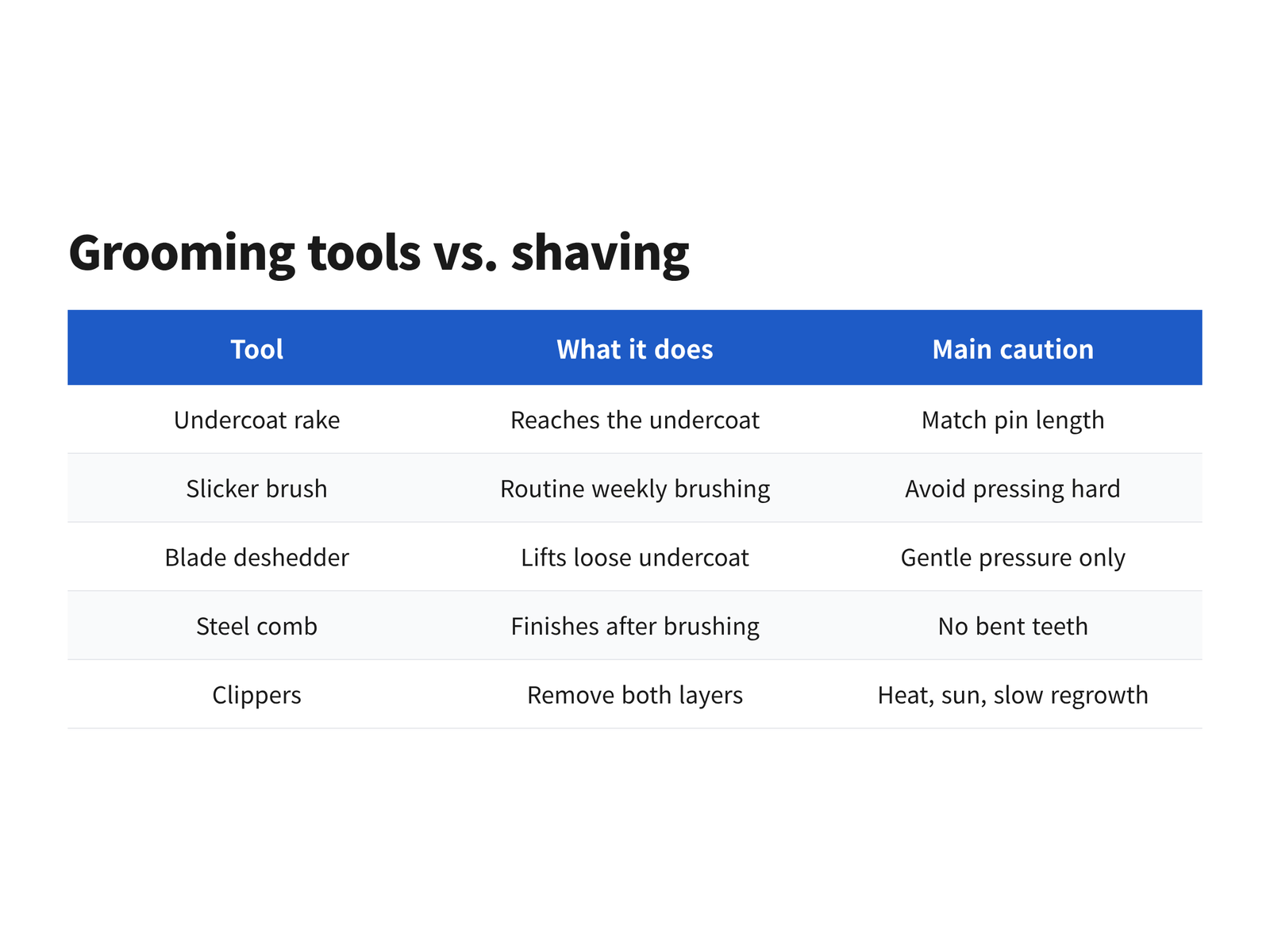
| Tool | What it does | Main caution |
|---|---|---|
| Undercoat rake | Reaches the undercoat | Match pin length |
| Slicker brush | Routine weekly brushing | Avoid pressing hard |
| Blade deshedder | Lifts loose undercoat | Gentle pressure only |
| Steel comb | Finishes after brushing | No bent teeth |
| Clippers | Remove both layers | Heat, sun, slow regrowth |
Bathing is the other half of coat care. Dale Martins cautions in AKC guidance that “bathing too often can deplete your dog’s natural oils and dry out their skin and coat.” For a Shiba Inu, steady brushing does more for shedding than extra baths or a shave.
When is clipping a Shiba Inu actually justified?
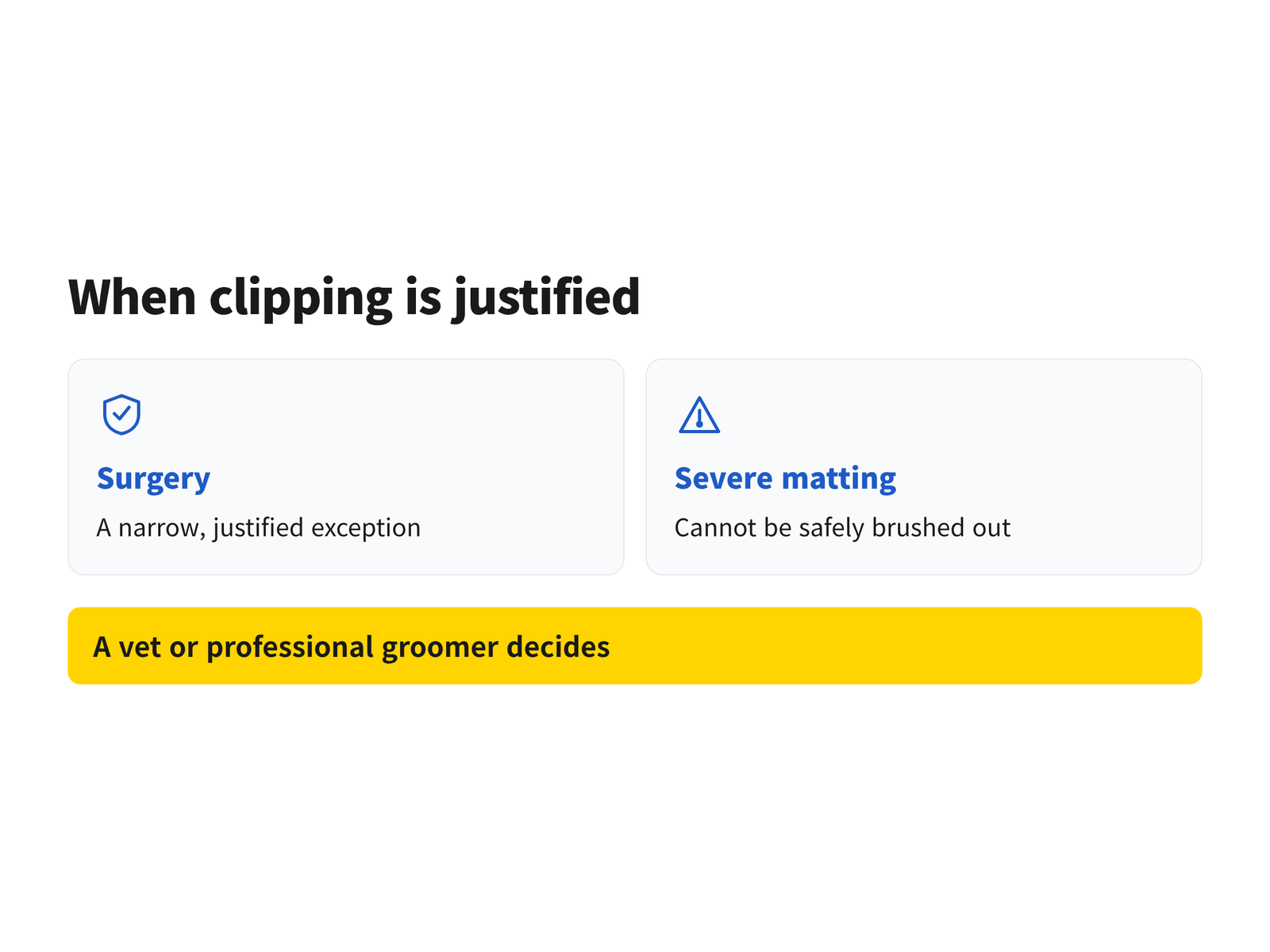
Clipping a Shiba Inu is justified only in narrow cases, such as surgery or matting too severe to brush out safely. Teri Becker DiMarino told the AKC that there are “generally only two reasons to shave a dog”: surgery, or severe matting that cannot be safely brushed out. Dale Martins gives a similar exception for coats with heavy tangles and thick build-up.
Even then, the ASPCA advises owners to “never shave down to the skin.” If a Shiba Inu has mats close to the skin, a wound, or a planned procedure, consult your veterinarian or a professional groomer about how much coat to remove and how to protect the exposed skin afterward.
Frequently asked questions
Should you shave a Shiba Inu in summer?
No. AKC experts say shaving a double coat does not cool a dog and removes protection against heat and sunburn. Regular brushing to clear loose undercoat, with a slicker brush and comb at least once a week, is the safer summer routine for a Shiba Inu.
What should you avoid while a Shiba Inu is blowing coat?
Avoid shaving, heavy pressure with blade-style tools, and combs with bent teeth. The AKC suggests brushing several times a week or daily during heavy shedding, after working out tangles with a steel comb or a mat splitter. Light pressure matters most with blade-style tools.
How often does a Shiba Inu need brushing?
The Kennel Club in the UK lists once a week for the Japanese Shiba Inu, and the AKC suggests at least weekly brushing for double coats, rising to several times a week or even daily during the spring and fall shedding seasons.
Sources
- American Kennel Club, “Is It OK to Shave Your Dog’s Coat in Summer?”, updated 2026-03-27 — https://www.akc.org/expert-advice/health/is-it-ok-to-shave-your-dog/
- American Kennel Club, “How Should You Groom a Double-Coated Dog?”, updated 2024-11-19 — https://www.akc.org/expert-advice/health/how-to-groom-a-double-coated-dog/
- American Kennel Club, “What Is a Double-Coated Dog?”, updated 2026-10-06 — https://www.akc.org/expert-advice/dog-breeds/double-coated-dog-breeds/
- American Kennel Club, “Dog Brushes: How to Choose the Right Dog Brush”, updated 2026-03-03 — https://www.akc.org/expert-advice/health/types-dog-brushes-shedding/
- American Kennel Club, “Dog Shedding: When Dogs Shed Most”, updated 2026-08-05 — https://www.akc.org/expert-advice/health/dog-shedding-what-to-expect-and-how-to-manage-it/
- American Kennel Club, “Official Standard of the Shiba Inu”, approved 1997-02-07 — https://images.akc.org/pdf/breeds/standards/ShibaInu.pdf
- The Kennel Club (UK), “Japanese Shiba Inu” breed page, accessed 2026-10-13 — https://www.thekennelclub.org.uk/search/breeds-a-to-z/breeds/utility/japanese-shiba-inu/
- Sheila M.F. Torres, “Canine Post-clipping Alopecia”, Small and Large Animal Dermatology Handbook Vol. 2, University of Minnesota, 2025 — https://open.lib.umn.edu/animaldermatology2/chapter/canine-post-clipping-alopecia/
- ASPCA, “Should You Shave Your Pet This Summer?”, 2020-08-11 — https://www.aspca.org/news/should-you-shave-your-pet-summer