The small breed dog food vs regular question has a narrower answer than most marketing suggests. Under AAFCO-based label rules, “small breed” is a limited-purpose claim about dog size, not a separate nutrient standard. An adult small-breed formula has to meet the same adult maintenance profile as any other complete adult food. The differences that matter sit elsewhere on the bag: the nutritional adequacy statement, the life stage, the calorie content and the feeding chart.
Is small breed dog food actually different from regular adult dog food?
Small breed dog food is not held to a different nutrient standard than regular adult dog food. The U.S. FDA Center for Veterinary Medicine explains that a “complete and balanced” food must either meet an AAFCO Dog Food Nutrient Profile or pass a feeding trial run under AAFCO procedures. The FDA describes only two dog profiles: growth and reproduction, and adult maintenance. Neither profile is split by body size.
The size wording sits on top of that framework. The Washington Administrative Code, which adopts the AAFCO model rules, treats a claim such as “size of dog” as a limited purpose that must be qualified on the label. The only size-specific nutrient distinction in those rules covers growth of large size dogs, meaning dogs expected to reach 70 lb or more as adults. A small-breed adult formula and a regular adult formula can therefore meet the identical adult maintenance profile.
That does not make a small dog’s needs identical to a large dog’s. The American Kennel Club notes that “despite their small size, small and toy breed dogs might need more calories per pound than large-breed dogs.” That is a fact about the dog, not a separate label standard for the food.
What does “small breed” on a dog food label not guarantee?
A “small breed” label does not guarantee that the food was built on a separate small-dog nutrient profile, because no such AAFCO profile exists. Under WAC 16-252-044, a food marketed for a limited purpose such as dog size must print that qualifier on the same panel, in the same size, style and color as the “complete and balanced” claim. Only a food for all life stages and sizes may use “complete and balanced” with no qualifier.
The American Kennel Club, citing the FDA, adds that “there is little information as to the true dietary needs of these more specific uses.” The “small breed” phrase tells a shopper who the food is marketed to. It does not confirm a calorie level, a kibble size, or that the portion printed on the bag suits a particular small dog. The nutritional adequacy statement is the line that carries the regulated information.
Why isn’t an “all life stages” food automatically right for a small adult dog?
An “all life stages” food meets growth-level nutrient minimums, so an adult small dog receives levels set for puppies and reproducing dogs. The American Kennel Club lists four life stages that can appear on a label: gestation and lactation, growth, maintenance, and all life stages. A food labeled for all life stages has to satisfy the most demanding of these.
Cailin Heinze, VMD, a board-certified veterinary nutritionist quoted by Tufts Your Dog, says those growth-level amounts “may be overkill” for an average adult, while also noting that “a healthy grown dog will not be hurt by the higher amounts.” The practical issue for a small adult dog is calories. Tufts Your Dog reports that growth and all-life-stages foods are often higher in calories than adult maintenance foods. For a small dog that needs to hold or lose weight, comparing the calorie statement on each bag is more useful than the life-stage phrase alone.
Should a small-dog owner worry about the “except for growth of large size dogs” line?
No, the “except for growth of large size dogs” line is not a warning for a small-dog owner. WAC 16-252-044 requires any food labeled for “Growth” or “All Life Stages” to state either “& including growth of large size dogs (70 lb. or more as an adult)” or “& except for growth of large size dogs (70 lb. or more as an adult).” Tufts Petfoodology reported this requirement when AAFCO introduced it around 2016 to 2017.
The clause only concerns puppies expected to reach 70 lb or more as adults. A small-breed puppy or adult falls well outside that group, so the “except” wording says nothing negative about the food for a Chihuahua, a Maltese or a Toy Poodle.
How do you read the nutritional adequacy statement on a small dog’s food?
The nutritional adequacy statement shows whether a food is complete and balanced, for which life stage, and how that was established. The WAC rules allow two routes: “formulated to meet” an AAFCO nutrient profile, or “animal feeding tests using AAFCO procedures.” A food that does not meet complete nutrition must say it is “intended for intermittent or supplemental feeding only,” and that product should not be the dog’s sole diet.
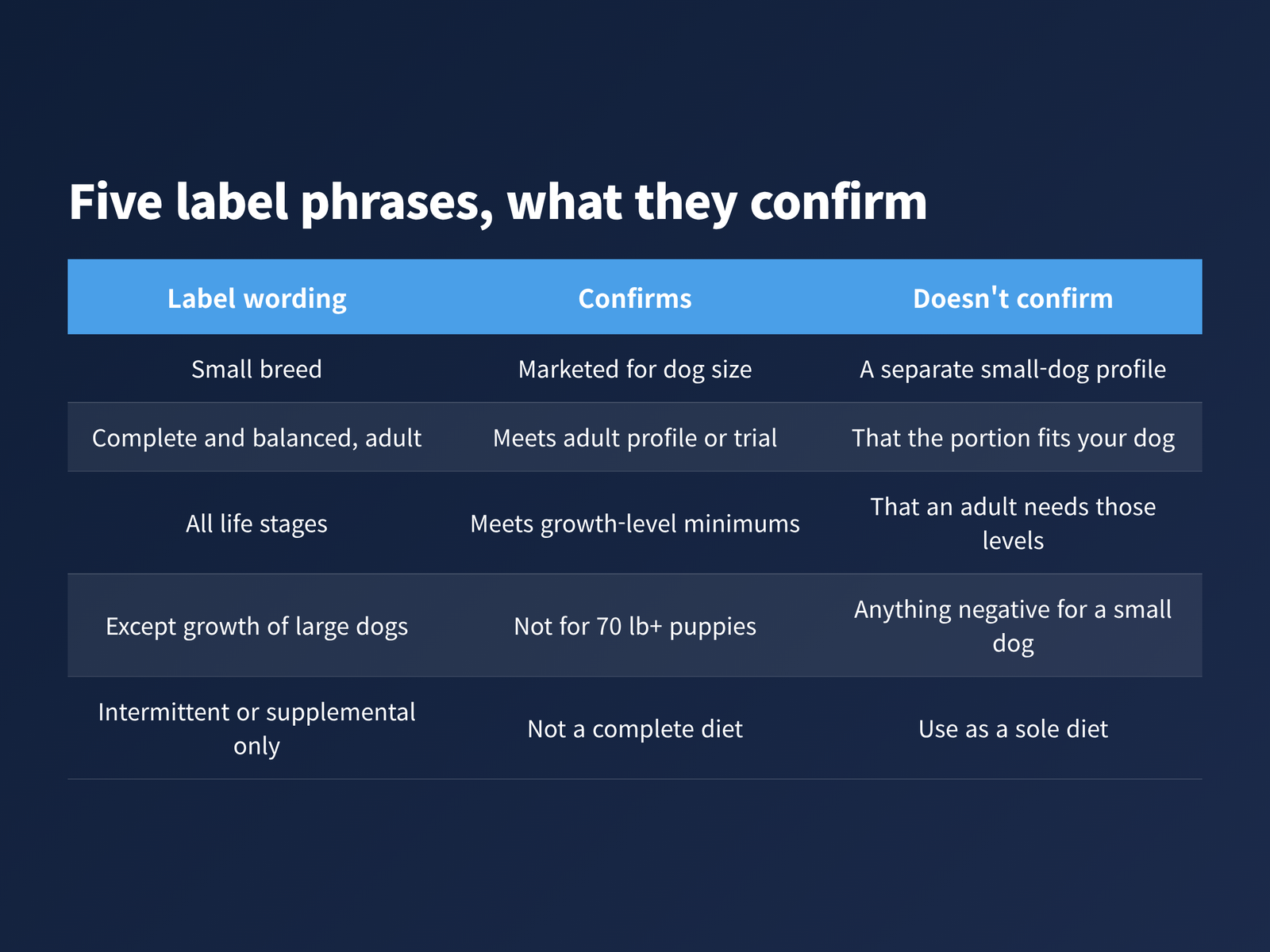
The FDA Center for Veterinary Medicine also requires certain basics on every pet food label: the product identity, net quantity, the name and address of the manufacturer or distributor, and a full ingredient list. The table below summarizes the most common wording.
| Label wording | What it confirms | What it doesn’t confirm |
|---|---|---|
| “small breed” | Marketed for dog size | A separate small-dog profile |
| “complete and balanced for adult maintenance” | Meets adult profile or trial | That the portion fits your dog |
| “all life stages” | Meets growth-level minimums | That an adult needs those levels |
| “except for growth of large size dogs” | Not for 70 lb+ puppies | Anything negative for a small dog |
| “intermittent or supplemental feeding only” | Not a complete diet | Use as a sole diet |
Why can the feeding chart on the bag miss for a small dog?
The feeding chart on the bag can miss because AAFCO does not standardize how those portions are calculated. The 2021 AAHA Nutrition and Weight Management Guidelines state that “in an ideal world, the pet owner will perform RER/MER calculations rather than relying solely on package guidelines because AAFCO does not standardize this process.” The American Kennel Club puts it more simply: “Feeding directions are guidelines, not regulations.”
Individual variation is the second reason. A 2023 study using pet food company data, by Jewell and Jackson in Frontiers in Veterinary Science, reported an average intake of 747 kcal per day with a standard deviation of 198.7 kcal, and found that differences between dogs outweighed errors in estimating the food’s energy. A 2014 meta-analysis in PLoS ONE by Bermingham and colleagues concluded that “estimating maintenance energy requirements based on BW alone may not be accurate,” and found lower energy needs after neutering.
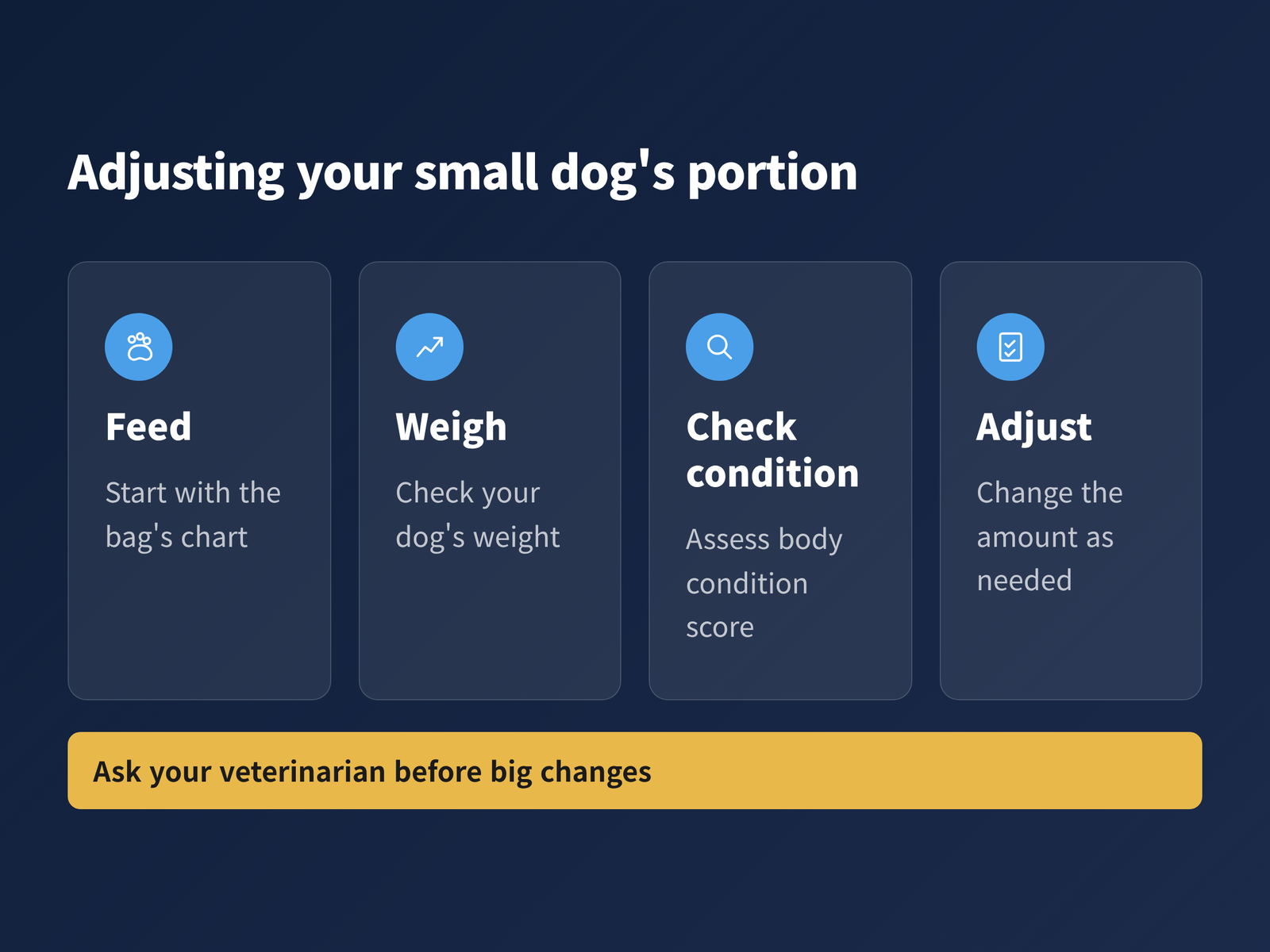
The workable approach is to treat the chart as a starting point, feed, check body weight and body condition, then adjust. AAHA recommends a 9-point body condition score scale for that check. AAHA also advises keeping treats and extras to no more than 10 percent of daily calories, a share a small dog can reach quickly. Consult your veterinarian before changing your dog’s diet or feeding amounts, especially if your dog needs to gain or lose weight.
When does a small-breed puppy usually move to an adult diet?
Small and medium breed puppies usually stay on a growth diet until approximately one year of age, according to the 2021 AAHA guidelines. A 2004 study in The Journal of Nutrition by Hawthorne and colleagues found that larger breeds have a longer growth period than smaller breeds, which is why the switch point depends on expected adult size.
Meal frequency for young small-breed puppies varies by source. The American Kennel Club suggests four to six meals a day, while The Royal Kennel Club suggests up to four. Because the guidance differs, the meal schedule and the switch to adult food are worth settling with a veterinarian during puppy visits.
Does kibble size matter for a small dog?
Kibble size matters for a small dog mainly because pieces that are too large may not be chewed properly. The Royal Kennel Club notes that “if the kibble size is too big, your dog may try to swallow it without chewing it fully.” Kibble size is a physical feature of the product, not a nutritional claim on the label.
An owner comparing a small-breed bag with a regular adult bag can separate two questions. The nutritional adequacy statement and calorie content show whether the food suits an adult dog. The kibble size shows whether a small mouth can manage it.
Frequently asked questions
Can a small dog eat regular adult dog food?
A small adult dog can eat a regular adult food that is labeled complete and balanced for adult maintenance, since small-breed adult formulas meet that same profile. Kibble size and calorie content are the practical points to compare.
Is “all life stages” food bad for an adult small dog?
Not necessarily. Cailin Heinze, VMD, notes that a healthy adult “will not be hurt by the higher amounts,” but these foods are often higher in calories, so weight is worth watching.
What do names like “chicken dinner” or “with beef” mean?
The American Kennel Club describes a 95% rule for single-ingredient names, a 25% rule for terms like “dinner” or “entree,” at least 3% for “with,” and no required percentage for “flavor.”
Sources
- U.S. FDA Center for Veterinary Medicine, “Complete and Balanced” Pet Food, content current 2020-02-28 – https://www.fda.gov/animal-veterinary/animal-health-literacy/complete-and-balanced-pet-food
- U.S. FDA Center for Veterinary Medicine, “Animal Food Labeling and Pet Food Claims”, content current 2026-03-02 – https://www.fda.gov/animal-veterinary/animal-foods-feeds/animal-food-labeling-and-pet-food-claims
- Washington Administrative Code, “WAC 16-252-044 Nutritional adequacy” (adopts AAFCO model rules), via Cornell LII – https://www.law.cornell.edu/regulations/washington/WAC-16-252-044
- American Kennel Club, “How to Read a Dog Food Label” (Jan Reisen), updated 2026-03-10 – https://www.akc.org/expert-advice/nutrition/what-do-dog-food-labels-really-mean/
- American Kennel Club, “Best Dog Food for Small Breeds: What to Know” (Anna Burke), updated 2026-03-10 – https://www.akc.org/expert-advice/nutrition/small-breed-dog-food/
- The Royal Kennel Club, “Small dogs’ diet”, 2026 – https://www.royalkennelclub.com/health-and-dog-care/health-dog-care/health/health-and-care/a-z-of-health-and-care-issues/small-dogs-diet
- Cline MG et al., “2021 AAHA Nutrition and Weight Management Guidelines for Dogs and Cats”, Journal of the American Animal Hospital Association 57(3):153-174, 2021 – http://www.aaha.org/wp-content/uploads/globalassets/02-guidelines/2021-nutrition-and-weight-management/resourcepdfs/new-2021-aaha-nutrition-and-weight-management-guidelines-with-ref.pdf
- Bermingham EN et al., “Energy requirements of adult dogs: a meta-analysis”, PLoS ONE 9(10):e109681, 2014 – https://doaj.org/article/6f478857d8134ef6a75d704460ece267
- Jewell DE, Jackson MI, “Predictive equations for dietary energy are improved when independently developed for dry and wet food”, Frontiers in Veterinary Science, 2023 (pet food company data; author affiliation disclosed) – https://www.frontiersin.org/journals/veterinary-science/articles/10.3389/fvets.2023.1104695/pdf
- Hawthorne AJ et al., “Body-weight changes during growth in puppies of different breeds”, The Journal of Nutrition 134(8):2027S-2030S, 2004 – https://pureportal.strath.ac.uk/en/publications/body-weight-changes-during-growth-in-puppies-of-different-breeds/
- Tufts Cummings School, Petfoodology, “Confused About What to Feed Your Large Breed Puppy? New Rules May Help!” (Deborah E. Linder, DVM), 2017-02-24 – https://sites.tufts.edu/petfoodology/?p=8948
- Tufts Your Dog, “How Can a Dog Food Be ‘For All Life Stages?'” (quoting Cailin Heinze, VMD) – https://tuftsyourdog.com/?p=40854