The short answer to why you shouldn’t pour dog food into a storage container is that the original bag carries information and protection a bare bin does not. The U.S. Food and Drug Administration (FDA) and the American Veterinary Medical Association (AVMA) both advise keeping dry food in its original bag, below 80 F, and placing the whole bag inside a clean container if a container is used. For small dogs, one bag can stay open for a long time, which makes the storage setup matter more.
Why do the FDA and AVMA say to keep kibble in its original bag?
The FDA and AVMA say to keep kibble in its original bag because the bag carries the lot number and the best-by date that identify the food. The FDA guidance on proper storage of pet food is direct: “Store pet food and treats in the original container or bag.” The AVMA adds a practical layer: “If possible, store dry pet food in its original bag inside a clean, dedicated, airtight container.”
The FDA also tells owners to keep the top of the bag tightly folded down between meals. In other words, the bin is an extra layer around the bag, not a replacement for the bag. The AVMA asks owners to keep the label panel that shows the manufacture date and lot number, which only works if the bag or that panel survives.
What goes wrong when you pour kibble straight into a plastic container?
Pouring kibble straight into a plastic container removes the recall trail and lets old fat and crumbs build up. Without the lot number, an owner cannot match the food in the bin to a recall notice. The FDA notes that fewer than half of the pet food complaints it receives include the lot number, which shows how often that detail is already lost.
The second problem is residue. The FDA advises washing and drying a container between bags to remove residual fat and crumbs, so a bin that is simply topped up carries the old layer into the new food. If pouring out is unavoidable, the FDA says the container must be clean, dry and fitted with a snug lid. Many households use an airtight lidded bin for this, and the safest way to use that bin is with the bag still inside it.
How long can an opened bag of dry food sit when a small dog eats slowly?
No FDA, AVMA or peer-reviewed source reviewed here gives a fixed number of weeks for an opened bag of dry dog food. What the sources do describe is how the risk grows with time, heat and humidity. A small dog eats less than a large dog, so the same bag empties more slowly and stays open longer. Feeding amounts differ by food and by dog, so the feeding guide printed on the bag is the place to check how long a bag is likely to last.
A 2008 study in Veterinary Dermatology by Brazis and colleagues opened bags of commercial dry dog food and stored them for six weeks under two conditions. Under warm, humid storage of about 23 C (23.2 +/- 2.1 C) and 71% relative humidity, 9 of 10 bags had storage mites by week five, compared with mites in 1 of 10 bags at opening. The authors concluded that “dry dog food can be a suitable substrate for storage mite reproduction.”
The same research area also has a calmer finding. A 2019 review in BMC Veterinary Research by Olivry and Mueller examined 10 articles (5 laboratory, 5 field studies) and reported little or no mite overgrowth when bags were kept indoors in temperate conditions. The review also states that “SM contamination usually is undetectable in newly-opened commercial dog foods.” For a small dog, the practical takeaway is to keep a slowly used bag sealed, cool and dry rather than to panic about every open bag.
Does the storage spot matter for dry dog food?
Yes, the storage spot matters because the FDA sets a limit of less than 80 F for dry pet food and asks for a cool, dry place. The FDA explains the reason plainly: “Excess heat or moisture may cause the nutrients to break down.” The AVMA repeats the same 80 F limit.
Warm or humid spots in a home are the ones to avoid, especially for a bag that will stay open for weeks. Olivry and Mueller report that storage mites do not bore through packaging but enter through defective seals, and that mite growth rises with heat, humidity, crushed kibble and mould. A cool cupboard with the bag top folded down tightly addresses several of those factors at once. The FDA also advises keeping the food where the dog cannot get into the whole supply.
Original bag, bag inside a bin, or loose in a bin – which is safer?
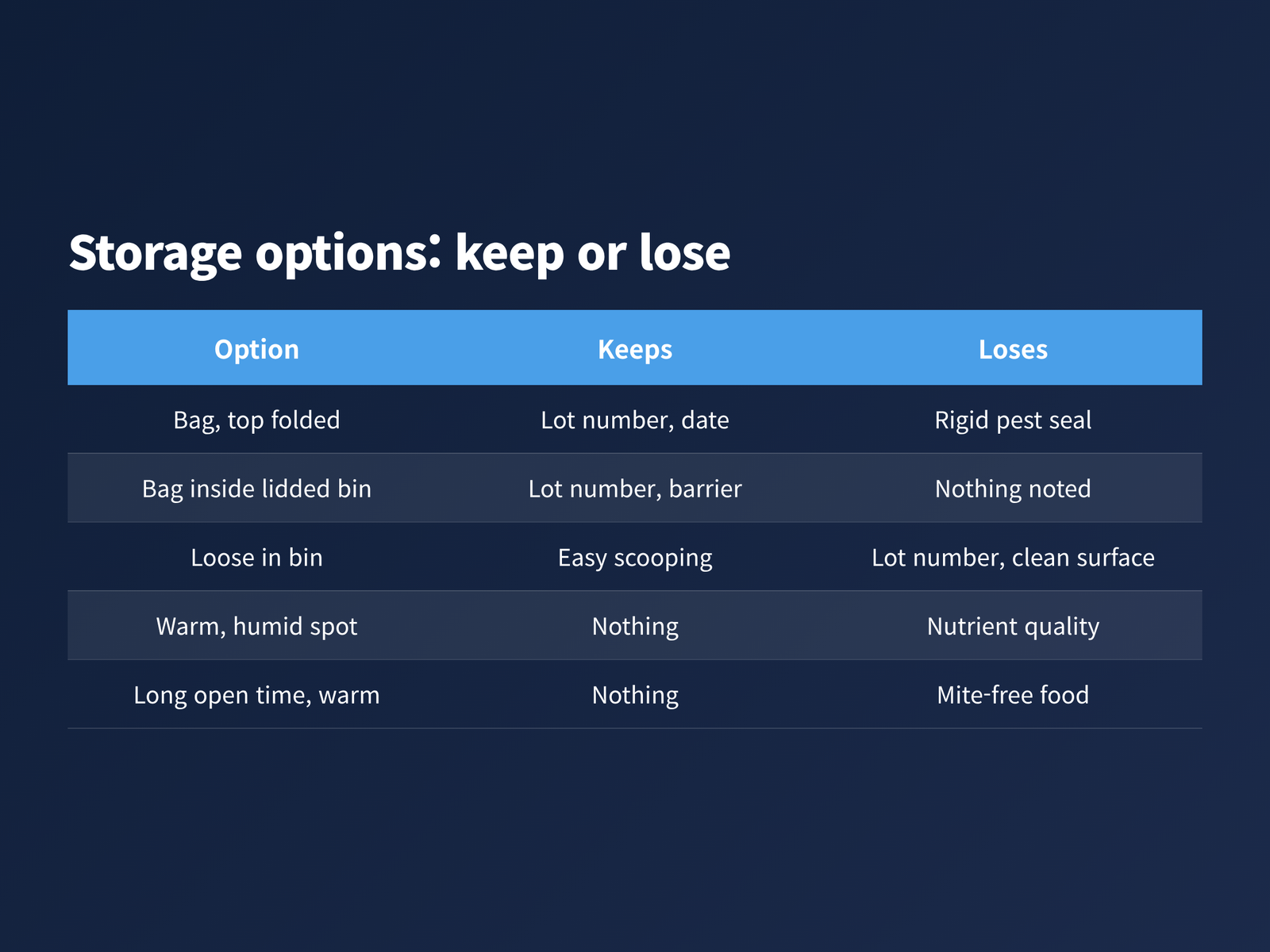
The bag placed whole inside a clean, lidded bin is the setup the FDA and AVMA describe as best. The original bag on its own still keeps the lot number and date, while loose kibble in a bin loses both unless the owner records them. The table below summarizes the trade-offs drawn from FDA guidance, the AVMA and the Brazis 2008 study.
| Option | Keeps | Loses |
|---|---|---|
| Bag, top folded | Lot number, date | Rigid pest seal |
| Bag inside lidded bin | Lot number, barrier | Nothing noted |
| Loose in bin | Easy scooping | Lot number, clean surface |
| Warm, humid spot | Nothing | Nutrient quality |
| Long open time, warm | Nothing | Mite-free food |
When buying a new bag, the FDA advises skipping any bag with dents, tears or discolouration. A damaged bag can already have a broken seal, which is the entry route Olivry and Mueller describe for storage mites. Checking the bag in the store is the first step of the routine below.
What should you keep from the bag before you throw it away?
If kibble has to be poured out, the FDA says to keep five details from the bag taped to the outside of the container. Those five details are the UPC, the lot number, the product name, the manufacturer and the best-by date. Bag layouts differ, so it is worth checking that every one of these details has been copied or kept before the empty bag goes in the trash.
Those details help an owner identify exactly which product is in the bin. Without the lot number, it is harder to match the food to a recall, and the FDA notes that fewer than half of pet food complaints include it. The AVMA makes a similar point when it asks owners to keep the label panel with the manufacture date and lot number. Keeping that information until the last scoop is used is a simple habit that makes later questions about the food easier to answer.
What does a safer kibble storage routine look like?
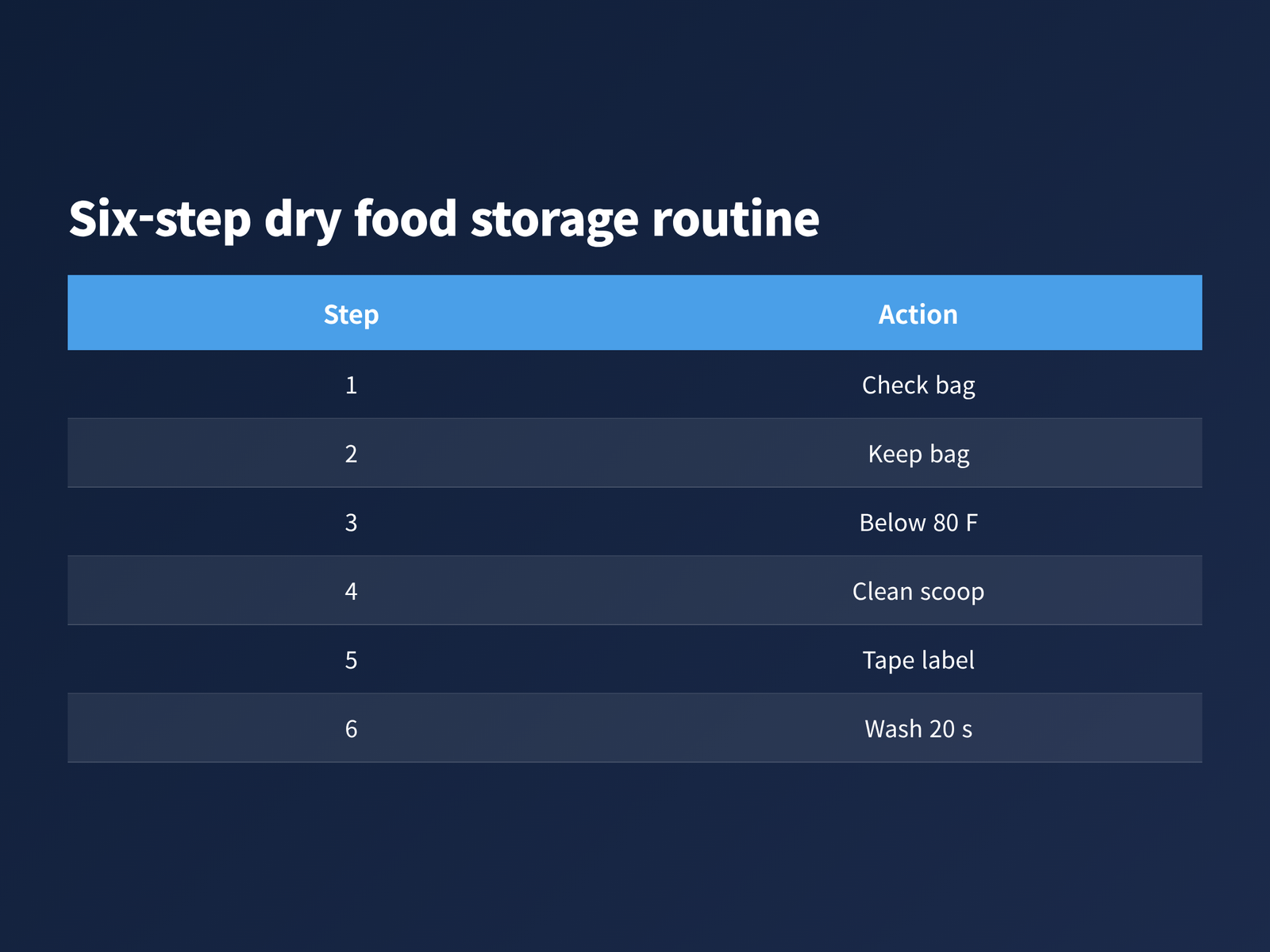
A safer kibble storage routine follows six steps taken from FDA and AVMA guidance. The routine works for any small dog, from a Chihuahua to a Bichon Frise, because it depends on the bag and the room rather than the breed.
- Check the bag at purchase for tears, dents or discolouration.
- Keep kibble in the original bag with the top folded down tightly, or drop the whole bag into a lidded bin.
- Store the bag in a cool, dry place below 80 F.
- Use a dedicated scoop and wash it after each use.
- If food is poured out, tape the UPC, lot number, product name, manufacturer and best-by date to the bin, and wash and dry the bin before refilling.
- Wash hands for at least 20 seconds after handling pet food.
The FDA adds one more habit: “Do not use your pet’s food bowl as a scooping or measuring utensil.” Handwashing matters for people too. The Centers for Disease Control and Prevention (CDC) lists children under 5 and adults 65 and older as groups at higher risk from germs in pet food, so homes with young children or older adults have extra reason to follow the 20-second rule.
Frequently asked questions
Is an airtight container bad for dog food?
An airtight container is not bad for dog food when the original bag goes inside it. The AVMA describes that exact setup as the preferred one. The problem starts when the kibble is poured loose and the bag, with its lot number, is thrown away.
Can splitting a large bag into smaller containers help a small dog household?
None of the FDA, AVMA or study sources reviewed here tests splitting a bag. Any container used for kibble still needs to be clean, dry and lidded, with the label details from the original bag recorded on it, according to the FDA.
Should I worry about storage mites in a newly opened bag?
Olivry and Mueller report that storage mite contamination is usually undetectable in newly opened commercial dog food, and that temperate indoor storage shows little or no overgrowth. If you have concerns about your dog’s diet or skin, consult your veterinarian.
Sources
- U.S. Food and Drug Administration, Center for Veterinary Medicine, “Proper Storage of Pet Food & Treats”, content current as of 2024-05-23 – https://www.fda.gov/animal-veterinary/animal-health-literacy/proper-storage-pet-food-treats
- U.S. Food and Drug Administration, “Tips for Safe Handling of Pet Food and Treats”, 2024-05-23 – https://www.fda.gov/animal-veterinary/animal-health-literacy/tips-safe-handling-pet-food-and-treats
- American Veterinary Medical Association, “Safe handling of pet food and pet treats” – https://www.avma.org/resources-tools/pet-owners/petcare/safe-handling-pet-food-and-pet-treats
- Centers for Disease Control and Prevention, “About Pet Food Safety”, 2025-01-30 – https://www.cdc.gov/healthy-pets/about/pet-food-safety.html
- Brazis P. et al., “Evaluation of storage mite contamination of commercial dry dog food”, Veterinary Dermatology 19(4):209-214, 2008 – https://pubmed.ncbi.nlm.nih.gov/18494758/
- Olivry T., Mueller R.S., “Critically appraised topic on adverse food reactions of companion animals (8): storage mites in commercial pet foods”, BMC Veterinary Research 15, 2019 – https://doaj.org/article/2b334a390b264730906788aba5bc5b59