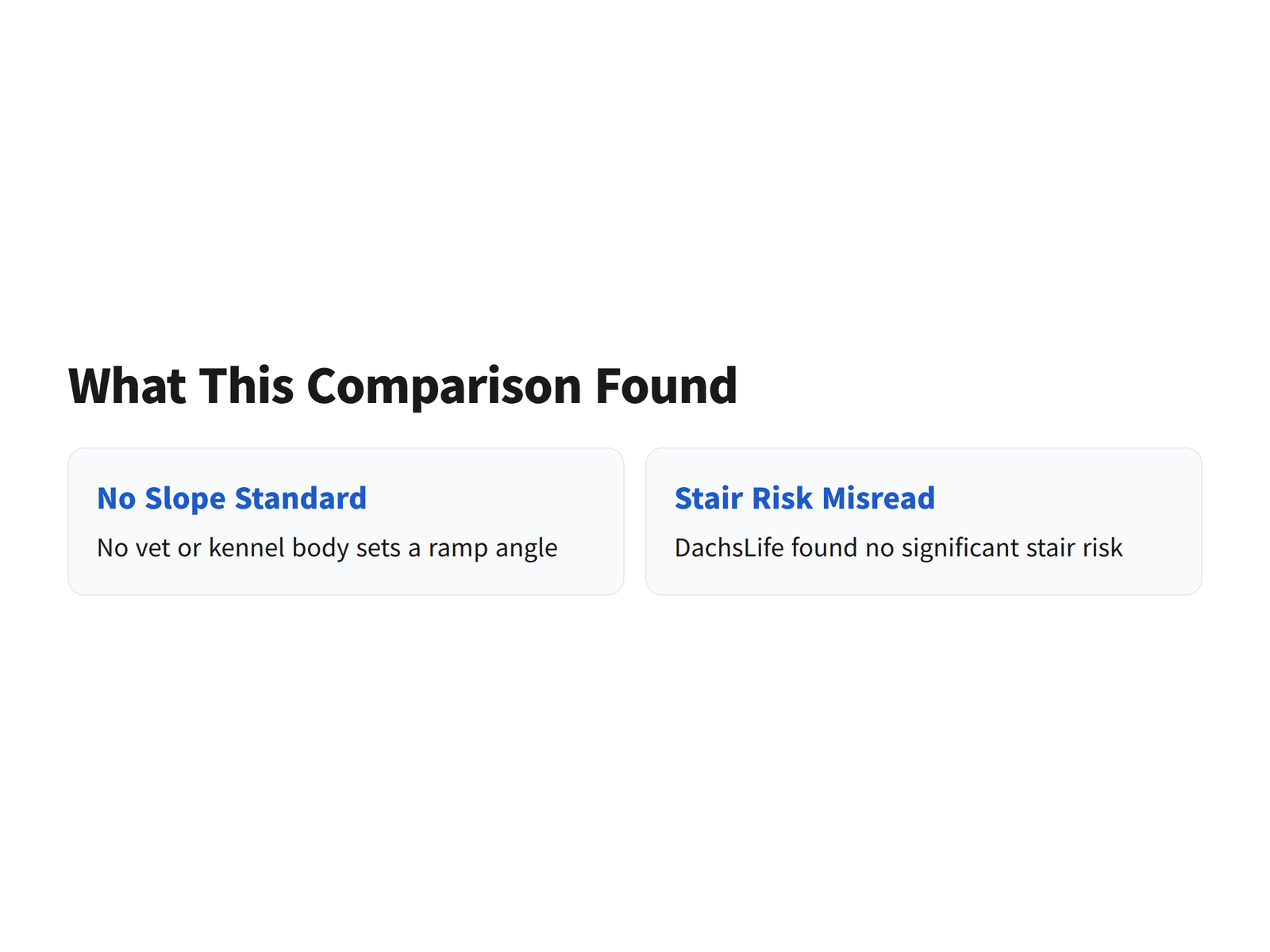
A ramp is not automatically the gentler option for a long-backed dog. What decides the load on a short-legged, long-spined body is the running slope of the ramp, and a short ramp propped against a bed can be steeper than the stair it replaced. No veterinary or kennel authority publishes a slope, width or step-rise figure for dogs at all. That gap, plus what the published Dachshund research actually reported, is what this comparison covers.

Is a ramp actually safer than stairs for a long-backed dog?
A ramp is safer only when its slope is genuinely shallow, and most household ramps are not. Running slope is vertical rise divided by horizontal run, the definition the US Access Board uses in ADA Standards section 405.2 for human ramps. Under that human standard the maximum running slope is 1:12, meaning 12 inches of ramp length for every 1 inch of rise. Very few consumer pet ramps are long enough to hit that ratio against household furniture. The ADA figures are a human accessibility standard used here as a reference point, never a canine requirement.
Steps face the same problem from the other direction: safety depends on individual step rise and tread depth, not on the label. Neither category has a published canine benchmark to measure against.
What does the research say about long-backed dogs and stairs?
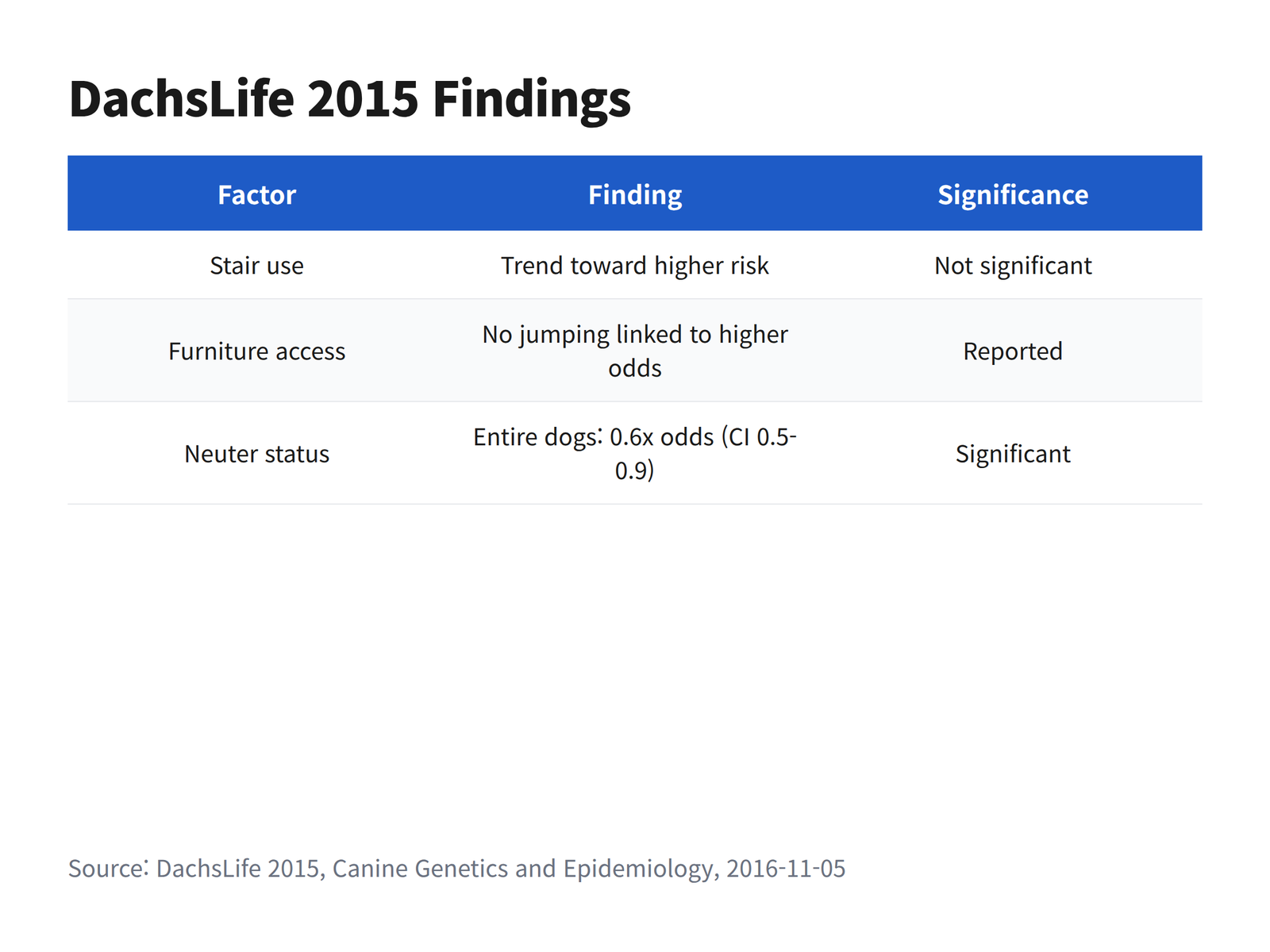
The published Dachshund research does not support banning stairs. DachsLife 2015, a survey of 2,031 individual Dachshunds published in Canine Genetics and Epidemiology on 2016-11-05, reported only a trend towards dogs that did not use stairs, or used a single step in and out of the house each day, being at increased risk, and that effect was non-significant. The same study reported that “Dogs who were not allowed to jump on and off furniture were at an increased odds of IVDD compared to those who were allowed.”
Association is not causation, and that finding does not license the opposite claim either. What it undercuts is the premise nearly every product page starts from. Neutering status was the variable with a statistically significant association in DachsLife 2015: entire dogs sat at 0.6 times the odds of IVDD, with a 95 percent confidence interval of 0.5 to 0.9, compared with neutered dogs. Consult your veterinarian about that, not a product page, and take any concern about your own dog’s spine to your veterinarian first.
How steep is too steep for a dog ramp?
No organisation has published an answer. The American Veterinary Medical Association, the American Animal Hospital Association, the American Kennel Club, The Kennel Club, the RSPCA and Blue Cross publish no maximum slope, no minimum width and no maximum step rise for dogs. The AKC page “Dog Stairs vs. Ramps”, updated 2026-03-02, gives no incline, height or width number. It asks only that the equipment reach the height of the furniture and use a slip-resistant surface.
Any degree figure on a retail listing is that retailer’s own number, not a standard. The workable approach is to treat the ADA human ceiling of 1:12 as a shallow reference point, compare the ratio a product actually produces against your own furniture height, and accept that the choice is a judgement call rather than compliance with a spec.
How long does a ramp have to be to reach a sofa or a bed?
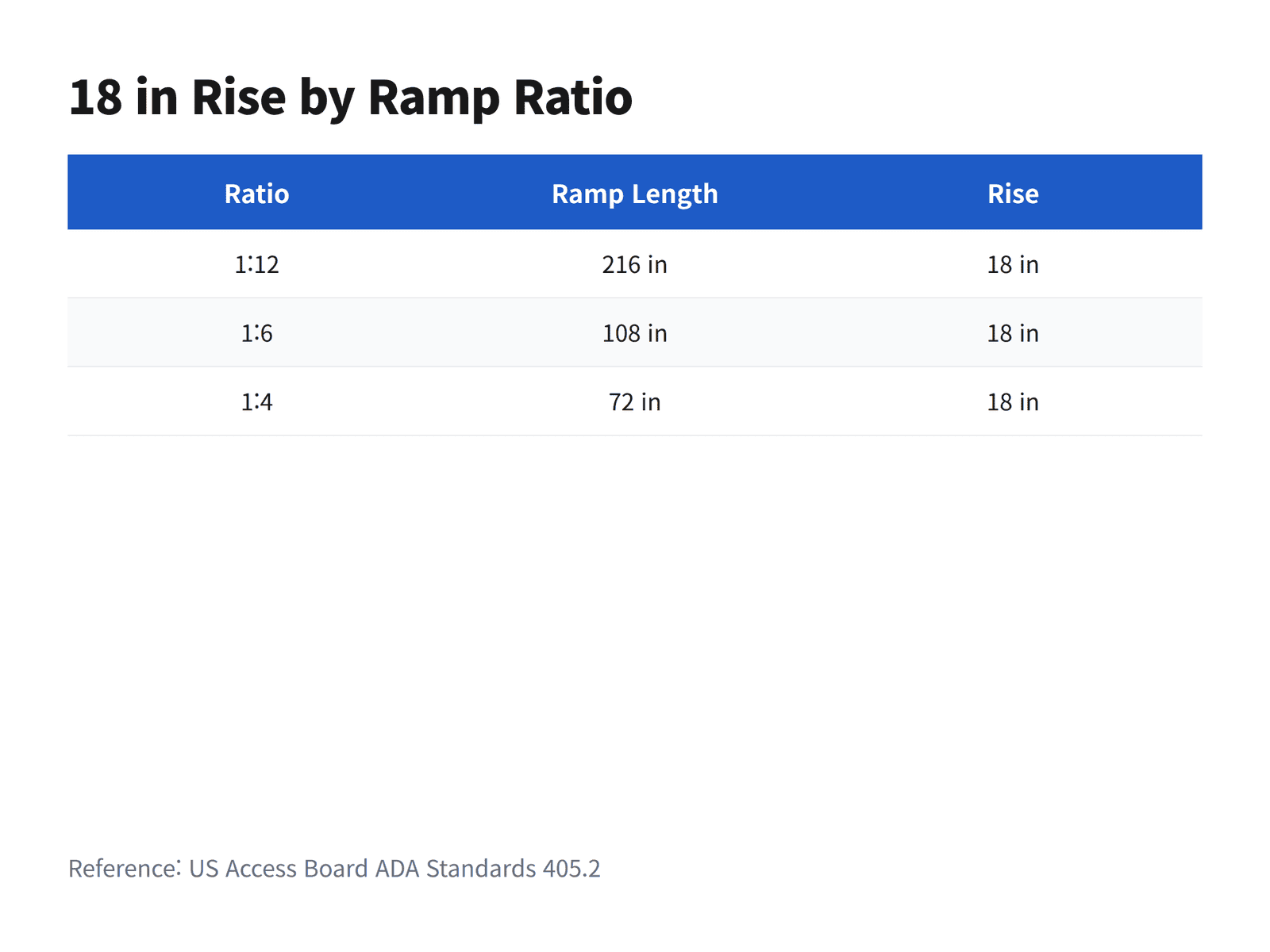
Length follows the furniture, because the rise is fixed and the run is the only variable an owner controls. Measure floor to the top surface of the sofa, bed or car sill in inches, then multiply by the second number of your target ratio. An 18 inch rise needs 216 inches of ramp at 1:12, 108 inches at 1:6, and 72 inches at 1:4. No authoritative source publishes typical sofa, bed or car-sill heights, so the measurement has to be your own.
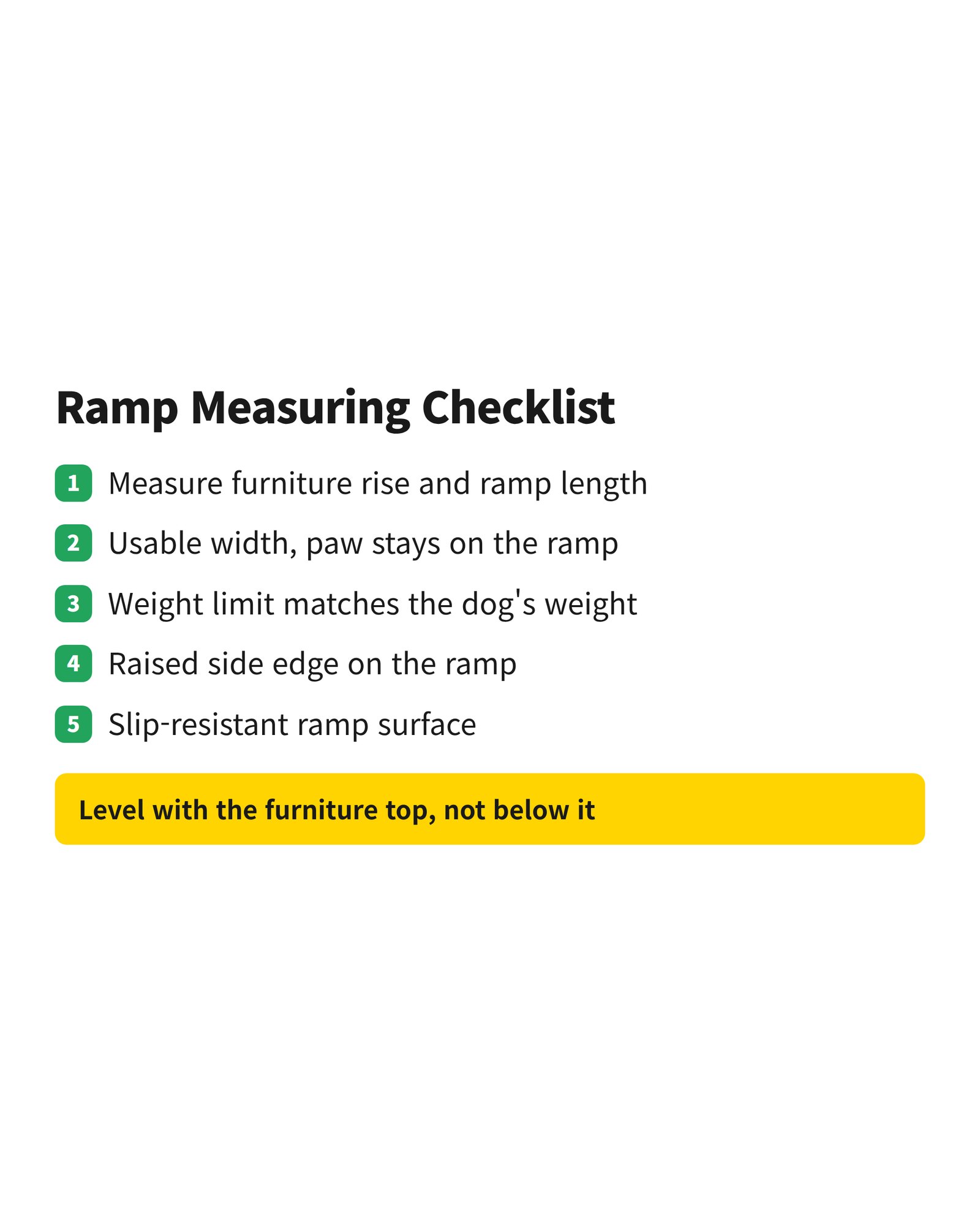
Five more checks come from the AKC guidance and from the ADA reference points:
- Usable width the dog can stand square on without a paw leaving the edge. ADA’s human minimum is 36 inches; there is no canine equivalent.
- A stated weight limit on the product, checked against the dog’s actual weight.
- A raised side edge. ADA requires handrails on human ramps once rise exceeds 6 inches, and the side rail is the pet analogue.
- A top that lands level with the furniture surface, not below it.
- A slip-resistant surface, which the AKC calls for without specifying any material.
Why will a long-backed dog refuse to use a ramp?
Refusal is usually a fit and training problem rather than stubbornness. AKC guidance treats an ignored ramp as the normal starting state: Erin Askeland, an Animal Health and Behavior Expert with a CPDT-KA credential, advises owners to “Use treats or a favorite toy to lure the dog up the ramp or stairs. Reward them with each step with praise and treats or playtime, creating a positive association with the new equipment.”
A short-legged dog also reads a narrow, high, wobbly surface differently from a taller dog. The UK Dachshund breed standard specifies ground clearance of not less than one quarter of the height at the withers, which leaves little margin for a ramp edge that catches a paw. Check width and stability before concluding the ramp was the wrong idea.
When do steps work better than a ramp for a short-legged dog?
Steps win whenever floor space runs out before the slope gets shallow. A ramp’s footprint grows in proportion to how gentle you make it, so the 216 inch answer for an 18 inch rise at 1:12 does not fit most rooms. Steps hold a fixed footprint regardless.
The trade is that steps reintroduce a drop at each tread, and Dachshund Health UK states that “Sudden shocks caused by jumping down, in particular, will put extra stresses on a dog’s spine.” Neither option removes that; a set of shorter, more frequent rises redistributes it rather than eliminating it.
What matters more than the ramp itself?
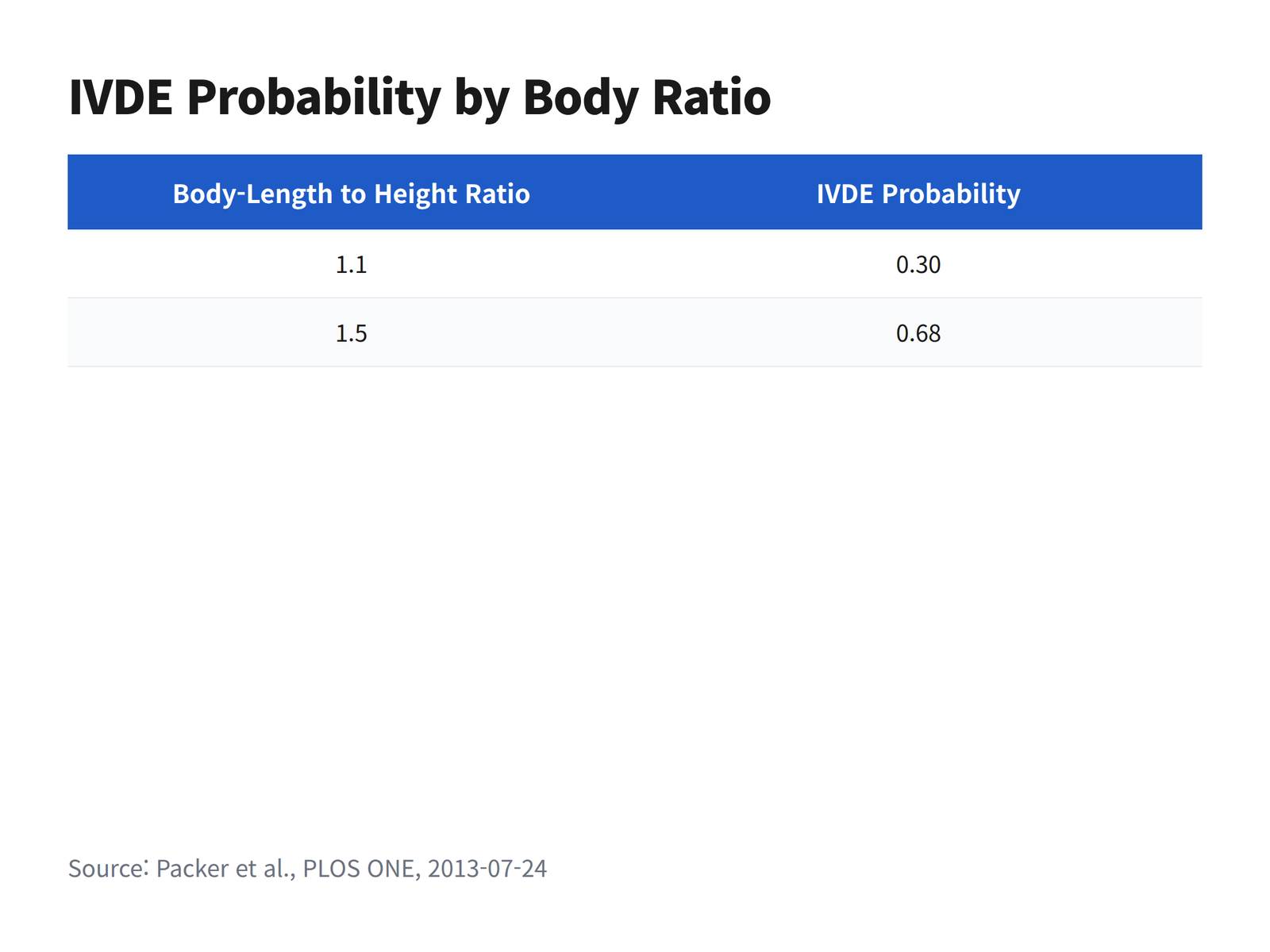
Body proportions outweigh furniture equipment. Packer and colleagues, publishing in PLOS ONE on 2013-07-24, measured and clinically examined 700 dogs, of which 79 had thoracolumbar intervertebral disc extrusion and 38 percent of those cases (30 of 79) were Dachshund breeds. The probability of IVDE for Miniature Dachshunds was 0.30 at a body-length to height-at-withers ratio of 1.1, against 0.68 at a ratio of 1.5. No ramp changes a dog’s proportions.
Body condition is the second lever, and here two A-grade sources genuinely differ. The 2013 PLOS ONE work found 46 percent of its study population overweight, with 46.2 percent of Miniature Dachshunds above a body condition score of 5 and 13 percent substantially overweight at BCS 7. DachsLife 2015 did not find body condition score to be an IVDD risk factor at all. The FDA Center for Veterinary Medicine, in guidance updated 2024-05-29, places the ideal at 4 to 5 on the 9-point scale and cites Association for Pet Obesity Prevention data putting 59 percent of US dogs overweight or obese.
The Dachshund Breed Council UK Health Committee put the priority plainly on 2019-03-13: “A Dachshund in good body condition, that is well-muscled, should be perfectly capable of tolerating the normal activities of day-to-day living.”
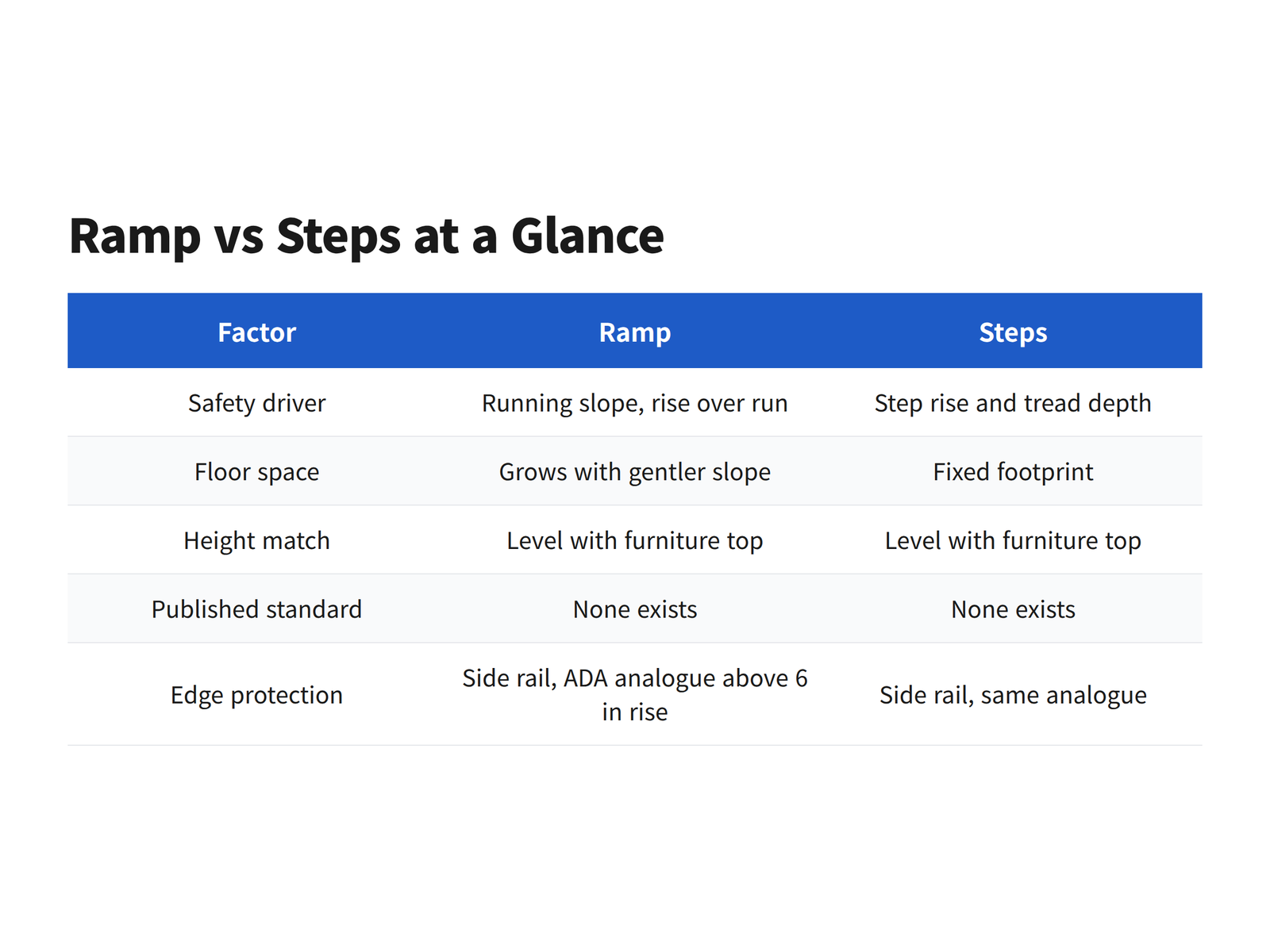
Ramp vs steps at a glance
| Factor | Ramp | Steps |
|---|---|---|
| Safety driver | Running slope, rise over run | Step rise and tread depth |
| Floor space | Grows with gentler slope | Fixed footprint |
| Height match | Level with furniture top | Level with furniture top |
| Published canine standard | None exists | None exists |
| Edge protection benchmark | Side rail, ADA analogue above 6 in rise | Side rail, same analogue |
Frequently asked questions
Does a ramp prevent disc disease in a long-backed dog? No study found tests ramp ownership as a variable. DachsLife 2015 tested stair use and furniture jumping, not ramps, so no prevention claim can be made for ramps in either direction.
Is there an official maximum angle for a dog ramp? No. The 1:12 ceiling quoted throughout this article is the ADA human accessibility standard from US Access Board section 405.2, used as a reference point only.
Which dogs does the breed health body flag as higher risk? Dachshund Health UK names puppies under 12 months and dogs over 7 years as the higher-risk groups. Equipment choice does not address either group on its own.
How heavy is a Dachshund meant to be? The AKC Official Standard of the Dachshund, effective 2018-01-01, gives 16 to 32 pounds for the standard size and 11 pounds and under at 12 months or older for the miniature.