A French Bulldog too heavy for in-cabin flight is the normal case, not the exception. The Royal Kennel Club sets the ideal adult weight at 12.5 kg for males and 11 kg for females, while Lufthansa, KLM and Air France cap the cabin at 8 kg including the carrier. At the same time, several airlines keep snub-nosed breeds out of the hold. This guide lines up breed-standard weights against each airline’s cabin cap, carrier size and cargo rule, as checked in September 2026.
How much does a French Bulldog weigh compared with airline cabin limits?
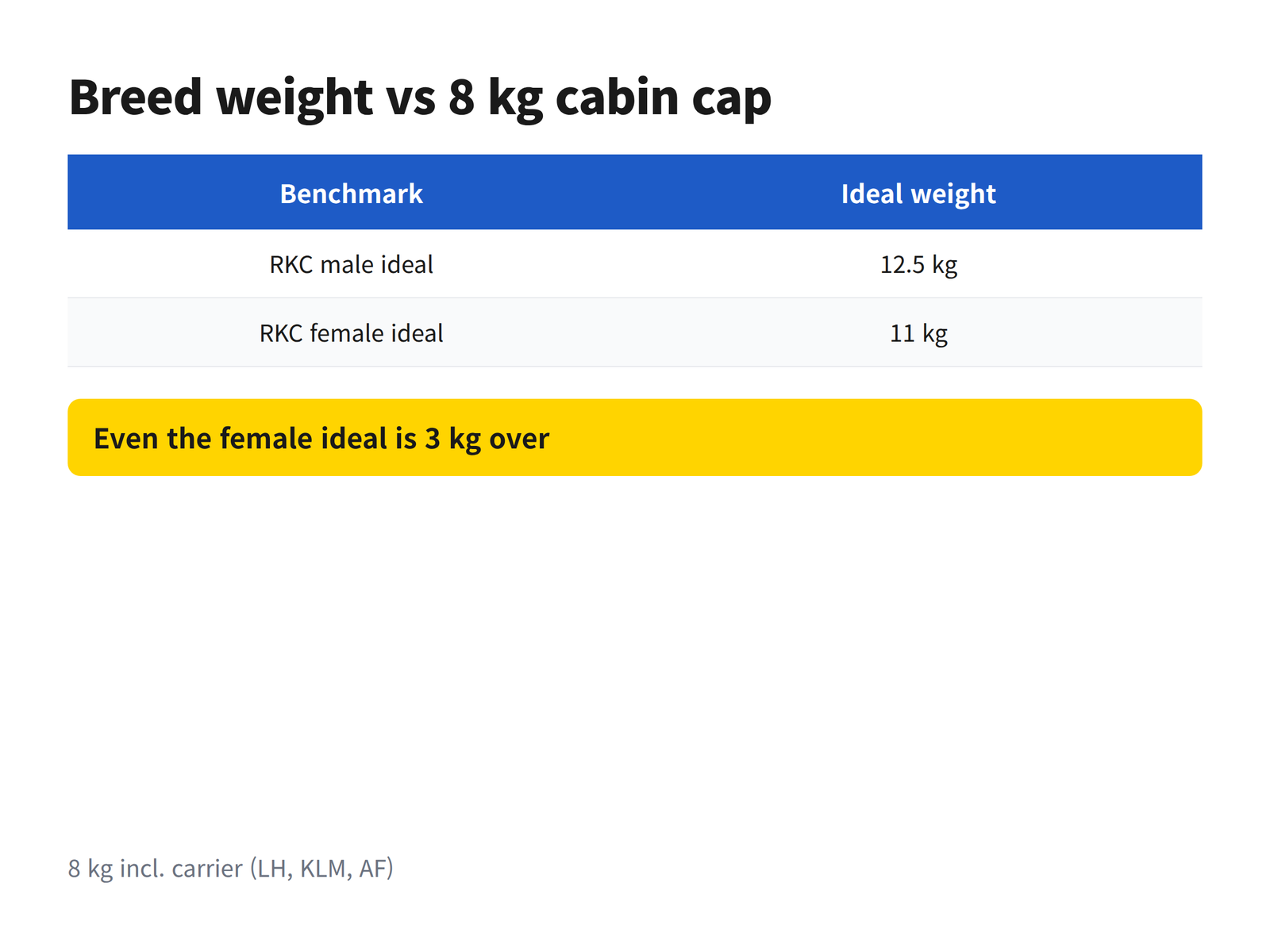
An adult French Bulldog built to the breed standard already weighs more than an 8 kg cabin cap before the carrier is added. The Royal Kennel Club French Bulldog standard, last updated on 1 August 2025, gives an ideal weight of 12.5 kg (28 lb) for dogs and 11 kg (24 lb) for bitches. The American Kennel Club standard, approved on 10 April 2018, sets a ceiling instead: “Weight not to exceed 28 pounds; over 28 pounds is a disqualification.”
| Benchmark | French Bulldog weight | Cabin cap compared |
|---|---|---|
| RKC ideal, male | 12.5 kg (28 lb) | 8 kg with carrier |
| RKC ideal, female | 11 kg (24 lb) | 8 kg with carrier |
| AKC upper limit | 28 lb | 20 lb with carrier (AA A321T) |
The Royal Kennel Club standard also states: “Soundness not to be sacrificed to smallness.” Individual French Bulldogs vary, so the only number that matters for a booking is what your own dog and the loaded carrier weigh on a scale.
Why does an 8 kg cabin limit rule out most adult French Bulldogs?
The 8 kg limit at Lufthansa, KLM and Air France counts the dog and the carrier together, so an 11 kg female French Bulldog is already 3 kg over before the carrier goes on the scale. KLM words the rule as “No more than 8 kg (17.6 lb), with your pet inside” and caps the carrier at 46 x 28 x 24 cm. Air France states “less than 8 kg / 17.64 lb., including the carrier.” Lufthansa sets the same 8 kg ceiling for pet plus container.
Weight is only the first test at KLM. KLM also requires that the pet can “stand up, turn around, and breathe comfortably” inside the carrier. A French Bulldog light enough for the 8 kg cap can still be refused if the carrier that holds the dog is too tight. Whether a particular dog passes depends on that dog’s weight and frame, so weigh the dog inside the loaded carrier and check the fit before paying for a ticket.
Do airlines without a weight cap solve the problem?
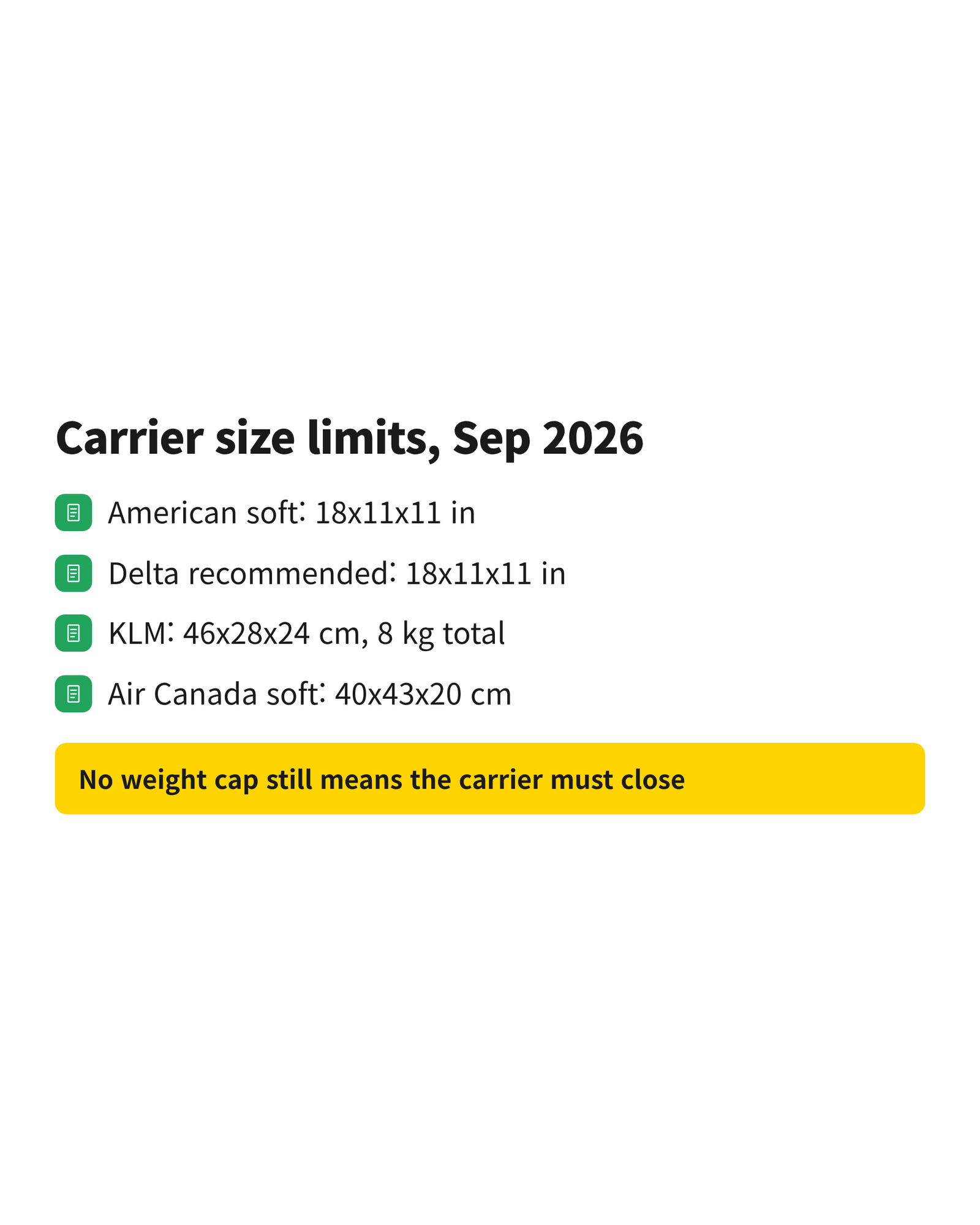
Airlines without a cabin weight cap do not solve the problem, because the carrier dimensions become the limit instead of the scale. American Airlines sets no cabin weight cap except on the A321T three-cabin aircraft, where pet plus carrier may weigh no more than 20 lb (9.07 kg). Everywhere else on American, the pet must “fit comfortably inside the closed / zipped carrier,” and a soft carrier can measure no more than 18 x 11 x 11 in (46 x 28 x 28 cm). The American Airlines in-cabin fee is $150 per kennel.
American Airlines caps hard carriers at 19 x 13 x 9 in on mainline flights and 16 x 12 x 8 in on American Eagle. Delta Air Lines follows a similar logic. The Delta kennel must fit fully under the seat, Delta recommends 18 x 11 x 11 in, and the pet must be able to move “without touching or sticking out from the sides.” That space rule is hard for a broad-framed dog to meet. Delta raised its domestic in-cabin fee from $95 to $150 on 8 April 2025 and charges $200 internationally.
Air Canada lists a soft carrier size of 40 x 43 x 20 cm, with fees of CA/US$50 to 60 within Canada and the US and $100 to 120 internationally. An Air Canada cabin weight cap was not confirmed for this guide, so check the Air Canada pets page before booking.
Which airlines refuse French Bulldogs in the cargo hold?
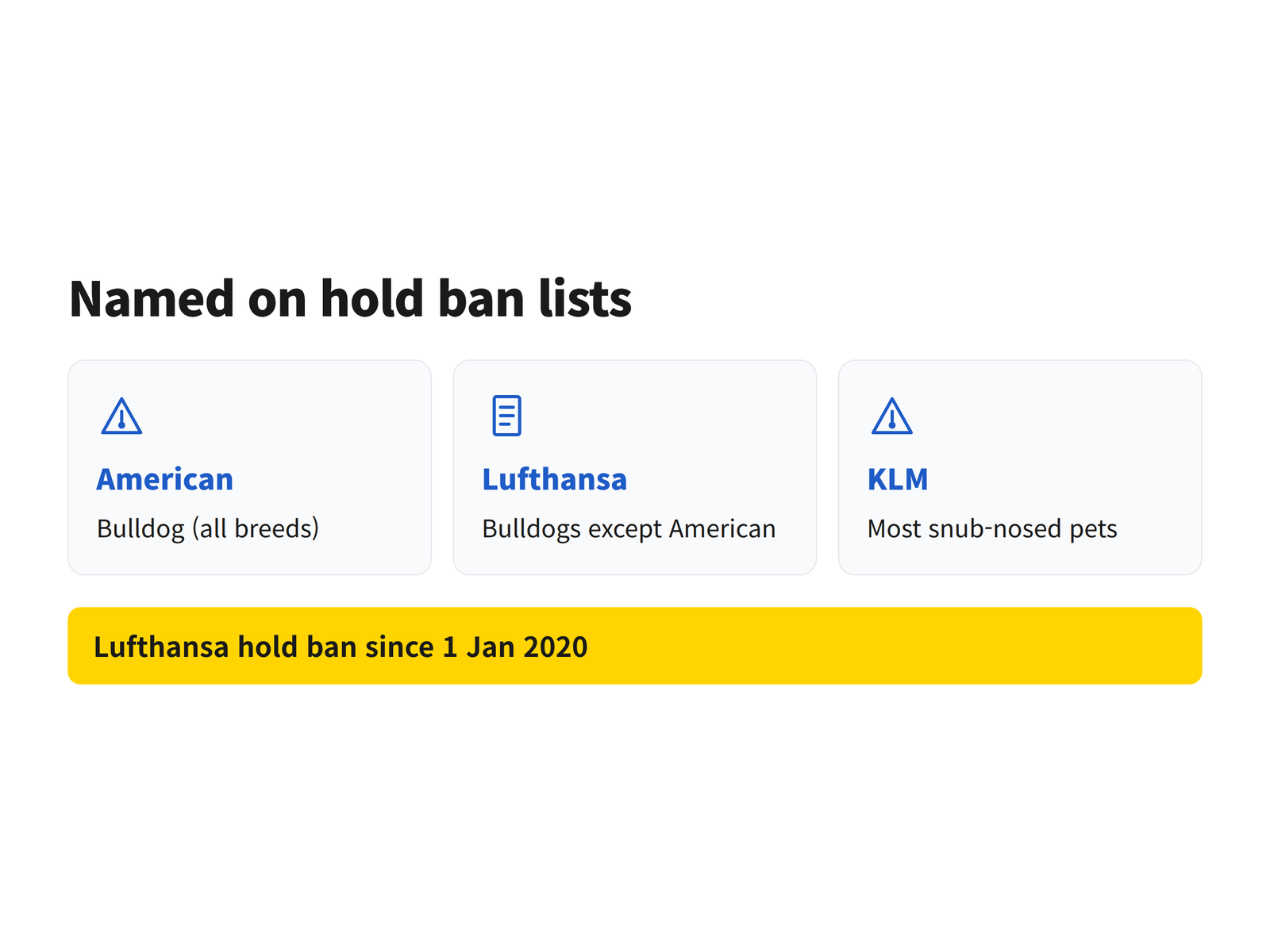
American Airlines and Lufthansa name bulldogs on their hold ban lists, Air Canada bars short/snub-nosed breeds from the baggage compartment, and KLM says “We cannot transport most of these pets in the hold.” The American Airlines checked-pet ban list includes “Bulldog (all breeds),” “Pug (all breeds)” and “Shih Tzu,” along with Boston Terrier, Pekingese and others. Lufthansa has banned snub-nosed breeds from the hold since 1 January 2020, and the Lufthansa list covers “Bulldogs (all breeds except American bulldogs).”
Delta Air Lines’ shipping page states: “Brachycephalic (snub-nosed) dogs, cats and their mixes are not permitted on Delta or Delta Connection flights.” That sentence sits on the Delta cargo shipping page, and this guide could not confirm how Delta applies it to the cabin, so ask Delta directly before booking. The Air France snub-nosed hold rule was also not confirmed. Pugs and Shih Tzus appear on the same American, Lufthansa and KLM lists, so the cargo side of this guide applies to those breeds too.
Why do airlines treat flat-faced breeds differently?
Air Canada cites heat and breathing risk for short-nosed breeds under stress, explaining that “short/snub-nosed (brachycephalic) breeds of dogs cannot travel in the baggage compartment because they are susceptible to increased risks of heat stroke and breathing problems when exposed to extreme heat or stressful situations.” The American Veterinary Medical Association adds that “although they have shortened noses, they still have to pack all of the same anatomical structures in there that dogs with longer snouts do.”
US Department of Transportation data reported by the AVMA in 2010 counted 122 dog deaths associated with air transport over the five years to August 2010. About half involved brachycephalic breeds, excluding mixed and unknown breeds, and the breeds included English Bulldogs, Pugs and French Bulldogs. The AVMA FAQ puts the count at 25 English bulldogs and 11 pugs over that five-year period. These figures are from 2010, and no newer DOT breakdown was checked for this guide.
A 2022 review in Veterinary Evidence found that “Dogs that are brachycephalic are likely to have an increased risk for developing heat-related illness compared to non-brachycephalic dogs,” rating the evidence as moderate. This background describes the breed group, not any individual French Bulldog. Consult your veterinarian before booking any flight with a French Bulldog, since only a vet who has examined the dog can judge whether air travel suits that dog.
How do the five airlines compare?
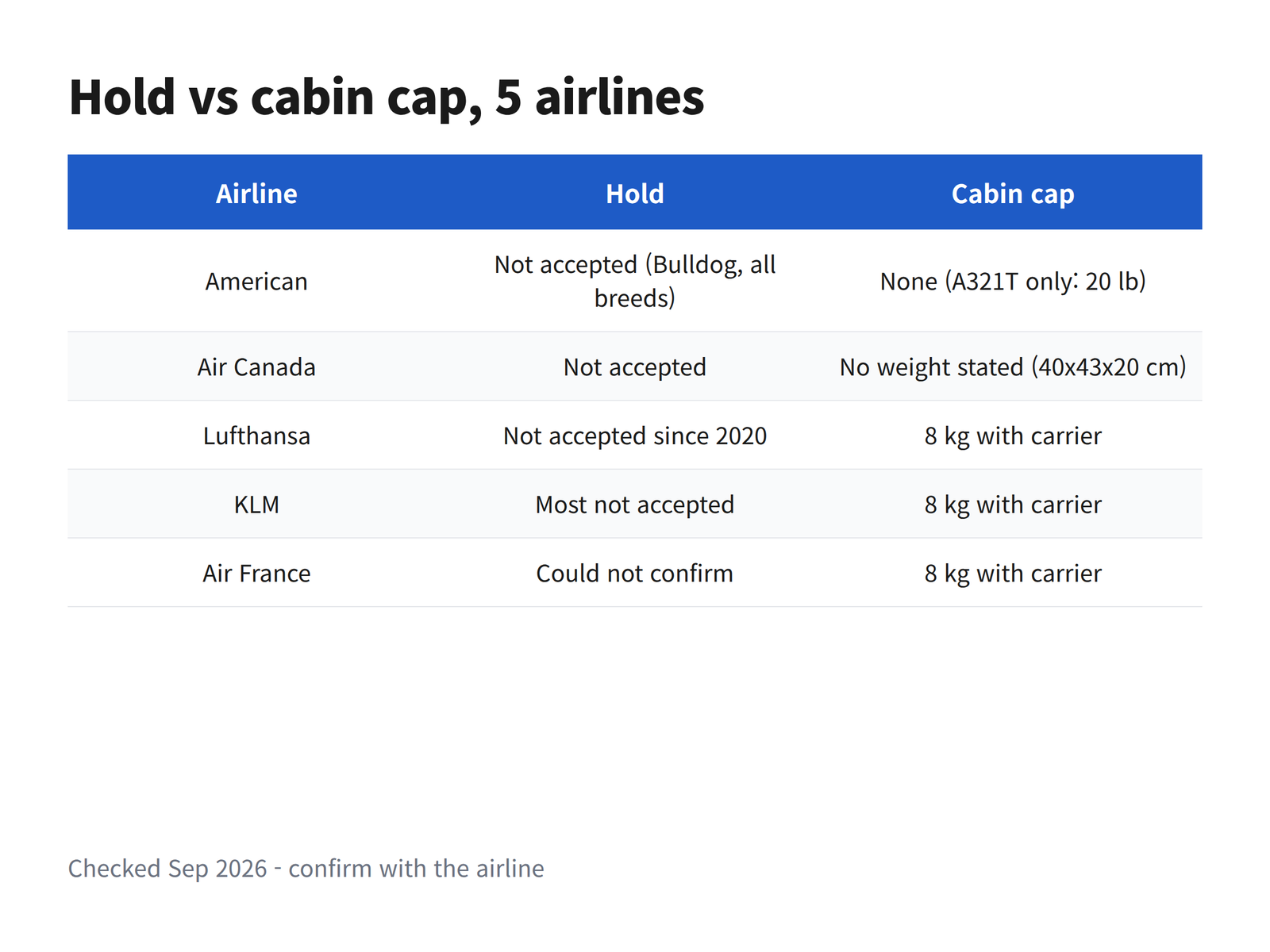
Three of the four airlines below with a confirmed hold rule refuse French Bulldogs in the hold, KLM refuses most snub-nosed pets, and the three 8 kg cabin caps sit below breed-standard weight. The table reflects each airline’s pet page as checked in September 2026. Airline pet rules and fees change often, so check the airline’s current page before booking.
| Airline | Hold for French Bulldogs | Cabin weight cap |
|---|---|---|
| American | Not accepted (Bulldog, all breeds) | None (A321T only: 20 lb) |
| Air Canada | Not accepted | No weight stated (40x43x20 cm) |
| Lufthansa | Not accepted since 2020 | 8 kg with carrier |
| KLM | Most not accepted | 8 kg with carrier |
| Air France | Could not confirm | 8 kg with carrier |
What options are left when a French Bulldog fits neither cabin nor cargo?
When a French Bulldog fits neither the cabin cap nor the hold rules, the remaining options are narrow, and each one depends on the individual dog. The steps below use only what the airlines and the AVMA state.
- Weigh the French Bulldog inside the loaded carrier and compare the total with the 8 kg or 20 lb caps.
- On American or Delta, check whether the dog fits an 18 x 11 x 11 in carrier, American’s soft-carrier maximum and Delta’s recommended size.
- Ask Lufthansa about Lufthansa Cargo, a separate air-freight service, not a passenger booking.
- Book a vet visit; the AVMA recommends one within 10 days before interstate travel.
- Avoid sedation plans; the AVMA says “We strongly recommend that you avoid tranquilizing your pet for air travel.”
- Consider ground travel or leaving the dog in care when no flight rule fits.
Consult your veterinarian about the dog’s fitness for any long trip, by air or by road.

Frequently asked questions
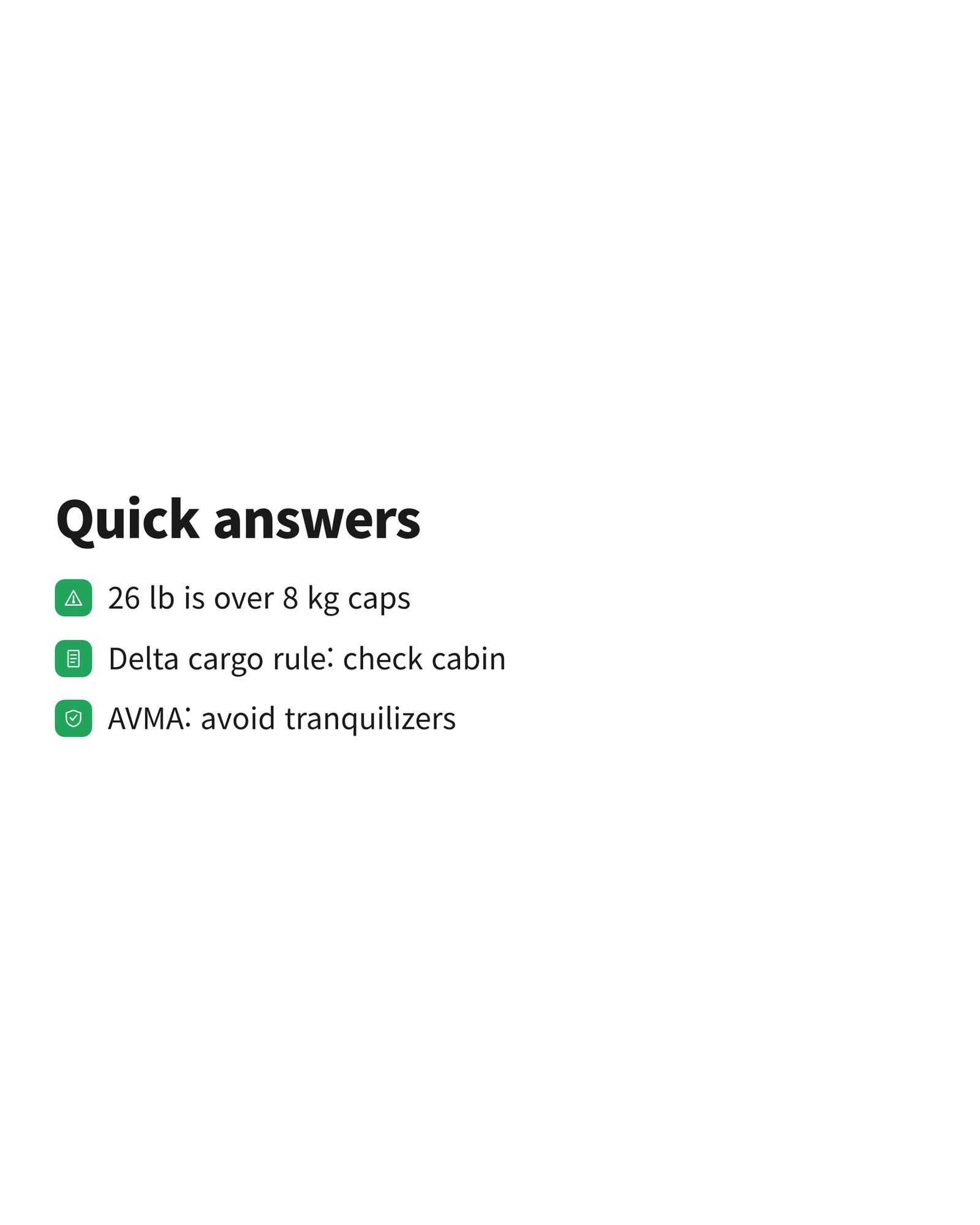
Can a 26 lb French Bulldog fly in the cabin? A 26 lb French Bulldog is over the 8 kg (17.6 lb) cap at Lufthansa, KLM and Air France before the carrier is counted. On American, outside the A321T, and on Delta, the question becomes whether the dog fits the airline’s carrier size and space rules.
Does Delta ban French Bulldogs from the cabin? Delta’s shipping page says brachycephalic dogs “are not permitted on Delta or Delta Connection flights,” but that page covers cargo. This guide could not confirm whether the sentence also covers the cabin, so confirm with Delta before booking.
Can a French Bulldog be sedated for the flight? The AVMA strongly recommends avoiding tranquilizers for air travel. Consult your veterinarian about any travel concern rather than planning medication on your own.
Sources
- Royal Kennel Club, “French Bulldog Breed Standard”, last updated 2025-08-01 — https://www.royalkennelclub.com/breed-standards/utility/french-bulldog
- American Kennel Club, “Official Standard of the French Bulldog”, approved 2018-04-10 — https://images.akc.org/pdf/breeds/standards/FrenchBulldog.pdf
- American Airlines, “Traveling with pets”, accessed 2026-09-23 — https://www.aa.com/i18n/travel-info/special-assistance/pets.jsp
- Delta Air Lines, “Shipping Your Pet”, accessed 2026-09-23 — https://www.delta.com/us/en/pet-travel/shipping-your-pet
- Delta Air Lines, “Pet Travel Overview”, accessed 2026-09-23 — https://www.delta.com/us/en/pet-travel/overview
- Air Canada, “Pets”, accessed 2026-09-23 — https://www.aircanada.com/ca/en/aco/home/plan/special-assistance/pets.html
- Lufthansa, “Fighting dog breeds and snub-nosed animals”, accessed 2026-09-23 — https://www.lufthansa.com/am/en/dangerous-dogs
- Lufthansa, “Travelling with animals”, accessed 2026-09-23 — https://www.lufthansa.com/us/en/travelling-with-animals
- KLM, “Flying with your pet in the cabin or hold”, accessed 2026-09-23 — https://www.klm.com/information/pets/reservation
- Air France, “Travel with your pet”, accessed 2026-09-23 — https://wwws.airfrance.us/information/passagers/voyager-avec-son-animal-chien-chat
- American Veterinary Medical Association, “Air travel and short-nosed dogs FAQ”, accessed 2026-09-23 — https://www.avma.org/resources-tools/pet-owners/petcare/air-travel-and-short-nosed-dogs-faq
- AVMA JAVMA News, “Brachycephalic dogs more likely than others to die during air transport”, 2010-09-01 — https://www.avma.org/javma-news/2010-09-01/brachycephalic-dogs-more-likely-others-die-during-air-transport
- Ewers Clark, “Heatstroke and brachycephalic dogs – is there an increased risk?”, Veterinary Evidence 7(4), 2022 — https://veterinaryevidence.org/index.php/ve/article/view/534